What this blog covers
Big-ticket B2B buying involves long cycles, several decision makers and heavy research. A paid funnel works when awareness campaigns reach the right accounts and roles, mid-funnel content builds proof through case studies, comparisons and webinars, and lower-funnel campaigns capture intent through search and retargeting, all connected to the CRM so that success is judged on qualified pipeline. Landing pages need citable proof, because B2B buyers increasingly ask AI assistants to shortlist vendors.
Quick Answer: Build three layers. At the top, reach the right companies and roles with targeted video, social and display that teach rather than sell. In the middle, retarget engaged visitors with case studies, comparisons and expert content, and capture contacts through high-value assets. At the bottom, buy intent keywords on search and run retargeting with a clear consultation offer. Send every click to a landing page with specific proof, keep forms short, connect leads to the CRM and judge the programme on qualified opportunities and pipeline value over cost per lead.
Table of Contents
- Why Big-Ticket B2B Breaks the Lead-Form Model
- Layer One: Reach the Right Accounts
- Layer Two: Build Proof in the Middle
- Layer Three: Capture Intent
- Landing Pages That Earn a Serious Conversation
- Measuring Pipeline Over Form Fills
- Paid Pages in the Age of AI Shortlists
- The B2B Paid Funnel Framework
- Client Proof From Our Work
- Key Takeaways
- CXO Takeaway
Why Big-Ticket B2B Breaks the Lead-Form Model
Cost-per-lead targets reward cheap contacts, and cheap contacts rarely turn into deals when the product costs lakhs or crores. Buying committees include a champion, a financial approver, a technical reviewer and sometimes a legal or procurement voice. Each needs different information at a different time.
Cycles run for months, and most of the research happens before anyone talks to sales. Our guide on why ten touchpoints often sound like ten different companies makes the case for a consistent story across the journey, and our overview of full-funnel marketing explains why isolated campaigns fall short.
Layer One: Reach the Right Accounts
Define the target before spending. List the industries, company sizes, regions and roles that buy from you, and the problems that start a purchase. Build account lists from your CRM, past customers and a sales-agreed target list.
Match channels to where those people spend time. Professional social platforms allow targeting by job role, seniority and company, and search and video platforms add intent and reach. Use custom audiences from your own lists where available, and expand carefully with similar-audience features.
Make the top-of-funnel content useful. Short videos that explain a problem, a data-backed point of view, an executive’s perspective or a practical checklist earn attention from busy buyers. Keep the call to action gentle: watch, read, download. Our guide on upper-funnel and lower-funnel advertising shows how the layers fit.
Layer Two: Build Proof in the Middle
Mid-funnel is where trust forms. Retarget people who watched, clicked or visited with proof that matches their stage: case studies with real numbers, customer stories, product comparisons, technical explainers, webinars and demos.
Offer assets worth giving contact details for, such as a benchmark report, a buying guide or a template. Gate sparingly, and keep forms short. Ungated proof pages build trust and supply search engines with content, so many teams gate only the highest-value assets.
Segment by role. A financial approver wants cost and return evidence, a technical reviewer wants architecture and security detail, and a marketing head wants outcomes and process. Our guide on catching leads better on a B2B website shows how to structure pages for each, and the piece on chatbots and website lead generation looks at one way to capture questions.
Layer Three: Capture Intent
Search captures buyers who already know what they need. Bid on intent keywords such as the service plus “agency,” “company,” “vendor,” “pricing” or “comparison,” along with brand and competitor terms where relevant and allowed. Keep campaigns tight, use negatives to cut irrelevant clicks and send traffic to pages written for that query.
Run retargeting with a clear offer: a consultation, an audit, a demo or a workshop. People who reach this stage want a conversation about their own situation, so make the next step specific and low-risk.
Our guide on maximising performance marketing ROI with full-funnel thinking covers how lower-funnel spend relies on the layers above it.
Landing Pages That Earn a Serious Conversation
A good B2B landing page answers three questions fast: what do you do, who is it for and why should I believe you. Lead with a clear headline, support it with proof in the first screen, such as client logos, a headline result or a short quote, and follow with specifics: how the work runs, what the buyer receives and what it costs to start.
Use case studies with numbers, dates and context. Avoid vague claims. Show named people and credentials, add FAQs that answer objections and keep forms short, asking for the minimum a salesperson needs to follow up well. Add a direct route to book a call.
Speed and mobile quality matter here too, since executives open links on phones between meetings. Test the page on a phone and on a slow network.
Measuring Pipeline Over Form Fills
Connect forms and calls to the CRM so every lead carries its campaign, keyword and audience. Track the stages that matter: marketing-qualified lead, sales-accepted lead, opportunity, proposal and closed deal. Import offline conversions back into the ad platforms where possible, so that bidding learns from qualified outcomes instead of raw form fills.
Judge channels by cost per qualified opportunity and by pipeline value, with the sales cycle in mind. A campaign that looks expensive per lead can look cheap per deal. Review lead quality with sales every week, and use their feedback to refine audiences, keywords and offers.
Be patient with attribution. Many B2B journeys pass through multiple channels and long gaps, so combine platform data, CRM data and sales conversations. Our guide on moving beyond ROAS explains how to read performance across the funnel.
Paid Pages in the Age of AI Shortlists
B2B buyers now ask AI assistants for vendor shortlists, comparisons and explanations, and the answers draw on pages that state facts clearly. A paid landing page that carries specific, citable proof also serves organic search and AI answers. Case studies with named results, comparison tables, process explanations and FAQs give engines material to quote.
Our guide on AEO versus SEO in the B2B search game explains how answer engines change B2B discovery, and our GEO playbook shows how to earn citations. Google’s page on AI features in Search says standard SEO fundamentals apply, so keep proof pages crawlable, fast and consistent with the claims in your ads.
Include consistency in your plan. When ads, landing pages, case studies and profiles all state the same facts, engines and buyers see one company.
The B2B Paid Funnel Framework
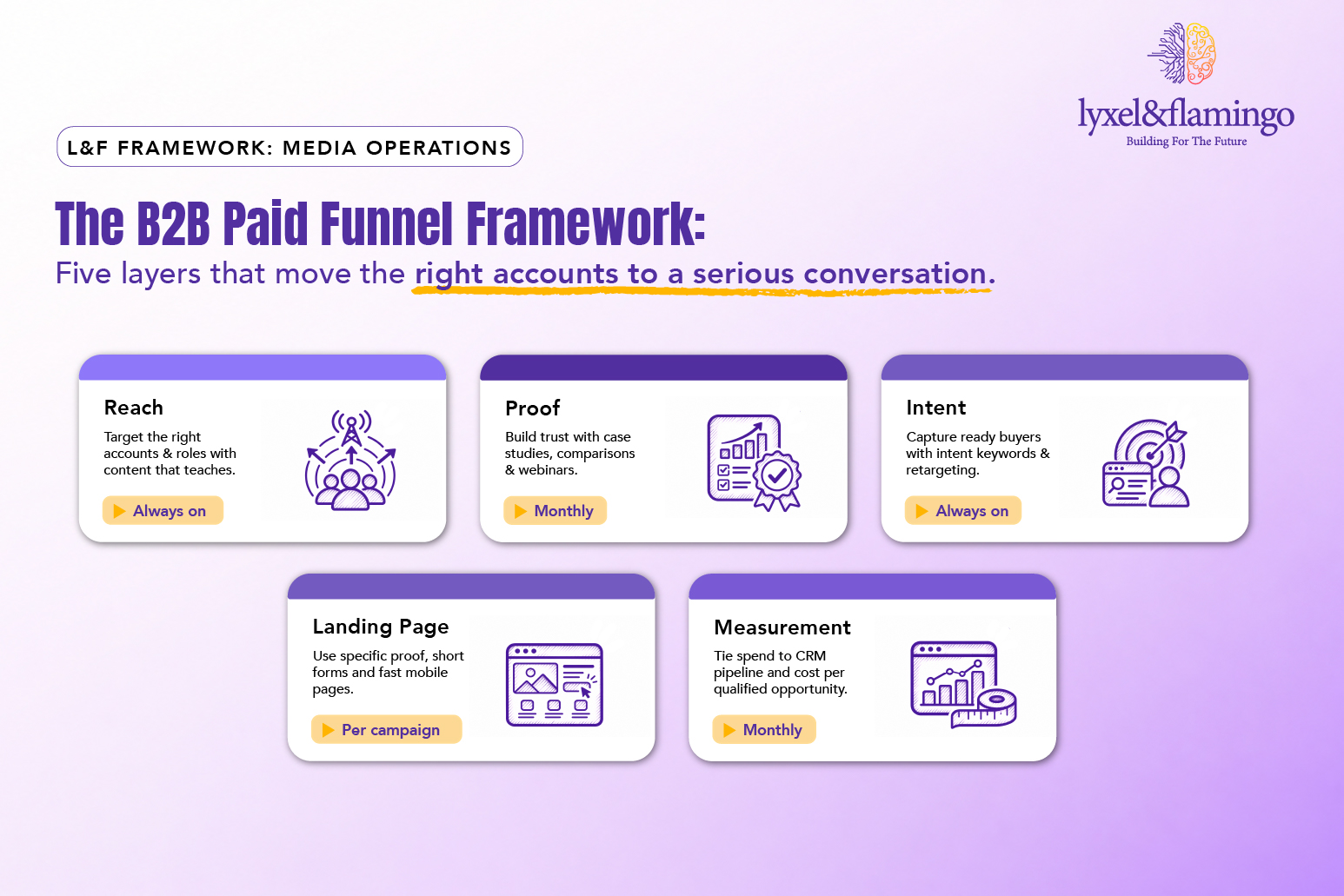
Framework Explained
Build the funnel from the top down, then check it from the bottom up. Reach fills the funnel, and measurement tells you which layer leaks.
Step 1: Reach. List the target accounts and roles, then reach them with video, social and display that teach instead of sell. Check: reach goes to listed accounts or tight lookalikes only.
Step 2: Proof. Publish case studies, comparison pages, webinars and role-based content that answer the questions buyers ask internally. Check: each target role has at least one piece of proof.
Step 3: Intent. Capture ready buyers with intent keywords, retargeting and a clear consultation offer. Check: intent campaigns have their own budget and goals.
Step 4: Landing Page. Send visitors to pages with specific proof, a short form and fast mobile loading. Check: form completion and page speed are reviewed monthly.
Step 5: Measurement. Connect ads to the CRM and import offline conversions so you can see qualified opportunities and pipeline value. Check: cost per qualified opportunity appears in the monthly report.
CAPABILITY NOTE: Lyxel&Flamingo’s media team builds paid funnels for B2B and high-consideration brands, connecting campaigns to CRM outcomes. This guide shares the working method and points to related client engagements in the proof section.
Client Proof From Our Work
B2B funnels succeed when each layer has its own goal. McAfee shows full-funnel structure and RupeeRedee shows optimisation toward deeper events.
McAfee and RupeeRedee are consumer brands. They appear here as evidence for funnel structure and event-based optimisation, which transfer to B2B. Neither page states a period.
Key Takeaways
- Big-ticket B2B buying involves long cycles and committees, so cost per lead misleads.
- Reach the right accounts with useful content, build proof in the middle and capture intent at the bottom.
- Landing pages need specific, citable proof, short forms and fast mobile performance.
- Connect leads to the CRM and judge by qualified opportunities and pipeline value.
- Buyers shortlist in AI assistants, so proof pages must be crawlable, consistent and citable.
CXO Takeaway
What did your last ten paid leads turn into, and what would you change if you judged the campaign on that? The answer usually reshapes the budget. Lyxel&Flamingo’s media team builds B2B funnels around pipeline rather than form fills.
Frequently Asked Questions
Reach target accounts with useful content, retarget engaged visitors with proof, capture intent through search and send everyone to specific landing pages connected to the CRM.
Cost per qualified opportunity and pipeline value, since cost per lead rewards cheap contacts that rarely convert.
Gate only the highest-value assets, and leave proof pages open so they build trust and attract search traffic.
Buyers ask them for shortlists and comparisons, so citable proof on your pages helps vendors appear in those answers.