
What This Blog Covers
A growing share of purchase decisions never touch a search results page anymore. A shopper asks an AI assistant to find the best option in a category, the assistant compares a shortlist it has already formed an opinion on, and the brand that never gets mentioned in that shortlist loses the sale before the shopper even opens a browser tab.
Agentic commerce, AI assistants that research, compare, and increasingly complete purchases on a shopper’s behalf, is moving from experiment to default behavior across ChatGPT, Perplexity, and Amazon’s own Rufus. This changes what “visibility” means: the goal is no longer ranking on a results page a human scans. It’s being the option an AI agent actually recommends or selects. This blog covers what makes a brand agent-legible, why structured data and entity clarity matter more than keyword density in this world, and how to start auditing for it now.
Quick Answer: AI shopping agents select brands based on structured, verifiable information (accurate product data, clear specifications, consistent entity signals across the web) rather than traditional keyword optimization. To be considered by an AI agent, a brand’s product and company information needs to be machine-readable through schema markup, consistent across every platform where it appears, and specific enough that an AI model can confidently compare it against competitors. Brands that only optimize for human-scanned search results pages are increasingly invisible to the agents now making the shortlist on a shopper’s behalf.
Table of Contents
What Changes When the Shopper Is an AI Agent
Traditional SEO optimizes for a human who scans a results page, compares snippets, and clicks through to evaluate options directly. An AI shopping agent compresses that entire process: it researches, compares, and forms a recommendation (sometimes a completed purchase) before the human sees more than a shortlist, if that.
This means the competitive battle moves earlier in the funnel, into the data an AI model can actually access and trust about a product. A brand that wins the click on a search results page, with thin, inconsistent, or unstructured product data underneath it, is set up to lose the agent-mediated purchase entirely, a gap that the L&F team has already been mapping in how schema markup affects AI citations.
Why Keyword Density Stops Mattering Here
An AI agent is not scanning for keyword frequency. It is trying to answer a specific comparative question: which product in this category best fits these criteria, using whatever structured and unstructured information it can find and trust.
This is a fundamentally different retrieval problem than classic search ranking. A page stuffed with a target keyword provides no advantage if the actual product specifications, pricing, and differentiators are buried in an image, a PDF, or inconsistent text that the model cannot confidently parse.
The Entity Clarity Problem
AI models build an internal understanding of a brand as an entity, its category, its known attributes, its relationship to competitors, largely from how consistently that information appears across the web. A brand whose name, specifications, and claims vary across its own website, marketplace listings, and press mentions creates ambiguity that a cautious model resolves by simply not citing it.
This is the same underlying logic behind entity-based SEO and knowledge graphs replacing keyword-only strategies: the AI-search era rewards brands with a clear, consistent, verifiable identity across the web, not brands that simply repeat a phrase often enough.
Structured Data as the New Storefront
Schema markup, product feeds, and structured specification data are no longer a technical nice-to-have buried in a developer’s backlog. They are increasingly the primary way an AI agent actually reads a product page, since structured data removes the ambiguity that free-form text introduces.
A product page with clean schema for price, availability, specifications, and reviews gives an AI agent exactly what it needs to compare that product against a competitor’s listing with confidence. A page without it forces the model to guess, and a cautious model that has to guess tends to default to a competitor it can verify more easily.
Auditing Whether Your Brand Is Agent-Legible
A practical starting audit asks three questions: is core product data structured and machine-readable, is that data consistent across every platform where the product appears, and is the brand’s entity information (category, differentiators, claims) verifiable rather than only asserted in marketing copy.
Most brands fail at least one of these today, not because the work is difficult, but because it was never prioritized while search rankings were the only visibility metric that mattered. The enterprise GEO checklist is a useful starting framework for running this audit systematically.
What to Do in the Next Quarter
Start with the highest-revenue product lines rather than attempting a full-catalog overhaul immediately. Clean and structure their schema data, verify consistency across every channel they appear on, and confirm that specification and differentiation claims can be independently verified rather than only stated.
This is not a one-time project. As AI shopping agents become a larger share of purchase-path traffic, agent-legibility becomes an ongoing discipline, similar to how technical SEO hygiene became a permanent function rather than a launch-day checklist.
Framework Explained
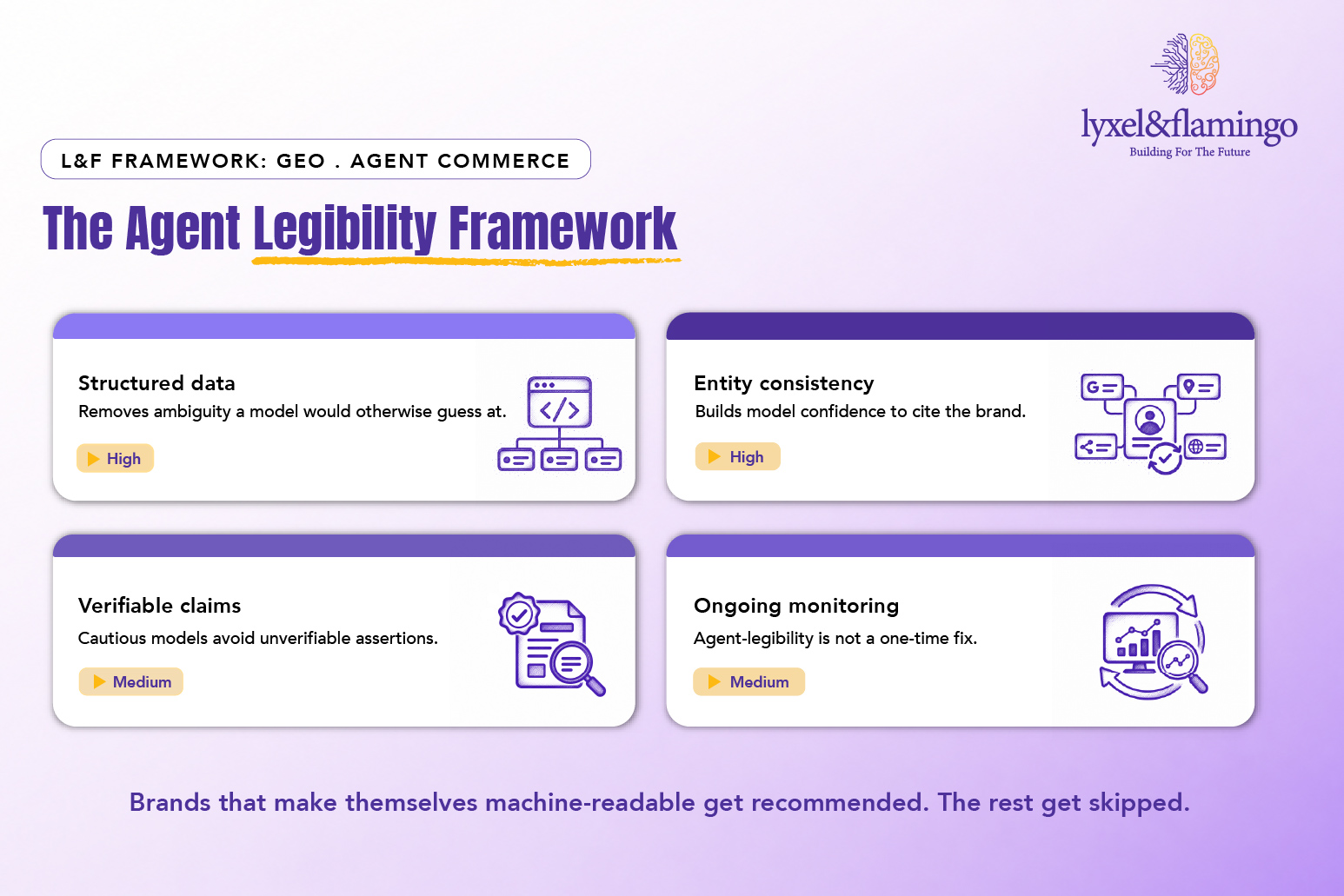
- Structure before you optimize: Clean schema and product data are the foundation an AI agent actually reads, ahead of any keyword-level work.
- Consistency builds trust: A model resolves ambiguous or conflicting brand information by simply not citing the brand.
- Verifiable beats persuasive: Claims a model can independently confirm outperform strong marketing copy it cannot verify.
- Treat it as ongoing: Agent behavior and citation patterns will keep shifting, so this is a maintained discipline, not a launch checklist.
Agentic commerce is early enough that Lyxel&Flamingo does not yet have a completed case study measuring AI-agent-driven conversion specifically. What the framework above draws on is the agency’s existing structured-data and entity-clarity work across SEO and GEO engagements, including the schema-and-citation research referenced throughout this piece. Brands that want to be an early mover here are, by definition, working ahead of the case-study curve.
Key Takeaways
- AI shopping agents compress research and comparison into a step that happens before a human ever sees a search results page, moving the competitive battle earlier in the funnel.
- Keyword density has little effect on agent-mediated visibility; structured, verifiable product data is what a model actually reads and trusts.
- Inconsistent brand or product information across platforms creates ambiguity that models resolve by not citing the brand at all.
- A practical starting audit checks structured data quality, cross-platform consistency, and whether differentiation claims can be independently verified.
CXO Takeaway
The question worth asking this quarter is not “where do we rank.” It is: if an AI agent were shortlisting our category right now, would our product data even qualify us for consideration?
Brands that wait for agentic commerce to mature before investing in agent-legibility will be auditing this under competitive pressure instead of ahead of it.
If your product data was never built for machine readability, Lyxel&Flamingo can run the structured-data and entity-clarity audit that gets your highest-revenue lines agent-ready before the shift accelerates further.
Frequently Asked Questions
An AI Overview or chatbot answer typically summarizes information for a human to act on. Agentic commerce goes further: the AI agent itself researches, compares, and in some cases completes the transaction, with the human approving rather than actively shopping.
No. Traditional SEO and GEO/agent-legibility work are complementary. Search rankings still drive discovery for a large share of shoppers; agent-legibility protects the growing share of purchases that route through an AI assistant instead.
Start with schema markup for the highest-revenue product lines: price, availability, specifications, and reviews. This is a bounded, measurable project rather than a full-catalog overhaul, and it establishes the pattern for scaling to the rest of the catalog.
Early signals include AI-agent referral traffic (where platforms report it), citation frequency in AI-generated comparisons, and, over time, share of category conversations where the brand is mentioned versus a direct competitor.