
What this blog covers
This blog explains how to plan reach and frequency so that neither is wasted. We define both terms, explain the idea of effective frequency (the sweet spot between too little and too much), show where budget quietly leaks at each end, give you the Effective Reach & Frequency Model, and translate it into practical planning and capping decisions grounded in real reach-led campaigns. It closes with a self-check and the questions planners ask most.
Table of Contents
- Reach and frequency, defined
- The two ways budget gets wasted
- What 'effective frequency' really means
- The Effective Reach & Frequency Model
- Frequency capping: the fix for the top end
- Reach: why unique matters more than raw impressions
- How to plan it in practice
- What good reach planning looks like
- Self-check: Is your reach plan leaking budget?
- Key takeaways
- Closing
Reach and frequency, defined
Two numbers describe any reach campaign. Reach is the number of unique people who saw your ad at least once. Frequency is the average number of times each of those people saw it. Multiply them, and you get impressions, which is why impressions alone tell you almost nothing: the same 10 million impressions can mean 10 million people seeing an ad once, or one million people seeing it ten times. Those are completely different campaigns with completely different outcomes.
Good planning is the deliberate management of the trade-off between the two. For a fixed budget, every extra impression you spend on someone who has already seen the ad enough times is an impression you did not spend reaching someone new. Reach and frequency planning is, at its core, the discipline of not overspending on the people you have already reached.
The two ways budget gets wasted
Waste in reach media hides at both ends of the frequency scale, and most plans leak at one of them without noticing.
At the low end, under-exposure: spreading the budget so thin that most people see the ad only once or twice, below the threshold where it registers and builds memory. You bought a lot of impressions, reached a lot of people, and built almost nothing, because a single fleeting exposure rarely creates a durable memory. The reach number looks impressive; the effect is negligible.
At the high end, over-exposure: showing the same ad to the same people far more often than needed. Past a point, extra views add no incremental effect and start doing harm: rising CPMs, falling click-through, and active irritation that can turn people against the brand. Every one of those surplus impressions is money that should have gone to reaching someone new. Both ends waste budget; they just waste it in opposite directions.
What ‘effective frequency’ really means
Effective frequency is the number of exposures needed for an ad to actually do its job: enough repetition to register and build memory, without tipping into fatigue. There is no single magic number; it varies by channel, message complexity, and whether the brand is new or established. As a rough guide, a new brand or campaign needs more repetition to break through, while an established brand refreshing memory needs less. The point is not the exact figure; it is that there is a zone: below it you are wasting money on exposures too light to land; above it you are wasting money on exposures too many to help.
This reframes the planner’s job. It is not ‘maximise reach’ or ‘maximise frequency ‘; it is ‘get enough people to the effective zone, and not one impression more’. Everything below that zone is undercooked; everything above it is burnt.
The Effective Reach & Frequency Model
The model captures the whole trade-off in one curve: effect rises with frequency, plateaus through an effective zone, then declines as fatigue sets in. The job is to land as many unique people as possible in that middle band.
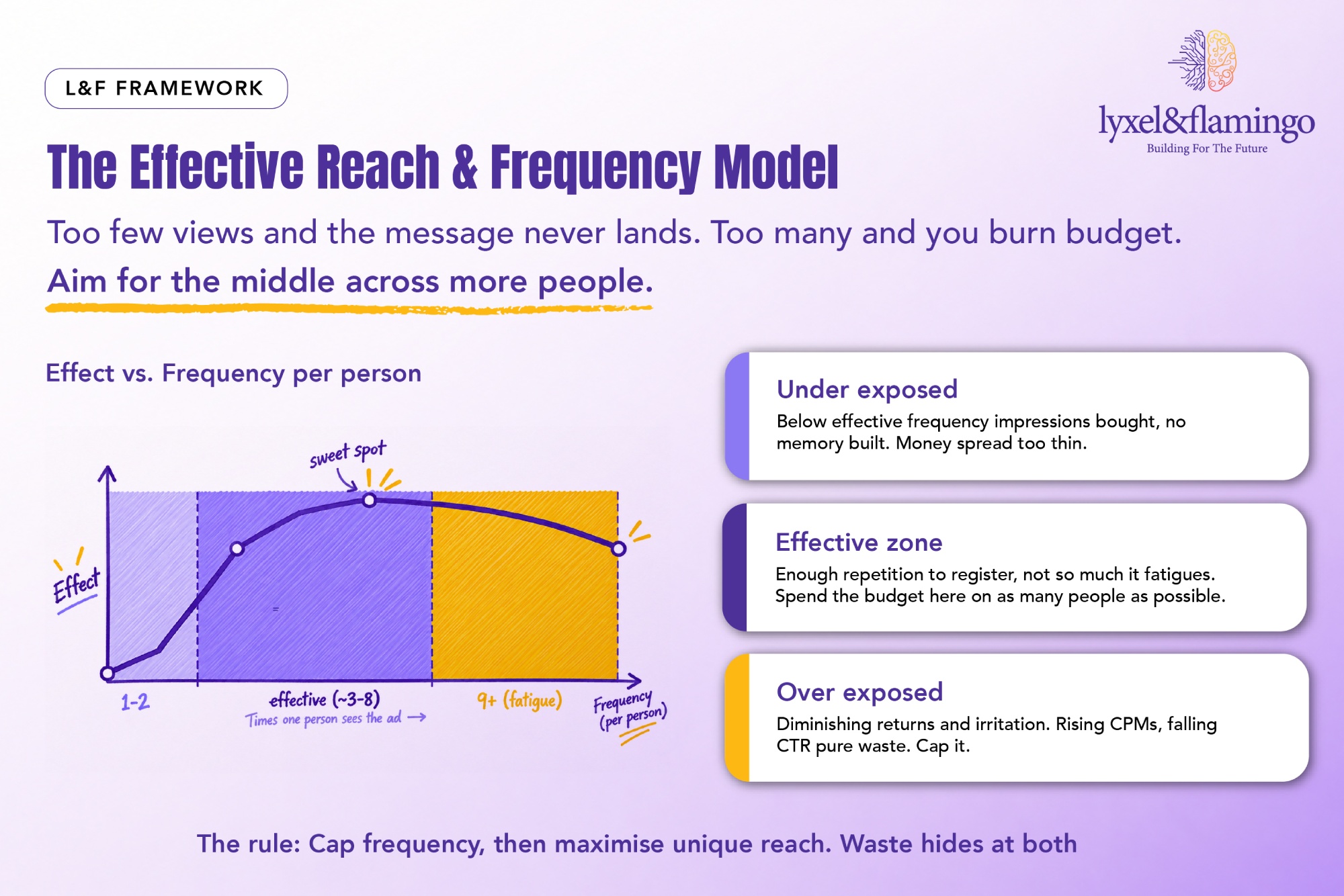
Framework: The Effective Reach & Frequency Model: waste hides at both ends of the curve.
Read it as a spending rule. Money spent pushing people below the effective zone is spread too thin to build memory. Money spent pushing people above it buys diminishing returns and irritation. The budget belongs in the middle, and once someone is in the effective zone, the next best rupee goes not to showing them again, but to bringing a new person into the zone. Cap the frequency, then maximise unique reach: that single move recovers the budget leaking at both ends.
Frequency capping: the fix for the top end
Frequency capping is the practical tool for stopping over-exposure: a limit on how many times any one person is shown the ad in a given period. Without a cap, auction algorithms will happily keep serving your most reachable, cheapest users again and again because they are cheap, concentrating spend on a small, over-exposed group while the rest of your audience never hears from you.
The subtlety in a modern plan is that caps have to work across platforms, not just within one. A cap of three per platform across four platforms is a cap of twelve – well into the waste zone. This is why a single, de-duplicated view of reach and frequency across your whole media mix matters: without it, you are capping in silos while the same person quietly racks up exposures everywhere. Getting this right is core media operations, and it is often the single fastest way to recover wasted reach budget.
Reach: why unique matters more than raw impressions
If capping fixes the top end, chasing unique reach fixes the bottom. The prize in demand creation is breadth: getting your message to as many category buyers as possible at the effective frequency, because creating demand means building memory across the whole future market, not just the few in-market today.
Raw impressions flatter this; unique reach measures it honestly. This is also where channel choice matters. Some of the widest, most efficient unique reach sits in premium inventory bought outside the open auction non-biddable media and in broad video across CTV and OTT. And when the reach lands, you can read it in the leading signals: branded search rising as new people, freshly reached, start looking you up.
How to plan it in practice
A practical sequence for a reach plan that does not leak:
- Set a reach goal against the right universe of all category buyers you want to build memory with, not just a narrow in-market segment.
- Choose an effective frequency target for the channel and message higher for a new brand or complex message, lower for a familiar one.
- Cap frequency across the whole mix, de-duplicated, so no one is pushed past the effective zone on any platform combination.
- Reallocate the recovered budget to unique reach, bringing new people into the effective zone rather than re-hitting saturated ones.
- Measure on unique reach, average frequency, and leading signals (branded search, view rate), not raw impressions or last-click alone.
What good reach planning looks like
Done well, disciplined reach planning shows up as large unique audiences reached at a frequency that actually builds memory and as leading signals that move.
- Kurlon (mattresses): A reach-led upper-funnel plan built a 90M+ engaged YouTube audience at a 55% video view rate, broad unique reach at a frequency that landed, which then lifted branded search 42%.
- vivo (V30, 15 countries): A reach-first launch delivered 846M+ total reach and unique breadth at continental scale, planned as demand creation.
- Sleepwell (festive): A reach push reached 186M+ unique users with a 27M+ engaged pool, feeding a 50.5% net-revenue uplift downstream.
In each case, the win was unique reach at an effective frequency, not the biggest impression count.
Self-check: Is your reach plan leaking budget?
Score your own plan one point per yes:
- You plan and report unique reach and frequency, not just impressions.
- You have an explicit effective-frequency target for each channel.
- Frequency is capped across the whole media mix, de-duplicated – not per platform.
- You can see how many people fall below, within, and above the effective zone.
- Recovered budget from capping is reinvested into new unique reach.
- Reach is judged against all category buyers, not a narrow segment.
- You read branded search and view rate to confirm the reach actually landed.
Five or more, and your reach budget is working. Three or fewer, and you are almost certainly leaking at one end or the other.
Key takeaways
- Impressions hide the truth; the same impressions can mean broad light reach or narrow heavy frequency. Plan on reach and frequency, not impressions.
- Budget leaks at both ends: under-exposure builds no memory, over-exposure buys diminishing returns and irritation.
- Effective frequency is a zone, not a number: enough to register, not so much that it fatigues. Get people into it, and no further.
- Cap frequency across the whole mix (de-duplicated), then reinvest the recovered budget into new unique reach.
- Judge the plan on unique reach, average frequency, and leading signals, not raw impressions or last click.
Closing
Reach and frequency planning is unglamorous, but it is where a surprising amount of media budget is quietly won or lost. The brands that plan it well are not the ones buying the most impressions – they are the ones who know exactly how many people they reached, how often, and whether that was enough to matter. Cap the waste at the top, chase unique reach at the bottom, and the same budget suddenly builds far more memory. That is the whole discipline: not more, but better placed.
Want to know where your reach budget is leaking?
Lyxel&Flamingo plans and buys reach media with de-duplicated frequency control across the whole mix so budget lands in the effective zone and reaches more unique people for consumer brands across India and worldwide. We will audit your current reach and frequency and show you the waste. Talk to L&F about reach planning and stop leaking budget at both ends.
Frequently Asked Questions
Reach is the number of unique people who saw your ad at least once; frequency is the average number of times each of them saw it. Reach measures how many, frequency measures how often. Impressions are the two multiplied, which is why impressions alone are misleading the same impression count can mean broad, light reach or narrow, heavy frequency, and those produce very different results.
Effective frequency is the number of exposures needed for an ad to do its job enough to register and build memory without causing fatigue. There is no universal number; it depends on the channel, how complex the message is, and whether the brand is new or established. New brands and campaigns generally need more repetition to break through; familiar brands refreshing memory need less. The practical point is that it is a zone: too few exposures build nothing, too many waste money and irritate.
Frequency capping is a limit on how many times one person is shown your ad in a given period. It matters because without a cap, auction algorithms keep re-serving your cheapest, most reachable users concentrating budget on an over-exposed few while the rest of your audience never sees you. Capping stops that waste and frees budget to reach new people. Crucially, caps must apply across your whole media mix, de-duplicated, or the same person racks up exposures platform by platform.
Attack both ends of the frequency curve. At the top, cap frequency across the whole mix so no one is over-exposed. At the bottom, make sure enough people reach the effective frequency rather than spreading budget so thin it builds no memory. Then reinvest the budget recovered from capping into new unique reach. And measure on unique reach, average frequency and leading signals not raw impressions, which hide both kinds of waste.
No. Frequency helps up to a point the effective zone and then turns negative. Beyond the zone, extra exposures add little to recall and start causing fatigue: rising CPMs, falling engagement, and irritation that can harm brand perception. The goal is to get people to the effective frequency and then stop spending on them, redirecting that budget to people who have not yet reached the zone. More is not better past the sweet spot; it is just more expensive.
It requires a single, de-duplicated view of reach and frequency across your whole mix, not platform-by-platform planning. Each platform only knows its own exposures, so a cap of three on four platforms is really a cap of twelve for anyone using all four well into the waste zone. Cross-platform planning means measuring unique reach and total frequency at the person level across channels, and capping against that combined number, which is a core media-operations capability.
Unique reach (how many distinct people you reached), average and capped frequency (how often, and whether anyone is over-exposed), and the share of your audience that fell below, within, and above the effective zone. Then confirm the reach actually landed using leading signals branded search and video view rate rising after the flight. Raw impressions and last-click conversions are the wrong yardsticks, because they hide both under- and over-exposure.