
What this blog covers
This blog explains how to measure brand lift in a way you can actually defend. We define what brand lift is, expose the mistake that makes most brand-lift numbers meaningless, lay out the Brand-Lift Measurement Method (define, control, measure the gap, pressure-test), show how to combine survey-based lift with behavioural signals, and give you a trust test for deciding whether a lift is real. It closes with a self-check and the questions practitioners ask most.
Table of Contents
- What is brand lift
- The mistake that makes most brand-lift numbers useless
- The Brand-Lift Measurement Method
- Survey-based lift vs behavioural lift
- The trust test: is this lift real?
- Why incrementality is the gold standard
- A brand lift you could trust
- Self-check: can you trust your brand-lift numbers?
- Key takeaways
- Closing
What is brand lift
Brand lift is the measurable change in a brand metric awareness, ad recall, consideration, favourability, or purchase intent that a campaign caused. The operative word is caused. Brand lift is not how high your awareness is after a campaign; it is how much higher it is than it would have been without the campaign. That distinction is the entire discipline, and it is the one most brand-lift reporting quietly skips.
It matters because brand-building is the part of marketing hardest to justify to a board, and a credible brand-lift number is how you justify it. Get the measurement right, and you can prove upper-funnel work moved perceptions and demand; get it wrong, and you produce a comforting number that falls apart the moment anyone asks how you know the campaign caused it.
The mistake that makes most brand-lift numbers useless
The near-universal error is measuring before and after a campaign and calling the difference ‘lift’. Awareness was 30% before, 38% after, so the campaign delivered eight points of lift, except it did not necessarily. Plenty of other things moved in that window: a competitor went quiet, the category grew, a seasonal spike arrived, PR happened, or the people you surveyed afterwards simply differed from those before. A before-and-after gap conflates your campaign with everything else that happened at the same time.
The only way to isolate the campaign’s effect is a control group of people (or regions) who were not exposed, measured over the same period. The lift is the difference between the exposed group and the control, not the difference between before and after. This is the same causal logic that underpins all serious media measurement: you cannot know what your marketing caused without knowing what would have happened without it.
The Brand-Lift Measurement Method
Measuring lift you can trust comes down to four disciplined steps. Skip any one and the number becomes decorative.
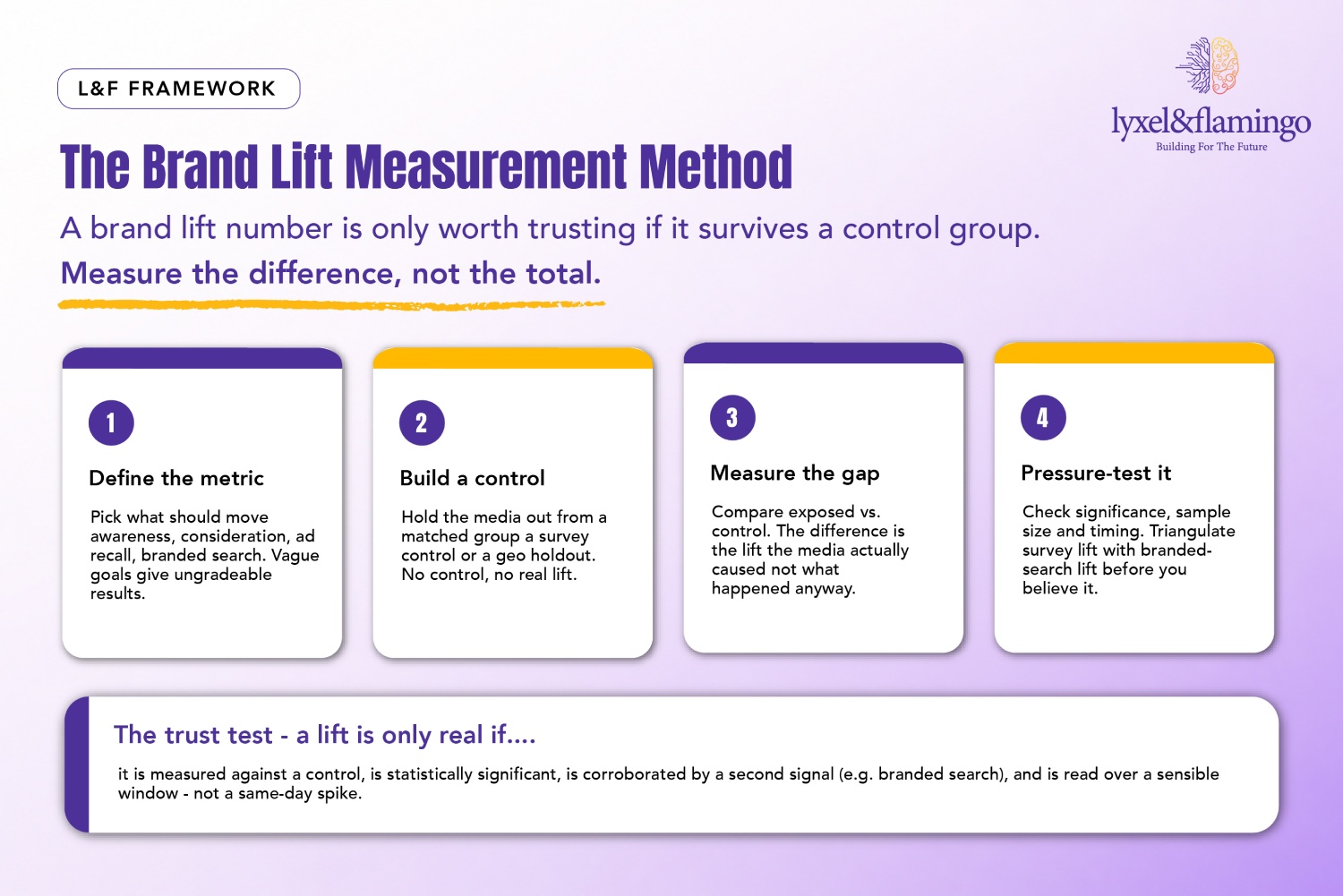
Framework: The Brand-Lift Measurement Method measures the difference against a control, not the total.
1. Define the metric
Decide up front exactly what should move and be specific. ‘Build the brand’ is not measurable; ‘lift aided awareness among 25-40 urban women’ or ‘increase consideration for the sub-brand’ is. Vague objectives produce ungradeable results, because you can always find some metric that went up. Pick the one or two metrics the campaign was actually designed to shift, and commit to them before it runs.
2. Build a control
Establish a group that is not exposed to the campaign but is otherwise comparable: a survey control (a matched audience the study withholds ads from) or a geo holdout (matched regions where the media does not run). The control is what turns a number into evidence. Without it, you have a before-and-after story; with it, you have a causal comparison.
3. Measure the gap
Compare the exposed group against the control on your chosen metric. The difference between them, not the change from before to after, is the brand lift the campaign actually caused. If exposed awareness is 38% and control awareness is 34% over the same period, your real lift is four points, not eight.
4. Pressure-test it
Before you believe the number, interrogate it. Is the sample large enough for the difference to be statistically significant, or is it noise? Is the window sensible, or are you reading a same-day blip? And does a second, independent signal agree: did branded search or direct traffic rise in step with the survey lift? A lift that passes all three is one you can take to the board.
Survey-based lift vs behavioural lift
There are two families of brand-lift evidence, and the strongest measurement uses both. Survey-based lift asks people directly about aided and unaided awareness, ad recall, consideration, and intent, comparing exposed and control respondents. It is the classic ‘brand lift study’ offered by the large platforms, and it captures perception changes that behaviour cannot show.
Behavioural lift reads what people do rather than what they say; above all, branded search and direct traffic rising after a campaign, which are hard to fake and immune to survey bias. The reason to use both is triangulation: a survey lift that is mirrored by a branded-search lift is far more credible than either alone. When the thing people say and the thing they do move together, you can trust the result.
The trust test: is this lift real?
Before any brand-lift number changes a decision, run it through four questions. If it fails one, treat it as directional at best:
- Is it measured against a control? A before-and-after gap is not lift. No control, no causal claim.
- Is it statistically significant? A two-point difference on a tiny sample is noise dressed as insight. Check the confidence interval.
- Is it corroborated? Does a second, independent signal – branded search, direct traffic – move in the same direction? One signal can mislead; two rarely do.
- Is it read over a sensible window? Brand effects build over weeks, not hours. A same-day spike is not a brand lift; it is a blip.
Why incrementality is the gold standard
The most rigorous form of brand-lift measurement is a proper incrementality test, and for behavioural outcomes, a geo holdout is the cleanest version. Keep the media live in some matched regions, hold it out in others, and measure the difference in the outcome you care about, whether that is branded search, site visits or sales. Because it is a genuine experiment, it settles the causal question that surveys can only approximate. We cover the design in depth in incrementality at scale: designing geo experiments.
Incrementality is also what connects brand lift to the wider measurement stack: it is the same method that proves attribution and media effects generally, applied to brand outcomes. A brand-lift number backed by a geo experiment is the strongest evidence a marketer can bring, which is exactly why it is worth the effort for your biggest brand bets.
A brand lift you could trust
The clearest example of trustworthy lift is one measured against a control rather than a before-and-after. For IndiGo, a brand-control approach and the experimental method isolated the true causal contribution of brand campaigns and proved 48% incremental sales at the same ROAS. Because it was measured against a control rather than assumed from a rising trend line, it was a number the business could act on with confidence.
The behavioural corollary shows up in reach-led work: when Kurlon’s upper-funnel campaign ran, branded search rose 42% – a behavioural lift, visible in what people did, corroborating that the brand-building actually landed. Survey lift would tell you perceptions moved; the branded-search lift proves it in behaviour. Together, they are the kind of evidence that survives scrutiny.
Self-check: can you trust your brand-lift numbers?
Score your own measurement – one point per yes:
- You define the specific metric a campaign should lift before it runs.
- You measure lift against a control group, not just before-and-after.
- You check whether the lift is statistically significant.
- You corroborate survey lift with a behavioural signal like branded search.
- You read lift over a sensible window, not same-day.
- You run a geo holdout for your biggest brand campaigns.
- You would be comfortable defending the number to a sceptical CFO.
Five or more and your brand-lift numbers are trustworthy. Three or fewer and you are probably reporting comforting noise.
Key takeaways
- Brand lift is the change a campaign caused, not how high a metric is afterwards. Causation is the whole point.
- The common mistake is before-and-after measurement, which conflates the campaign with everything else that moved.
- Measure lift against a control (survey control or geo holdout), then pressure-test for significance, window, and corroboration.
- Triangulate survey lift with behavioural lift, branded search, and direct traffic – for a number you can defend.
- A geo-holdout incrementality test is the gold standard, and the strongest evidence for your biggest brand bets.
Closing
Brand lift has a bad reputation because so much of it is measured badly a rising number with no control- presented as proof. Done properly, it is one of the most valuable things a marketer can produce: hard evidence that brand-building works, in a language a finance team respects. The difference is entirely in the method. Measure against a control, pressure-test the result, corroborate it with behaviour, and brand lift stops being a comforting story and becomes a number you can build a budget on.
Want brand-lift numbers a CFO can’t poke holes in?
L&F designs brand-lift and incrementality measurement – control groups, geo holdouts, and behavioural corroboration for consumer brands across India and worldwide. We will build measurement that proves your brand-building works, not just describes it. Talk to L&F about brand-lift measurement and turn brand-building into evidence.
Frequently Asked Questions
Brand lift is the change in a brand metric - awareness, ad recall, consideration, favourability or purchase intent - that a campaign caused. The key word is caused: it is not how high the metric is after the campaign, but how much higher than it would have been without the campaign. Measuring that requires comparing an exposed group against a control, not simply looking at a before-and-after change.
With a control-based comparison. Define the specific metric that should move, establish a comparable group that is not exposed to the campaign (a survey control or a geo holdout), run the campaign, and measure the difference between the exposed group and the control on that metric over the same period. That difference is the lift. Then pressure-test it for statistical significance, a sensible time window, and corroboration from a second signal like branded search.
Because lots of things change during a campaign window besides your campaign - competitors' activity, seasonality, category growth, PR, and differences between the people surveyed before and after. A simple before-and-after gap credits all of that to your campaign. Only a control group, measured over the same period, isolates what your campaign actually caused. Without a control, you have a story, not evidence.
A brand lift study usually means a survey-based measurement asking exposed and control respondents about awareness, recall or intent. Incrementality is the broader causal method: running a controlled experiment (often a geo holdout) and measuring the difference in an outcome, which can be a behavioural metric like branded search or sales, not just a survey answer. Survey lift measures perceptions; incrementality can measure behaviour. The strongest approach uses both.
Run it through four checks. Is it measured against a control, not just before-and-after? Is the difference statistically significant given the sample size, or is it noise? Is it corroborated by an independent signal such as branded search or direct traffic moving in step? And is it read over a sensible window - weeks, not the same day? A number that passes all four is defensible; one that fails any is directional at best.
Yes, at least partly, through behavioural signals and a geo holdout. Branded search and direct traffic are free-to-track behavioural indicators of brand lift, and a simple geo experiment - holding media out of matched regions and comparing outcomes - gives you a causal read without a formal survey panel. Survey-based lift studies add perception data that behaviour cannot show, but you do not need one to start measuring lift credibly.
Long enough for the effect to build and for your sample to be meaningful typically several weeks rather than days, since brand effects accumulate over time and a same-day reading captures noise. The exact duration depends on your reach and frequency and the metric you are tracking, but the principle is to read lift over a window that reflects how memory actually forms, and to make sure the exposed and control groups have both had enough time and scale to compare fairly.