
What this blog covers
Retail media is changing because AI shopping agents are becoming part of the buying journey. These agents compare products, prices, reviews, delivery timelines, and return policies without ever looking at banner ads or emotional copy. That changes what brands should optimise first. Product feeds, structured attributes, stock accuracy, and review quality now influence visibility more than creative alone.
Table of Contents
- What Is AI-Powered Retail Media?
- The Ad You Bought Was Never Built for a Machine to See
- Why Agent Buying Breaks Your Bidding Model
- The Numbers Make the Case Better Than Any Agency Deck Could
- The Agentic Shelf Stack: Lyxel&Flamingo’s Rebuilding Media Operations for Machine Buyers
- How This Plays Out Inside a Real Marketplace Account
- 5 Things to Audit Before Your Next Retail Media Planning Cycle
- Conclusion: The Brands Getting This Right Aren't Waiting for Certainty
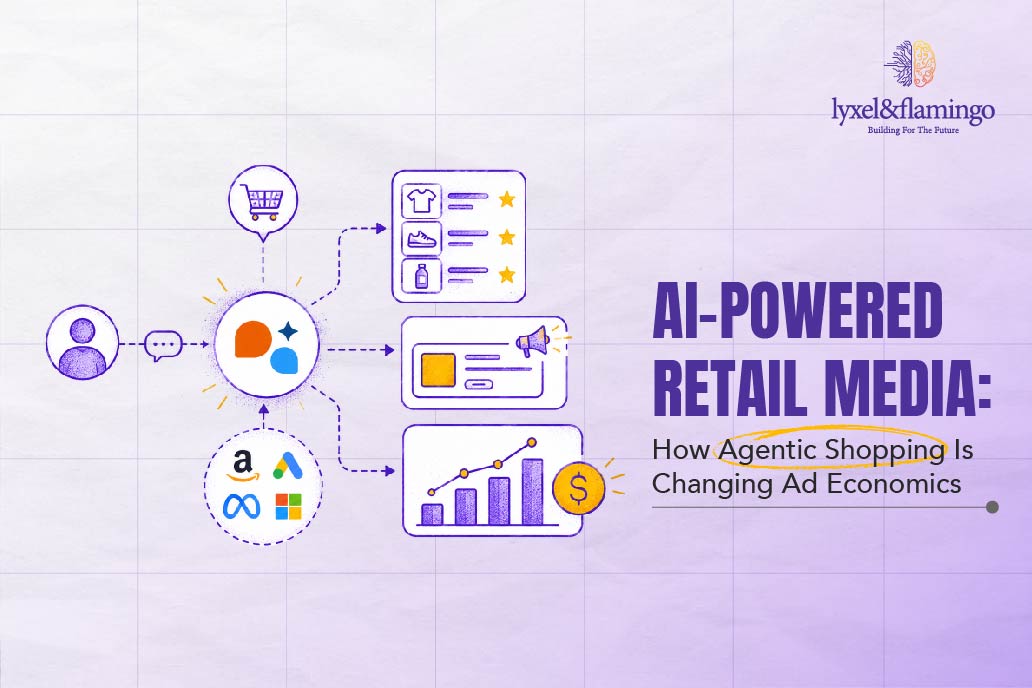
The blog explains why traditional retail media models built around clicks and impressions are becoming less reliable as agent-driven shopping grows across Amazon, Flipkart, Myntra, ChatGPT, Google AI Mode, and quick commerce platforms. It also introduces the Agentic Shelf Stack, a practical framework that helps brands improve machine readability before increasing ad budgets. Real marketplace examples show why fixing catalogue quality often delivers better results than spending more on media. Brands that prepare now will stay visible as AI shopping grows, while those delaying these changes may lose valuable product discovery without noticing the shift immediately.
Retail media budgets are still built to persuade a human. Increasingly, the shopper on the other end is software that can’t be persuaded, only satisfied.
Global retail media ad spend is set to cross $196.7 billion in 2026, claiming 16% of all ad dollars spent worldwide, more than linear and connected TV put together. That’s the headline figure everyone in retail marketing already knows. What most brands haven’t priced in yet is who is doing the browsing on the other side of that spend. A growing slice of “shoppers” on Amazon, Flipkart, Myntra and a dozen quick commerce apps aren’t people anymore. They’re AI shopping agents, sent out by a person to compare, filter and sometimes buy, and they don’t look at banner creative the way a bored human scrolling at 11 pm does. This is the shift underneath AI-powered retail media, and it changes what teams running media operations and creative optimisation get paid to optimise for.
Want to see how review velocity, return rates and catalogue depth already decide ad performance on a real marketplace, before agents even enter the picture? Read this blog: Cracking Myntra Ads: A Performance-First Playbook to Scale Fashion Brands Profitably
Most retail media budgets are still built for a human funnel: impressions, click-through, a banner that earns a second glance before a thumb keeps moving. Agentic AI shopping breaks that funnel at the first step because an agent doesn’t scroll or glance. It reads a product feed, checks a price against a stated budget, and moves on in milliseconds. Brands treating this as a 2027 problem are already losing shelf space they can’t see disappearing, because the loss shows up in a session they were never invited to.
What Is AI-Powered Retail Media?
AI-powered retail media is advertising bought, ranked and served with AI agents, not only humans, as part of the audience. It spans sponsored placements inside AI Overviews, Google’s AI Mode, ChatGPT’s shopping results, and the retailer apps where autonomous agents now browse on a person’s behalf. It operates one layer above traditional programmatic retail media, because the entity evaluating an ad may be a language model reading structured data rather than a person scrolling a feed.
It matters now because the agents aren’t experimental anymore. Google’s AI Mode, Amazon’s Rufus and ChatGPT’s shopping tools are live, transacting and growing faster than the human channels they were modelled on ever did. A brand invisible to those agents is invisible at the exact moment someone was ready to buy, and there’s no retargeting a shopper who was never shown the option in the first place.
The Ad You Bought Was Never Built for a Machine to See
Most retail media bidding today follows the standard AI in ecommerce advertising playbook: win a scroll-past glance from a human before their thumb moves on. That’s the entire logic behind sponsored search placements, hero banners, and the creative variants agencies A/B test against each other. It is built around attention, not verification. An AI shopping agent does not scroll past anything. It pulls your product feed, checks the listed spec against a stated goal, and moves to the next option in milliseconds, whether or not your creative ever caught anyone’s eye.
Adobe’s traffic data from early 2026 shows why this matters more than most media plans account for. In the first three months of the year, AI-referred traffic to US retail sites grew 393% year over year, and for the first time on record, that traffic converted 42% better than regular site visitors, a full reversal from converting 38% worse just twelve months earlier. Shoppers arriving through an agent aren’t casually browsing. Bain’s Consumer Lab already finds 30% to 45% of US shoppers turning to generative AI shopping assistants for product research and comparison, a range that only moves in one direction from here.
Retail media was built to sell attention, and agents don’t pay attention. They extract data and act on it.
Why Agent Buying Breaks Your Bidding Model
Persuasion and instruction are not the same thing, and retail media was built entirely around the first one. When a person opens a shopping app, a retailer’s ranking system competes for attention against a dozen visual distractions, so traditional retail media relies on creative built to interrupt a scroll. Agentic commerce advertising operates under a different constraint entirely: there is no scroll to interrupt, only a goal to satisfy. An agent instructed to find a running shoe under four thousand rupees with a reasonable return window works through structured data to close that gap, checking price, spec match, stock, delivery date and review sentiment, typically in that order.
This isn’t a small tweak to Google’s Helpful Content System or Amazon’s A10 ranking logic. It’s a parallel ranking layer running alongside them. Google’s Universal Commerce Protocol, launched for AI Mode in January 2026 and co-built with Shopify, Etsy, Wayfair and Target, lets agents complete purchases inside Search without a human ever clicking through to a retailer’s site.
Agentic checkout is already rolling out with merchants such as Wayfair, Chewy and Quince. Amazon has shipped its own version through Rufus for discovery, plus new “ads agent” and “creative agent” tools that let brands generate and target campaigns built specifically for agent traffic. OpenAI’s Agentic Commerce Protocol does roughly the same job for ChatGPT’s shopping results. None of these systems rewards the creative signals a media buyer has spent a decade learning to optimise for.
Want to know how Amazon’s ranking algorithm decides what shows up first, and how to win that fight before an AI agent ever gets involved? Read this blog: Amazon SEO in 2026: Ranking, Ads & Conversion Optimisation
| Human-led retail media | Agent-led retail media | |
| What wins the placement | Visual appeal, bid, historical CTR | Feed accuracy, price competitiveness, delivery certainty |
| What the buyer reads closely | Hero image, headline copy | Structured attributes, review sentiment, return policy |
| What triggers the purchase | Emotional nudge, urgency copy | Whether the product matches a stated constraint |
| What gets measured | Impressions, CTR, ROAS | Answer inclusion, completed transactions |
Programmatic retail media bidding logic, built to win human glances at scale, is now competing in an auction where a growing share of the bidders on the other side of the screen are software. Software doesn’t get tired of comparing forty options before it picks one. That’s AI retail media economics in practice, not a slide in next year’s planning deck.
The Numbers Make the Case Better Than Any Agency Deck Could
- By 2028, 90% of B2B buying will be AI agent intermediated, pushing over $15 trillion of B2B spend through AI agent exchanges. That’s enterprise procurement, not consumer shopping, but it sets the direction every commerce platform, retail included, is now building toward.
- Agentic commerce could orchestrate $3 trillion to $5 trillion in global retail spend by 2030, with as much as $1 trillion of that inside the US alone. For a brand, that isn’t an abstract number. It’s the size of the shelf that won’t have a human standing in front of it.
- US retail media ad spend is forecast to reach $71.09 billion in 2026, up roughly 18% year over year. Growth this steep on a base this large explains why every major retailer is racing to open new ad inventory before agents make some of the old inventory less valuable.
- US spending on AI-driven search ads could reach roughly $26 billion by 2029, about 14% of total search ad spend. That’s a media-plan line item that barely existed three years ago, and it didn’t exist at all five years ago.
- By 2030, 25% of global e-commerce sales are expected to be enabled by AI agents, yet only 31% of retail executives say they’re actively addressing how to influence AI-assisted shoppers. That gap, between where the money is headed and where the planning is happening, is the opportunity for brands willing to move before the category gets crowded.
The Agentic Shelf Stack: Lyxel&Flamingo’s Rebuilding Media Operations for Machine Buyers
At Lyxel&Flamingo’s Media Operations practice, when we rebuild a retail media ad economics model for a brand losing ground to agent traffic, we don’t start with creative. We start by checking whether an agent can even read the brand’s shelf in the first place. We call this the Agentic Shelf Stack, four layers, built in this order, because getting the sequence wrong burns budget on layers that can’t work yet.
- Feed Integrity Layer: Product titles, attributes, stock status and pricing need to be accurate and structured cleanly enough for an agent to parse without guessing at what you meant. Most catalogues fail here first, well before creative ever enters the conversation.
- Bid Logic Layer: Retail media bidding needs a separate track for agent-originated queries, because agents query in bursts, compare more SKUs per session than a person would, and don’t respond to frequency capping the way human traffic does.
- Machine-Readable Creative Layer: This is where creative optimisation work changes shape entirely. Copy has to answer a comparison question directly, fit, warranty length, delivery window, rather than simply look good inside a carousel.
- Trust Signal Layer: Review sentiment, return rates and delivery reliability are becoming ranking inputs, not just trust badges on a landing page, because agents weigh them roughly the way a search algorithm weighs backlinks.
In the marketplace and quick commerce accounts we run, the third layer is consistently the one brands skip first, and it’s the one with the fastest payoff once someone fixes it.
How This Plays Out Inside a Real Marketplace Account
We manage marketplace and quick commerce media for consumer brands across Amazon, Flipkart, Myntra and platforms such as Blinkit and Zepto, the kind of accounts where a ranking change shows up in revenue within days, not quarters. India’s quick commerce segment alone has grown into a $7 billion to $8 billion market, expanding at 110% to 130% a year between 2021 and 2025, and that pace makes agent-driven discovery a current problem for Indian brands, not a future one.
Curious how marketplaces went from a side channel to where most of India’s online shopping already happens? Read this blog: The Rise of Online Marketplaces: A Digital Revolution Reshaping
The pattern we keep running into as agent traffic grows isn’t that sales collapse overnight. It’s that branded search share erodes first, while overall sales still look fine for a few more reporting cycles, because agents are comparing a brand against competitors it has never been bid against before, inside a session the brand has no visibility into.
The fix hasn’t been more ad spend. It’s been fixing product feeds and review signals before the media plan gets touched at all, because an agent won’t recommend a product it can’t verify, no matter what a brand pays for placement. Brands treating feed quality as a Media Operations priority, not a data-hygiene afterthought, are the ones whose share holds up as agent-originated sessions keep growing every quarter.
5 Things to Audit Before Your Next Retail Media Planning Cycle
- Run your own product listing through an AI shopping agent this week. Ask ChatGPT or Google’s AI Mode to find and compare your product against two competitors, and note exactly where it gets your specs, price or stock status wrong. That gap is costing you visibility right now, not eventually.
- Separate agent traffic from human traffic in your analytics before touching the media plan. Most dashboards still lump the two together, so a team can’t see which channel needs the next rupee of budget.
- Audit review sentiment and return-rate data as ad inventory, not customer service data. Agents read that data to decide what to recommend, so a support team’s KPI has become a media performance input, whether anyone signed off on that or not.
- Test one sponsored placement inside an AI-native surface, even a small one. Whether that’s Amazon’s newer ads agent tools or inventory inside Google’s AI Mode, the learning curve is worth more this early than the spend itself.
- Rewrite your top 20 SKU descriptions to answer a comparison question in the first line. Not “premium quality fabric,” but the actual fit, warranty length or delivery window an agent needs to complete a match against a shopper’s stated goal.
Conclusion: The Brands Getting This Right Aren’t Waiting for Certainty
Retail media spend isn’t slowing down at all. It’s being rerouted toward whichever brands an agent can understand, read and trust on the first pass. Of all the retail media network trends 2026 has produced, this is the one still parked on next year’s roadmap for most teams instead of this quarter’s, and that gap is worth closing first.
The future of retail media networks won’t be won by whoever spends the most. It will be won by whoever an agent trusts enough to recommend without checking twice. Fixing a product feed doesn’t feel as exciting as launching a new campaign, but right now, it’s the work that decides whether a brand shows up in the conversation at all.
If you want a second opinion on where your retail media spend is leaking into agent-invisible inventory, talk to our Media Operations team.
Frequently Asked Questions
It's retail advertising priced, placed and measured for an audience that includes AI shopping agents, not only human shoppers. It spans sponsored slots inside AI Overviews, AI Mode, ChatGPT shopping and traditional marketplace ad units, all evaluated by very different rules than a human-facing banner.
Programmatic retail media automates ad buying for human audiences through real-time bidding. Agentic commerce advertising goes a layer further, built to be read and evaluated by AI agents acting on a shopper's behalf, so it depends on structured data far more than it depends on visual creative.
Start with your product feed and review data, not your ad creative. Agents can't recommend what they can't verify, so feed accuracy usually moves the needle before any bid increase does, and it's cheaper to fix.
Now is the right time, even if you start at a small scale. Deloitte's 2026 outlook found only 31% of retail executives are actively addressing AI-assisted shopping, so brands investing in agentic commerce marketing today are competing against far less noise than they will face a year from now. That gap is the future of retail media advertising arriving faster than most media plans account for.
It's arguably worth more to mid-sized brands specifically, because agent-driven discovery doesn't favour size the way traditional search rankings often did. An agent comparing products on spec and price can surface a smaller brand just as easily as a large one, provided the underlying data is clean and complete.