
What this blog covers
Your SEO can be strong and still lose festive footfall if individual store listings are not ready for local search. Customers searching “near me” are looking for the closest relevant store, accurate opening hours, recent reviews, directions, and useful local information. This blog explains why multi-city retailers need to optimise every location instead of relying on one national website strategy. It covers Google Business Profile accuracy, city-specific store pages, review activity, duplicate listings, local content, and festive search behaviour. Lyxel&Flamingo’s Local Visibility Stack breaks the work into three practical layers: Listing Integrity, City Content, and Review Velocity. The guide also shares what happened when these areas were improved for a consumer electronics retailer and outlines actions brands can take before festive demand rises. From checking store hours and categories to building location pages and managing reviews, the focus is practical. Because when customers search locally during the festive season, every store has to compete on its own.
Table of Contents
- What Is Local SEO for Multi-City Retail Brands?
- Why "Near Me" Works Differently the Moment You Cross Into a Second City
- The Evidence: What the Data Shows Us
- The Lyxel&Flamingo Local Visibility Stack
- What This Looked Like for a Consumer Electronics Retailer
- Things to Do Before Your Next Festive Campaign
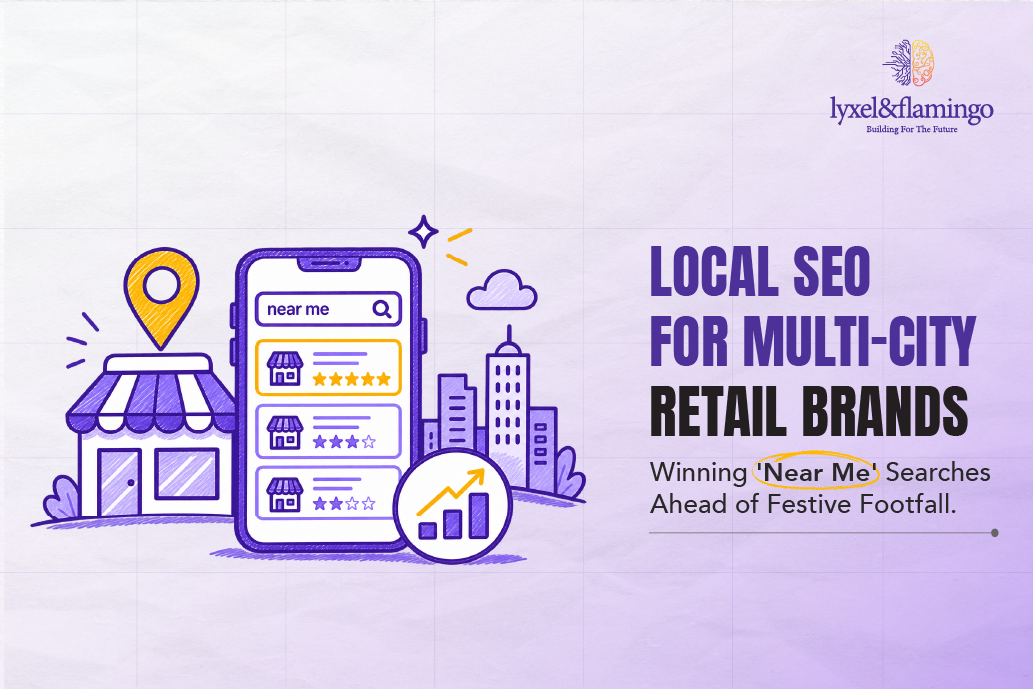
Most multi-city retail brands polish their homepage for search and leave forty individual stores to fend for themselves. That’s exactly where festive footfall quietly disappears.
Local search ranking factors now weigh Google Business Profile signals at 32% of local pack rankings, with reviews adding another 20%. That’s over half the ranking equation sitting completely outside your website, in places most brand teams rarely check.
If you run one store, fine, that’s manageable with a Sunday afternoon and a checklist. Run 35 stores across 12 cities, though, and it turns into a structural problem fast. This is exactly where our SEO team keeps seeing damage happen, quarter after quarter, right before the festive rush.
Most retail brands treat their local presence like an afterthought bolted onto a national strategy. One shiny homepage, one blog calendar, and forty store listings nobody’s touched since the day they were created. Meanwhile, a customer typing “electronics store near me open now” three days before Diwali isn’t thinking about your homepage at all. She’s checking which store shows up first, whether the hours are right, and if the reviews look recent enough to trust.
We’ve watched this exact pattern repeat across categories heading into festive quarters. A brand runs a strong national campaign, generates real search demand, then loses a chunk of it in the final few metres because the nearest store’s listing shows last year’s closing time or hasn’t responded to a review in eight months. The local search optimisation underneath it did not.
A brand’s national SEO score barely matters to a customer standing three kilometres from the wrong store listing.
What Is Local SEO for Multi-City Retail Brands?
Local search optimisation for multi-city retail means making every single store, not just the brand’s main site, independently findable and trustworthy in results tied to a specific place. It spans Google Business Profile management across every location, city-level landing pages, review activity per store, and citations that match across the board without gaps.
It matters right now because search behaviour in India has moved fast toward assisted discovery methods. The IAMAI-Kantar Internet in India 2025 report, released this January, found 44% of India’s 958 million active internet users had already used voice search, image search, chatbots, or AI filters, and that jumps to 57% for users aged 15 to 24. A near-me SEO strategy built only for old-school typed queries is already behind how people are searching today.
Wondering how to track whether you’re truly visible where these searches are happening now? Read this blog: SEO vs GEO Tracking Strategy: Measuring Visibility Across Search and AI
Why “Near Me” Works Differently the Moment You Cross Into a Second City
Here’s the mechanism most brand teams miss entirely, and it’s the whole reason multi-city local SEO can’t be run as one strategy stretched thin across every location.
Google does not rank a brand for “near me” searches. It ranks each listing, competing inside its own local pack, against every other business sitting near that particular searcher. Your Mumbai store and your Pune store aren’t teammates here. They’re separate contestants running completely separate races, each one judged by its own proximity, its own review count, its own citation accuracy, its own page content.
This is exactly where a single centralised website starts working against you. A generic “Contact Us” page listing forty addresses in one long block gives Google almost nothing to work with for a hyperlocal query. No city-specific content. No local service description. No location-anchored proof that this particular store is relevant to this particular search. Now put that up against a competitor with a dedicated page for each city, naming the neighbourhood, listing what’s currently in stock there, showing recent reviews from real local customers. Google reads that second brand as structurally closer to the query, even when the store itself sits further away on a map.
Think of it less like one race and more like forty separate franchises, each one needing its own reputation built and defended on its own terms. A brand running one flat, domain-level strategy across all of them is asking a single athlete to run forty different races at once, then wondering why nobody medals.
There’s a second layer to this specific to the festive window too, and it’s the part most seasonal local SEO planning gets wrong. Search intent compresses into a much shorter runway during this period. Redseer’s Festive 2025 e-commerce tracking recorded a 23 to 25% year-on-year jump in Day 0 and Day 1 sales alone, meaning most of the buying decision now happens in a tight burst rather than spread evenly across weeks like it once did. When that much demand lands in that few days, a listing with wrong hours or a two-star average from last Diwali doesn’t get time to quietly fix itself mid-surge.
Think of 40 separate local packs running at once, each with its own proximity score, its own review trust, its own citation accuracy. That’s the real unit of competition here, not the brand as a single whole.
The Evidence: What the Data Shows Us
- 93% of Indian consumers shop omnichannel today, yet fewer than 40% of firms have built a physical and digital presence adequate to match that behaviour. That mismatch between how shoppers behave and how ready brands are on the ground is where most retail SEO for the festive season budget gets wasted chasing national traffic while the local layer stays broken underneath.
- 9 in 10 offline buyers use online touchpoints to research before they buy anything, and even among rural shoppers, 7 in 10 do the same despite 85% of their purchases still happening physically in a store. Online and in-store aren’t two separate journeys anymore for a local SEO for retail brands strategy to plan around separately. It’s one journey, and the local search result is often the front door to it.
- 958 million Indians were active internet users as of the IAMAI-Kantar 2025 report, growing roughly 8% year-on-year, with rural adoption climbing nearly four times faster than urban growth. A local SEO for festive season plan built only around metro search volume is missing where a meaningful share of new demand comes from now.
- Google Business Profile carries 32% weight in local pack rankings, more than any other single factor category on its own. For a brand running forty stores, that means forty separate profiles, each one needing active, correct management, not a setup job from two years back that nobody’s revisited since.
- Only 20% of consumers trust a review once it’s more than two weeks old, a number that itself fell 7 percentage points from the year before. Review freshness isn’t optional anymore, it’s decaying faster than most brands’ review-collection habits can keep pace with.
Want to understand how these trust signals feed into what Google and AI models reward? Read this blog: E-E-A-T: How Indian Brands Build Trust Signals Google and AI Reward
The Lyxel&Flamingo Local Visibility Stack
At Lyxel&Flamingo, building a multi-location SEO strategy for retail brands heading into a festive quarter, we run a three-layer model we call the Local Visibility Stack. Every festive season SEO strategy we build for a client starts here, not with a keyword list.
- Listing Integrity Layer: Every store’s Google Business Profile gets audited category by category: tags, service area, hours, photos, corrected before any city content work even begins. Sounds basic. It’s also where we find most of the damage existing, duplicate listings left over from old franchise transitions, addresses pointing to a store that shut down two years back, categories set once and forgotten. Nothing built on top of a broken listing performs, no matter how good the content above it is.
- City Content Layer: Each location gets its own dedicated page, not a shared template with just the city name swapped in. Real neighbourhood mentions, real notes on what’s currently in stock there, real store-specific proof. In our work with multi-city retail clients, this layer is consistently the most under-invested one, and it’s also the one with the fastest visible impact once fixed, because it’s what hands Google a genuine reason to rank that specific store for that specific city.
- Review Velocity Layer: A structured, store-by-store review request cadence timed around festive footfall spikes, not one generic “please leave us a review” email blasted out once a quarter and forgotten. Given how fast review trust decays, this layer has to keep running through the entire festive window, not stop once it starts.
Order matters a lot here. Content sitting on top of broken listings gets ignored by both Google and the customer. Reviews collected before listings are fixed often attach to the wrong local pack entry entirely. Skip one layer and the two sitting above it lose most of their effect.
What This Looked Like for a Consumer Electronics Retailer
A leading consumer electronics retailer came to L&F roughly ten weeks out from the festive quarter, running a single national SEO strategy across dozens of city locations, with local visibility that had sat flat for over a year.
We rebuilt the Listing Integrity and City Content layers first, city by city, before we touched a single national keyword.
- A sharp rise in store-level “near me” impressions within the first eight weeks
- A meaningful jump in Google Business Profile direction requests during the festive window itself
- A noticeable lift in in-store footfall attributed directly to Google touchpoints, measured against the previous festive quarter
That pattern matches what Google’s own case data shows at a much bigger scale too. Croma’s local listing impressions grew 70% within a single month after equivalent profile and content work, and Tanishq found 26% of its store sales carried a direct Google touchpoint, per Think with Google’s omnichannel retail strategy report for Indian shoppers. Fixing the local layer isn’t some marginal add-on sitting quietly on top of national SEO. For a multi-city retailer, it’s often the bigger lever in the room.
Things to Do Before Your Next Festive Campaign
- Audit every store listing for accuracy this week, not next month. Pull the full list of Google Business Profiles across your cities and check hours, categories, and photos against what’s true on the ground today. Festive hours shift constantly, and a wrong closing time loses you the customer who searched at 8 pm sharp.
- Build one city-specific page per location, starting with your top ten stores by footfall. Don’t just template it and swap a city name in. Name the neighbourhood, note what’s sitting on the shelf there right now, and let each page earn its own relevance instead of borrowing it.
- Set a review-response SLA now, before footfall spikes hit, not once they’re already underway. Given how fast trust in reviews decays past two weeks, aim to respond to every review within 48 hours through the whole festive stretch, not just the bad ones.
- Go find your duplicate or zombie listings from old franchise moves or closed stores. These quietly cannibalise ranking signal away from your active listings, splitting the exact trust signals you’re trying so hard to build up.
- If you’re mid-migration on Shopify or any other platform, lock your redirect map down before festive traffic shows up, not after it already has. A Shopify migration without losing rankings hinges almost entirely on how carefully old URLs get mapped to new ones. A poorly mapped one can put 2 to 4% of total revenue at risk, per Shopify’s own SEO migration guidance, published this January. Recovery for larger catalogues can stretch four to six months, and that’s a timeline no retailer wants bleeding into Diwali.
Still not sure why your brand isn’t showing up when customers ask AI tools directly? Read this blog: Why My Brand Isn’t Showing Up in AI Search Tools, and How to Fix It
Conclusion
The brands winning festive footfall this year won’t be the ones with the flashiest national campaign. They’ll be the ones whose weakest store listing is still accurate, still recently reviewed, still built well enough to be found entirely on its own. That distance between polished national SEO and neglected local listings only grows the longer it sits there, and by next festive quarter it’s twice the work to close.
Frequently Asked Questions
It's the work of optimising each store, its Google Business Profile, its city-specific content, and its reviews, so it can rank on its own in local search. Not relying on one national website strategy to carry every single location by itself.
Single-location SEO is about winning one listing against nearby competitors. Multi-city SEO means running dozens of separate local packs at the same time, each with its own proximity, review, and citation profile, competing individually instead of as one combined brand push.
Ideally eight to ten weeks before the festive quarter kicks off. Listing fixes and city page content both need time to get crawled and trusted by Google before demand surges, and review velocity needs a running start rather than a cold one on day one.
It can, if redirects aren't mapped properly beforehand. Most well-run migrations see traffic dips of 10% or less, but recovery can still take months for bigger catalogues, which is exactly why migrations shouldn't be scheduled close to a peak sales window.
For any brand running more than a handful of physical stores, yes, pretty clearly. Over half of local pack ranking weight sits in Google Business Profile, and review signals that a national website strategy never even touches, and that's real footfall left sitting on the table every single festive cycle.