
What this blog covers
The native-versus-PWA debate is usually framed as a technology question. It is not it is a business-strategy question with a capital-allocation answer. This blog gives you a practical decision matrix across six criteria, then walks three real-world archetypes through it, so the choice becomes a matter of business logic rather than engineering preference or boardroom fashion.
Table of Contents
- Native app vs PWA, in plain terms
- Why this is a business decision, not a tech one
- The real pain points
- Framework: The App vs PWA Decision Matrix
- The Framework explained
- The decision in the real world: Taco Bell
- Three archetypes, one matrix
- Going deeper: the hybrid middle ground
- Decision checklist
- Key takeaways
- Closing thoughts
Native app vs PWA, in plain terms
A native app is built for a specific platform (iOS or Android), installed via an app store, with full access to device hardware and operating-system features. It runs as a standalone application on the device.
A Progressive Web App (PWA) is a web application built with modern browser APIs to behave like an app; it can be saved to the home screen, work offline to a degree, and send push notifications, but it runs in the browser engine and needs no app-store distribution. In practice it is closer to the low-code and modern-web approaches reshaping how storefronts get built.
Both are legitimate. Neither is universally superior, which is precisely why a framework beats an opinion.
Why this is a business decision, not a tech one
The conversion case for apps is well-documented: apps convert at roughly 3x the rate of mobile web, with retail apps around 94% higher and users viewing about 4.2x more products per session (Criteo/Button, 2024). But those numbers describe engaged, returning users a behaviour you have to earn before the advantage is real.
Speed matters whichever route you choose. A 0.1-second improvement in mobile load speed lifted retail conversions 8.4% and average order value 9.2% (Deloitte/Google, 2020), and 53% of mobile visits are abandoned if a page takes longer than three seconds (Think with Google). A slow PWA and a slow native app both leak revenue; performance is a conversion discipline, not a format.
So the question is not which format is faster in theory. It is which format best serves your specific users, in your specific market, for the specific outcomes you are chasing.
The real pain points
- Defaulting to native because it sounds impressive: Prestige does not justify the higher build and maintenance cost if the use case does not require it.
- Choosing PWA to save money, then hitting the wall: PWAs cannot access all device hardware on iOS; camera, Bluetooth, background processing, and, historically, push have been restricted by Apple’s WebKit engine.
- Underestimating app-store friction: Submission, review times, and version management add ongoing overhead that PWAs avoid entirely.
- Ignoring discoverability differences: Native apps benefit from app-store search; PWAs are found through web search, which can be an advantage if your SEO is strong.
- Neglecting the hybrid option: React Native and Flutter produce near-native experiences from a single codebase, cutting cost without sacrificing most native capability.
Framework: The App vs PWA Decision Matrix
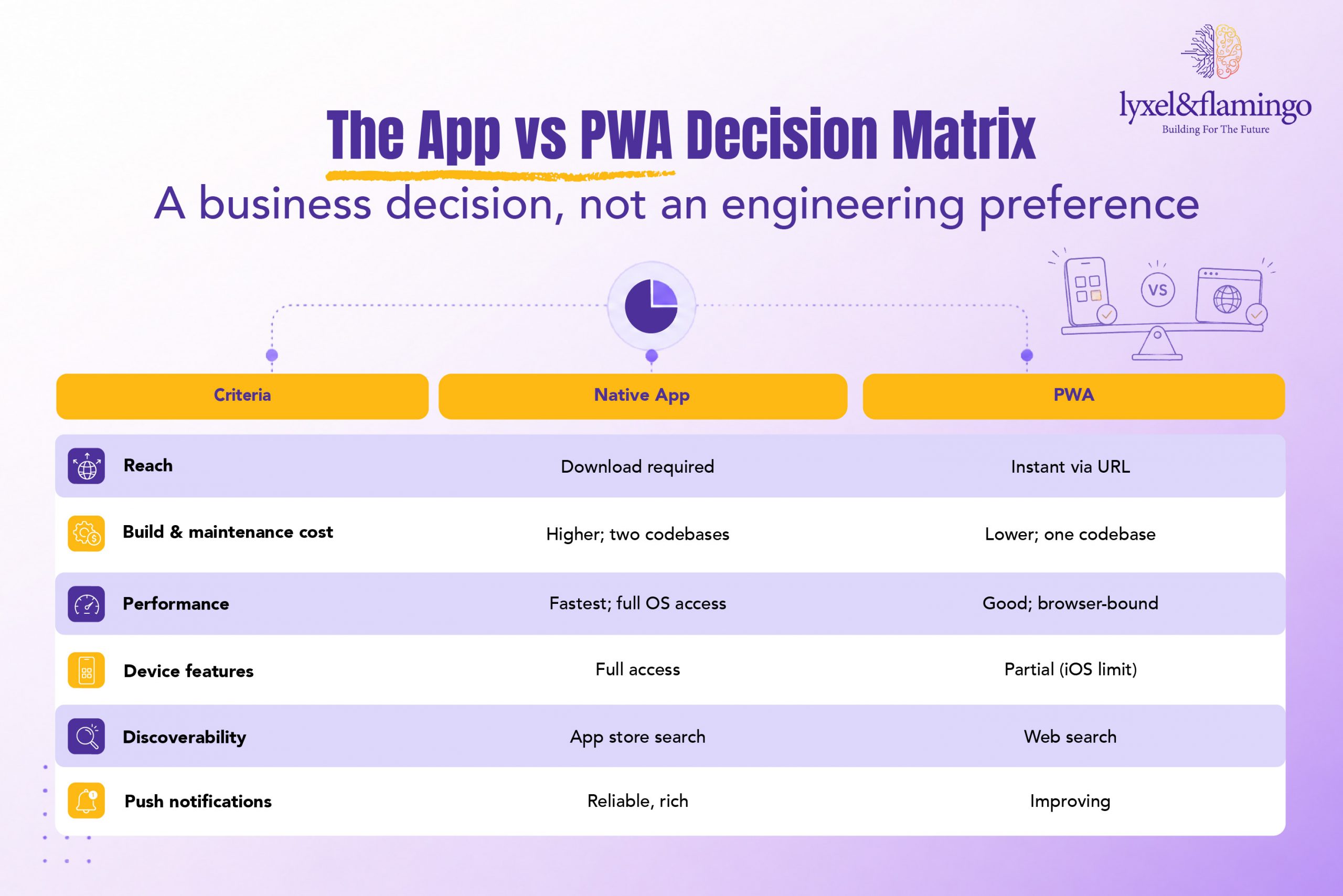
Evaluate the decision across six criteria and be honest about which ones your business actually depends on.
The Framework explained
01. Reach: Determines the size of your potential audience before conversion is even discussed. A PWA needs only a URL: no store account, no storage, no update prompt. For first-time users, high-churn markets, or audiences where data costs make downloads prohibitive (a real constraint across much of India), that frictionless entry is a structural advantage. Native’s failure mode here is attrition at the door: users who abandon the download before they experience the product at all.
02. Build and maintenance cost: Is an ongoing commitment, not a one-off. Native means separate iOS and Android tracks, separate submissions, and a QA pass for every OS update Apple and Google ship. A PWA’s single codebase deploys a fix once and everywhere. For a business still validating its mobile proposition or running a lean team, that difference is the gap between a sustainable product and one perpetually behind platform standards.
03. Performance: Is native’s most defensible advantage. Running inside the OS rather than a browser, a native app renders at 60fps, handles complex real-time data, and taps OS features without browser overhead. For gaming, AR, complex dashboards, or any experience where half a second is a broken interaction, native is a requirement, not a preference. The PWA gap narrows yearly, but for the most demanding cases it has not closed.
04. Device features: Decide whether your core experience is even possible on a PWA. If the product needs a camera for scanning or AR, GPS for real-time location, Bluetooth for pairing, or background sync for offline, iOS WebKit’s restrictions are not inconveniences they are blockers. Map the specific capabilities your experience requires before the technology decision; if they sit outside WebKit, native is a constraint the brief imposes.
05. Discoverability: Is the criterion that most surprises businesses mid-decision. App-store search surfaces native apps to users with explicit intent (“loyalty app for [brand]”) without competing in organic web results. PWAs are found through web search and are linkable and shareable. For a brand with a strong content and SEO programme, PWA discoverability is a genuine advantage; for one relying on store editorial or entering a new market, native presence has value a URL cannot replicate.
06. Push notifications: Are the most commercially consequential criterion for any retention-led business. OS-level push from native apps is reliable, rich, and reaches users whether or not a browser is open. iOS 16.4 extended push to PWAs in 2023, but the implementation remains browser-dependent and less consistent. Where a notification at the right moment offers expiring, order-ready, restock is the engine of repeat purchase, native’s marginal reliability edge is not theoretical. It is revenue.
The decision in the real world: Taco Bell
Taco Bell India is an instructive case precisely because native was a deliberate decision, not a default.
The requirements made the call: a loyalty programme integrated through Xeno APIs, reliable performance when a promotion drives 10x normal traffic, a seamless payment-to-kitchen flow via POSIST and Razorpay, and precise GPS and geofencing for store-finder and live delivery tracking across a base of 8.5 lakh-plus users. Those are exactly the capabilities OS-level reliability, deep device and payment integration, real-time location where a PWA’s constraints bite hardest.
So L&F built the app natively in SwiftUI on iOS, Jetpack Compose on Android, and a backend engineered for high-concurrency spikes. The infrastructure went on to support a 5x store expansion to 150-plus live stores, with orders scaled 2x. Native here was not prestige; it was the requirement the brief imposed.
Three archetypes, one matrix
The matrix is easiest to trust when you see it decide three very different businesses:
01. The content or media brand. High reach, casual visitors, discovery through search and social, no dependence on device hardware. The matrix points clearly to PWA: frictionless reach and a single codebase matter far more than OS-level push. A native app here would buy prestige and lose reach.
02. The scaling D2C brand. A growing skincare or apparel label with a loyal but not-yet-daily audience, tight budget, and strong SEO. The matrix points to PWA first, native later launch fast and cheap, validate that customers return, and migrate to native only when loyalty and frequency prove out. Spending native money before the habit exists is the classic premature build.
03. The QSR or loyalty brand. Frequent orders, a points programme, push-driven offers, delivery, POS and payment integration exactly Taco Bell’s profile. The matrix points firmly to native, because the experience depends on the capabilities only native reliably delivers.
Same six criteria, three different honest answers. That is the point of a framework.
Going deeper: the hybrid middle ground
For many businesses, the binary is false. Three practical paths exist:
01. PWA first, native later: Launch a PWA to validate demand and build an audience. If the engagement data supports it – high frequency, strong return rates, clear device-feature needs migrate to native. This de-risks a costly native build before product-market fit.
02. Hybrid native (React Native / Flutter): A single codebase delivering near-native performance on both platforms. L&F builds in both; it is the pragmatic answer for most mid-market businesses that have cleared the App Value Test but want to reduce cost and time-to-market.
03. Super-app or mini-programme: In markets where WhatsApp and platform-embedded experiences are primary, much of India included, a mini-programme inside an ecosystem your audience already lives in can outperform a standalone app you have to convince them to download.
Decision checklist
- Users will engage weekly or more → lean native
- Experience depends on camera, Bluetooth, GPS or background processing → native required
- Reliable, rich push is a core retention mechanic → lean native
- Testing demand or targeting a broad, low-commitment audience → start with PWA
- Budget requires a single codebase → hybrid native or PWA
- SEO and organic web discovery are primary acquisition channels → PWA advantage
- Markets with app-store payment friction or high data costs → PWA advantage
Key takeaways
- Native apps deliver superior conversion, performance and device access but only earn that advantage when the use case demands it.
- PWAs have closed much of the gap and remain right for broad reach, lean budgets and web-first discovery.
- Taco Bell India shows how loyalty, payment trust, POS integration and reliable performance at promo-scale tipped the decision firmly toward native infrastructure that then powered a 5x store expansion.
- Three archetypes, three honest answers: content brand → PWA; scaling D2C → PWA-first; QSR/loyalty → native.
- Speed matters regardless of format: a 0.1s improvement lifts conversion 8.4% (Deloitte/Google, 2020) on native and web alike.
Closing thoughts
The app-versus-PWA choice looks technical, but for a CXO it is capital allocation with long-term consequences. Choose native without clearing the engagement, retention, and device-feature criteria, and you commit budget to an asset that will underperform and age badly. Choose PWA when your loyalty model needs OS-level push and deep device integration, and you will find the limitation at the worst moment when a customer never receives the notification that would have brought them back. The right answer is always grounded in the outcomes you are driving, the users you serve, and the capabilities your experience genuinely requires. Run the matrix before the technology conversation begins, and the path becomes a matter of business logic, not opinion.
Frequently Asked Questions
For content, commerce and information-led experiences with moderate frequency often yes. For loyalty-heavy, notification-dependent or hardware-intensive experiences not yet, particularly on iOS.
Apple added PWA push in iOS 16.4 (2023), narrowing the gap with Android. But some hardware APIs remain restricted under WebKit, and there is no app-store discoverability for PWAs on iOS.
Typically 30-60% less to build and meaningfully cheaper to maintain one codebase versus two. The calculus shifts if you use a hybrid framework like React Native or Flutter.
Many mature businesses run both: a PWA for new-user acquisition and SEO, and a native app for their most engaged, loyal customers. They are not mutually exclusive.
Begin with the App Value Test if you clear three or more of the five gates, native or hybrid native is the right conversation. If you do not, a fast PWA (or a better website) is almost certainly the smarter first move.