
What this blog covers
How the search landscape is shifting, why traditional SEO alone is no longer sufficient, and a practical framework, the Find-Convert-Credit Model, that aligns your digital presence with where your customers actually go to look for answers.
Table of Contents
- SEO, GEO and tracking, defined: get found, earn the visit, prove what worked
- Why visibility is fragmenting and budgets with it
- Where brands lose the visibility they have already earned
- Framework: The Find-Convert-Credit Model
- The Framework explained
- Real-world scenario: Timex
- Going deeper: The Visibility Hygiene Checklist
- Key takeaways
- The CXO takeaway
SEO, GEO and tracking, defined: get found, earn the visit, prove what worked
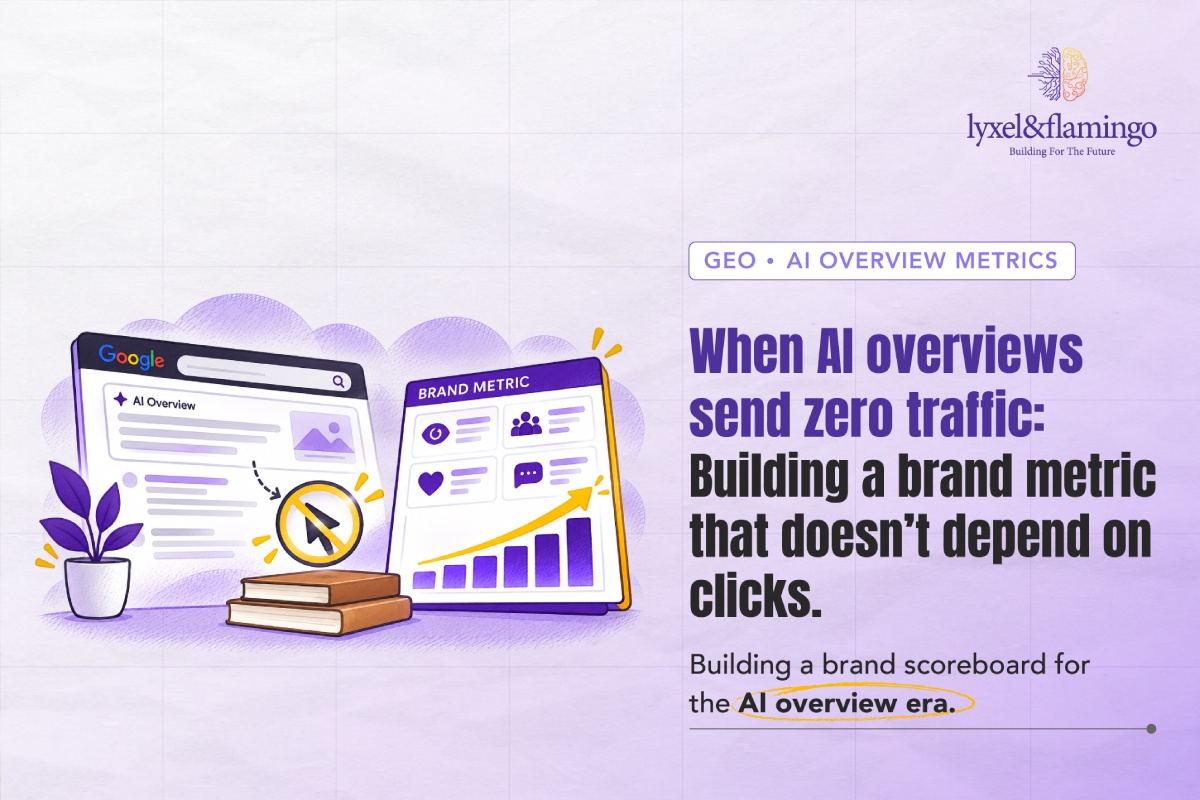
SEO (Search Engine Optimisation) is the practice of making your website visible and rankable in traditional search engines like Google. GEO (Generative Engine Optimisation) is the emerging discipline of ensuring your brand is cited, referenced, or surfaced by AI-powered answer engines, ChatGPT, Perplexity, Google AI Overviews, and their successors. Tracking and attribution is the infrastructure layer that tells you which channels are actually driving growth.
Together, they form a continuous loop: get found, earn the visit, understand what drove it.
Why visibility is fragmenting and budgets with it
The ground is shifting beneath every marketing budget. Traditional search engine query volume is predicted to drop 25% by 2026 as AI chatbots and virtual agents take share (Gartner, Feb 2024). At the same time, AI-driven referral traffic to retail sites surged approximately 693% year on year during the 2025 holiday season (Adobe Analytics, 2025).
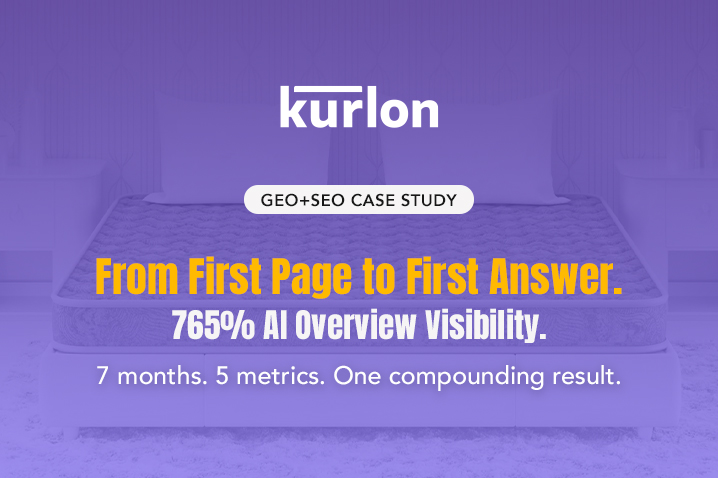
These two data points tell a coherent story: users are migrating to AI interfaces for answers, and those AI interfaces are already sending meaningful commercial traffic. The brands that are being cited and linked within AI responses are capturing that traffic. Those that are not are invisible to an increasingly large share of their potential audience. This is not a hypothetical, it is exactly the gap L&F closed for Kurlon, whose AI Overview visibility grew 765% in seven months once its content was rebuilt to be citable.
Waiting another 12 months is not a neutral decision. It is a decision to cede ground.
Where brands lose the visibility they have already earned
- Fragmented visibility: A brand may rank well in Google but be absent from AI-generated responses entirely: two different audiences, two different sets of ranking signals, one strategy trying to serve both. Our guide to ranking in zero-click and answer engines covers this split in depth.
- Attribution collapse: As more users arrive via AI tools, chatbot referrals, or zero-click searches, standard GA4 configurations misattribute or lose source data entirely. Leaders cannot tell what is actually driving conversions.
- Content without authority: Publishing volume has never been higher. But AI systems prioritise content that demonstrates expertise, experience, authoritativeness and trustworthiness (E-E-A-T) not content that is merely frequent or keyword-stuffed. Building those trust signals that Google and AI both reward is now a distinct discipline.
- Tracking gaps at launch: Many websites go live with incomplete analytics setups: missing event tracking, unverified Search Console properties, broken pixel integrations. Every untracked session is a permanent data loss.
- No cross-channel view: Paid, organic, direct, and AI referral often live in separate dashboards. Without a unified attribution model, the board conversation remains anecdotal.
Framework: The Find-Convert-Credit Model
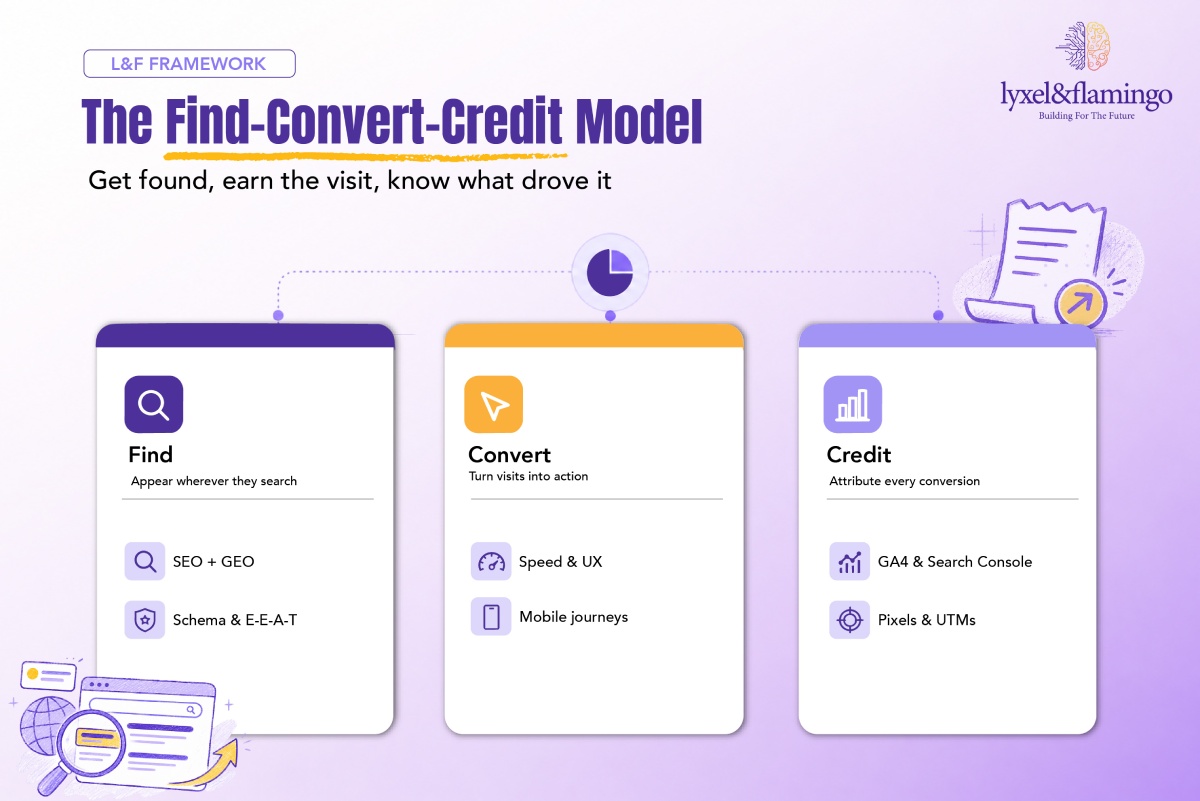
The model is deliberately sequential. Fixing “Credit” without fixing “Find” produces accurate data about a shrinking audience. Fixing “Find” without “Credit” means you are optimising blind. All three stages must function together.
Find: Demands that your content be structured so that both traditional crawlers and AI systems can parse, trust, and cite it. That means clear topical authority, consistent E-E-A-T signals, schema markup, and an answer-first content architecture.
Convert: Is where UX investment pays back. Research from Forrester puts the return at up to $100 for every $1 invested in UX, a figure that aligns with what L&F observes across full-funnel engagements where speed and usability improvements directly lift commercial metrics.
Credit: Is the measurement backbone. Without a properly configured GA4 property, verified Search Console account, correctly fired conversion pixels, and a clean sitemap, you are flying without instruments.
The Framework explained
01. Find: Is the stage most organisations believe they have already solved because they rank on Google. But ranking in traditional search and being cited in AI-generated responses are two separate outcomes, governed by two separate sets of signals. A brand with strong keyword rankings but no structured content, no schema markup, and no third-party citations can be entirely absent from the AI responses its audience is now reading first. The failure mode is silent: traffic declines gradually, attribution looks stable, and by the time the gap is visible in data it has been widening for months. A CXO applying this stage asks: “Are we present in the places our audience actually starts their search including AI tools?”
02. Convert: Is where the Find investment either pays off or is wasted. A user who finds your brand via an AI-cited article and arrives on a slow, confusing, or mobile-unfriendly page is a warm lead converted into a bounce. The UX quality of the landing experience page speed, information hierarchy, clarity of the next step determines whether the audience you worked to attract becomes the audience that acts. The Forrester figure of up to $100 returned per $1 of UX investment is not an abstraction; it is the compounded effect of incrementally better conversion rates across every channel simultaneously. The failure mode here is treating UX as a design aesthetic rather than a commercial lever.
03. Credit: Is the most underestimated stage, and the one most likely to be incomplete at the moment it matters most. When a CXO asks “which of our channels is actually driving revenue?”, the answer depends entirely on whether GA4 is correctly configured, whether UTM parameters are applied consistently, whether conversion events are firing on the right triggers, and whether AI referral traffic is being captured rather than bucketed into “direct.” An organisation without rigorous Credit infrastructure is making budget allocation decisions on incomplete information – routinely defunding channels that are working and over-investing in channels that look good in a broken dashboard. The failure mode is not a missing number; it is a systematically wrong strategic direction.
Real-world scenario: Timex
Timex, the watch brand founded in 1854, had exactly the profile the Find-Convert-Credit Model is designed for: real brand equity, but a search-visibility gap compounded by technical hygiene errors on the website and thin content across category and product pages. Strong brand, under-performing digital presence.
L&F’s programme addressed all three stages as a system:
- Find: A full technical and on-page SEO rebuild, covering URL structure, meta tags, contextual interlinking, canonicalisation fixes, schema markup, and keyword-aligned content pillars so that both crawlers and users could find the right page for the right query. Off-page work (content outreach, guest blogging) built the external authority that Find depends on.
- Convert: Core Web Vitals improvements, site-speed enhancements, and product-page content optimisation turned newly-won visits into engaged sessions rather than bounces.
- Credit: The measurement stack, GA4, Google Search Console, Screaming Frog, SEMrush, Ahrefs, was used to instrument the programme end to end, so every gain was attributable and every next decision was data-led.
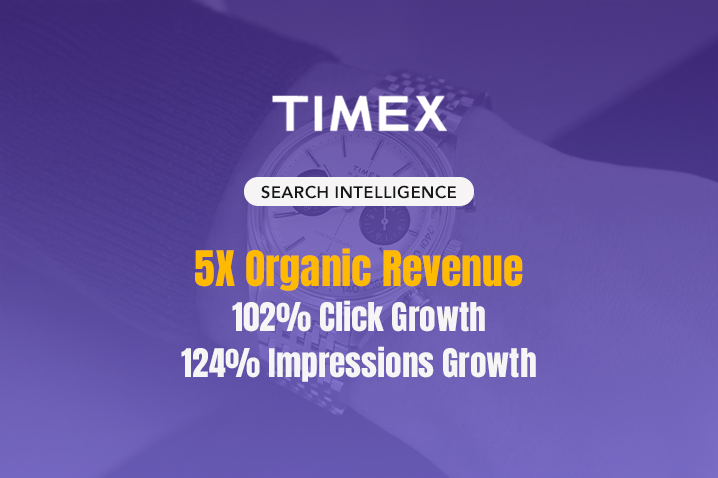
The result across seven months was compounding, not cosmetic: 26% organic traffic growth, 102% growth in organic clicks, 124% growth in organic impressions, and 5X organic revenue growth. That is what happens when Find, Convert and Credit are resourced as one integrated system rather than three disconnected projects.
For a brand facing the newer, AI-driven half of the Find challenge, the same integrated logic produced Kurlon’s 765% growth in AI Overview visibility and 600% increase in brand mentions, a reminder that Find now spans both classic search and generative engines.
Going deeper: The Visibility Hygiene Checklist
Before investing in content or paid media, verify these fundamentals are in place:
- GA4 property configured with correct data streams and conversion events
- Google Search Console verified and sitemap.xml submitted
- robots.txt reviewed not blocking key pages or resources
- Meta pixel and any other ad-platform pixels firing correctly on all key pages
- Schema markup (Organisation, Article, FAQPage, Product as relevant) implemented
- Core Web Vitals reviewed in Search Console, LCP, CLS, INP within green thresholds
- UTM parameters applied consistently across all paid and partnership links
- AI-accessible content audit: do your key pages answer questions directly in plain language?
- Content freshness review: are published dates and facts current?
- Third-party citations: does your brand appear in credible external sources that AI engines can find?
Key takeaways
- The search landscape has bifurcated: traditional SEO and GEO are now distinct but complementary disciplines that must be managed in parallel.
- AI referral traffic is already material, the 693% surge in 2025 (Adobe Analytics) is not a future trend, it is a present commercial reality, and Kurlon’s 765% AI Overview visibility gain shows what capturing it looks like.
- The Find-Convert-Credit Model provides a structured way to audit and improve visibility, UX and measurement as an integrated system, as Timex’s 5X organic revenue growth demonstrates.
- Technical hygiene, i.e., GA4, Search Console, pixels, schema, and sitemap, is the non-negotiable foundation before any content investment makes sense.
- E-E-A-T is not a content style guide; it is an architectural principle that determines whether your brand gets cited by AI systems or ignored by them.
The CXO takeaway
The Find-Convert-Credit Model matters precisely because most brands are optimising one stage in isolation. SEO programmes that generate traffic to experiences that do not convert. UX investments that improve conversion on channels no one can accurately measure. Attribution dashboards that look clean but misclassify an increasing share of AI-driven visits. The compounded cost of these disconnects in wasted budget, in missed revenue, in strategic misdirection is a board-level issue, not a marketing team issue. The CXOs who will gain durable competitive advantage over the next three years are those who treat visibility, experience, and measurement as a single integrated system and resource it accordingly. The window to build that system before AI search behaviour fully matures is open now, but it will not remain open indefinitely.
Frequently Asked Questions
No. SEO optimises for traditional search engine ranking algorithms. GEO optimises for the citation and summarisation logic of AI answer engines. The content and structural requirements overlap significantly but are not identical.
Not necessarily. A well-structured content and technical SEO programme, built around E-E-A-T principles and clear answer-first architecture, serves both channels. The strategic intent should, however, explicitly account for both.
It means being able to answer the question: “Which activity drove which commercial outcome?” That requires a correctly configured GA4 account, consistent UTM tagging, working conversion pixels, and ideally a single attribution dashboard that consolidates organic, paid, AI referral and direct traffic.
AI systems update their training and retrieval indices on varying schedules. Structural changes in schema implementation, authoritative content publication, third-party citation building can begin influencing AI responses within weeks to months. Kurlon’s programme showed material movement across a seven-month window.
An honest visibility audit: run the Hygiene Checklist above, pull a Search Console performance report, and identify the gap between where your content currently ranks and the questions your audience is actually asking. That gap is your strategic brief.