
What this blog covers
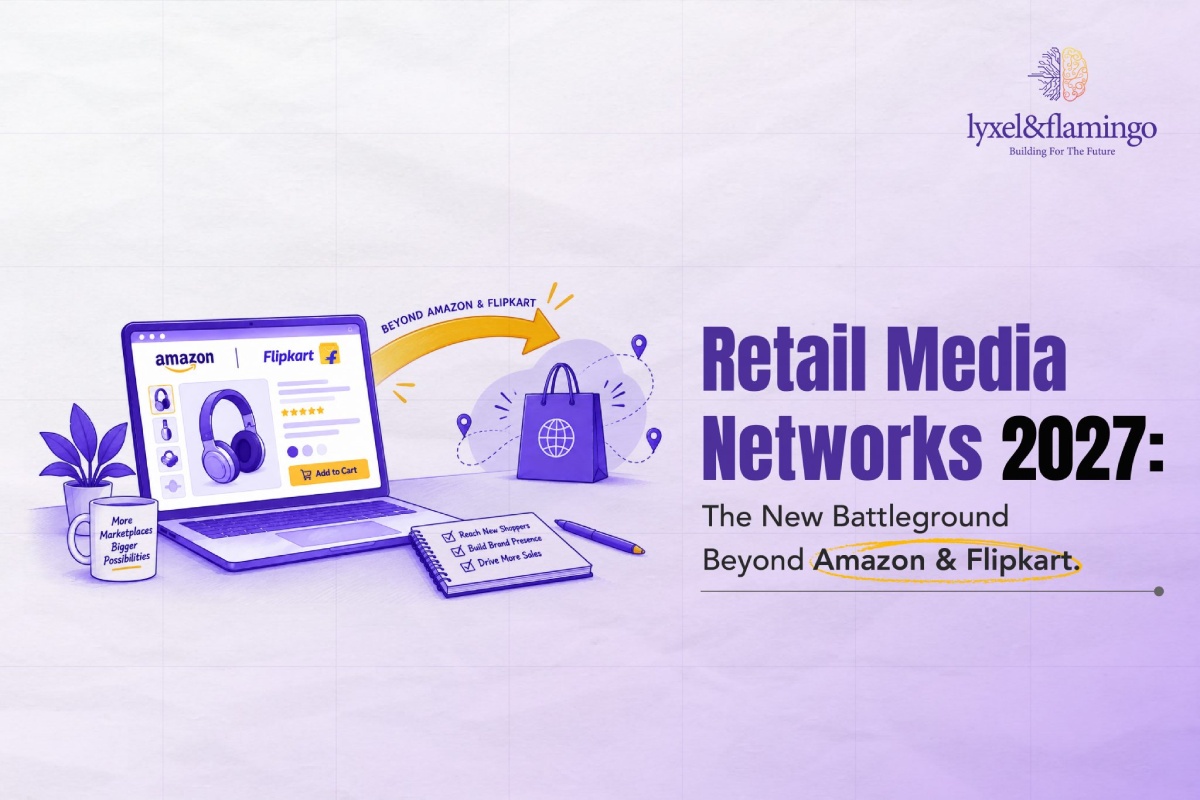
Retail media in India has moved well beyond Amazon and Flipkart, and brands can no longer treat it as a small performance channel. This blog explains how retail media advertising works, why first-party purchase data matters more now, and what is pushing brands toward quick commerce platforms. It covers the country’s major retail media networks, including Zepto, Blinkit, Swiggy Instamart, Nykaa, Meesho, Tata Neu, FirstCry, Myntra and others.
Table of Contents
- What Is Retail Media Advertising?
- Why Retail Media Is Eating Everyone's Ad Budget Currently
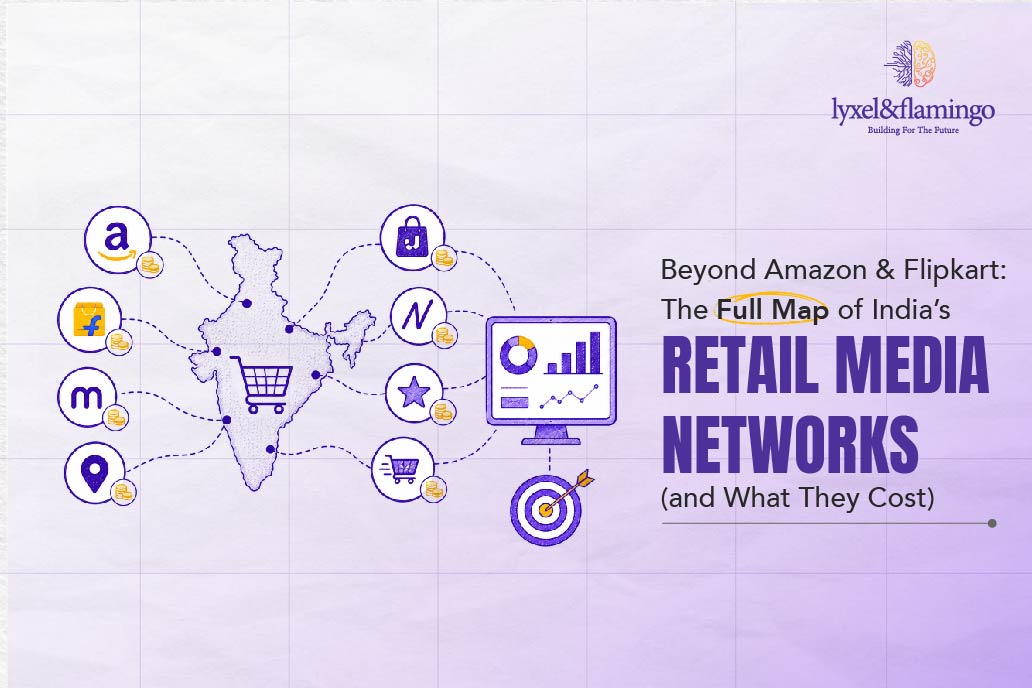
- The Full Map: Every Retail Media Network Worth Knowing in India
- Where Most of Your Budget Should Go: Flipkart, Zepto and Swiggy Instamart
- What It Costs: CPMs, CPCs and the Metrics That Matter
- The Retail Media Sequencing Framework: Lyxel&Flamingo's Playbook for Brands Entering This Market
- Conclusion
It also breaks down platform costs, auction models, CPC benchmarks and the operational challenges of managing campaigns across multiple marketplaces. Instead of chasing every platform together, brands need a better sequence, stronger product listings and one consistent way to measure real returns. Whether you are planning FMCG campaigns or building a broader commerce media strategy, this blog offers practical direction based on current market trends and platform behaviour, not broad assumptions or outdated digital advertising playbooks.
On Google or Meta, ads interrupt people while they scroll, read, or watch something else. Retail media works differently, and that changes everything for brands. Someone searched for atta minutes ago, or opened Zepto because eggs ran out before dinner. The buying intent is already there, not created later. That simple shift pushed retail media into the spotlight across India around 2024. Brands noticed it fast, and many changed where they started spending.
India’s retail media networks are gaining momentum, while the broader advertising market is expected to grow 9.7% in 2026. According to WPP Media’s This Year Next Year (TYNY) forecast, India’s advertising revenue is projected to reach ₹2,01,891 crore in 2026, adding ₹17,844 crore over 2025.
Retail media isn’t a bolt-on ad format anymore. It’s the fastest-growing line item in Indian advertising, and most brand budgets still treat it like an afterthought.
What Is Retail Media Advertising?
Retail media is advertising bought directly on a retailer’s own digital property. Think search results, category pages, checkout screens, even the home feed of an app. Amazon Ads, Flipkart Ads, Blinkit’s Brand Central and Zepto’s ad stack all sit under this umbrella. The retailer sells access to its own shoppers using its own first-party purchase data, and a brand pays to show up right when someone is actively deciding what to buy.
It’s a different animal from a banner on a news site or a video ad on Instagram, because the retailer can tie that ad directly to a completed purchase inside its own systems. No cookie required, no survey, no seven-day modelled guess. That closed loop is exactly what’s pulling ad budgets out of open-web display and into retail media this fast.
Why Retail Media Is Eating Everyone’s Ad Budget Currently
Three factors are pushing this growth, and they are easy to notice now. Brands are following results, not passing trends anymore.
First, first-party data got a lot more valuable the moment third-party cookies started dying. McKinsey’s research on commerce media notes that retailers running their own retail media network are better positioned in a post-cookie world, simply because they own a large, stable base of shoppers and know exactly what those shoppers bought, not just what they clicked on. Google and Meta still have plenty of reach, but neither one carries a receipt to back it up.
Second, retail media makes tracking much clearer than regular display advertising. Brands can see whether someone viewed an ad and later bought the product on that same platform. BCG (Boston Consulting Group) describes this direct link between ads and real sales as the “holy grail of marketing.” There is far less guessing involved. Either the purchase happened there, or it simply did not.
Third, and this is the one FMCG brands feel hardest, their customers moved to quick commerce faster than most category plans accounted for. Britannia told investors on its Q4 FY26 earnings call in May 2026 that nearly 70% of its online business now comes through quick commerce platforms, a figure it expects to climb to 85% as Amazon and Flipkart keep scaling their own rapid delivery arms. When your customer’s shopping trip physically moves apps, your media budget has to move with it.
Scale backs this up from two more directions.
- IBEF projects India’s online shopper base growing from roughly 300 million today to well past 420 million by 2030, and
- Deloitte and FICCI’s PRIME report from August 2025 clocks quick commerce’s growth at 70 to 80% CAGR, the fastest pace anywhere in the world right now.
That’s not a niche channel anymore, it’s where a huge chunk of India’s next shoppers will show up first.
Here’s the tension, though, and it’s the one that shapes everything else in this piece. Brands chasing this shift are now running ads across five or more separate commerce media networks at once, each with its own login, its own auction logic and its own definition of what counts as a “click.” McKinsey found 53% of advertisers used five or more commerce media networks in 2024, up from 38% a year earlier. The market is spreading out fast, not centring around one platform.
The Full Map: Every Retail Media Network Worth Knowing in India
Most marketing conversations about retail media in India start and stop at Amazon, Flipkart and maybe Blinkit. That’s a mistake worth correcting before next year’s budget locks in. India now has more than fifteen retail media networks with genuine scale, and brands sticking to just the big three are leaving reach and often cheaper inventory sitting on the table.
-
Horizontal marketplaces
Amazon and Flipkart remain the two largest retail ad players in the country, per WPP Media’s TYNY report cited above. Both run full-funnel stacks covering search, display and programmatic. Amazon folded its sponsored ads and DSP into a single unified Campaign Manager across Asia Pacific, India included, in late 2025.
Meesho has built a user base of north of 120 million monthly actives on value commerce and is now opening that inventory up to brands and sellers directly. JioMart and AJIO, run by Reliance, blend digital ordering with offline retail reach, and that combination plays especially well outside metro India. Snapdeal, now a pure-value third-party marketplace where almost every product is priced under ₹1,000, is smaller, but it still has tens of millions of monthly users worth knowing about if your brand competes in that price band.
-
Quick commerce
This is where the actual growth is, and where retail media advertising on Indian q-commerce platforms has scaled faster than any other ad format in the country. Quick commerce advertising in India has stopped being a side experiment and turned into the default entry point for most FMCG media plans. Blinkit ads for FMCG brands in India run through Brand Central, Blinkit’s self-serve manager for sponsored search listings, banners, video and dedicated brand shelves, and advertising now makes up close to 15% of Blinkit’s total revenue as quick commerce nears 69% of parent company Eternal’s FY26 revenue.
Zepto and Swiggy Instamart run comparable ad stacks, both covered in more depth just below. Beyond the big three, BB Now, BigBasket’s quick commerce arm under the Tata umbrella, keeps expanding its dark store footprint. Flipkart Minutes has crossed 1,000 micro-fulfilment centres since its August 2024 launch and is targeting 1,500 by the end of 2026. Amazon Now, live in 15-plus cities since launching in 2025, is backed by an investment north of ₹2,800 crore aimed at 100 cities and over 1,000 dark stores. Every one of these is building an ad stack alongside its delivery network, not after it.
-
Vertical specialists
Category-focused platforms often deliver the richest returns per ad rupee because the shoppers arriving there already carry high intent. Nykaa raised its ad and marketing spend 34.5% to nearly ₹995 crore in FY25, and it has leaned hard on Google’s AI-driven Performance Max tools to scale that spend efficiently, a shift Think with Google APAC documented in a dedicated case study. Myntra‘s advertising expense jumped 37% over the same period, and its retail media network now ships self-serve tools and APIs built for agency and adtech integration.
FirstCry owns the parenting and baby category outright, with over a thousand physical stores backing its app. Pepperfry does the same for furniture and home decor.
The super-app and the food delivery wildcard
Tata Neu ties BigBasket, Tata CLiQ, Tata 1mg, Croma and a dozen other Tata properties into one loyalty layer built around NeuCoins, and that gives brands a shot at cross-category reach most single-category platforms simply can’t offer.
Then there’s Zomato, which has expanded well past restaurant ads into CPG categories like beverages, personal care and home care, running banner, short video and gamified scratch-card formats at the exact moment someone’s already hungry, and their guard is down.
Where Most of Your Budget Should Go: Flipkart, Zepto and Swiggy Instamart
These three absorb the bulk of most Indian brands’ retail media spend, for good reason. Here’s how each one really works, not just what the sales deck claims.
Flipkart Ads
A working Flipkart ads strategy for FMCG brands starts with Product Listing Ads, Flipkart’s CPC-driven format that runs a fresh auction every single time a shopper searches or browses. The winner isn’t simply whoever bids highest. Flipkart weighs the bid against a quality score built from product rating, review count, catalogue completeness, image quality and past conversion history, so a listing with 200-plus reviews and a strong rating can beat a higher bid from a thinly reviewed competitor. Product Contextual Ads and Smart ROI campaigns round out the stack for brands chasing placement beyond pure search.
How to win on Flipkart:
- Fix your catalogue before you touch your bids. Quality score moves your CPC more than aggressive bidding ever will.
- Budget for a real break-even, not a hopeful one. Low-margin FMCG typically needs 6 to 8 times ROAS just to cover Flipkart’s fees and cost of goods.
- Feed search term data back into the keyword strategy every week. Start broad to learn what converts, then migrate winners to exact match.
Zepto Ads
The Zepto advertising platform gives brands sponsored product listings and in-app banner placements, and it has grown into a genuinely large business fast. Zepto’s own IPO filing shows advertising revenue jumping 151% to ₹1,636 crore in FY26, up from ₹651 crore a year earlier, with more than 2,400 brand partners now buying ads on the platform. In May 2025, Zepto launched Atom, a tool giving advertisers neighbourhood-level market share data and live sales insight, a level of granularity most Indian retail media networks still don’t offer.
How to win on Zepto:
- Treat dayparting as seriously as bidding. Demand spikes here are sharper and shorter than on a horizontal marketplace, so flat bids waste money outside peak windows.
- Use Atom’s local data to defend the share store by store, not just city by city.
- Expect costs to move faster here than on Flipkart. Rebid weekly, not monthly, and check the data more often than feels necessary.
Swiggy Instamart Ads
Swiggy ads for brands in India run across five formats: homepage banners, inline search results ads, keyword-targeted product placements, category and browsing page placements, and post-purchase ads on the order confirmation screen. Swiggy’s own reporting shows advertising revenue climbing 45% this year over Rs. 1000 crore, with Instamart and in-app placements doing most of that lifting. Instamart’s take rate, the share of order value the platform captures once advertising is folded in, has been climbing toward a steady state of 20 to 22%, per Swiggy’s own investor commentary.
How to win on Swiggy Instamart:
- Don’t skip post-purchase placements just because they feel like an afterthought. They’re cheap relative to search and strong for cross-sell.
- Bid keyword ads around the actual craving, not just the category. “Midnight snacks” converts very differently from “chips” does.
- Watch take rate creep closely. As Swiggy’s monetisation matures, effective costs will likely rise faster than they have over the last two years.
What It Costs: CPMs, CPCs and the Metrics That Matter
Here’s the honest caveat before you look at the table below: almost none of this is CPM at all. Most sponsored product ads on quick commerce in India run on cost-per-click, decided fresh by auction every time, and none of the three big quick commerce players publishes a public rate card. Every figure below is a range reported by media buyers spending real money on these platforms, not a fixed listed price, so treat it as a planning guide and not a quote.
| Platform | Ad Model | Indicative Range | What Moves It |
| Amazon Ads India | CPC | Personal care and beauty run richer, roughly ₹25 to ₹80 per click; grocery and staples run leaner, around ₹6 to ₹18 | Category competitiveness, with ACoS targets typically 25-35% in beauty |
| Flipkart Ads | CPC | Swings sharply by quality score; well-reviewed listings can win at noticeably lower bids | Catalogue quality, category, and seasonal demand |
| Blinkit / Zepto / Swiggy Instamart | CPC with some CPM banners | A wide range depending on category, placement and time slot | Dayparting, commission structure, festive spikes |
The sector rule of thumb holds regardless of platform. High-margin categories like beauty and personal care can absorb rich CPMs because basket size and repeat rate justify it, while grocery and staples need to stay lean or the ad spend eats the entire margin. A Staples brand chasing beauty-category CPCs will lose money even with a perfectly good conversion rate.
There’s a bigger issue here than the raw numbers, though, and it’s the metric brands keep optimising against when they measure retail media ROI across India’s marketplaces. Quick commerce dashboards typically report return on ad spend against gross order value, not the discounted price a shopper paid at checkout, and Instamart’s take rate alone is already trending toward 20 to 22% of order value once advertising gets folded in. That gap between what the dashboard shows and what lands as real margin is exactly where a lot of “great ROAS” campaigns turn out flat, or worse, once commissions and cost of goods are subtracted properly.
The Retail Media Sequencing Framework: Lyxel&Flamingo’s Playbook for Brands Entering This Market
Most brands approach retail media the way performance marketing got approached back in 2015: throw budget at every platform at once and see what sticks. That worked when CPMs were cheap and platforms were few. It does not work across fifteen-plus networks with different auctions, different data and different definitions of a conversion. In our work helping brands sequence spend across marketplaces and quick commerce, six moves consistently separate the campaigns that scale from the ones that just burn budget with little to show for it.
- Sequence, don’t spread. Pick the one or two platforms where your category already over-indexes and win there first, a grocery brand chasing five quick commerce apps at once dilutes both budget and the internal bandwidth needed to manage bids properly.
- Fix the digital shelf before you touch the ad budget. Product images, ratings, review count and catalogue completeness decide your quality score and your CPC, on Flipkart especially. Ad spend on a weak listing is just money spent making a bad page more visible.
- Normalise measurement across platforms before you compare them. Platform-reported ROAS on gross order value is not the same number on Zepto as it is on Amazon. Build one internal true-ROAS calculation, net of commission and cost of goods, and run every platform through that same formula.
- Map ad format to funnel stage, not to whatever inventory happens to be available. Banners and brand shelves build awareness. Search and keyword ads capture intent that already exists. Post-purchase placements drive repeat purchases and cross-sales. Buying only search because it converts best optimises for today’s sale at the cost of tomorrow’s.
- Treat search terms as an SEO engine, not just a bidding list. The keywords converting on Blinkit or Zepto tell you exactly what to fix in your organic listing title and backend search terms too. Most brand teams only ever look at this data inside the ads dashboard and never feed it back into content.
- Account for the cost of complexity, not just the cost per click. Five platforms mean five logins, five reporting formats and five different definitions of a click. That operational overhead carries a real cost even when the CPCs look cheap on paper, and it’s the one line item most brand teams forget to budget for entirely.
Conclusion
None of this is genuinely hard to understand, platform by platform. Flipkart’s auction logic, Zepto’s dayparting quirks, and Swiggy’s post-purchase placements. Each one is learnable in a week. Performance marketing on Swiggy, Zepto and Blinkit looks manageable in isolation. What breaks brand teams is running all of it at once, with five different attribution windows and no single source of truth for what “true ROAS” even means in a given month.
That’s the operational reality we see most often when brands bring us their retail media mix, and it’s rarely a platform problem so much as a coordination problem. A media team built to run one or two big platforms well doesn’t automatically scale to run eight of them well, and bolting on a ninth network without fixing that first just adds more noise to a dashboard nobody fully trusts anymore.
The brands pulling ahead in Indian retail media right now aren’t the ones on the most platforms. They’re the ones with one coherent view of performance across every platform they touch.
If you’re trying to build that view internally, our guide on winning quick commerce funnels across Blinkit, Zepto and Instamart goes deeper on funnel-stage buying, and getting started with Flipkart Ads is a solid next stop for the marketplace side. Or talk to our Commerce Strategy team directly if you’d rather have someone map the sequencing for your category from scratch.
Frequently Asked Questions
Register on each platform's advertiser portal separately, Swiggy Ads Manager for Instamart and the Zepto ads console for Zepto, then run sponsored listings against your highest-intent keywords first. Both platforms need your catalogue and ratings in good shape before ads perform well, so fix listings before you set a budget. Bids are managed separately on each, since neither platform shares data with the other.
Neither platform publishes a public CPM rate card, and most inventory on both sells on a cost-per-click rather than CPM. Amazon's CPCs run roughly ₹6 to ₹18 for grocery and staples and ₹25 to ₹80 for beauty and personal care, while Flipkart's cost depends heavily on your listing's quality score. Treat any fixed CPM figure you find online as a rough guide, never as a firm quote.
Start with one or two platforms where your category already sells well, fix your digital shelf before raising bids, and build a single true-ROAS formula that works across every platform you touch. Map each ad format to a funnel stage instead of buying whatever performs best in isolation this week. The Retail Media Sequencing Framework above walks through this in order, start to finish.
There isn't one clean winner across all three platforms right now. It depends on your category, your margin structure and how well your listing already converts organically before you add ads. Personal care and health brands often see stronger true ROAS on Zepto given its leaner commission range, while Blinkit's larger, more mature user base tends to win on raw volume. Run the same product on two platforms for a full month before committing serious budget to just one.
Most brands underestimate this because they're still comparing it to older open-web display budgets from a few years back. A better starting point is treating retail media as its own dedicated line item, since India's retail media spend is growing faster than digital advertising as a whole right now. Start small on one platform, measure true ROAS with real numbers, and scale only once that figure, not the platform's own dashboard number, looks healthy.