
What this blog covers
E-E-A-T has changed a lot, and Indian brands cannot treat it as another SEO checklist anymore. Google, ChatGPT, Gemini, and other AI search tools now look beyond a brand’s own website before deciding who deserves visibility. Reviews, Reddit discussions, Quora answers, digital PR coverage, and branded mentions carry far more weight than many teams still expect.
Table of Contents
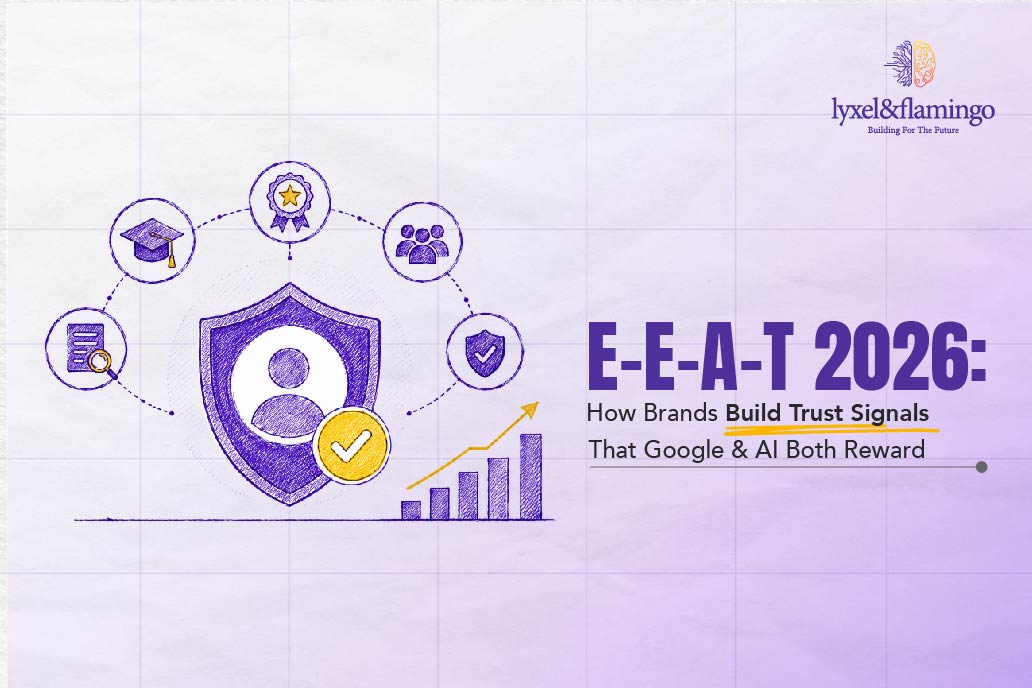
This blog explains why trust signals built outside your website matter just as much as on-page improvements. It also breaks down fresh research, Google’s latest quality guideline updates, and real industry data showing why branded mentions now outperform backlinks for AI visibility.
It also introduces Lyxel&Flamingo’s Trust Surface Stack, a practical framework that connects on-site proof with community trust and reputation management. Brands that start building these signals now will have a stronger chance of earning Google rankings, AI citations, and customer confidence over the coming years.
Branded web mentions now predict whether Google’s AI Overviews cite a brand three times more reliably than backlinks do. The correlation sits at 0.664 for mentions against just 0.218 for traditional backlinks, based on an Ahrefs study spanning 75,000 brands. That single number should worry every Indian brand still treating E-E-A-T as an on-page checklist copied from a 2022 blog post.
Most Indian D2C and B2B marketing teams still read E-E-A-T as an author name, a generic About Us page, and a handful of backlinks bought through a vendor somewhere. That reading was thin even back in 2023, and it is flat-out wrong now. Google’s Search Quality Rater Guidelines added an entire chapter on evaluating AI Overviews in September 2025, and the same proof that convinces a human rater is what now decides whether ChatGPT, Gemini or Perplexity ever say a brand’s name out loud. The part most Indian marketers still miss sits nowhere near their own website. It lives in Reddit threads, Quora answers, digital PR placements, and the reviews nobody on the team has been assigned to manage. Trustworthiness in 2026 gets built mostly off the domain, not on it.
What Is E-E-A-T?
E-E-A-T stands for Experience, Expertise, Authoritativeness and Trustworthiness, the framework Google’s human quality raters use to judge whether a page deserves to rank, and whether it deserves to be believed. Google folded Experience into the older E-A-T model back in December 2022, a change that rewarded people who had lived through the thing they were writing about instead of people who had merely researched it well.
For Indian brands, this matters more in 2026 than it did even twelve months back. Google’s Quality Rater Guidelines now carry a dedicated section on rating AI Overview answers, and every major AI search engine leans on roughly the same underlying logic to decide who gets cited. A brand that fails E-E-A-T does not just slip a few ranking positions on Google. It goes invisible the moment someone asks ChatGPT or Gemini the same question.
Indian Brands Are Still Optimising for Google That No Longer Works Alone
Walk through the SEO checklist most Indian e-commerce or B2B websites still run on, and it reads like something frozen in 2023. Author name added to the blog post. A generic About Us page nobody has touched in years. A pile of backlinks bought through a vendor at some point. That entire checklist assumed one thing above everything else: that Google’s organic results were the only place a buyer went looking for proof before they trusted a brand.
That assumption is breaking apart fast, and the timing could not be worse for Indian brands, since Deloitte’s October 2025 Consumer Products Industry Outlook found global executives now rank India as the second-highest growth priority market worldwide outside North America and Europe, just behind Southeast Asia. New buyers are arriving faster than most brands can build real trust with them.
McKinsey’s August 2025 survey found a brand’s own website now accounts for just 5-10% of the sources AI-powered search cites when answering a buying question, with affiliate content, reviews and community discussion filling most of the rest. Indian brands polishing only their own domain are optimising the smallest slice of what decides whether they get mentioned at all. Worse still, 44% of AI-search users now call it their preferred source of insight, ahead of traditional search at 31% and retailer sites at a distant 9%.
The real problem is not weak content sitting on Indian brand websites. It is a trust footprint that stops at the edge of the domain, in a search landscape where most trust now gets built somewhere else entirely.
The Mechanism: One Signal, Feeding Two Algorithms
Google’s ranking system and the large language models answering questions inside ChatGPT or Perplexity are, in a very practical sense, reading the same underlying proof of trust.
Google’s Helpful Content System and its Quality Rater Guidelines were built to separate real expertise from manufactured expertise, and the September 2025 update added specific criteria for judging AI Overview responses, treating them roughly the way raters already judged featured snippets. Around the same time, AI answer engines started leaning hard on exactly the kind of content Google’s raters were already trained to reward: threads with genuine lived experience, coverage from real journalists, and reviews that read like an actual customer typed them out on a Tuesday night.
This explains why Reddit, licensed to Google for AI training under a reported $60-million-a-year data deal, now accounts for roughly a fifth of citations inside Google’s AI Overviews for social-source queries, per Profound’s analysis of ten million AI citations.
Quora shows a similar pattern on ChatGPT specifically. Brands with meaningful Quora mention volume are up to three times more likely to get cited by the model than brands with almost none.
Neither platform ranks a brand because the brand bought an ad there. They rank threads and answers because real people, arguing with each other in public about which product works, are the closest thing the open web has to unfiltered proof of experience. That is the whole mechanism, in one line. Google and the LLMs are not running two separate trust checks anymore. They are increasingly running one, while most Indian brands still hand the two jobs to two separate interns who never talk to each other.
| Old E-E-A-T Checklist (2022 to 2024) | The 2026 Trust Surface |
| Author name added to the blog | Named author with verifiable credentials and schema markup |
| A generic, static About Us page | Transparent ownership plus consistent brand mentions across trusted third-party publications |
| A handful of purchased backlinks | Digital PR and carefully vetted paid GP placements on real editorial sites |
| Reviews left unmanaged | Active ORM, resolving negative reviews within days, not quarters |
| No presence in communities | Genuine, disclosed presence inside relevant Reddit and Quora threads |
The Evidence: What the Data Shows
- 64% of Indian consumers now use generative AI tools to shop, comparing products and evaluating brands before they buy, one of the highest adoption rates recorded anywhere in the world. This is not a niche behaviour confined to metro-city early adopters anymore.
- A brand’s own website supplies only 5 to 10 per cent of what AI-powered search cites. The rest comes from affiliates, reviews, and community discussion, which the brand rarely controls directly.
- Branded mentions now beat backlinks as a predictor of AI visibility, and by a wide margin. Mentions correlate with AI Overview visibility at 0.664, versus 0.218 for traditional backlinks, across a study spanning 75,000 brands. For teams that spent years chasing link volume, the budget conversation now has to shift toward being talked about, not just linked to.
- India’s online shopper base is set to grow by well over 140 million people this decade, from roughly 280 to 300 million in 2025 to somewhere between 420 and 440 million by 2030, with nearly 45 per cent women and about 30 per cent from rural India already. That is a huge pool of buyers who have never met an Indian brand offline and have no built-in reason to trust it.
The Lyxel&Flamingo Trust Surface Stack
At L&F’s GEO Practice, we stopped treating E-E-A-T as a one-time on-page audit sometime in 2025. What moves both Google rankings and AI citations now sits across four connected layers, and skipping any one of them weakens the other three. We call it the Trust Surface Stack.
- On-Site Proof Layer. Named authors with real, checkable credentials, structured author schema, and content that shows genuine hands-on experience instead of a well-researched summary. This is the layer most agencies still stop at, and by 2026, it is table stakes, not a differentiator anymore.
- Digital PR and Paid GP Layer. Earned coverage on genuine tier-1 and tier-2 Indian business and trade publications, paired with carefully vetted paid guest posting on sites that still have real editorial standards, not link farms dressed up as blogs. This layer produces entity co-occurrence, a brand’s name sitting next to its category inside a publication AI systems already trust, and no volume of on-site content can fake that.
- Community Proof Layer. Structured, honest presence inside relevant Reddit subreddits and Quora spaces, built around genuinely useful answers rather than promotion wearing a disguise. Given that Reddit alone supplies close to a fifth of AI Overview citations for social sources, this layer stops being optional for any brand selling a considered purchase.
- Reputation Shield Layer. Active ORM, meaning review monitoring, prompt response management, and pushing outdated or misleading content off page one of a branded search. This layer protects everything the other three layers spent months building.
In our work across Indian consumer-durables and fintech clients, the Community Proof layer is consistently the most under-invested of the four, and it is also the one that moves AI citation numbers fastest once a brand finally shows up there.
A Real Trust Rebuild: Layer by Layer
A leading Indian consumer-durables brand came to L&F’s GEO Practice with an odd problem sitting on its plate. Its website ranked fine on Google for most category keywords, yet it never once surfaced when a buyer asked ChatGPT or Google’s AI Overview an actual buying-guide question. We ran a full trust surface audit and found almost no Reddit or Quora presence anywhere, a scattered paid guest-posting history full of weak, low-quality placements, and a cluster of three-star reviews sitting untouched on page one of its own branded search.
We rebuilt the stack across two quarters, layer by layer. Digital PR placements landed on established Indian business and consumer-tech publications ahead of the festive buying season. Genuine, clearly disclosed answers went up inside relevant Reddit and Quora threads where buyers were already comparing options with each other. A structured ORM sprint addressed the unresolved reviews and pushed verified, recent feedback well above them.
5 Things to Do This Quarter
- Audit your Reddit and Quora footprint before you write another blog post. Search your brand name plus your top three product categories on both platforms directly. If nothing meaningful shows up, that gap is costing you AI citations today, not at some point down the road.
- Replace scattered paid guest posting with a targeted digital PR calendar. Pick five Indian trade or business publications your actual buyers read regularly, then pitch data-led stories instead of generic guest posts aimed at link farms.
- Fix your worst branded search result this month, not next quarter. If a three-star review or an old complaint thread still sits on page one for your brand name, that single result is quietly shaping what buyers and AI models both believe about you.
- Add named, credentialed authors to your highest-traffic pages first. Start with the ten pages driving the most organic traffic rather than trying to fix the entire site in one sprint.
- Track AI citations the same way you already track keyword rankings. Ask ChatGPT, Gemini and Perplexity your top ten buying-guide queries every month, and log whether your brand shows up in the answer.
Conclusion
E-E-A-T stopped being a Google-only concept sometime around September 2025, whether Indian marketing teams noticed the shift or not. The brands winning both search rankings and AI citations right now are not the ones with the biggest content budgets sitting behind them. They are the ones treating Reddit threads, Quora answers, earned media and honest reviews as core trust infrastructure, not side projects nobody on the team owns.
The brands building this trust surface now are compounding an advantage that gets structurally harder to close with every quarter they wait.
If you want to know exactly where your brand’s trust surface has gaps, book a complimentary GEO and Trust Audit with LyxelFlamingo’s GEO Practice. For more on the ideas covered here, read our guides on what generative engine optimisation means for Indian marketers and why your Google rankings can look fine while your AI visibility quietly disappears.
Frequently Asked Questions
Indian brands need on-site proof, meaning named authors, real experience and structured data, combined with off-site signals like digital PR placements, genuine Reddit and Quora presence, and active review management. Google's 2025 guideline updates weigh all of this, not just what sits on the brand's own domain.
Google's quality raters look for named authors with real, checkable expertise, transparent business information, and evidence that credible outside sources mention or link to the brand. For e-commerce specifically, verified reviews and clear return or refund policies carry real extra weight.
Show it, do not just declare it. Use original photos, specific numbers and first-person detail that only someone who did the work would know. Generic advice with no specific detail reads as researched rather than experienced, to both human raters and AI models.
Yes, arguably more than it affects traditional Google rankings. AI Overviews and tools like ChatGPT pull heavily from third-party mentions and community discussion instead of a brand's own site, so regional brands with a thin off-site presence get skipped entirely, no matter how polished their website looks.
Yes, and arguably more so than for large brands. Big names often get cited on reputation and scale alone. Mid-sized brands need deliberate trust-signal building just to compete for the same AI citations, since they cannot lean on decades of pre-existing recognition to carry them.