
Table of Contents
- Why Decision Friction Is the Real Conversion Barrier
- Personalization at Scale Is Now Expected
- AI UX Across D2C and B2B Journeys
- How Generative AI Is Transforming Interface Design?
- Connecting UX with Marketing and Commerce Systems
- The Measurable Impact of AI-First UX
- Operational Benefits Beyond Conversion
- How Lyxel&Flamingo Builds Conversion-Focused AI UX Systems?
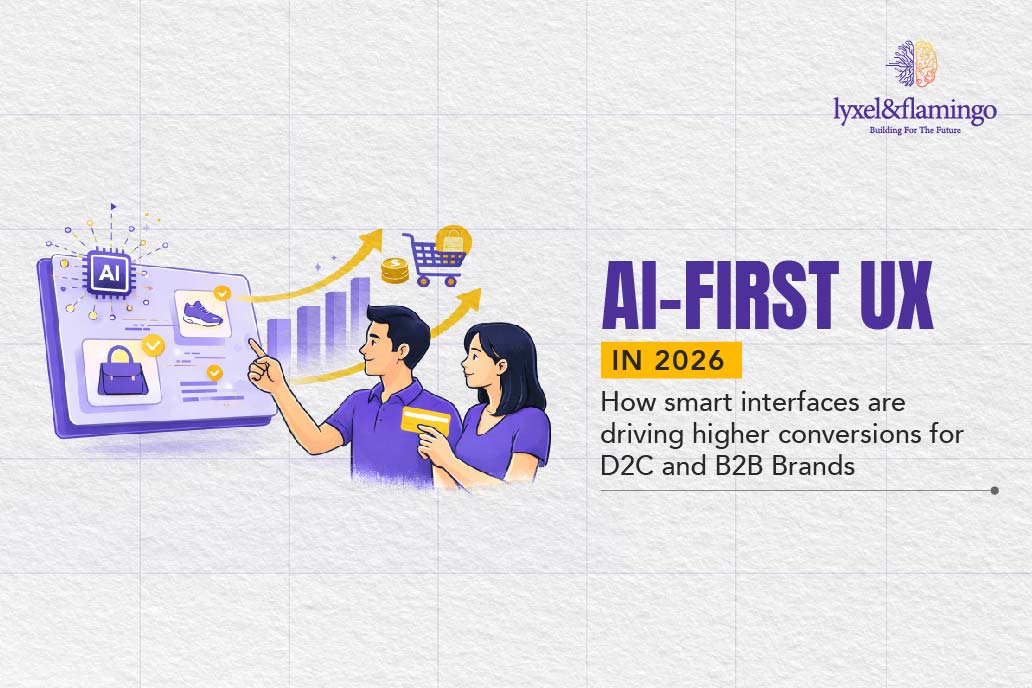
In 2026, user experience is no longer just a design discussion. It has become a conversion strategy.
Digital teams for ages have focused on aesthetics. They aimed for sleek design, quick loading, and a mobile-friendly interface. While these changes improved usability, they didn’t address the main problem that often disrupts digital experiences: decision friction. Users often leave a website, not because of its design, but because it doesn’t help them make clear and confident decisions.
That’s the reason AI-first UX is quickly becoming a key strategic asset for businesses. Rather than relying on static pages and predetermined user paths, companies are now creating intelligent interfaces. These interfaces analyze user behavior, predict needs, and customize interactions in real-time. At Lyxel & Flamingo, we increasingly see brands moving toward these intelligent UX systems to simplify decision-making and improve conversion outcomes across both D2C and B2B environments.
Why Decision Friction Is the Real Conversion Barrier
Most conversion problems do not originate from traffic shortages. They originate from confusion. When visitors encounter unclear navigation, overwhelming product choices, or incomplete information, hesitation appears quickly.
AI-driven UX systems tackle this problem head-on. They analyze behavioral cues, such as browsing patterns, user engagement levels, and search queries. These smart interfaces don’t just offer a one-size-fits-all approach; they tailor both content and navigation to align with the specific goals of individual users.
This is the foundation of AI-driven conversion optimisation, where UX actively guides users toward decisions. Smart interfaces typically reduce friction by:
- Highlighting the most relevant products.
- Simplifying navigation paths.
- Prioritising critical information.
- Reducing unnecessary options.
When users understand what to do next, conversion becomes far more likely.
Personalization at Scale Is Now Expected
Customer expectations have undergone a considerable transformation. Research suggests that around 80% of consumers now lean towards brands that offer personalized experiences. Moreover, more than 90% of consumers choose brands that provide product recommendations tailored to their individual needs.
For platforms experiencing rapid growth, the notion of hand-crafting tailored experiences becomes impractical. Consequently, businesses are turning to structured AI-first UX strategy frameworks, which automate personalization throughout the entirety of a user’s digital journey.
AI-powered personalization systems typically analyze:
- Browsing and search patterns
- Previous purchases
- Engagement signals
- Device and session behavior
These analyses allow interfaces to automatically adjust product recommendations, messages, and navigation, all in an effort to create experiences that feel intuitive, not jarring.
AI UX Across D2C and B2B Journeys
The role of AI-powered UX varies depending on the business model.
AI UX for D2C brands focuses on faster discovery and smoother purchase decisions. E-commerce platforms rely heavily on predictive search systems, recommendation engines, and adaptive landing pages to guide shoppers efficiently.
These enhancements markedly boost the e-commerce experience. Shoppers can quickly find what they need and evaluate their options, avoiding the hassle of a long, drawn-out hunt.
In enterprise environments, AI UX for B2B websites addresses a different challenge: complexity. Business-to-business platforms often involve longer decision-making processes, and many people are involved. AI systems help simplify these processes by highlighting important information and guiding users through a structured evaluation.
How Generative AI Is Transforming Interface Design?
A major transformation in digital experiences is happening, driven by the rise of generative AI in UX design. Instead of building fixed interface structures, design teams are using AI to generate content and layout variations that respond to user interactions.
Generative UX systems enable interfaces to adapt on the fly. Content, messaging, and product layouts can all shift based on how users interact.
These systems support improvements such as:
- Dynamically generated landing page variations.
- Personalized messaging layers.
- Automated UX experimentation.
- Adaptive product content.
A 2025 study found that sales performance boosted 16% through digital experiences driven by artificial intelligence. This highlights the growing importance of using artificial intelligence to improve conversion rates.
Connecting UX with Marketing and Commerce Systems
The impact of AI-driven user experience amplifies significantly when integrated with existing marketing and commerce systems.
User interfaces provide valuable behavioral data. This data is then used to influence marketing strategies, targeting methods, and how products are displayed. Integrating this data into marketing systems allows organizations to improve their marketing automation. Consequently, they can then deliver more relevant messaging across multiple channels.
Improving user journeys directly influences a marketplace’s success. A better user experience often results in:
- Enhanced marketplace seo optimization.
- Improved acos optimization for advertising campaigns.
- Measurable marketing roi improvement through higher conversion efficiency.
That’s precisely why many brands are collaborating with experts such as Lyxel&Flamingo. Our focus is on making sure that any enhancements to the user experience actually lead to measurable improvements in marketing results and the effective implementation of digital growth plans.
The Measurable Impact of AI-First UX
The difference between traditional UX and intelligent UX becomes clear when comparing operational outcomes.
| UX Capability | Traditional UX | AI-First UX |
| Personalization | Static audience segments | Real-time behavioral personalization |
| Product discovery | Manual browsing | Predictive recommendations |
| Decision support | Generic information | Contextual guidance |
| Optimization method | Periodic A/B testing | Continuous AI learning |
| Marketing performance | Channel-based optimization | Unified behavioral intelligence |
Companies implementing AI-first UX frameworks are increasingly seeing improvements in engagement, session depth, and conversion rates.
Operational Benefits Beyond Conversion
The most obvious advantage is the boost in conversions, but an AI-powered user experience also simplifies operations.
Companies leveraging intelligent interfaces frequently see positive outcomes. This translates to fewer customer support requests, simpler browsing through vast product selections, and faster testing of marketing campaigns.
Additional operational advantages include:
- Lower bounce rates.
- Improved session engagement.
- Stronger data insights for marketing teams.
- More efficient product discovery in large catalogs.
These improvements demonstrate how AI-driven UX contributes to long-term digital performance.
How Lyxel&Flamingo Builds Conversion-Focused AI UX Systems?
At Lyxel&Flamingo, UX is treated as a performance framework rather than a visual design exercise. The process begins with identifying friction points within digital journeys and analyzing how users interact with platforms across different stages of the funnel.
Using behavioral insights, Lyxel&Flamingo builds structured AI-first UX strategy systems that improve clarity, navigation intelligence, and decision confidence. For e-commerce brands, this often includes advanced PDP optimization combined with intelligent product recommendation engines to strengthen AI UX for e-commerce experiences.
Lyxel&Flamingo crafts AI-driven user experiences for B2B websites, helping companies clarify intricate data structures. We also blend UX research with larger growth strategies, including marketing automation integration.
This approach ensures that user behavior data directly supports campaign performance and marketplace strategies.
Conclusion
The evolution of digital experience is no longer about design improvements alone. It is about intelligence.
AI is reshaping the way we find, assess, and ultimately buy things. It’s making these steps more efficient and tailoring them to individual preferences. This shift is exactly why AI-powered conversion optimization has become a key driver of expansion for businesses today. User experience is now a key factor in driving success.
As the digital landscape becomes increasingly cutthroat, businesses that prioritize AI-powered user experiences for direct-to-consumer brands, B2B websites, and adaptable interface designs are poised to shape the future of successful digital platforms.
For brands, partnering with experienced digital transformation teams such as Lyxel&Flamingo helps accelerate this shift toward intelligent, conversion-focused user experiences.
Frequently Asked Questions
AI-First UX uses artificial intelligence to shape and improve user experiences in real-time. This approach streamlines the customer experience, offering brands a more direct route to boosting their conversion rates.
AI analyzes user behavior to deliver relevant content, smarter recommendations, and faster decision paths, which helps companies increase conversion rates across websites and apps.
Lyxel&Flamingo frequently uses AI recommendation systems, predictive search tools, behavioral analytics platforms, and generative AI design systems to enhance their personalization efforts.
Smart interfaces customize both what you see and how you move through it, all based on what you want to achieve. As a result, the experiences become more relevant and engaging.
Behavioral data, user experience testing, and AI-powered personalization are all essential. Seamless integration with marketing and analytics platforms is equally important.