
What this blog covers
What an AI search visibility programme is actually made of, which cost lines are fixed and which scale, what the tracking tools genuinely cost, and why the price of covering four engines is not four times the price of covering one.
Table of Contents
What does AI search optimisation cost cover?
An AI search optimisation budget covers five distinct cost lines: measurement, technical and entity foundations, content restructuring, earned third-party credibility, and original data. Only the third of those resembles conventional content marketing, and in most programmes it is not the largest.
Understanding the split matters because the lines behave differently. Two are close to fixed regardless of ambition. Two scale with the number of engines, markets and languages in scope. One is a discretionary investment that produces disproportionate returns when a brand can afford it. A quote that does not distinguish between them is difficult to compare against anything.
Why nobody publishes a number
Two reasons, and only one of them is defensible.
The defensible reason is that the work genuinely does not have a single price. A programme covering one engine, one market and one language for a brand with clean entity data and a consolidated site is a fraction of the cost of the same programme across four engines, two markets, two languages and a catalogue with hundreds of competing pages. Those are different products sharing a name.
The less defensible reason is that opacity protects margin. In a survey of Indian agencies publishing AI search services, a small minority state any pricing at all. That opacity has a cost of its own: it makes the category harder to buy, slows budget approval, and leaves finance teams treating the whole line as speculative.
A brand that cannot describe what it is buying cannot defend the budget when it is challenged, which is why most AI visibility pilots are cut in their second quarter rather than their fourth. The purpose of a cost breakdown is not to compare quotes on price. It is to give the person defending the budget something concrete to defend.
The five things you are actually paying for
The measurement layer is the smallest line and the easiest to price, because the tools publish their rates. As of August 2026, published list pricing puts Ahrefs Brand Radar at around fifty to seven hundred US dollars a month depending on tier, Profound from around a hundred to four hundred on annual billing, Semrush’s AI visibility toolkit from around two hundred to five hundred and fifty, and Otterly from around thirty to five hundred with Gemini and AI Mode tracking sold as paid add-ons. Their methodologies differ materially: some model visibility from synthetic prompt sets, others from real user prompts or from question data with actual search volume, which matters more than the price difference between them.
The technical and entity layer is largely fixed and largely front-loaded. Schema deployment, entity consistency across properties, crawlability for AI user agents, page consolidation where multiple pages compete for one question. This work happens once properly and is maintained cheaply thereafter.
Content restructuring scales with the size of the existing library rather than with the number of engines. Rewriting openings so the answer appears in the first fifty words, shaping headings as buyer questions, building question-and-answer modules, retiring or merging cannibalising pages. A brand with forty priority pages and a brand with four hundred are not in the same conversation.
Earned third-party credibility is usually the largest line and the one most frequently under-scoped. Independent mentions in trade press, review platforms, expert commentary, and credible reference sources are what move a brand from a single unverified voice to category consensus. This is relationship and outreach work with a long cycle, and it cannot be compressed by spending more in a single month.
Original data is discretionary and disproportionately effective. Research, proprietary benchmarks, and first-hand findings are cited by AI systems because they exist nowhere else, and they earn the external references that the credibility line otherwise has to buy one at a time.
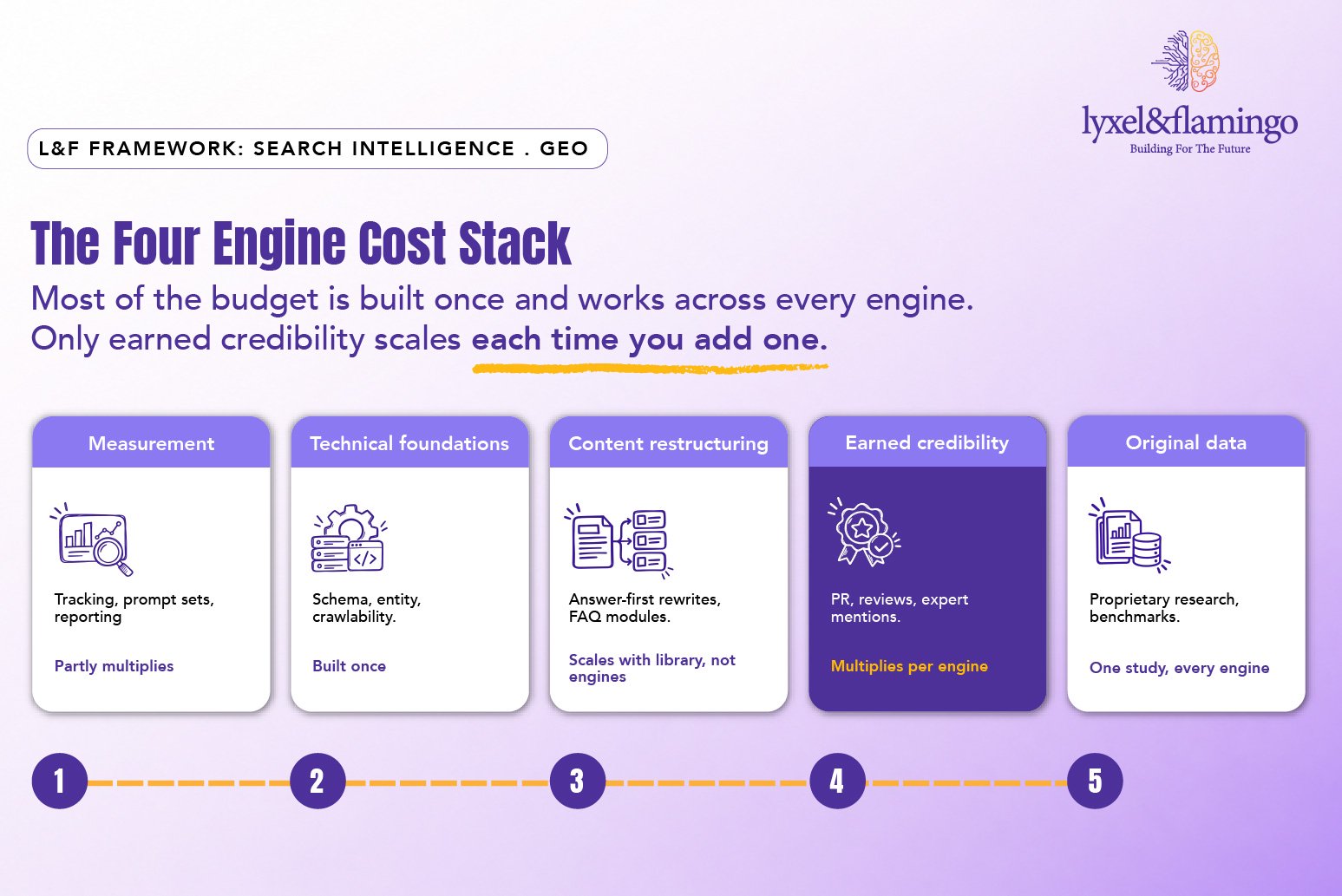
Framework: The Four-Engine Cost Stack
Our Search Intelligence practice scopes AI visibility across five lines, and tells clients which of them multiply when engines are added and which do not. We call it the Four-Engine Cost Stack.
Read the third column carefully. Three of the five lines are close to engine-agnostic. Adding a second engine does not double the budget; it increases one line substantially and leaves the others largely intact.
Indicative INR bands by scope and company stage: [to be completed by Lyxel&Flamingo commercial team before publication].
The stack explained
The reason four engines do not cost four times one is that most of the work is shared.
Schema, entity accuracy, page consolidation and answer-first structure serve every retrieval system at once. A study published openly is retrievable by all of them. What genuinely differs per engine is the fourth line, because each engine draws from its own pool of trusted external sources. A programme that adds engines is mainly adding outreach targets rather than rebuilding foundations.
That said, the fourth line is the expensive one, which is why the honest version of an expansion conversation is uncomfortable. Adding an engine means identifying where that engine sources its category answers and earning presence there, which is slower and less predictable than publishing. Agencies that quote engine expansion as a small uplift are usually pricing lines one to three and quietly under-resourcing line four.
The measurement line deserves specific attention because it is where scope creep is easiest to hide. These systems are non-deterministic, and a single run of a prompt set captures noise alongside signal. A programme priced for one measurement run a month is priced for a number that cannot be trusted. Ask how many runs per engine per cycle the quote assumes, and whether variance is reported alongside the average.
On team structure, the evidence points one way. Minuttia’s 2026 survey found only 9.2 per cent of organisations had a dedicated AEO specialist, with 52.8 per cent assigning the work to the existing search team (Minuttia, 2026). Semrush’s 2026 index found integrated search and AI teams reporting an eighty-one per cent success rate against thirty-six per cent for siloed ones. Budgeting this as a separate function with a separate supplier tends to cost more and perform worse than resourcing it inside the existing search programme.
Real-world scenario: Airtel Payments Bank
Airtel Payments Bank arrived with a problem that no amount of content spend would have solved, which is why it is a useful illustration of where budget belongs.
Key payment pages had been removed without forwarding signals, leaving years of accumulated ranking authority unattached to anything. Core banking pages carried thin metadata and content aimed at the wrong queries, so the brand was effectively invisible for savings accounts, FASTag and fixed deposits despite substantial brand equity.
The programme weighted lines two and three heavily. More than 280 high-value keywords were mapped across four service pillars representing roughly three million monthly searches in India. Deleted pages were restored with forwarding signals and redirect chains repaired, rebuilding crawlability end to end. Meta titles, headings, and schema were rewritten across core banking pages. Off-page work added high-authority submissions and presence on community platforms including Reddit and Quora, which is line four.
Across four months, measured through Google Search Console:
- 39.4% growth in total clicks.
- 167% lift in generic, non-brand click-through rate.
- Average ranking position improved from 14.1 to 6.3.
- 73% growth in generic clicks.
- 23.6% growth in impressions.
Almost none of that came from publishing new articles. The budget went into foundations and architecture, which is the pattern in most programmes where the brand already has equity and the problem is retrievability rather than reputation.
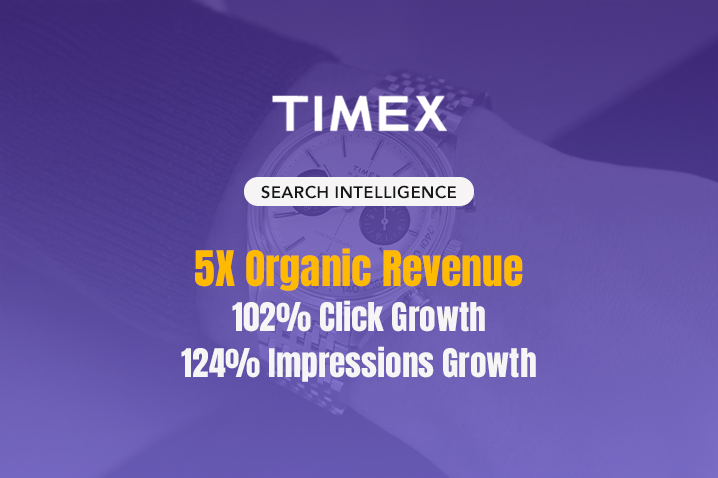
Read the full Airtel Payments Bank case study, or the Timex programme where the same foundations work produced 5X organic revenue.
Airtel Payments Bank x Lyxel&Flamingo, Search Intelligence Practice, June to October 2025.
Going deeper: scoping your own programme
Answer these before requesting a quote. They determine the number more than anything a supplier will ask you.
- How many engines are genuinely in scope, and can you name why each one matters to your buyers?
- How many markets and languages? Each additional language multiplies the measurement and content lines.
- How many priority pages does your existing library contain, and how many of them compete with each other for the same question?
- Is your entity data currently consistent across your website, business profiles, and third-party listings? If not, budget for that before anything else.
- How many independent sources have mentioned your brand in the last twelve months? A short list means line four is your constraint.
- Do you hold data nobody else has? If so, publishing it is likely your cheapest route to credibility.
- How many measurement runs per engine per month does the quote assume, and does it report variance?
- Will this sit inside the existing search team or alongside it? The evidence favours inside.
Key takeaways
- Around 40 per cent of organisations running AEO have no dedicated budget, and about half plan to create one within twelve months (Minuttia, 2026), so most budgets are being set without reference points.
- An AI visibility budget contains five lines: measurement, technical and entity foundations, content restructuring, earned third-party credibility, and original data. Only one of them is conventional content work.
- Three of the five lines are engine-agnostic. Adding an engine mainly expands earned credibility work rather than rebuilding foundations, so four engines do not cost four times one.
- Tracking tools are publicly priced and are the smallest line. Their differing methodologies matter more than their price difference.
- Only 9.2 per cent of organisations have a dedicated AEO specialist, and integrated teams report 81 per cent success against 36 per cent for siloed ones (Minuttia and Semrush, 2026). Resourcing this inside the existing search team usually costs less and performs better.
The CXO takeaway
The budget conversation goes wrong in a predictable way. The board asks what AI visibility will cost, the answer arrives as a single monthly figure, and nobody can say what would change if that figure were halved or doubled. Six months later the programme is cut because it produced a dashboard rather than a decision.
The version that survives scrutiny separates the five lines and states which of them the organisation is choosing not to fund this year. A brand may reasonably decide to build foundations and measurement now, defer original research, and add a second engine in the following year. That is a defensible plan. A single undifferentiated retainer with no breakdown is not, however competent the team delivering it.
Most of what determines whether a brand is cited by AI systems is built once and serves every engine, which means the expensive decision is not how much to spend but how long to keep spending before the compounding starts. The brands that hold position three years from now will be the ones whose finance teams understood the shape of the investment well enough to keep funding it through the quarters where nothing visible happened.
Frequently Asked Questions
It varies by scope rather than by a standard rate, because the work spans five distinct cost lines that scale differently. The largest variables are the number of engines, markets and languages in scope, the size of the existing content library, and how much independent third-party credibility the brand already holds. Ask any supplier to price those lines separately.
No. Three of the five cost lines - technical foundations, content restructuring and original data - serve every engine at once. Only earned third-party credibility scales meaningfully per engine, because each engine draws from a different pool of external sources. It is the largest line, so expansion is not free, but it is a long way from four times.
As of August 2026, published rates run roughly from fifty to seven hundred US dollars a month for Ahrefs Brand Radar, a hundred to four hundred for Profound on annual billing, two hundred to five hundred and fifty for Semrush's AI visibility toolkit, and thirty to five hundred for Otterly with Gemini and AI Mode as paid add-ons. Methodology differs significantly between them and matters more than price.
The evidence favours integration. Minuttia's 2026 survey found only 9.2 per cent of organisations had a dedicated specialist, with the majority assigning it to the existing search team, and Semrush found integrated teams reporting an 81 per cent success rate against 36 per cent for siloed ones. Capability matters more than a separate supplier.
Structural changes such as schema and content restructuring can begin influencing AI responses within weeks. Earned third-party credibility runs longer. Programmes we run typically show material movement across a six to nine month window, and budgets cut at three months rarely reach the point where the work compounds.
Publishing something only you know. Original data, benchmarks or first-hand findings are cited because they exist nowhere else, and they earn the external references that would otherwise have to be pursued one at a time. For most brands it is the highest return per rupee in the whole stack.