
What this blog covers
This blog explains why a strong B2B omnichannel marketing strategy depends more on consistency than on adding new channels. Today’s buyers move across paid ads, email, sales calls, websites, and many other touchpoints before making a decision. The real problem starts when every team shares a different message. Buyers notice those gaps, and trust drops much faster than most companies expect. The article explores why disconnected ownership, separate goals, and isolated tools create this issue. It also uses recent industry research to show how inconsistent messaging affects supplier selection and revenue growth. Readers will find a practical five-layer continuity framework that helps marketing and sales work from one shared narrative instead of separate campaigns.
Table of Contents
- What Is a B2B Omnichannel Marketing Strategy?
- One Buyer – Three Different Versions of Your Brand
- What Breaks When You Add a Tenth Channel?
- Five Data Points That Confirm the Pattern
- The Lyxel&Flamingo Ten-Touchpoint Continuity Stack
- Where the Consistency Payoff Shows Up First
- 5 Things to Do Before Your Next Campaign Touches a Tenth Channel
- Conclusion: A B2B Omnichannel Marketing Strategy Beats a Bigger Channel List Every Time
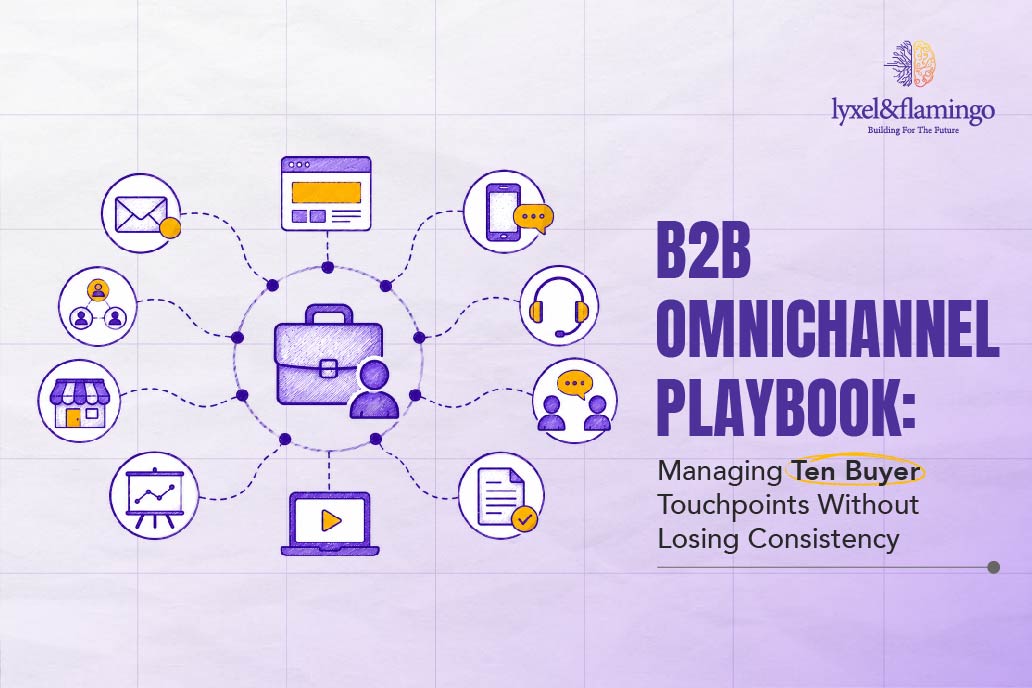
The blog finishes with simple actions businesses can take before expanding into another channel. Better coordination across existing touchpoints often delivers stronger results than opening new ones without fixing the experience buyers already receive.
The average B2B buyer now moves through ten separate channels before committing to a vendor, according to McKinsey’s 2026 Global B2B Pulse Survey, which polled nearly 4,000 decision makers across 13 countries. That number alone changes what a working B2B omnichannel marketing strategy needs to account for. What matters even more is a second finding from the same research: for the first time, the top reason B2B buyers switch suppliers isn’t price or product fit, it’s inconsistent information passed between teams. A buyer who leaves because your paid ads, your sales deck, and your account manager told three different versions of the same story was never really a targeting problem, and that’s exactly why continuity has to come before channel count in any real Full Funnel Marketing approach.
Most B2B marketing teams still plan channel by channel, though. Paid media belongs to one owner, account-based marketing touchpoints answer to another, and the sales sequence lives inside a CRM that nobody outside the sales team ever opens. Ten touchpoints, run by five or six teams, telling one buyer five or six slightly different versions of the same pitch. That’s the gap this playbook is built to close. Not by adding more channels. By governing the ones already in place.
What Is a B2B Omnichannel Marketing Strategy?
A B2B omnichannel marketing strategy is the practice of coordinating every buyer-facing channel, paid, organic, email, sales outreach, events, and self-serve, around one shared account view and one consistent narrative, instead of running each channel as its own campaign. It differs from an older multichannel B2B sales strategy, where channels run in parallel without sharing data or messaging back and forth. Think of it as the backbone of any true omnichannel customer journey B2B buyers experience today: one thread instead of ten disconnected ones.
It matters right now because the buyer side of this equation has already changed. McKinsey’s research shows buyers treat omnichannel as the baseline, not a bonus, and they switch suppliers who can’t deliver it. Any credible B2B customer experience strategy built this year has to assume a buyer already crossed half your channels before a rep even knows the account exists. And any omnichannel commerce for B2B brands approach now has to treat the online store, the distributor, and the sales team as one system, not three departments separately competing for the same order.
One Buyer – Three Different Versions of Your Brand
A paid search campaign brings one lead. Marketing sends a generic email without matching earlier promises. LinkedIn messaging tells a different story. Then sales pitches something else during the call. Procurement ends up seeing mixed claims. One brand, but the experience feels confusing and disconnected.
This happens in many B2B companies, not only a few. Every team works with its own goals and priorities. Marketing, sales, and digital channels keep saying different things. Nobody checks if the message stays consistent. The brand looks scattered, and buyers notice those gaps pretty fast. Bain & Company’s 2026 B2B Growth Agenda, a survey of more than 1,100 senior executives across 18 industries, found that only 4% of B2B companies report having a value proposition that’s clearly defined and consistently understood across their own teams. The other 96% are, in some form, running the scenario above right now.
The real problem was never how many touchpoints a buyer crosses. It’s how many different versions of the truth they hear along the way.
Want to know why enterprises keep losing repeat buyers even with a full retention program already in place? Read this blog: Cohort-Based Marketing: The Customer Retention Strategy Enterprises Are Still Getting Wrong
What Breaks When You Add a Tenth Channel?
Every new customer touchpoint usually gets handled by a different team. Each team follows its own tools and targets. Paid social focuses on lead costs. Sales wants more meetings booked. Content teams chase website traffic. Nobody really tracks whether buyers get the same message everywhere. Because of that, every team improves its own numbers, while the overall customer experience keeps becoming disconnected without anyone noticing it. Each channel gets better locally, while the whole system becomes more fragmented. That’s less a strategy failure than an incentive design failure.
It gets more complicated because buyers aren’t moving through channels in a straight line anymore. McKinsey’s 2026 Pulse data splits B2B buyers into three groups:
- Adapters, who default to trusted reps and familiar processes
- Seekers, who expect every channel to feel like one integrated system and switch fast when it doesn’t, and
- Innovators, who test new tools early and expect suppliers to match their pace. Most accounts contain all three types at once, sometimes inside the same buying committee. A single-channel-optimised program cannot serve all three well, because each one is testing a different part of the experience for cracks.
Gartner’s own May 2026 research adds another layer. 69% of B2B buyers say they still validate AI-generated research with a human sales rep before acting on it, drawing on an average of seven information sources per purchase. That means your digital research phase and your human sales phase are being compared against each other, live, inside the same deal. If those two don’t agree, the buyer notices fast.
Five Data Points That Confirm the Pattern
None of this is a hunch. It shows up consistently across separate research from firms that don’t talk to each other.
B2B buyers now cross an average of ten channels before committing to a supplier, and inconsistent information across teams has overtaken poor digital experience as the top reason they switch. For any brand still treating its channels as separate campaigns, that is the exact failure point being measured.
A typical B2B buying decision now involves 13 internal stakeholders and nine external influencers, a number that climbs further for complex or high-value purchases. Every one of those 22-plus people can hit a different touchpoint, at a different time, carrying a different message.
Only 4% of B2B executives say their organisation has a value proposition that’s clearly defined and consistently understood, yet the companies that do achieved 19% revenue growth in 2025 versus 12% for everyone else. Consistency isn’t a nice-to-have layered on top of growth. It behaves like a growth mechanism in its own right.
B2B suppliers with high digital-commerce maturity beat their annual sales targets by a 110% greater margin than low-maturity competitors. Maturity here means integrated channels and shared front-office data across omnichannel commerce for B2B brands, not simply having more channels open at once.
97% of B2B marketers now call original, expert-led content critical to their funnel, and research-backed content consistently outperforms AI-generated content for building buyer trust. A consistent narrative needs consistent proof behind it, not just consistent tone.
Curious how much B2B buying has already shifted to marketplaces instead of your own sales team? Read this blog: The Rise of Online Marketplaces: A Digital Revolution Reshaping
The Lyxel&Flamingo Ten-Touchpoint Continuity Stack
At Lyxel&Flamingo, we stopped asking clients which channels they were missing. What predicts whether an enterprise omnichannel strategy holds together is something less obvious: what happens in the space between the channels a company already runs. So we built a five-layer model around that question, and we call it the Ten-Touchpoint Continuity Stack.
- Narrative Anchor. One short, internal document defining the value proposition, the proof points, and the exact language every channel is allowed to use. Not a brand guideline nobody reads, a working reference sales and marketing both open before writing anything.
- Account Signal Layer. A shared record, CRM plus CDP, visible to every team touching an account, so a rep isn’t cold-pitching someone who already downloaded three whitepapers last month.
- Sequencing Logic. Explicit rules for which touchpoint fires when, and who owns triggering it. Skip this and five teams end up contacting the same buyer in the same week with zero coordination between them.
- Human Handoff Points. Defined moments where self-serve research is meant to end and a person takes over. Given how many buyers now double-check AI research with a rep, this handoff needs to be designed on purpose, not left to chance.
- Attribution Feedback Loop. A way to see which touchpoints influenced the deal, not just which one closed it. In our work with mid-sized B2B clients, this layer is consistently the most skipped, and the one that unlocks the clearest budget reallocation once it finally gets built.
That’s buyer touchpoints management treated as a discipline instead of a channel checklist, and it’s the difference between an omnichannel plan that looks good on a slide and one a buyer feels while living inside it.
Wondering whether your website is pulling its weight as a real B2B channel, or just taking up space as a placeholder? Read this blog: Your Website Is a Growth Engine, Not a Line Item: A CXO’s Guide to Web ROI
Where the Consistency Payoff Shows Up First
We don’t have a single named B2B case study to drop in here with a tidy percentage next to it, and we’d rather say that plainly than invent one. What we can share is the pattern we consistently see across Full Funnel Marketing engagements with B2B and BFSI-adjacent clients: accounts that stall mid-pipeline are rarely the ones missing a channel. They’re the ones where the paid team, the content team, and the sales team can’t point to the same one-page narrative when asked what the brand is claiming.
When a client fixes the Narrative Anchor and Account Signal layers first, the pattern that follows is faster deal velocity through the middle of the funnel, not a flood of new top-of-funnel leads. That tracks with what Deloitte found at industry scale: the gains from digital commerce maturity come from beating sales targets by a wider margin, not from generating more raw traffic. It’s a consistency dividend, and it tends to show up in the accounts already sitting in your pipeline before it shows up in new ones.
5 Things to Do Before Your Next Campaign Touches a Tenth Channel
- Write the one-page narrative document before the media plan, not after. If sales, content, and paid can’t each recite the same three proof points from memory, fix that before spending another rupee on a new channel.
- Audit for B2B marketing consistency across channels using one real buyer, not a dashboard. Pull the actual emails, ad creative, and sales deck a single named account received over the last 60 days and read them back to back.
- Give every touchpoint a trigger and an owner, not just a budget line. Vague ownership is exactly how five teams end up emailing the same procurement lead in the same week without knowing it.
- Score your B2B lead nurturing touchpoints by influence, not last click. A whitepaper download three months before close usually matters more to the outcome than the demo request that gets all the credit.
- Build one explicit handoff moment from self-serve research to a human rep. Don’t leave it to chance, not when this many buyers are already double-checking digital research with a person before they decide.
Conclusion: A B2B Omnichannel Marketing Strategy Beats a Bigger Channel List Every Time
Buyers already told us what they want: one coherent experience, delivered through whichever ten channels they personally choose to use. The B2B brands pulling ahead right now aren’t the ones with the most touchpoints. They’re the ones where every touchpoint agrees with every other one. That gap compounds over time. A brand that fixes its narrative and account-data layer this quarter will look meaningfully more trustworthy by the next one, while a competitor still running ten disconnected campaigns falls further behind with every new channel it bolts on.
If you’re not sure where your own channels disagree with each other, that’s usually the fastest place to start looking. Talk to Lyxel&Flamingo’s Full Funnel Marketing team about a consistency audit before your next campaign launch.
Frequently Asked Questions
It's the coordination of every buyer-facing channel, paid media, content, email, events, and sales outreach, around one shared account view and one consistent message. The goal isn't more channels. It's one experience that happens to run across several of them.
Multichannel means you're present across several channels that mostly run independently of each other. Omnichannel means those channels share data and messaging, so a buyer's activity on one shows up and gets used on the next. Most companies are multichannel and assume they're already omnichannel.
Around ten, on average, according to McKinsey's 2026 Global B2B Pulse Survey. That number climbs higher for complex or high-value purchases, especially once a buying committee of Forrester's reported size, 13 internal and nine external stakeholders, gets involved in the decision.
Start with a shared account record every team can see, then map which stakeholder saw which message and when. Without that visibility, it's nearly impossible to stop two people on your own team from contradicting each other inside the same account.
Yes, arguably more so than for large enterprises, since mid-sized teams run leaner and can't absorb the cost of a deal lost to contradictory messaging. Start with the narrative and account-data layers before adding new channels. That order matters more than the size of the budget.