
What this blog covers
There is a persistent myth that the homepage is a website’s busiest most important page so it gets loaded with every message and judged on conversion. It usually isn’t the busiest page at all; category and product pages are. This blog reframes the homepage around the job it genuinely does best brand credibility, positioning and routing, and gives CXOs a way to brief and measure it correctly.
Table of Contents
What is a homepage ?
A homepage is your brand’s credibility and positioning hub-the front door where a visitor decides whether you are worth trusting and considering and the routing layer that sends people to the pages that actually carry your traffic and conversions: category or product-listing pages (PLPs) and product-detail pages (PDPs). It is rarely the most-visited page on a site. It is almost always the most brand defining one. Confusing those two facts is where most homepage briefs go wrong.
Why this matters now
Search engines and paid campaigns increasingly drop visitors straight onto deep pages. Someone searching “running shoes for flat feet” lands on a category or product page, not your homepage. The Nielsen Norman Group notes that category and listing pages drive the majority of an ecommerce site’s traffic apart from the homepage, and that for large sites the homepage can receive only a small fraction of visits. So briefing the homepage as your traffic and conversion workhorse is optimising the wrong page.
Here is the nuance that matters for brand leaders: the homepage punches far above its traffic weight because the people who do visit it are disproportionately high-value. They are comparison shoppers validating a shortlist, returning customers, prospects referred by a friend or an ad, and the partners, press, investors and talent who look you up. That is the brand-credibility stage of the journey, and it is decided in seconds.
Which is why the fundamentals still bite: 53% of mobile visitors leave if a page takes longer than three seconds to load, and a 0.1-second speed improvement can lift conversions by 8.4% (Deloitte/Google, 2020). The homepage is not where most of your traffic arrives; it is where much of your brand is judged.
The real pain points
- The homepage is asked to do everything: Every team adds its message and its CTA, and it is expected to be the primary conversion page-a job that actually belongs to PLPs, PDPs and dedicated landing pages.
- It is measured on the wrong KPIs: Judged on raw sessions, bounce rate and on-page conversion, its true value-brand credibility and routing stays invisible, so it gets “optimised” in the wrong direction.
- Brand and credibility are under-invested: Teams chase conversion tactics, the homepage ends up generic, and it fails the very visitors who came specifically to decide whether to trust the brand.
- Paid traffic is pointed at the homepage: Sending campaign clicks to the homepage instead of a dedicated, message-matched landing page dilutes performance and wastes spend.
- The pages that carry the load are neglected: PLPs and PDPs, which actually attract the traffic and do the converting get less attention than the homepage that does neither.
- It is left to go stale: Returning and referred visitors, the homepage’s core audience, see credentials, offers and a brand story frozen a few years in the past.
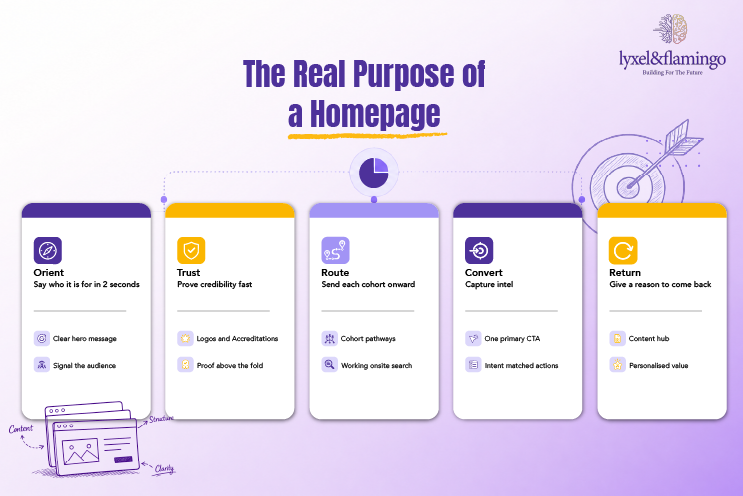
Framework: The 5 Jobs of a Homepage
Brief the homepage against the five jobs it is genuinely built to do-credibility and routing, not traffic capture and direct conversion.
1. Position
2. Build Credibility
3. Tell the Brand Story
4. Route to Conversion
5. Reassure and Return
The framework explained
1. Position: In the first few seconds, confirm who you are and who you serve. A visitor who arrives from a recommendation or an ad is asking “Am I in the right place?” Answer that question with a clear value proposition and an unmistakable signal of your primary audience. This is orientation, not a sales pitch.
2. Build Credibility: This is the homepage’s signature job and the reason it matters despite modest traffic. Accreditations, recognisable client or partner logos, verifiable proof and outcomes placed high, not buried in the footer, do the work that reviews do on a product page. For the comparison shopper deciding between you and a rival, this is where the decision tilts.
3. Tell the Brand Story: Say why you, not them. The homepage is where distinctive brand assets and a clear point of difference build the mental availability that makes all your downstream marketing cheaper. A product page sells the product; the homepage sells the reason to prefer your brand at all.
4. Route to Conversion: The homepage’s conversion job is to hand off, not to close. Its success is measured by how efficiently it routes each visitor to the pages that actually convert your PLPs, PDPs, service pages and contact pages supported by genuinely useful on-site search. Treat it as an intelligent junction, not the destination.
5. Reassure and Return: Because returning and referred visitors are a core part of homepage traffic, it must reassure people who already know you and give them a reason to come back fresh content, current offers and new proof. A homepage that never changes tells your most loyal audience that the brand has stopped moving.
Real-world scenario: Medanta (and the D2C parallel)
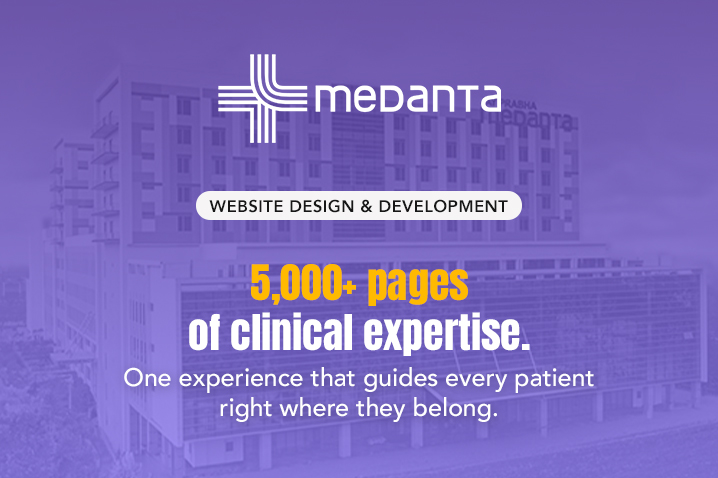
When Lyxel&Flamingo built the website for Medanta, one of India’s leading hospital networks, the homepage was never the highest-traffic page-patients arrive on deep condition, speciality and doctor pages that rank for what they actually search. The homepage’s job was different and harder: establish credibility instantly (a Newsweek World’s Best Hospitals brand, shown through accreditations and specialist proof) and act as an intelligent router into more than 5,000 pages so patients, carers and clinicians each reach the right place fast. Credibility plus routing, not traffic capture, was the brief.
The same logic holds for a D2C store. The homepage builds the brand and points people to the category and product pages, but it is the PLP and PDP that carry the traffic and do the converting. Judging a D2C homepage by its own conversion rate misreads its role entirely; its contribution shows up in brand perception, in the quality of the visitors it forwards, and in the performance of the storefront as a whole.
Going deeper: Measure your homepage by the right KPIs
Stop grading the homepage as if it were a landing page. Grade it on the jobs it actually does.
Credibility (Is it building trust?)
- Brand and branded-search lift over time.
- Engagement from returning visitors (they came to re-validate, not to be sold).
- Scroll and attention on credibility elements (accreditations, proof and outcomes).
Routing (Is it sending people onward well?)
- Click-through rate from the homepage to PLPs, PDPs, service and contact pages.
- On-site search usage and success rate.
- Next-page depth and paths for each primary cohort.
Assisted Role (What part does it play in journeys?)
- Assisted conversions where the homepage appears in the user journey.
- Performance of returning and referred visitor segments specifically.
Fundamentals and Freshness
- Mobile load time under three seconds.
- Homepage refreshed at least quarterly with current proof, offers and brand story.
If you only measure on-page conversion rate, you will conclude the homepage is “underperforming” and optimise away the exact things, credibility and routing, that make it valuable.
Key Takeaways
- The homepage is rarely a site’s highest-traffic page; category/listing pages and PDPs usually are (Nielsen Norman Group).
- Its real purpose is brand credibility, positioning and routing the stage where high-value visitors decide whether to trust and consider your brand.
- Brief it against five jobs: Position, Build Credibility, Tell the Brand Story, Route to Conversion, and Reassure and Return.
- Its conversion job is to hand off visitors to PLPs and PDPs, not to be the conversion page, so don’t judge it on on-page conversion rate.
- Measure it on credibility, routing effectiveness and assisted conversions, keep it fast and refresh it quarterly.
Closing Thoughts
The homepage’s importance was never about traffic; it was always about trust. It is the one page where a prospect who has heard your name, a customer deciding whether to return, or a partner sizing you up forms a fast, durable judgement of your brand.
Load it with conversion tactics and grade it like a landing page, and you will systematically dismantle the very thing it is for. Brief it as your credibility and routing hub, let your PLPs and PDPs do the heavy lifting they are built for, and the homepage will quietly do the most valuable job on your website:making the brand worth choosing.
Frequently Asked Questions
A full redesign is typically warranted every two to three years, or when there is a significant shift in brand positioning, audience, or product portfolio. However, strategic updates - refreshed case studies, new partner logos, updated metrics, revised CTAs - should happen quarterly. A homepage that never changes tells returning visitors that the brand is standing still.
It depends on your primary conversion goal and the dominant intent of your visitor cohort. For a diagnostics or healthcare brand, it is often “Book Now” or “Find a Test.” For a B2B technology brand, it is more likely “Request a Demo” or “Talk to Us.” The mistake is using a generic CTA - “Learn More” - that routes nobody to anything.
Significantly. Visitors who use on-site search convert at materially higher rates than those who browse, because search signals active intent. A homepage that surfaces a prominent, well-tuned search bar - as L&F built for Medanta - effectively turns every visitor into a self-qualifying lead.
Should a homepage be different for mobile and desktop? A: Not different in content, but different in layout, hierarchy, and interaction design. What works as a rich, multi-column desktop experience should be reimagined - not reflowed - for mobile. The fold is shorter, thumbs replace cursors, and patience is measurably thinner. Mobile-first design means briefing for mobile first and adapting upward, not designing for desktop and compressing downward.
By traffic, yes - for most brands. But strategic importance and traffic volume are not the same thing. In SEO-mature sites, deep content pages - condition pages, product pages, service pages - may carry more commercial intent than the homepage. The homepage’s unique importance is as the brand’s first impression and routing mechanism; it sets the frame within which every other page operates.