
What This Blog Covers
Feature comparisons between Shopify and Shopify Plus are useful, yet incomplete; they describe what changes without answering when the upgrade is actually worth the additional cost. This blog reframes the decision around payback timing instead, using O3+’s zero-downtime migration to a custom Shopify storefront serving both professional salon partners and direct-to-consumer customers as a reference point for what the upgrade needs to deliver to justify itself, and when in a brand’s growth curve that calculation typically flips.
Quick Answer: The Shopify Plus upgrade pays for itself when the operational cost of staying on standard Shopify, checkout customization workarounds, API rate-limit constraints, multi-channel complexity, exceeds the additional platform cost. This typically happens for brands managing multiple distinct customer segments or sales channels (like O3+ serving both salon partners and D2C customers), brands hitting API or app-integration limits that slow operations, or brands whose checkout needs exceed what standard Shopify’s customization allows. Below that complexity threshold, the upgrade is a cost without a corresponding operational return yet.
Table of Contents
- Why a Feature Table Does Not Answer the Real Question
- The Complexity Threshold That Actually Triggers the Upgrade
- What Multi-Channel or Multi-Segment Complexity Looks Like in Practice
- Checkout Customization: When Standard Shopify Genuinely Runs Out
- Measuring Payback, Not Just Comparing Features
- Signs You Are Past the Threshold Already
- Framework Explained
- Key Takeaways
- CXO Takeaway
Why a Feature Table Does Not Answer the Real Question
A feature comparison tells a brand what Shopify Plus offers that standard Shopify does not. It does not tell that brand whether their specific operational situation actually needs those features enough to justify the cost difference, which is a fundamentally different question than a side-by-side capability list can answer. Shopify’s own Plus overview still leads with the feature list, which is useful context, just not the decision-making framework a CFO actually needs. Shopify’s own help documentation on choosing a plan has the same gap, it explains what each tier includes without ever asking what a specific brand’s operations actually cost today.
The more useful framing asks what specific operational friction the brand is currently experiencing on standard Shopify, and whether Shopify Plus’s capabilities would genuinely resolve that friction in a way that pays back the additional investment, rather than simply offering more headroom the brand is not yet using.
The Complexity Threshold That Actually Triggers the Upgrade
The upgrade tends to pay for itself once a brand’s operational complexity crosses a specific threshold: managing genuinely distinct customer segments with different needs, hitting real API or integration constraints that slow day-to-day operations, or requiring checkout customization that standard Shopify’s app-based workarounds cannot cleanly deliver.
Below that threshold, a brand is paying for headroom it is not using yet, which is a legitimate strategic bet on future growth, a different decision than paying for capability that is solving a problem today. For more context, read Why Are Global Brands Moving to Shopify Plus for Scale, Security & Automation?
What Multi-Channel or Multi-Segment Complexity Looks Like in Practice
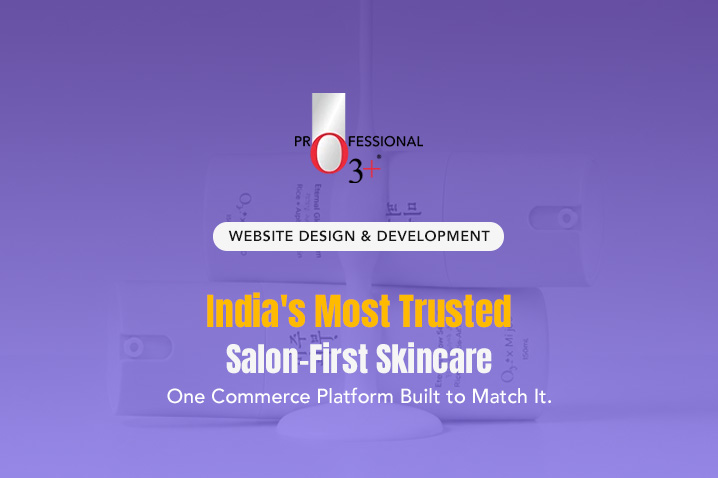
O3+’s Shopify migration and website development project needed to serve two genuinely distinct audiences, professional salon partners with over 10,000 relationships and a growing direct-to-consumer retail channel, across India and neighboring markets, without those two segments creating operational conflict or a degraded experience for either one.
This kind of multi-segment complexity is exactly the scenario where Shopify Plus’s additional flexibility starts to pay for itself: the platform needs to support meaningfully different customer journeys, potentially different pricing or ordering logic, and scale across markets simultaneously, capability that becomes genuinely necessary rather than simply nice to have.
Checkout Customization: When Standard Shopify Genuinely Runs Out
Standard Shopify’s checkout customization is more limited than what Shopify Plus allows, and for many brands this limitation is invisible because their checkout needs are straightforward enough that the standard platform never becomes a constraint. For brands with complex logic, salon-partner pricing structures, multi-step B2B-style ordering, or heavily customized promotional logic, standard Shopify’s checkout constraints become a real operational bottleneck. This gap is widening further with checkout.liquid sunsetting: the customization that used to be possible with workarounds on standard Shopify is narrowing even more as Shopify moves every merchant toward its newer extensibility model. See Lyxel&Flamingo’s Shopify Plus migration checklist for related migration considerations.
O3+’s migration specifically addressed this by streamlining checkout into a 3-step process that reduced cart abandonment while accommodating the brand’s dual-audience complexity, a level of customization that reflects exactly the kind of checkout flexibility the upgrade is meant to unlock. Read the full O3+ case study.
Measuring Payback, Not Just Comparing Features
Rather than asking “what does Shopify Plus offer,” a brand evaluating the upgrade should ask what specific operational cost it is currently absorbing on standard Shopify, developer hours spent on checkout workarounds, lost conversion from a suboptimal multi-segment experience, operational friction from API constraints, and estimate whether the platform cost difference is smaller or larger than that ongoing cost.
This reframes the decision from a feature checklist into an actual payback calculation, which is the version of the question that a CFO or founder evaluating the upgrade decision actually needs answered.
Signs You Are Past the Threshold Already
A brand is likely past the threshold when developer time is regularly spent working around standard Shopify’s limitations rather than building new capability, when distinct customer segments are being served through compromises rather than genuinely tailored experiences, or when growth into new markets or channels is being delayed by platform constraints rather than business readiness. That symptom is exactly what a Shopify development and technical assessment is built to surface: a store carrying 30 or 40 apps to patch gaps standard Shopify can’t close natively.
O3+’s zero-downtime migration and 10,000-plus salon-partner scale illustrate what the upgrade needs to deliver once a brand has crossed this threshold: not just more features, a platform that actually removes the operational friction that was previously the real cost of staying on standard Shopify.
Framework Explained
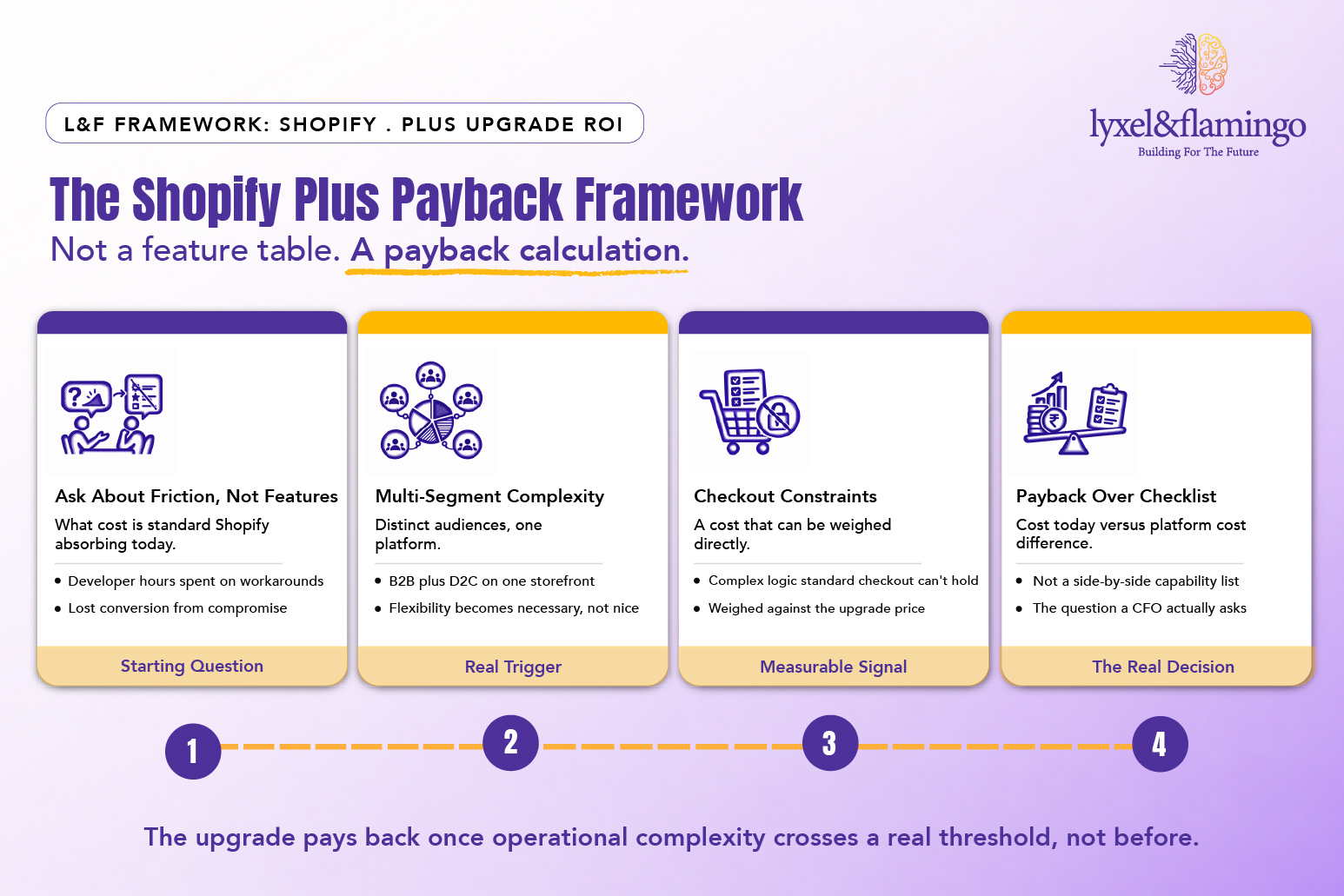
- Ask about friction, not features: the useful question is what operational cost the brand is absorbing today, not what capability the upgrade adds in the abstract.
- Multi-segment complexity is a real trigger: serving genuinely distinct audiences, like O3+’s salon partners and D2C customers, is exactly where the upgrade starts to pay for itself.
- Checkout constraints are a measurable signal: when standard Shopify’s checkout customization limits are actively costing conversions, that cost can be weighed directly against the upgrade price.
- Payback beats a feature checklist: compare the platform cost difference against the ongoing operational cost of staying on standard Shopify, not against a list of capabilities in isolation.
✓ CLIENT PROOF POINT O3+ executed a zero-downtime migration to a custom Shopify storefront serving both 10,000+ professional salon partners and a growing D2C channel across India and neighboring markets, with a streamlined 3-step checkout that reduced cart abandonment. The migration illustrates exactly the multi-segment, checkout-complexity threshold where the Shopify Plus upgrade begins to pay for itself. Read the full O3+ case study.
Artize Luxury Bathware’s website project with Lyxel&Flamingo and Pizza Pizza Mexico’s website design and development project show the same threshold playing out in retail and multi-location food service, operational complexity, not revenue alone, is what decides when a platform upgrade actually pays back.
Key Takeaways
- A feature comparison between Shopify and Shopify Plus does not answer whether the upgrade pays back for a specific brand’s operational situation.
- The upgrade tends to justify itself once a brand crosses a complexity threshold: multiple distinct customer segments, real API constraints, or checkout needs standard Shopify cannot cleanly support.
- O3+’s dual-audience, multi-market operation is a clear example of the multi-segment complexity where Shopify Plus’s flexibility becomes genuinely necessary rather than simply available.
- The right evaluation question is a payback calculation, current operational cost versus platform cost difference, not a side-by-side feature checklist.
CXO Takeaway
The question worth asking before approving the Shopify Plus upgrade is not “what extra features do we get.” It is: what is standard Shopify’s current limitation actually costing us in developer time, conversion, or delayed growth, and does that cost exceed the upgrade price?
O3+’s migration paid back specifically because the brand had crossed the multi-segment, checkout-complexity threshold where the upgrade solves a real, measurable problem.
If you are evaluating this upgrade without a clear payback calculation, Lyxel&Flamingo’s Shopify development team can help quantify your current operational cost and determine whether you have actually crossed the threshold.
Frequently Asked Questions
Revenue and order volume are indicators, not the determining factor on their own. Operational complexity, distinct customer segments, checkout needs, API usage, is a more reliable signal than scale alone, since a smaller brand with complex needs can hit the threshold before a larger, simpler one does.
App-based workarounds can address some checkout limitations. They add cost, complexity, and potential reliability risk of their own. For genuinely complex checkout logic, native Shopify Plus customization tends to be more stable than stacking multiple apps to approximate the same result.
This depends heavily on existing complexity, data volume, and integration needs, similar to any platform migration. A brand already on standard Shopify generally has a shorter migration path than one moving from an entirely different platform.
It can be, as a deliberate strategic bet. That is a different decision than a payback-driven upgrade. Brands making this choice should be explicit that they are paying for future headroom, not solving a current operational problem.