

Blog Summary
During the festive season, every brand in a category floods the same ad auctions at the same time, and the cost of being seen climbs sharply. Left unmanaged, a brand can spend far more to win the same visibility and watch its return on ad spend quietly collapse at the exact moment volume is highest. Defending ROAS through the festive bidding war is a discipline of its own, and this is the playbook for holding efficiency when everyone else is bidding up.
Table of Contents
- The auction everyone crowds into at once
- What defending ROAS actually means
- Bid discipline: knowing where to stop
- Dayparting: spending into the hours that convert
- SKU priority: backing the heroes
- Brand defence: holding your own ground first
- Defending festive ROAS
- What efficiency looked like
- The question to sit with
- Closing
The auction everyone crowds into at once
For most of the year, a brand’s ad auctions are relatively calm. During festive, that calm disappears. Every competitor in the category turns its budgets up in the same weeks, chasing the same shoppers through the same placements, and the price of winning a click or a top slot climbs with the crowd. The visibility a brand bought comfortably in August now costs materially more in October, and a plan that simply keeps bidding to stay seen watches its efficiency erode even as its spend rises. The auction did not change its rules. It just filled up.
This is the festive bidding war, and it is where a lot of festive profit quietly leaks away. The brands that come through it well are not the ones who outspent the crowd. They are the ones who defended their return with discipline while everyone around them was bidding on instinct.
What defending ROAS actually means
Return on ad spend is the revenue a brand earns for every rupee of advertising, and defending it through festive means protecting that ratio while the cost of visibility climbs, spending where the return still holds and refusing to spend where it no longer does. It is not about spending less; volume matters in festive, and under-spending cedes the season to a competitor. It is about spending with discipline, so a brand grows its festive sales without letting the rising cost of the auction hollow out the profit underneath. This is the performance edge of the broader shift to retail media, felt at its sharpest when the whole market bids at once.
Bid discipline: knowing where to stop
The first lever is the hardest: knowing where the return stops justifying the bid. As auction prices climb, there is a point on every placement beyond which a brand is paying more for a click than the sale behind it is worth, and the discipline is to cap there rather than chase the slot on principle. This is where many brands lose the season: they treat a top position as a trophy and keep bidding for it past the point of profit. Defending ROAS means being willing to lose a placement that has become too expensive to win, and moving that budget to one that still pays.
Dayparting: spending into the hours that convert
The second lever is timing. Festive demand does not arrive evenly; it concentrates in particular hours and particular days, and spend that runs flat across the clock wastes budget in the quiet windows to fund the busy ones poorly. Dayparting – shaping spend towards the hours when shoppers actually convert and easing off when they do not stretches the same budget further and protects efficiency without sacrificing the peaks. In a crowded auction, when a brand spends can matter as much as how much.
SKU priority: backing the heroes
The third lever is focus. Not every product deserves festive spend, and spreading budget evenly across a catalogue during the most expensive auction of the year is a quiet way to erode return. The discipline is to back the hero SKUs that carry the volume and convert efficiently, and to starve the slow movers that would only bid up cost without returning it. Concentrated spend on the products that work holds ROAS far better than thin spend spread across products that do not.
Brand defence: holding your own ground first
The fourth lever is order of priority. In a crowded festive auction, it is usually cheaper and more efficient to hold a brand’s own ground in its branded terms and with existing shoppers, where intent is already high, than to chase expensive new-customer placements against the full weight of competitors. Securing the efficient, defensible demand first, and treating aggressive expansion as what a brand does with the margin that discipline creates, keeps the overall return intact. Defence before offence is not timidity; in a bidding war, it is how efficiency survives.
Defending festive ROAS
Held together, defending festive ROAS runs on four levers: bid discipline that knows where to stop, dayparting that spends into the hours that convert, SKU priority that backs the heroes, and brand defence that holds the efficient ground first. None of them is exotic. What makes them work is applying them together, and applying them before the auction heats up rather than in a panic once the return has already slipped.
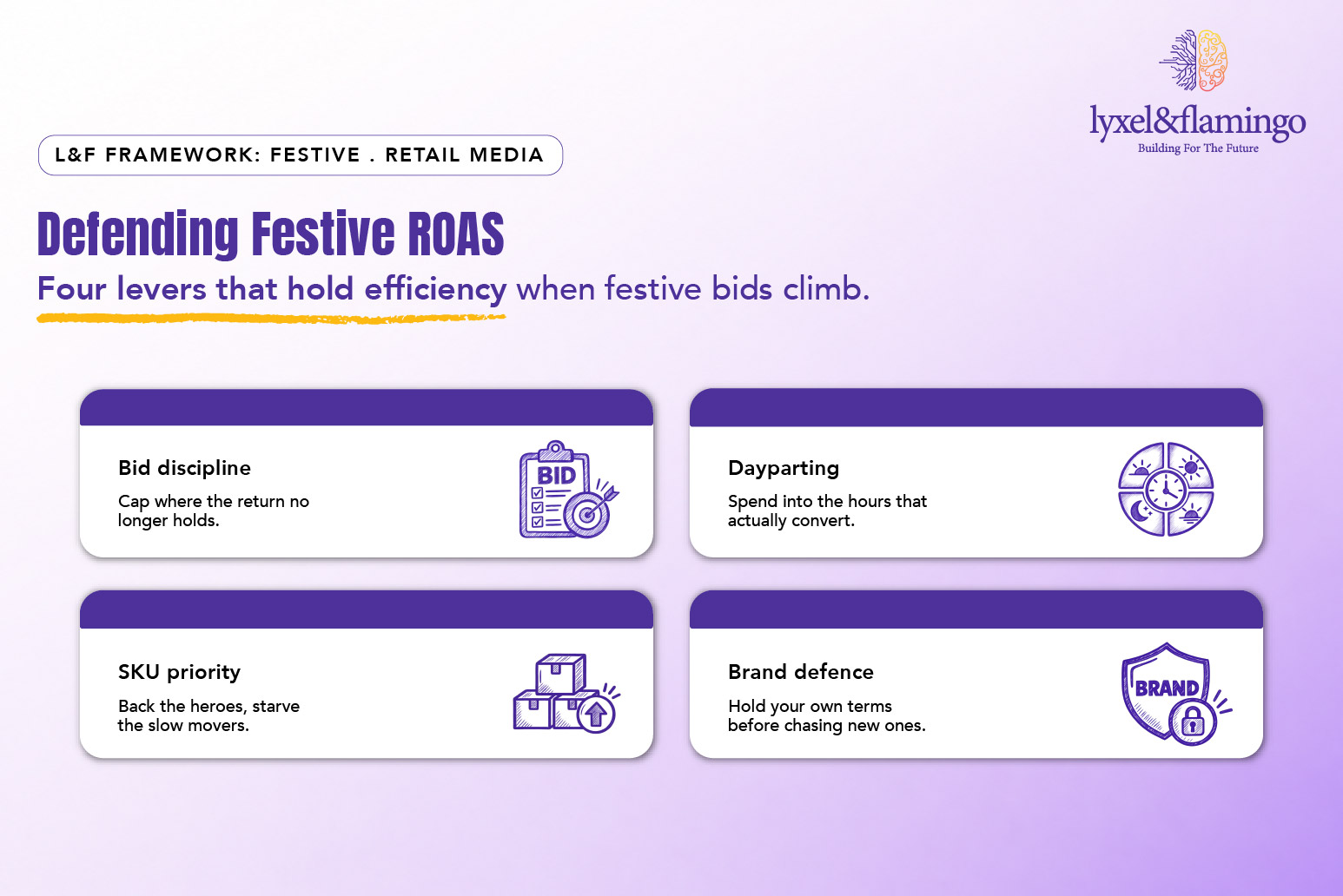
Defending Festive ROAS: four levers that hold efficiency when festive bids climb.
What efficiency looked like
The pattern is not theoretical. Working with Gits Food Products through the festive Rakshabandhan window a short, fiercely competitive sale the goal was to grow hard without letting festive costs erode profit. The disciplined approach lifted return on ad spend by 53% and cut cost per acquisition by 25%, while the brand grew to roughly five times its usual run-rate and outpaced its category’s GMV by about 25%. The campaign later took a Silver at the e4M Performance Marketing Awards 2025. The growth counted precisely because the efficiency held. We shared the full story on LinkedIn.
The question to sit with
It is tempting to judge a festive campaign by how much visibility it won. The sharper judge is what that visibility cost, and whether the return survived the auction. So the question worth carrying into the season is not whether your brand can stay seen through the festive bidding war. It is whether it can stay seen without letting the rising cost of being seen quietly spend away the profit the season was supposed to deliver.
Closing
Defending efficiency through the festive auction is a discipline, and it is one Lyxel&Flamingo runs alongside brand teams every season. If you would like a clear read on where your festive spend is at risk of outrunning its return, our marketplace team can pressure-test your bidding plan and show you where to hold the line. Start that conversation with us whenever you are ready.
Frequently Asked Questions
Because every brand bids at once, so the cost of the same visibility climbs. Festive ROAS falls when rising auction costs are left unmanaged, as brands pay more for the same clicks and slots.
With bid discipline, dayparting, SKU focus and defending their own ground first. Festive ROAS is defended by spending where the return still holds and refusing to bid past the point of profit.
No, under-spending cedes the season; the answer is spending with discipline. Defending ROAS is about spending efficiently, not spending less, since volume still matters in festive.
Chasing a top slot past the point where its return justifies the bid. The commonest festive error is treating a top ad position as a trophy and bidding for it beyond profitability.