
What this blog covers
Most CRM journeys still follow a calendar. A customer abandons a cart, waits a day, receives an email, then gets another message three days later. The problem is simple: customer behaviour keeps changing while the journey stays fixed. This blog explains how an AI-driven CRM can change that approach by reading signals such as browsing activity, cart actions, support interactions, app sessions and recent purchases before deciding what should happen next. It introduces Lyxel&Flamingo’s Signal Continuity Loop, built around three stages: capturing useful signals, scoring customer intent and adapting the response. The blog also looks at 2026 industry data, showing the growing gap between AI experiments and scaled deployments. A Kimirica retention program provides a practical example, with improvements across ROAS, retention, revenue, orders and click-through rates. The blog ends with five practical changes brands can make before their next CRM campaign, without replacing their existing platforms.
Table of Contents
A customer abandoning a cart at 11 PM and another comparing three competitor prices for two weeks should not receive the same follow-up journey. Yet many CRM setups still send identical emails on day three and day seven, regardless of what the customer did before leaving. The problem isn’t a lack of data. Brands already collect browsing activity, cart events, support interactions, app opens, and purchase history.
The problem starts when teams treat those signals as decoration instead of using them to change the customer journey. We’ve seen this across D2C, retail, and hospitality brands in India. Engagement drops first, then retention starts flattening despite higher acquisition spend. Static journeys can’t respond to customers whose intent keeps changing. That’s automation, not personalisation.
What Is an AI-Driven CRM?
An AI-driven CRM is a customer relationship system where machine learning models continuously read behavioural, transactional, and contextual signals to decide what a customer sees next, rather than following a pre-set calendar of touchpoints. Unlike a traditional CRM, which stores customer data for marketers to segment manually, an AI-driven CRM actively predicts the next best action and adjusts message timing, channel, and content in real time.
This matters now because the gap between reactive scheduling and adaptive response is the real differentiator in retention performance, not the channel mix or the creative quality most brands still obsess over.
The Problem With “Personalisation” as Most Brands Practice It
Only 41% of AI deployments inside customer-facing functions had fully scaled as of mid-2026, according to McKinsey’s July 2026 analysis on rewiring customer experience for the agentic era. Most brands are stuck in pilot mode, running AI on top of journeys that were never built to consume its output.
Most teams built their CRM logic around campaign calendars first, then bolted personalisation tokens (first name, last purchase category) onto emails that would have gone out regardless. That’s reversed. The signal should decide whether a message goes out at all, and what it says, not just whose name appears in the subject line.
Static drip sequences optimise for consistency, but retention rewards responsiveness, and those two goals pull in opposite directions. An AI marketing automation strategy built around fixed calendars will keep losing to one built around live signal, no matter how good the copywriting gets.
Why Drip Logic Breaks: The Mechanism
A traditional drip sequence runs on trigger-plus-timer logic. Someone abandons a cart, a timer starts, an email fires at hour 24, another at hour 72. The trigger matters, the timer doesn’t adapt to anything that happens after it starts.
An AI lifecycle automation engine works differently. It treats every subsequent action, opening the follow-up email, ignoring it, visiting a competitor site if that signal is available, browsing a different category, as a fresh input that can override the original timer. Think of it less like a scheduled train and more like a GPS recalculating a route the moment traffic conditions change, not one that just announces the next station regardless of what’s happening on the road.
BCG’s May 2026 research on the new rules of customer experience frames this as the shift from episodic engagement to what they call a “Live Layer,” where brands maintain continuous context across sessions instead of treating each visit as a fresh start. That’s the structural cause behind why static journeys underperform: they were built for episodic thinking in a world that’s moved to continuous signal.
Imagine two lanes running together. One sends fixed messages at fixed intervals, while the other tracks cart activity, page depth, support contact, and price checks. An AI-driven CRM brings these signals together before every message gets sent. That changes the journey as customer behaviour shifts. Most CRM setups still follow the first lane alone, then call the result personalisation. The gap is becoming harder to ignore.
The Evidence: What the 2026 Data Shows
- Scaled AI customer-experience deployments are 3.5 times more likely to succeed than pilots stuck at the edges of the business. McKinsey’s July 2026 findings tracked a UK energy retailer that applied this at scale across 7 million annual calls and saw a 6-point CSAT increase alongside a $10 million annual run-rate impact.
- Generative AI-driven retail traffic grew 700% year over year, with Cyber Monday 2025 alone showing a 670% spike in AI-agent-assisted shopping sessions. This isn’t a future prediction, it already happened, and it means the customers entering CRM journeys today arrive having already used AI to shop before your brand ever sees them.
- The personalisation engine market itself grew 26.1% in a single year, reaching $1.2 billion. Budget is following the shift, whether or not journey design has caught up with it yet.
- Only 21% of organisations report mature governance for agentic AI, even as roughly 75% plan to deploy it within two years.
The Signal Continuity Loop: Lyxel&Flamingo’s Framework for AI-Personalized Journeys
At Lyxel&Flamingo, we don’t treat personalisation as a content layer stacked on top of existing automation. We rebuild the decision layer itself. We call this The Signal Continuity Loop, a three-stage model for personalized crm journeys and ai personalized crm builds that stay accurate across the full customer lifecycle instead of decaying after the first two touchpoints.
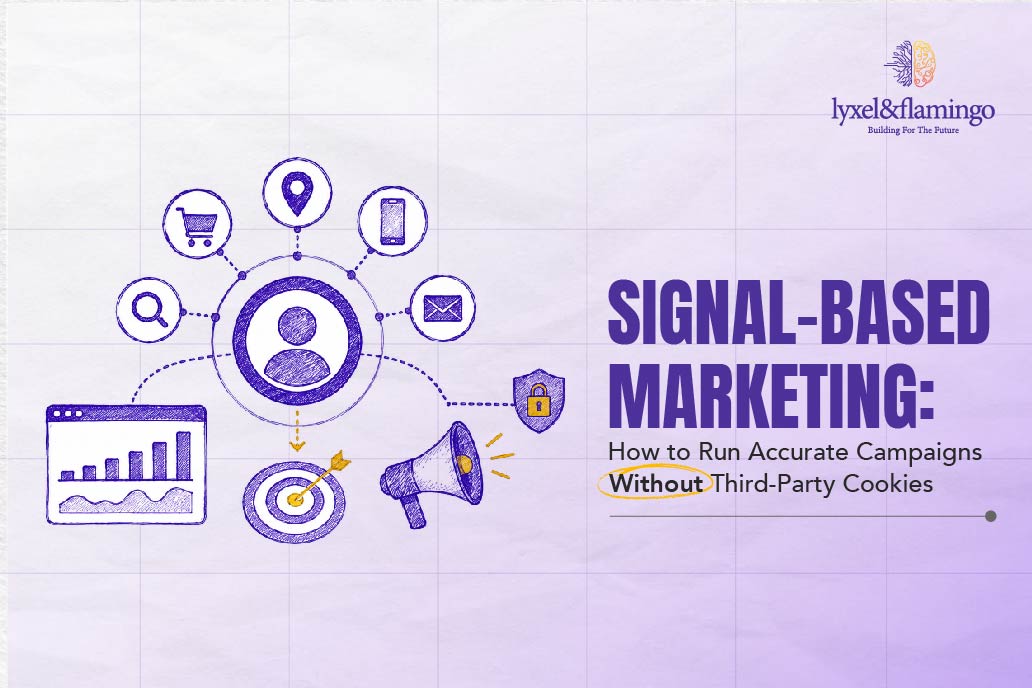
- Signal Capture Layer: Every meaningful action (browse, cart, support ticket, app session, price comparison where trackable) feeds into one unified profile in near real time, not batched overnight. Most brands’ biggest miss here isn’t a lack of data. It’s data sitting in five disconnected tools that never talk to the send decision.
- Intent Scoring Layer: Machine learning models weight recent signals more heavily than historical signals, so a customer who just compared three competitor prices this week outranks a purchase from eight months ago when deciding what happens next. This is where most legacy CRM platforms fall short, they can store the signal but can’t rank it by recency.
- Adaptive Response Layer: The system selects channel, message, and timing based on the scored intent, not a fixed calendar slot. A high-intent, price-sensitive signal might trigger an immediate WhatsApp nudge with a time-bound offer, while a low-intent browse waits, or skips messaging entirely that week.
In our work running AI crm automation for retention-focused D2C and beauty brands, the second layer, intent scoring, is consistently the most under-invested piece. Brands build strong capture systems and decent response templates, but skip the scoring logic that decides which signals deserve a response right now.
Want to see how this plays out when retention becomes the core growth lever instead of a side metric? Read this blog: LTV-Led Growth: Why Retention Is the New Acquisition Strategy
Proof: What This Looks Like in a Live Retention Program
Kimirica, a skincare brand we worked with, came to Lyxel&Flamingo running retention campaigns on a standard drip cadence.
We rebuilt the lifecycle logic around real-time signals instead of calendar triggers, layering intent scoring on top of existing CRM data rather than replacing the platform outright.
- 6.6X ROAS achieved across the retention program window
- 3X contribution to overall retention compared to the prior static approach
- 2X revenue growth and 2.5X order volume in the same period
- 3X improvement in click-through rate against baseline campaign performance
These results didn’t come from better subject lines or prettier templates. They came from the send decision itself becoming responsive to what each customer was doing right then, not what day it happened to be in a fixed sequence.
Five Things to Fix Before Your Next Campaign
- Audit your trigger logic for timer dependency. Pull up your top three automated flows and check whether any step fires purely because a fixed number of hours passed, regardless of what the customer did after the trigger. If yes, that step is scheduling, not running a real AI customer engagement strategy.
- Weight recent signal above historical signal. A customer’s activity in the last 7 days should outrank a purchase from six months back when your system decides the next message. Most platforms default to equal weighting unless you explicitly configure otherwise.
- Separate high-intent signals from low-intent noise. Not every page view deserves a response. Build a threshold, three or more product views in a session, a repeat cart add, before triggering outreach, so customers aren’t messaged for casual browsing.
- Test channel-switching, not just message-switching. If email engagement is dropping for a segment, the fix often isn’t a better email, it’s moving that segment to WhatsApp or SMS, where response rates are still meaningfully higher for time-sensitive nudges.
- Review governance before scaling further. With only 21% of organisations reporting mature AI governance per Deloitte’s 2026 findings, confirm someone owns model oversight and data consent tracking before expanding AI retention marketing further, especially with India’s DPDP Rules 2025 phasing in compliance obligations through May 2027.
Conclusion: The Real Choice Brands Are Making Right Now
The brands treating personalisation as a scheduling problem will keep losing ground to the ones treating it as a signal-processing problem, and that gap compounds every quarter it goes unaddressed.
This isn’t about adding more automation. It’s about rebuilding what triggers a message in the first place, so the system responds to the customer in front of it instead of running a script written for an average customer who doesn’t exist.
If your current lifecycle programs are still running on fixed-day triggers, that’s the place to start, not the messaging, not the design, the decision layer underneath both. Book a complimentary lifecycle audit with Lyxel&Flamingo’s team to see where your CRM logic is still stuck in scheduling mode.
Curious how this connects to the smaller, real-time moments that build toward a purchase decision? Read this blog: Micro-Moments Marketing Strategy for Real-Time Growth
To see how L&F structures full retention programs end to end, explore our services or dig into our automation capabilities built specifically around this kind of adaptive lifecycle logic.
Frequently Asked Questions
A regular CRM stores and organises customer data for marketers to act on manually. An ai driven crm actively analyses that data in real time and decides the next best action, channel, or message on its own, without waiting for a human to build a new segment or campaign.
A drip campaign fires messages on a fixed schedule regardless of customer behaviour after it starts. AI lifecycle automation keeps recalculating the next step based on new signals, so the journey changes based on what the customer does, not just what day it is.
Yes, if retention is already a priority metric. The build cost is layering intent scoring on top of existing CRM data, not replacing the platform, so mid-sized brands can start with one high-value segment rather than rebuilding the entire stack at once.
The moment your retention numbers plateau despite rising acquisition spend is usually the clearest signal. Waiting until churn becomes visible in quarterly reporting means you're already several months behind where the fix should have started.
No. It replaces manually built static segments and timer-based triggers, not strategic judgment. Someone still needs to define what counts as high intent, set governance boundaries, and decide what the brand's voice sounds like across every adaptive touchpoint.