
What this blog covers
AI creative testing has changed how performance marketing campaigns improve in 2026. Meta and Google no longer reward only strong targeting or bigger budgets. They also reward brands that supply enough creative variations for their algorithms to learn faster. This blog explains why testing only a handful of ads every month slows campaign performance and leaves valuable insights undiscovered. It also breaks down how Meta Andromeda and Google Performance Max evaluate creative assets differently from traditional A/B testing.
Table of Contents
- What Is AI Creative Testing?
- The Problem With Testing Five Ads a Month
- Inside Meta Andromeda and Google Performance Max: Why Volume Beats a Single "Best" Ad
- Why AI Creative Testing Beats Creative Guesswork
- The Creative Variant Architecture: Lyxel&Flamingo's 48-Hour Framework
- What Happened When a D2C Brand Stopped Guessing
- Things to Do Before Your Next Campaign Brief
- Conclusion: The Real Advantage Isn't the Algorithm, but a Habit.
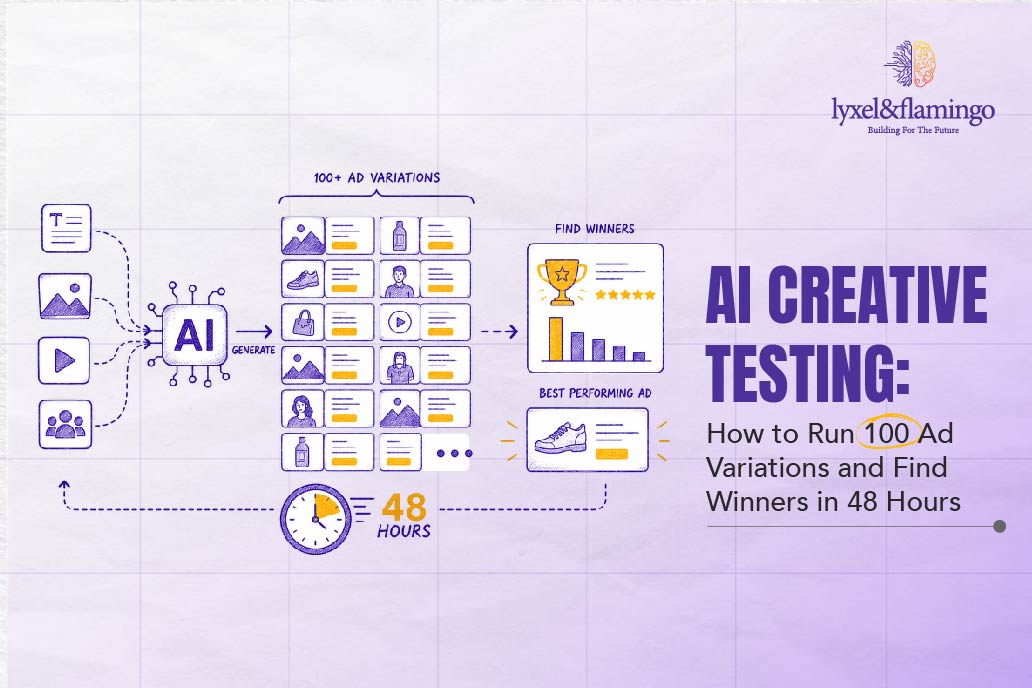
You will learn Lyxel&Flamingo’s 48-hour Creative Variant Architecture, a structured process that expands a few strategic ideas into nearly 100 ad variations, identifies winners quickly, and shifts budgets toward stronger performers.
The blog also covers key metrics to monitor, common testing mistakes, and why continuous creative experimentation has become a competitive advantage for D2C brands that want faster learning, better conversions, and more efficient media spend.
Creative quality drives up to 56% of a digital campaign’s sales lift, according to Meta’s own analysis of Nielsen data, more than targeting, bidding, or media placement combined. Most performance marketing teams already sort of know this. It’s why every strategy deck has a slide about creative excellence. And yet the average team is still testing three to five ad concepts a month, picking a winner in a Monday meeting, and calling that a process.
That gap, between what actually moves sales and how little of it gets tested, is why AI creative testing for ads in 2026 looks nothing like the A/B tests marketers ran in 2020. Meta’s Andromeda system and Google’s Performance Max now rank creative the way they rank bids: continuously, against thousands of competing variants, inside an auction that rewards volume almost as much as it rewards quality. Feed either system five ideas, and it has next to nothing to learn from. Feed it a hundred, and it starts finding patterns a human planner would need months to spot.
What Is AI Creative Testing?
AI creative testing is the practice of using generative AI and platform algorithms to produce, launch, and rank dozens or hundreds of ad variations at once, so the winning combination of hook, visual, and copy surfaces in days rather than weeks. It differs from a standard A/B test, which compares two or three ads over several weeks and calls whichever one has a marginally higher click-through rate the winner. Put simply, this is how modern teams find winning ad creative with AI tools instead of waiting on a gut-feel review meeting.
It matters right now because Meta and Google have quietly rebuilt their ad auctions around creative variety. A brand still testing five concepts a month isn’t being careful. To the algorithm, it’s barely visible.
The Problem With Testing Five Ads a Month
Consider the scenario playing out inside most performance marketing teams today. A brief goes out on a Monday. Two weeks later, three or four ad concepts return from the creative team or an agency partner. Someone reviews them, selects a preferred option based on instinct, and it goes live. It runs until performance declines, and the cycle repeats.
That process made sense when Meta and Google ranked ads primarily on bid and audience match. The same ad creative is typically shown to a given person several times within a matter of weeks, and a meaningful share of impressions reaches people who have already seen that exact creative multiple times. Repeated exposure is consistently associated with a marked decline in the likelihood of conversion as repetition continues. Taken together, a five-concept testing cycle tends to exhaust itself before a campaign reaches a confident read, let alone a genuine winner.
Most brands are not short on creative talent. They are short on volume and speed, running a process built for a slower, less crowded auction. The real gap is not a talent gap, it is a throughput gap, and it quietly costs brands their best-performing week of every campaign before the algorithm has enough to work with.
Inside Meta Andromeda and Google Performance Max: Why Volume Beats a Single “Best” Ad
Meta’s own engineering team laid out the mechanics in a technical post on its retrieval architecture: the ad system now scans tens of millions of ad candidates and narrows them to a short list before a single impression is served. That first stage, called retrieval, used to run on simple rules. Andromeda replaced it with a deep learning model that scales with how many creative variants a brand actually feeds it. Meta reports that advertisers who turned on Advantage+ creative for the first time saw a 22% increase in ROAS, and that businesses using its AI image generation saw a 7% increase in conversions. More than a million advertisers are now using Meta’s generative AI tools to produce over 15 million ads in a single month, and Andromeda exists specifically to make sense of that volume in real time.
Google runs a structurally similar system across Search, Display, and YouTube inventory through Performance Max. Instead of ranking one static ad, Google’s own guidance recommends supplying up to 15 images, 15 headlines, and 5 videos per asset group, specifically so its AI has enough raw material to assemble and test combinations on its own. Fewer assets don’t just mean fewer creative options to choose from. It means the algorithm has less signal to work with, and it defaults to safer, blander combinations.
Meta’s fatigue alerts inside Ads Manager are, in effect, an ad creative fatigue solution powered by AI, flagging tired creative automatically. But an alert only helps if there’s already a fresh variant queued up to replace it. This is the part most teams misunderstand about automated creative testing on Facebook and Google ads: it was never really about producing ads faster for its own sake. It’s about giving two retrieval systems, built to compare thousands of options per auction, enough honest variation to do their job. That’s also the mechanical reason AI-powered creative optimisation for performance marketing now depends on volume as much as it depends on any single “best” idea.
None of this is isolated to two platforms, either. McKinsey estimates that agentic AI could unlock $463 billion in marketing productivity value, and Deloitte’s 2026 predictions tie more than half of this year’s biggest technology and media shifts directly to AI. Creative testing just happens to be the sharpest, earliest edge of that shift, because it’s the one workflow every performance marketer touches every week.
Why AI Creative Testing Beats Creative Guesswork
- Marketing leaders expect AI automation of marketing work to more than double, from 16% in 2026 to 36% by 2028. Creative testing is one of the first workflows being automated because it’s repetitive, measurable, and expensive to run slowly.
- Only 8% of CMOs currently run campaigns where multiple AI agents operate autonomously, even though 96% say AI is transforming their marketing function end to end. That gap between believing in automation and actually operationalising it is exactly where most creative testing budgets are still stuck.
- WARC’s 2026 measurement research names “creative intelligence,” AI systems that assess and rank creative assets before and during a campaign, as one of the three biggest shifts in how marketers will measure effectiveness this year.
The Creative Variant Architecture: Lyxel&Flamingo’s 48-Hour Framework
At Lyxel&Flamingo Creative Intelligence practice, we run a four-layer process that takes a single brief from concept to a validated winner inside 48 hours. We call it the Creative Variant Architecture, and it’s built around a rule most teams break without noticing: variation has to come from a strategic angle, not just colour swaps and button copy. If you’ve been searching for how to test 100 ad variations fast, this is the underlying mechanism, not a tool subscription, that actually makes it possible.
- Seed Layer (Hours 0 to 6). Lock three to four genuinely distinct strategic angles, different value propositions or emotional hooks, not four versions of the same idea. This is the only manual, human-led step, and it decides whether everything downstream is testing something real or just testing noise.
- Multiplication Layer (Hours 6 to 18). Use generative AI tools alongside Meta’s and Google’s native creative generation to expand those three or four angles into 80 to 100 variants across hook, visual treatment, format, and CTA. Eighty to a hundred. Not eight. The goal isn’t a hundred good ads, it’s a hundred honestly different attempts.
- Signal Layer (Hours 18 to 40). Launch everything into a single, wide ad set or asset group with a controlled minimum spend per variant. Watch early ranking signals, hook rate, hold rate, and CTR, rather than waiting for full statistical significance on each individual variant.
- Consolidation Layer (Hours 40 to 48). Cut the bottom 80%, shift budget to what survives, and write down why the winners won. In our work across D2C and BFSI accounts, this last step is consistently the one teams skip under deadline pressure, and it’s the one with the most compounding value, because it’s what makes the next Seed Layer smarter instead of random.
This matters even more in India, where Meta Advantage Plus creative testing in India is scaling alongside one of the fastest-growing D2C markets anywhere. India’s D2C segment is compounding at close to a 40% CAGR, and Bain & Company puts India’s e-retail growth at 19 to 21% through 2025, accelerating to an estimated 23 to 25% in early 2026. Brands growing that fast cannot really afford a three-week creative review cycle. The market is simply moving faster than that process ever could.
What Happened When a D2C Brand Stopped Guessing
A D2C personal care brand came to L&F in late 2025, running exactly the process described earlier under “The Problem”: four ad concepts a month, a two-week turnaround, and a flat cost per acquisition nobody could quite explain. Our Creative Intelligence team rebuilt their entire testing pipeline around the Creative Variant Architecture, replacing the monthly creative review with a rolling 48-hour test cycle tied to their always-on Meta and Google spend, and layering in creative performance analytics for D2C brands as part of weekly reporting rather than a quarterly deck.
Across the first two full quarters on the new pipeline:
- A meaningful drop in cost per acquisition on Meta campaigns, comparing the quarter before and after the pipeline change
- Several times more creative variants are tested every month, without adding headcount to the creative team
- Under 48 hours, down from roughly three weeks, to reach a statistically confident winning variant
- A larger share of monthly ad spend reallocated away from creative that would otherwise have run untouched for a full month
None of this came from better ideas, oddly enough. It came from testing enough ideas, fast enough, for the algorithm to actually tell the brand something true.
Things to Do Before Your Next Campaign Brief
- Rewrite your creative brief around angles, not finished executions. Ask for four distinct strategic hooks instead of four polished ad concepts, and let AI tools handle the multiplication into visuals, formats, and copy once those angles are locked.
- Set a minimum variant count before launch, not a maximum. If a campaign is going live with fewer than 20 to 30 variants across your ad sets, you’re under-feeding the algorithm before you’ve spent a single rupee.
- Build a 48-hour review cadence into your media operations, not a monthly one. This is the core of any real automated ad testing strategy for media operations, and honestly, it’s a calendar change before it’s a tooling change.
- Track hook rate and hold rate alongside CTR. These early signals show up before conversion data becomes statistically significant, and they’re what let you cut losers on day one instead of day fourteen.
- Write down why every winner won. A simple tag, angle, format, and hook style turns each test cycle into training data for the next one instead of a one-off result nobody remembers by next quarter.
Conclusion: The Real Advantage Isn’t the Algorithm, but a Habit.
Every brand reading this has access to the same Meta and Google tools everyone else does. The advantage was never going to come from some secret algorithm hack. It comes from being the team that tests 100 variants while competitors are still debating three. Twelve months from now, the gap between brands running always-on creative testing and brands still running monthly reviews will be structurally difficult to close, simply because one side will have a year of ranked, tagged data on what actually works, and the other will still be guessing.
If your current testing cycle takes longer than 48 hours, Lyxel&Flamingo Creative Intelligence team can show you exactly where it’s leaking time. Book a Creative Testing Audit and we’ll map your process against the Creative Variant Architecture in under a week.
Related reading from Lyxel&Flamingo’s Creative Intelligence practice:
- Why Meta Andromeda Means Your Creative Volume Is Now a Media Strategy Decision
- The 11x Gap: What Separates the Best-Performing Creative From the Worst, on Identical Spend
- How Amazon’s A10 Algorithm Judges Your Creative Before Your Customer Does
Frequently Asked Questions
Start by locking three or four genuinely different strategic angles, then use generative AI tools alongside Meta's and Google's native creative tools, Advantage+ creative and Performance Max asset groups, to expand each angle into multiple variants. Launch them together in a single ad set or asset group with a small budget per variant, and let the platform's early ranking signals decide what survives, not your personal favourite. This is the core of any workable AI ad creative optimisation strategy in 2026.
Meta's Advantage+ creative and Google's Performance Max both generate and test variants natively once you supply enough raw assets: images, headlines, and video. Generative AI tools for image, video, and copy production sit upstream of these platforms, multiplying a handful of strategic angles into the volume both systems actually need. No single tool does the whole job here; the workflow connecting them matters more than any one platform does.
Compress the cycle into four stages: lock your angles, generate 80 to 100 variants, launch them together and watch early signals like hook rate and CTR instead of waiting on full statistical significance, then cut the bottom 80% and reallocate spend to what's left. Most teams lose time in production and in the "wait and see" phase. A 48-hour cycle removes both by testing widely and deciding early.
D2C brands need a framework built for always-on spend, not campaign-by-campaign testing, because that's how most D2C media budgets actually run day to day. L&F's Creative Variant Architecture, a four-layer system moving from strategic seed angles to AI-multiplied variants to live signal tracking to weekly consolidation, was built specifically around that always-on pattern instead of a one-off launch.
It's arguably more important for mid-sized brands, since they have far less room to waste spend on creative fatigue than a brand with a bigger cushion. The tools involved, generative AI for asset production and the platforms' own native testing features, don't require enterprise pricing to use. What it actually requires is a process change, not a bigger budget.