
What this blog covers
Choosing between a CDP and a CRM is rarely the right starting point for an e-commerce brand. Both systems solve different problems, anlyxeld better results come from implementing them in the right sequence. This blog explains how CRMs manage customer relationships while CDPs unify customer data across multiple channels for stronger marketing and personalisation. It also explores why many D2C brands invest in new technology before fixing poor data quality, creating expensive problems that remain hidden for months.
Table of Contents
- What Is the Difference Between a CDP and a CRM?
- Where Most Brands Get the CDP vs CRM Call Wrong
- How a CRM and a CDP Handle Your Data Differently
- What the Numbers Show About CDP and CRM ROI
- Lyxel&Flamingo’s Full-Funnel Data Bridge: A Sequencing Model for CDP and CRM
- What This Sequencing Looks Like Inside a Real D2C Brand
- Five Things to Do Before You Sign Any CDP Contract
- Conclusion: The Right Stack Starts With the Right Sequence
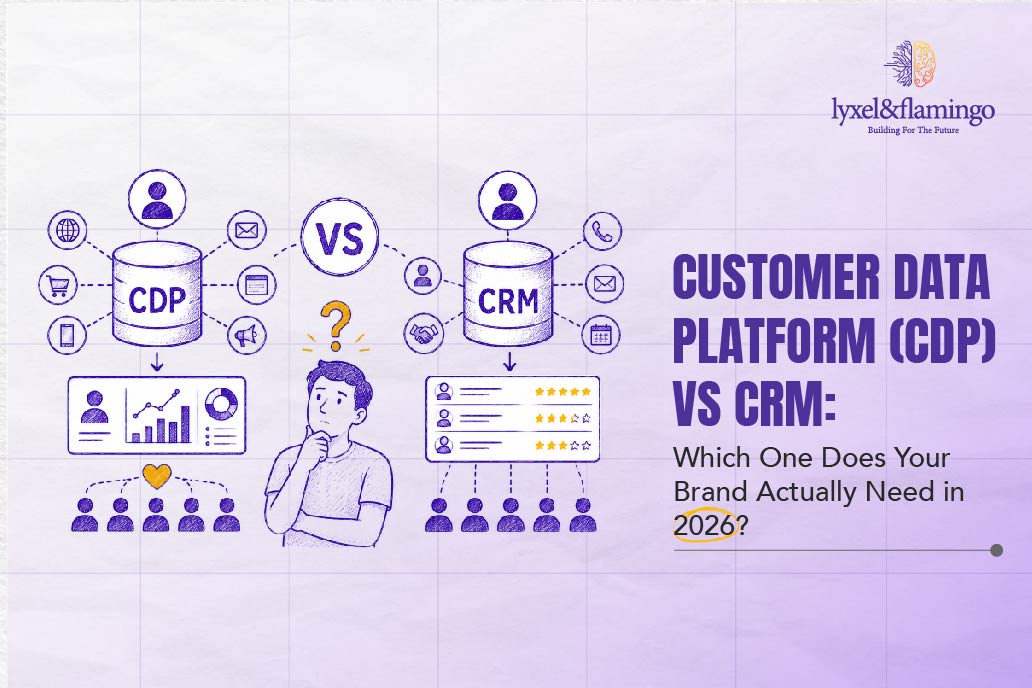
Along with the differences between the two platforms, it also introduces Lyxel&Flamingo’s Full-Funnel Data Bridge, a practical framework for cleaning, unifying, activating, and measuring customer data. Backed by current e-commerce trends and customer data insights, the article outlines common implementation mistakes, practical rollout steps, and key evaluation points. Brands can use these insights to improve retention, marketing efficiency, and long-term customer value without investing in technology too early.
CDP vs CRM is still the wrong question for many brands in 2026. These tools solve different business problems, even though they are often compared together. Brands treating them as interchangeable usually miss better customer insights, weaker marketing decisions, and slower returns from both investments.
Many D2C brands in India still solve the wrong problem first. They invest in a CDP when messy customer data is slowing everything down inside the CRM and other systems. Or they upgrade their CRM and expect it to deliver the kind of real-time, full-funnel marketing a CRM was never architected to handle.
Research for Customer Data Platforms found the category splitting into what it calls platformization and agentification, with CDP buying groups now averaging two to three functional teams (IT, marketing, sales, sometimes finance) signing off on a single purchase. That alone tells you this stopped being a marketing-only decision a while back.
The real question for 2026 isn’t CDP or CRM. It’s which one your brand needs first, and in what sequence, before either tool can deliver a meaningful return.
What Is the Difference Between a CDP and a CRM?
A customer data platform (CDP) is software that unifies a brand’s customer data from marketing, sales, service, and commerce systems into one persistent, addressable profile per customer.
A CRM (customer relationship management) system, by contrast, is defined as a business strategy and software layer built to manage direct customer relationships, mostly sales, service, and support conversations, to drive revenue and loyalty.
The distinction matters more now than it did three years back. A CRM tells you what happened in a conversation with a customer. A CDP tells you what that same customer did everywhere else, on the app, on paid ads, on WhatsApp, at your store counter, before and after that conversation ever happened. Indian D2C brands running their own app alongside quick commerce and marketplaces are finding CRM data alone isn’t enough anymore.
Where Most Brands Get the CDP vs CRM Call Wrong
A review of marketing performance at a mid-sized D2C brand tends to surface the same set of complaints. Retention campaigns feel generic, designed for an average customer who does not really exist. WhatsApp broadcasts are sent to the wrong segment more often than most teams care to admit. A customer who has already placed five orders still receives a first-purchase discount code months later. None of this is strictly a CRM failure. It is what happens when a brand attempts to personalise at scale using a system built to log interactions rather than unify identity across channels.
The instinct is to hold the CRM responsible and begin evaluating CDP vendors. That instinct is only partly correct, and the remaining half of the problem is where brands lose money without recognising it. Research found that only 45% of brands are successfully delivering the personalised experience their own customers expect, even as personalisation budgets climb 29% year over year. Acquiring additional software does not close that gap on its own. Most of that shortfall can be traced back to data distributed across five disconnected systems that do not communicate with one another, and no new platform resolves that simply by being layered on top of the existing mess.
The brands losing this argument are the ones buying a CDP to skip the data cleanup a CRM overhaul should have forced them to do first.
How a CRM and a CDP Handle Your Data Differently
The mechanical difference between the two systems is worth examining closely, since it explains most of what follows in this piece. A CRM is structured around a contact record. A customer provides an email address, a phone number, or completes a sign-up, and only then does the system begin tracking that person in any structured way. Everything before that moment, the products browsed, the advertisement clicked, the cart abandoned on two separate occasions, either never enters the CRM or arrives later, disconnected from the rest of that customer’s journey.
A CDP does not wait for that moment to begin tracking. It performs what the industry calls identity resolution, stitching deterministic signals (a logged-in email, a phone number used at checkout) together with probabilistic ones (device IDs, session behaviour, app installs) into one profile that exists whether or not the person has converted yet. That’s a structural difference between the two tools, not a feature difference you can bolt on later. This is exactly where the CRM vs CDP marketing automation decision gets made in practice, long before anyone signs a contract, and rarely the way a vendor slide frames it.
This distinction matters more in 2026, as the foundation underlying third-party data continues to shift. Google reversed its plan to deprecate third-party cookies in Chrome in April 2025, then retired several of its own Privacy Sandbox replacement tools by October of the same year. Safari and Firefox continue to block third-party cookies by default, regardless of Chrome’s direction. None of this changes the underlying reality marketers must now contend with: cross-channel identity must be built from data a brand owns outright, and a CRM was never designed to perform that function across ad accounts, applications, quick commerce storefronts, and offline point-of-sale systems simultaneously. Common customer data platform use cases in e-commerce, such as recovering an abandoned cart across two devices or reconciling an in-store return with an online loyalty tier, depend on precisely this kind of data stitching. A CDP was built to perform that function.
What the Numbers Show About CDP and CRM ROI
Here’s what the customer data platform India 2026 conversation shows, once you follow the real figures instead of a vendor pitch deck.
India’s e-retail GMV reached $65 to $66 billion in 2025, growing 19 to 21% for the year, with growth reaccelerating to 23 to 25% in the first quarter of 2026 alone. Quick commerce is a large part of that story, pulling in $10 to 11 billion of GMV and roughly 16 to 17% of total e-commerce GMV in India, ahead of most other markets worldwide. Brands selling across their own app, marketplaces, and quick commerce at once now generate customer signals no single CRM was ever built to unify.
India’s e-commerce sector will grow at a 27% CAGR to reach $163 billion by 2026, after surpassing $145 billion in 2025. That growth is increasingly credited to mobile commerce and AI-driven personalisation, not just cheaper acquisition.
India’s D2C and digital-native brand segment is roughly $10-$12 billion, on track for close to $60 billion by 2026, with D2C brands now accounting for nearly 40% of all online sales. That’s a lot of first-time and repeat customers to tell apart without a unified profile.
53% of customers reported a negative experience from personalisation, and those customers were 3.2 times more likely to regret their purchase afterwards. A CDP makes precision possible across every channel a brand operates. It does not make judgment automatic, and poorly targeted personalisation is still poor targeting, just delivered faster and at a much greater scale.
Line these four up together, and this is what the customer data platform India 2026 buying decision looks like once vendor noise gets stripped away: a market growing fast, budgets rising faster than execution, and real cost in getting the rollout order wrong.
Lyxel&Flamingo’s Full-Funnel Data Bridge: A Sequencing Model for CDP and CRM
At Lyxel&Flamingo, we do not move a brand directly into a CDP conversation the moment personalisation is raised. We begin one layer below it instead. This is how we approach CDP and CRM integration for full-funnel growth, following this sequence rather than whatever order a vendor demonstration suggests:
- Hygiene Layer: Before anything else, dedupe and standardise the customer records already spread across your CRM, POS, and helpdesk tools. Most brands skip this step because it’s unglamorous, and that’s exactly why their eventual CDP inherits the same broken data, just faster and considerably more expensive.
- Unification Layer: This is the function a CDP is designed to perform: consolidating known and anonymous signals (web, app, ads, quick commerce, in-store) into one addressable unified customer profile, using both deterministic and probabilistic identity resolution. Most customer data platform use cases in e-commerce, including loyalty tiering, win-back journeys, and cross-device cart recovery, reside within this layer.
- Activation Layer: Push those unified segments back out again: into your CRM for sales and support context, into ad platforms for suppression and lookalike audiences, and into WhatsApp, SMS, or email for lifecycle journeys. A CDP that only unifies data and never activates it is an expensive dashboard nobody opens twice.
- Measurement Layer: Close the loop back to the unified profile instead of last-click attribution, so you can tell which channel drove the second and third purchase, not only the first one.
In our experience running this sequence with growth teams across the region, the layer brands most under-invest in is the first one. Everyone wants to skip straight to unification because that’s the part a CDP vendor demo makes look impressive. The brands that get this sequence backwards spend twelve months paying for a CDP that just mirrors the mess already sitting in their CRM.
What This Sequencing Looks Like Inside a Real D2C Brand
A leading D2C beauty and personal care brand came to us running five different tools to manage roughly 400,000 customers: a CRM for support tickets, a separate email tool, a helpdesk, a loyalty plug-in, and a spreadsheet nobody wanted to admit was still load-bearing. Instead of recommending a CDP on day one, we spent the first six weeks entirely on the Hygiene Layer, merging duplicate profiles and standardising purchase history before a single new platform got touched.
Over the two quarters that followed:
- Repeat-purchase revenue grew as a share of total revenue
- Blended customer acquisition cost eased noticeably
- WhatsApp and email click-through on lifecycle campaigns improved substantially once segments were finally built on unified profiles instead of fragmented ones
None of that came from extra ad spend or deeper discounting. It came from the brand finally being able to tell its best customers apart from its one-time discount hunters, something its CRM alone was structurally never going to manage.
Five Things to Do Before You Sign Any CDP Contract
- Audit where your customer data lives before you audit vendors. List every tool holding a piece of customer identity, your CRM, helpdesk, loyalty program, POS, and ad accounts, and mark which ones can export clean, deduplicated records today.
- Fix deduplication inside your CRM first, even if it costs you six weeks. A CDP stitching together three broken versions of the same customer just produces one large broken version, only faster and pricier.
- Ask any CDP vendor how they handle deterministic versus probabilistic matching for your exact channel mix, especially WhatsApp, in-app, and quick commerce, since Indian D2C stacks differ fundamentally from the average US SaaS reference customer most vendor demos are built around.
- Pick one activation use case to prove value within 90 days, such as win-back segmentation or repeat-purchase timing, rather than trying to unify every data source before activating anything at all.
- Set a measurement baseline before rollout, never after. You cannot prove a CDP improved ROI if nobody measured blended CAC and repeat-purchase share before the contract got signed.
Conclusion: The Right Stack Starts With the Right Sequence
CDP vs CRM was never really the decision sitting in front of your brand. The real decision is whether you fix your data before you scale personalisation or after, and after is a lot more expensive. Brands that sequence this correctly in 2026 build a compounding advantage in retention and CAC efficiency, one that gets harder for slower-moving competitors to close with every quarter that passes.
If you’re already deep into a CDP evaluation, it might be worth pressure-testing your data hygiene first. Our Growth Marketing practice works with D2C and e-commerce brands on exactly this sequencing problem. You can also read our related breakdowns on first-party data strategy for Indian brands and what full-funnel marketing automation requires in practice.
Frequently Asked Questions
A CRM manages relationships you already have, mostly sales, support, and service conversations tied to a known contact. A CDP unifies customer data across every channel, known and anonymous, into one unified customer profile so marketing can act on it in real time. Most e-commerce brands need both, sequenced correctly, not one instead of the other.
If your CRM data is still clean, deduplicated, and mostly single-channel, a well-configured CRM might carry you a while longer. Once you're running your own app, marketplaces, and quick commerce storefronts together, a CRM alone cannot stitch that behaviour into one view, and that's usually when a CDP earns its cost.
There's no single answer to the best CDP for D2C brands in India, the right platform depends on your channel mix more than any global vendor ranking. Brands often frame this as a MoEngage vs CleverTap CDP India decision, but the more useful question is which platform's identity resolution and WhatsApp-native activation fit your stack, not which brand name comes up most in searches.
A customer data platform for marketing automation in India improves ROI by letting brands target based on unified behaviour across channels instead of fragmented, channel-by-channel guesses. Deloitte's research links stronger personalisation execution to measurably higher loyalty, though those gains only show up once the underlying data is genuinely unified, not just recently purchased.
The right trigger isn't company size, it's channel complexity. Once a brand sells across three or more channels (app, marketplace, quick commerce, offline retail) and support teams and marketing teams are working off different versions of the same customer, that's the signal to sequence in a CDP.