
What this blog covers
Should you sustain presence or concentrate spend? This blog explains when to run always-on media and when to burst, how to layer the two, and how Sleepwell and Agilus phased their calendars for festive peaks and always-on intent.
Table of Contents
- What Media Phasing Really Means Once You Treat It as Memory
- The Hidden Cost of Going Dark Between Campaigns
- Where Stop-Start Calendars Quietly Bleed Budget
- Framework: Always-On + Burst Phasing
- Inside the Phasing: What Each Layer Fixes
- The Traps Worth Naming Early
- How to Draw Your Base, Then Plan the Peaks
- What a Well-Phased Calendar Actually Feels Like
- Signals to Watch
- Two Brands, Two Patterns: Sleepwell and Agilus
- Score Your Own Media Phasing: A Quick Self-Check
- Key Takeaways
- The Cost of Being Forgotten Keeps Rising
What Media Phasing Really Means Once You Treat It as Memory
Media phasing is the decision of when to spend, not just how much. Always-on media sustains a continuous base of presence that holds mental availability and captures steady demand. Burst media concentrates spend into short, high-intensity windows around launches, festive moments or category peaks. The two are complementary, not alternatives.
- Always-on: a continuous base that holds mental availability and captures steady demand.
- Burst: concentrated spend for launches, festive windows and category peaks.
- The skill is layering and timing: bursts on top of the base, timed by signals not just the calendar.
Phasing is really a memory-management problem: brand memory decays when you go quiet, so the question is not whether to run always-on or burst, but how large a base keeps you remembered and where the peaks add the most incremental attention.
The Hidden Cost of Going Dark Between Campaigns
Because buying is continuous but attention is seasonal. Only a small share of any category is in-market at once, so a brand that goes dark between bursts forfeits the steady demand and the memory it spent to build (Ehrenberg-Bass Institute).
And because brand effects decay: activation bursts spike sharply and fade, while a sustained base preserves the compounding brand effect between peaks (Binet & Field).
There is a hidden cost to a stop-start calendar: every time you go dark, you stop paying to be remembered, and you re-buy that memory, at a premium, when you switch back on. A steady base plus timed peaks almost always delivers more effective presence per rupee than a series of disconnected bursts.
Where Stop-Start Calendars Quietly Bleed Budget
- Spend lurches from campaign to campaign, going dark in between and losing the memory it just paid for.
- Everything is a “burst”, so there is no base capturing everyday demand.
- Festive and launch peaks are planned late, so costs spike and inventory of good creative runs out.
- No signal is used to time bursts: they follow the calendar, not the market.
Framework: Always-On + Burst Phasing
A Base You Hold, Peaks You Time
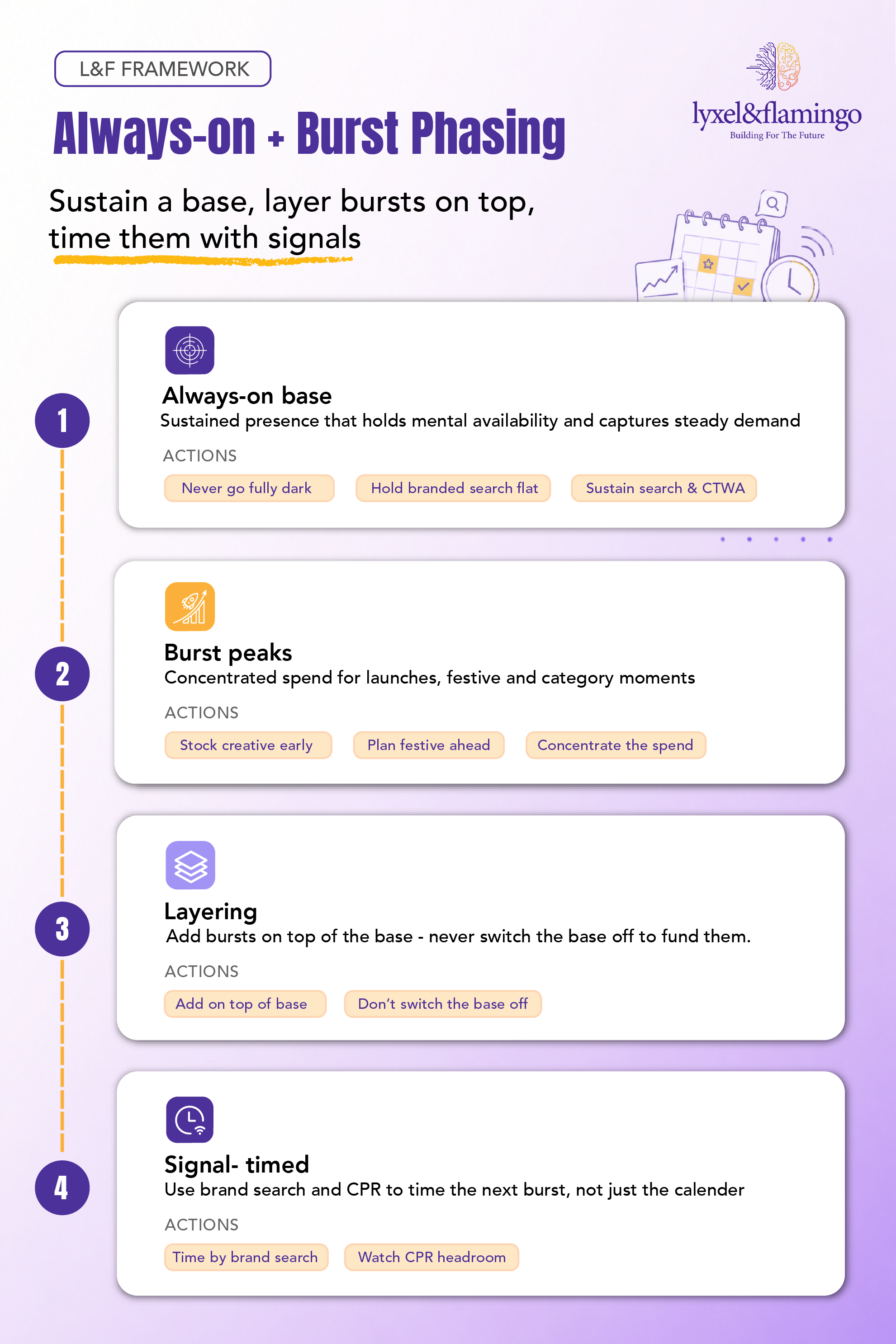
Sustain a base; layer bursts on top; time them with signals.
Inside the Phasing: What Each Layer Fixes
01. Always-on base:
The problem it fixes: Spend lurches from campaign to campaign and goes dark in between, so the brand keeps re-buying the memory it just paid for.
How this layer solves it: The always-on base sustains presence: holding branded search and direct traffic roughly flat between peaks, so you stop paying twice to be remembered.
In practice: Size the base so branded search and direct traffic stay roughly flat when you are quiet; if they dip, the base is too small.
02. Burst peaks:
The problem it fixes: Everyday demand is under-served and launch moments arrive with no creative stocked, so peaks cost more and convert less.
How this layer solves it: Burst peaks concentrate spend on the moments that genuinely matter: launches, festive and category windows, planned and stocked ahead so you exploit the attention efficiently.
In practice: Reserve bursts for genuine attention spikes: launches, festive, category moments, and stock the creative weeks ahead.
03. Layering:
The problem it fixes: Teams fund a burst by switching the base off, forfeiting steady demand and the memory built between peaks.
How this layer solves it: The layering rule is simple and decisive: add bursts on top of the base, never swap, so peaks amplify rather than cannibalise your always-on presence.
In practice: Layer, never swap: fund peaks with incremental budget on top of the base, so you do not re-buy the same memory.
04. Signal-timed:
The problem it fixes: Bursts are timed to the calendar alone, so budget lands when competition is fiercest and attention is thinnest.
How this layer solves it: Signal-timing uses brand search and CPR headroom to decide when a peak is worth pressing, so you spend into rising demand rather than a fixed date.
In practice: Trigger the next burst off rising brand search and CPR headroom, not just a fixed date on the calendar.
The Traps Worth Naming Early
- Funding a burst by switching the always-on base off, then paying a premium to rebuild the memory you just lost.
- Planning festive and launch peaks late, so media costs spike and you run out of good creative mid-flight.
- Timing bursts purely by the calendar, ignoring where category demand and your own brand-search trend actually are.
- Running everything as a “campaign”, leaving no steady base to capture everyday demand.
How to Draw Your Base, Then Plan the Peaks
Begin by drawing the two layers explicitly. Define the always-on base: the channels and budget that run continuously to hold memory and capture steady demand, and list the moments that genuinely deserve a burst: product launches, festive windows, category spikes. If everything is a “campaign”, you have no base; if nothing is a burst, you are under-exploiting your biggest moments.
Next, protect the base and plan the peaks ahead. Size the base so branded search and direct traffic stay roughly flat when you go quiet, and lock it so bursts are always funded with incremental budget on top, never by switching it off. Stock burst creative weeks in advance, because the most expensive festive campaign is the one that runs out of good assets halfway through.
Then let signals, not just the calendar, time your peaks. Watch category interest, your own brand-search trend and CPR headroom, and press harder into rising demand rather than a fixed date. Over a year, a steady base plus a few well-timed, well-stocked bursts almost always beats a series of disconnected campaigns.
What a Well-Phased Calendar Actually Feels Like
A well-phased calendar looks calm, not frantic. There is a visible always-on base that never switches off, a small number of genuinely big moments that are planned and stocked months ahead, and a clear rule that peaks are funded on top of the base rather than by raiding it. The result is a brand that is present enough to be remembered and concentrated enough to win the moments that matter.
Watch the base and the peaks separately. Between bursts, branded search and direct traffic should hold roughly flat: if they sag every time you go quiet, the base is too thin. Around peaks, the tell is whether cost per result stays sane while volume jumps; if CPR spikes, you either mistimed the burst or ran out of fresh creative. Both are fixable once you are watching them.
Done well, phasing is one of the cheapest sources of efficiency in media. You stop re-buying the same memory, you exploit high-attention windows fully, and you time spend into rising demand rather than a fixed date. The brands that get this wrong are not usually under-funded: they are just running a string of disconnected campaigns with the lights switched off in between.
Signals to Watch
- Branded search and direct traffic between bursts: does the base hold?
- Cost per result during peaks: is CPR staying sane?
- Creative stocked ahead of festive and launch windows.
- Category-interest trend: to time the next burst.
Two Brands, Two Patterns: Sleepwell and Agilus
For Sleepwell’s festive push, we concentrated a full-funnel burst around the peak and drove a 38.7% rise in transactions and a 50.5% uplift in net revenue. For Agilus Diagnostics, the opposite pattern won: an always-on Click-to-WhatsApp engine scaled from 3 to 10 campaigns with cost-per-result rising just 4%: proof that sustained intent capture compounds.
The contrast between the two brands is the lesson. Sleepwell concentrated a full-funnel burst on the festive peak and captured a moment of high category attention; Agilus ran a sustained, always-on Click-to-WhatsApp base that compounded quietly across the year. Neither would have worked as the other’s strategy: the base and the peak solve different problems, and most brands need both.
Phasing is one decision inside the wider plan: it sits under the full-funnel media engine, flexes with your growth-stage media mix, and is best timed by the branded-search signal and your reach-and-frequency plan.
Score Your Own Media Phasing: A Quick Self-Check
Score your operation. One point per yes.
- Base
An always-on layer runs continuously, not just during campaigns.
- Peaks
Festive and launch bursts are planned well ahead, with creative stocked.
- Layering
Bursts are added on top of the base, not funded by switching it off.
- Timing
Brand search and CPR trends inform burst timing, not only the calendar.
Key Takeaways
- Always-on holds memory and steady demand; bursts capture concentrated moments.
- Layer bursts on top of the base: never go dark to fund a peak.
- Time bursts with signals (brand search, CPR), not just the festive calendar.
- Sleepwell burst: +38.7% transactions; Agilus always-on: 3-to-10 campaigns at +4% CPR.
The Cost of Being Forgotten Keeps Rising
Phasing is where a lot of wasted spend hides. A steady base plus well-timed bursts beats a series of disconnected campaigns that keep re-buying the same memory. Decide your base first, then plan your peaks on top.
As media inflation rises and attention fragments, the cost of being forgotten between bursts only grows. A steady base is increasingly the cheapest insurance a brand can buy, and the discipline of layering peaks on top of it, rather than instead of it, is what separates brands that stay top of mind from those that have to reintroduce themselves every festive season.
Frequently Asked Questions
Bursts alone force you to re-buy awareness each time and forfeit steady demand between them. A base is usually cheaper over a year.
Enough to hold branded search and direct traffic roughly flat between peaks. If those dip when you go quiet, your base is too small.
When demand or attention genuinely concentrates, a launch, festive window or category moment, and you have creative ready to exploit it.
Lead with signals: rising category interest, your own brand-search trend, and CPR headroom, not only the fixed calendar.
Yes. Always-on nurtures the 95% not ready to buy; bursts convert the moments they enter the market.
There is no fixed ratio, but a good starting point is an always-on base large enough to hold branded search and direct traffic roughly flat between peaks, with incremental budget layered on top for launches and festive windows. If your baseline metrics dip whenever you go quiet, the base is too small.
For genuinely seasonal businesses or very early-stage tests with tiny budgets, concentrated bursts can make sense. Even then, a light always-on presence usually protects the memory you paid to build, so you are not starting from zero each cycle.