
What This Blog Covers
Annual phishing simulations create a false sense of security: a good click-rate number in March says very little about how employees will respond to a genuinely novel phishing attempt in October. This blog breaks down why testing frequency and realism matter more than most training programs account for, what a genuinely effective phishing simulation cadence looks like, and why CMOs specifically, not just IT, need to be involved in designing this program given how much of a brand’s external-facing communication style phishing attempts now convincingly mimic.
Quick Answer: Effective phishing simulation programs run quarterly at minimum, not annually, since awareness and vigilance decay measurably within a few months without reinforcement. Simulations need to reflect current, realistic attack patterns, including techniques that mimic a brand’s own marketing and communication style, rather than generic, easily-spotted templates. CMOs should be involved in designing simulations because phishing increasingly impersonates brand communications, invoice formats, and customer-facing language that marketing, not just IT, understands best.
Table of Contents
- Why an Annual Click-Rate Number Is a Misleading Metric
- How Fast Phishing Awareness Actually Decays
- Generic Templates Train Employees to Spot the Wrong Thing
- Why This Is a CMO Problem, Not Just an IT Problem
- What a Genuinely Effective Simulation Program Looks Like
- Measuring Progress Beyond the Click Rate
- Framework Explained
- Key Takeaways
- CXO Takeaway
Why an Annual Click-Rate Number Is a Misleading Metric
A single annual phishing test produces a single data point: how employees responded to one specific simulated email, on one specific day, using one specific technique. Reporting that click rate to leadership as evidence of security awareness treats a narrow snapshot as if it represents ongoing organizational readiness, which it does not.
Real attackers do not send one email a year using a technique employees have already been trained to recognize. They adapt, and an organization’s actual readiness is better reflected by how it responds to varied, evolving attempts over time, not a single test result. CISA’s phishing guidance highlights the importance of recognizing and reporting suspicious messages as techniques evolve, which is exactly why a once-a-year test can’t keep pace.
How Fast Phishing Awareness Actually Decays
Awareness built from a single training session or simulation measurably fades within a few months, well before the next annual cycle would naturally reinforce it. This is not a failure of the training content; it reflects how skill retention generally works when a behavior is practiced infrequently.
This decay curve is exactly why a quarterly, or even more frequent, simulation cadence produces meaningfully better real-world resilience than an annual program, even when the annual program’s individual test is well-designed. Frequency compensates for the natural decay in a way that a single, better-designed annual test cannot.
Generic Templates Train Employees to Spot the Wrong Thing
Many off-the-shelf phishing simulation templates use obviously generic language, awkward phrasing, or unrealistic sender domains that employees learn to spot quickly. That pattern-matching does not transfer to a genuinely sophisticated attempt. Employees end up trained to recognize bad simulations, not real attacks.
Effective simulations need to mirror the actual sophistication of current phishing techniques, including realistic sender spoofing, plausible urgency framing, and, increasingly, attempts that closely mimic a brand’s own internal communication style or a trusted vendor’s actual email format.
Why This Is a CMO Problem, Not Just an IT Problem
A growing share of sophisticated phishing attempts do not impersonate generic corporate communication; they impersonate a brand’s own marketing emails, invoice formats, or customer service language, since attackers know employees are more likely to trust something that looks like it came from inside their own organization’s established communication patterns.
This means the CMO’s team, who understands exactly what the brand’s legitimate communications actually look like, has direct relevance to designing realistic simulations and to identifying when the brand’s own external communication style has become a template attackers are exploiting. It is the same cross-functional gap covered in Why Your Marketing Stack Is Your Weakest Security Link: security decisions that assume IT owns the entire attack surface miss exactly the tools and communications marketing controls.
What a Genuinely Effective Simulation Program Looks Like
A strong program runs quarterly simulations at minimum, varies the technique and framing each cycle rather than reusing the same template, and includes immediate, specific feedback for anyone who clicks: a specific explanation of exactly which signals in that specific email should have raised suspicion, not a generic reminder. The FTC’s own guidance on recognizing and avoiding phishing scams is a useful reference point for exactly which signals a simulation should be training employees to notice.
This also means escalating realism gradually. Early simulations can use more obvious signals to build baseline awareness, with later simulations in the same program increasing in sophistication to match the level of technique a genuinely skilled attacker would use.
Measuring Progress Beyond the Click Rate
Click rate alone is an incomplete metric. Report rate, how many employees who received the simulation actively reported it as suspicious, is often a more meaningful signal of genuine organizational vigilance, since it reflects proactive behavior rather than the absence of a mistake.
Tracking both metrics over multiple simulation cycles, rather than a single annual snapshot, gives a genuine picture of whether the security awareness training program is actually building durable behavior change or just producing a number that looks acceptable once a year. A successful phishing attempt is often the first step toward a data breach, exactly the scenario DPDP Act compliance for ecommerce was written to help brands get ahead of, before it becomes a compliance incident, not just a security one.
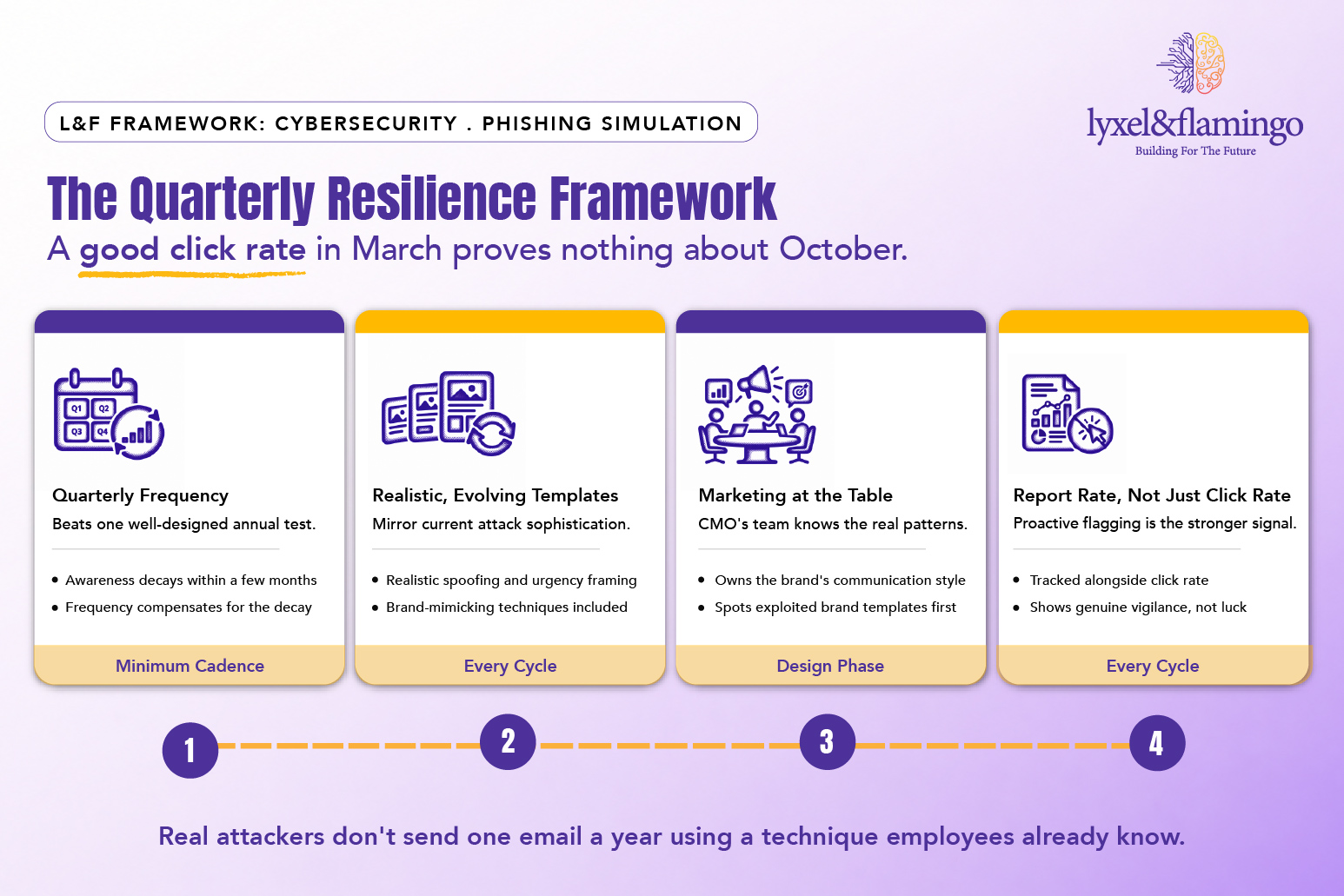
Framework Explained
- Frequency beats a single well-designed test: quarterly cadence compensates for how quickly phishing awareness naturally decays between sessions.
- Realism over generic templates: simulations should reflect the sophistication of real current attacks, including brand-mimicking techniques.
- Marketing has a seat at this table: the CMO’s team understands the brand’s legitimate communication patterns better than IT alone, which matters as attackers increasingly impersonate brand-specific formats.
- Report rate matters as much as click rate: proactive reporting behavior is a stronger vigilance signal than simply the absence of a click.
CAPABILITY NOTE This framework is drawn from Lyxel&Flamingo’s security awareness training and phishing simulation capabilities as a standing service offering. A dedicated client case study with disclosed click-rate and report-rate results is not yet publicly available to cite here.
Key Takeaways
- An annual phishing simulation’s click rate is a narrow snapshot, not a reliable indicator of ongoing organizational readiness against evolving attack techniques.
- Phishing awareness measurably decays within a few months, which is why quarterly or more frequent simulation cadence outperforms even a well-designed annual test.
- Generic, easy-to-spot templates train employees to recognize bad simulations rather than sophisticated real attacks, particularly ones mimicking a brand’s own communication style.
- Report rate, not just click rate, should be tracked over multiple cycles as a more meaningful signal of genuine vigilance.
CXO Takeaway
The question worth asking about the current phishing training program is not “what was our click rate last time.” It is: has our simulation program’s sophistication kept pace with how phishing attempts targeting our industry have actually evolved this year?
Most annual programs have not, simply because the cadence does not allow for it.
If your organization’s phishing simulations still run once a year with a generic template, Lyxel&Flamingo’s cybersecurity team can help design the quarterly, brand-aware program that builds real, durable resilience instead.
Frequently Asked Questions
Measurable decay typically begins within a few months, which is significantly faster than most annual training cycles account for, making quarterly reinforcement a meaningfully better cadence for durable resilience.
A growing share of sophisticated phishing attempts mimic a brand’s own marketing, invoice, or customer communication style specifically because employees trust familiar internal patterns. Marketing understands those legitimate patterns better than IT alone.
Not bad, just incomplete. Click rate should be tracked alongside report rate, how many employees proactively flagged the simulation as suspicious, for a fuller picture of organizational vigilance.
Realistic enough to reflect current attack sophistication, including plausible sender spoofing and brand-mimicking techniques, escalating gradually so early simulations build baseline awareness before later ones test against more advanced technique.