
Blog Summary
The most expensive thing that can happen to a brand during the festive sale is not a weak ad or a soft price. It is running out of the product everyone came for, on the day they came for it. Availability during festive is not a warehouse task that sits downstream of marketing; it is a growth strategy of its own, because demand that meets an empty shelf does not wait, it moves to whoever is still stocked. This is a practical look at planning festive inventory so the hero products stay on the shelf when it counts.
Table of Contents
- The Bestseller that Vanished on Day One
- Why Availability is a Festive Strategy
- Forecast: Reading Demand Before It Spikes
- Buffer: Days of Cover on the Heroes
- Replenish: Cadence Over panic
- Distribute: Right stock, Right place
- The Availability Safeguard
- What an Out-of-stock Really Costs
- The Question to sit with
- Closing
The Bestseller that Vanished on Day One
There is a particular kind of festive failure that stings more than the rest. A brand does everything right, strong creative, sharp pricing, campaigns humming, the demand arrives exactly as hoped, and then the hero product sells out on the first morning. For the rest of the sale, the best-performing listing shows as unavailable, the ad spend keeps sending shoppers to a dead end, and the ranking the brand spent weeks building quietly collapses. The season’s biggest opportunity becomes its biggest leak, and it was an inventory decision, not a marketing one, that caused it.
Why Availability is a Festive Strategy
It is tempting to treat stock as an operational detail that sits below the marketing plan. During festive, that hierarchy is exactly backwards. Availability is the foundation every other festive investment rest on, because a product that is out of stock cannot convert an ad, hold a ranking or answer a demand spike. This is the strategic partner to everything we cover in, winning on quick commerce and it becomes non-negotiable in a season where demand is concentrated, unforgiving and gone the moment it is not met. Getting availability right is not the price of entry to the festive sale; it is a large part of winning it.
Forecast: Reading Demand Before It Spikes
The first habit is forecasting demand at the level that actually matters by product and by location, not as a single national number. Festive demand is lumpy and local; a hero SKU can spike in one city and stay flat in another, and an average hides exactly the peaks that cause stockouts. Reading demand granularly, before it arrives, is what lets a brand position the right quantity in the right place rather than discovering the mismatch when the shelf empties. The forecast does not have to be perfect. It has to be specific enough to plan against.
Buffer: Days of Cover on the Heroes
The second habit is holding a genuine buffer on the products that carry the season. Not every SKU needs deep cover, but the handful of hero lines that will do most of the volume need enough days of stock to absorb a spike bigger than the forecast. Running the heroes lean to protect working capital is a reasonable instinct eleven months of the year and a costly one during festive, when a single day out of stock on a bestseller can outweigh the carrying cost of the buffer many times over. The buffer is insurance against the season’s most expensive failure.
Replenish: Cadence Over panic
The third habit is replenishing on a rhythm rather than in reaction. Through the peak, stock should be topped up on a planned cadence, watched daily, refilled before it runs low, store by store and warehouse by warehouse, so the brand never finds itself scrambling to restock a listing that has already gone dark. Panic replenishment is always slower and more expensive than planned replenishment, and during festive the gap between the two is measured in lost bestseller days. Cadence keeps the hero on the shelf; panic is what happens after it has already fallen off.
Distribute: Right stock, Right place
The fourth habit is distribution making sure the right stock sits in the right place for how each channel fulfils. A marketplace with central inventory forgives a lot; quick commerce, fulfilling from neighbourhood dark stores, does not, because being in stock nationally means nothing if the specific store serving a high-demand pocket has run dry. Festive distribution is about matching stock to the geography of demand and the mechanics of each channel, so availability holds where the shoppers actually are rather than only in aggregate.
The Availability Safeguard
Together these four habits, forecast, buffer, replenish, distribute make a safeguard that keeps a hero product on the shelf through the rush. None of them is complicated on its own. What makes them work is doing them early and together, as a plan set before the season, rather than as four separate reactions once the demand is already outrunning the stock.
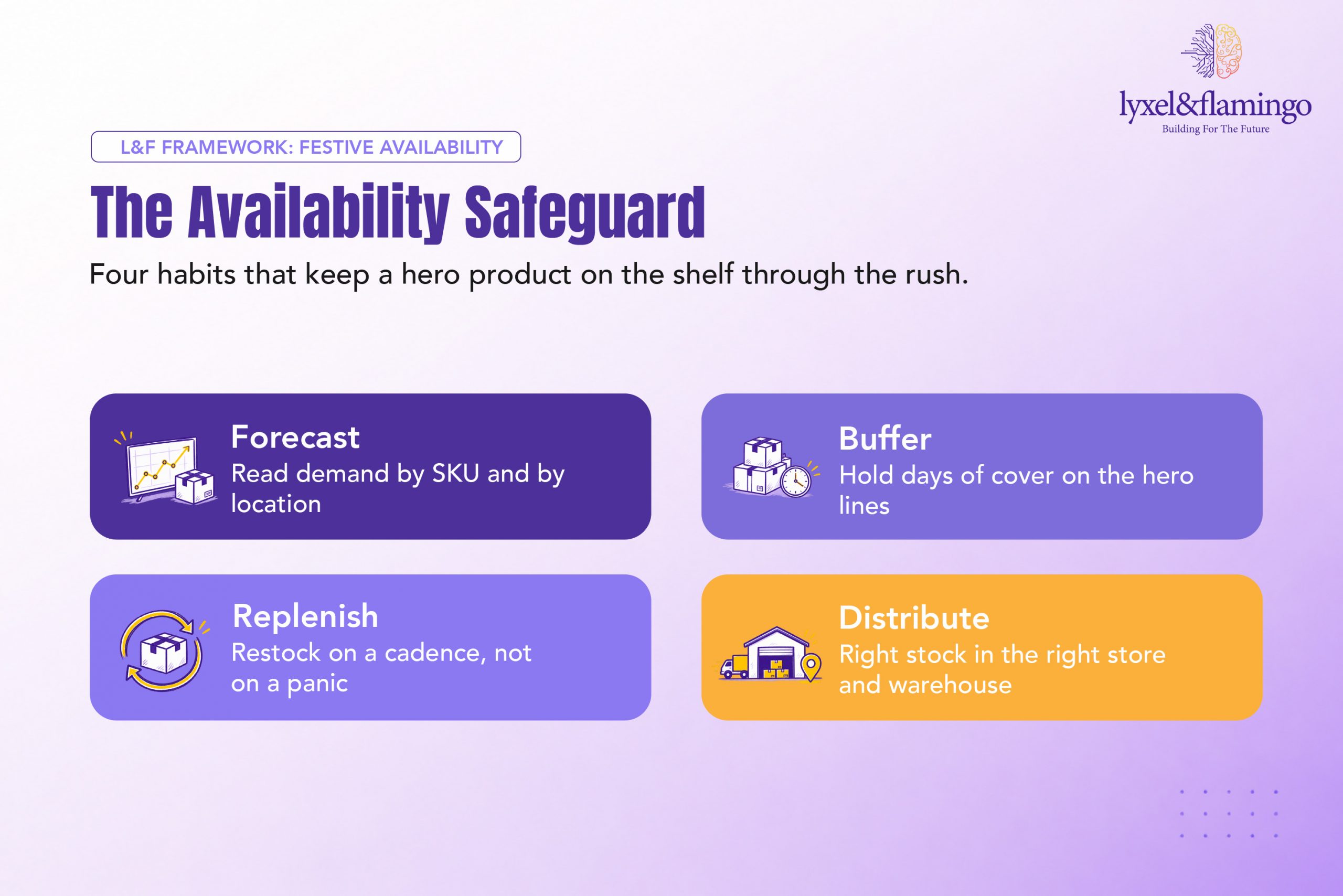
The Availability Safeguard: four habits that keep a hero product on the shelf through the rush.
What an Out-of-stock Really Costs
The full cost of a festive stockout is larger than the sale it misses, which is why it deserves its own reckoning, the lost ranking, the wasted ad spends, the shopper handed to a competitor and perhaps kept. That standalone argument, that an out-of-stock is your costliest advertisement, is one we take up on its own elsewhere in this cluster. For the festive season, the point is narrower and sharper: the brand that plans availability as carefully as it plans its creative is the one still selling on the last day of the sale, when the brands that under-planned are watching their best listings show as unavailable.
The Question to sit with
So, the question worth carrying into the season is not whether your festive campaign is ready. It is whether, on the busiest evening of the sale, your hero product will still be on the shelf or whether all the demand you worked to create will arrive to find nothing there to buy.
Closing
Planning festive availability is a discipline, and it is one Lyxel&Flamingo runs alongside brand teams forecasting demand, sizing buffers, and keeping the hero lines in stock across marketplaces and quick commerce through the peak. If you would like a clear read on where your festive availability is at risk before the season arrives, our marketplace team can audit your plan and show you where the shelf is most likely to slip. Start that conversation with us whenever you are ready.
Frequently Asked Questions
Because demand is concentrated and moves instantly to whoever is still in stock. A festive stockout on a hero product loses the sale, the ranking and the ad spend driving traffic to it, all at the peak of demand.
Enough on the hero lines to absorb a spike larger than the forecast, even if other SKUs run leaner. Festive buffer stock should be concentrated on the few hero products that drive most of the volume.
It is fulfilled from local dark stores, so national stock is not enough. Quick commerce availability depends on stock in the specific dark store serving a demand pocket, not on national inventory.
Far more than the missed sale, ranking, ad efficiency and the shopper themselves. An out-of-stock hero during festive is often the season’s costliest failure, because it wastes the demand a brand paid to create.