
What this blog covers
How much of your budget should build the brand, versus drive the sale? This blog explains the 60/40 rule, why it maximises profit, how to adapt it to your category and stage, and how a balanced mix played out for boAt.
Table of Contents
- What the 60/40 Rule Actually Means for Your Media Plan
- The Profit Curve Hiding Inside Your Budget Split
- The Four Ways Budget Splits Drift Off Course
- Framework: The 60/40 Balance
- Inside the Balance: What Each Layer Fixes
- The Traps Worth Naming Early
- How to Find Your Real Split, Then Move It
- What Good Looks Like
- Signals to Watch
- From Standing Start to 2.5X: boAt Nirvana
- Score Your Own Budget Split: The 60/40 Scorecard
- Key Takeaways
- The One Decision Everything Else Follows From
What the 60/40 Rule Actually Means for Your Media Plan
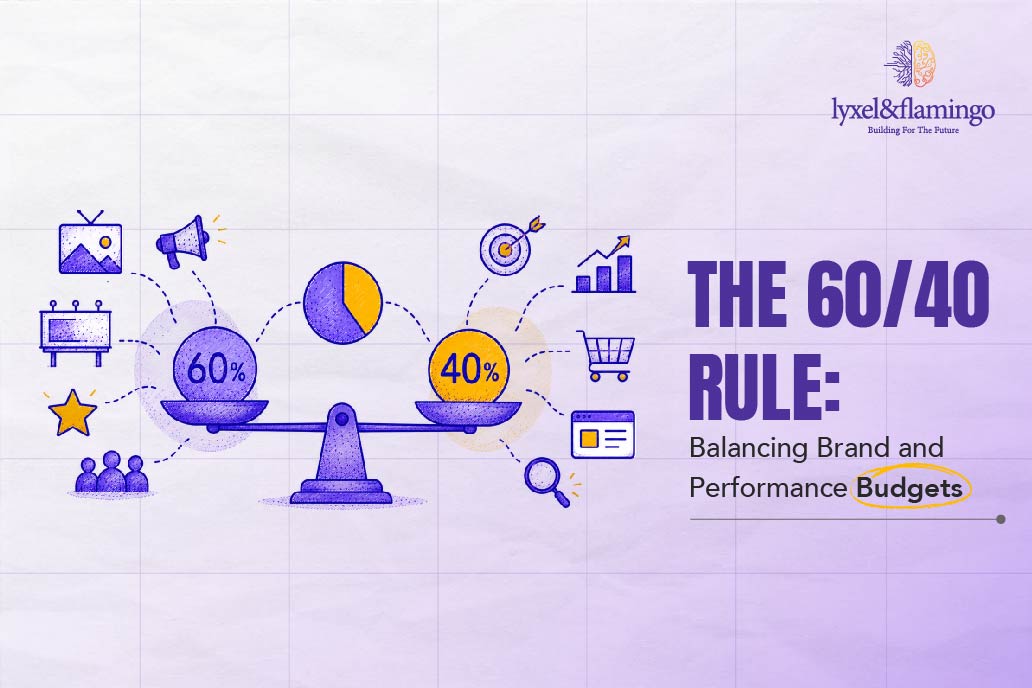
The 60/40 rule is a budgeting heuristic from Les Binet and Peter Field: allocate around 60% of spend to brand building and 40% to sales activation. Brand building is broad, emotional, long-term work that creates future demand; activation is targeted, rational, short-term work that converts demand now. The ratio is a starting point for balance, not a law.
Brand building and sales activation are the two pillars of this media split:
- Brand building: broad, memorable, long-term work that creates future demand (~60%).
- Sales activation: targeted, rational, short-term work that captures demand now (~40%).
- The ratio is a defensible default from 996 IPA case studies; adjusted by stage and category, not abandoned.
In practice, the ratio is a portfolio decision measured on two different clocks: the brand share buys future demand, mental availability and pricing power over months and years, while the activation share converts demand that already exists this week.
The Profit Curve Hiding Inside Your Budget Split
The 60/40 split comes from analysis of 996 campaigns in the IPA Databank, which found this balance produces the maximum combined short and long-term profit (Binet & Field). Tilt too far to activation and you harvest yourself into stagnation; too far to brand and you leave near-term revenue on the table.
It is a baseline, not dogma. B2B skews closer to ~46/54, and early-stage brands often need more activation first; the discipline is to hold a deliberate ratio and defend the brand share when budgets get cut (WARC).
Get the ratio wrong and the damage is invisible for a quarter, then permanent. Over-index on activation and your branded search, direct traffic and pricing power slowly erode until acquisition costs climb and growth flattens, at which point ‘more performance budget’ only makes it worse. The split is the single highest-leverage decision on the media plan.
The Four Ways Budget Splits Drift Off Course
- When budgets tighten, brand is cut first because it is the hardest to defend in a last-click review.
- Activation-heavy mixes show great ROAS while overall growth quietly flattens.
- The split is set by internal politics, not by evidence or growth stage.
- Brand and activation are measured on the same short-term metric, so brand always “loses”.
Framework: The 60/40 Balance
Two Budgets Running on Two Different Clocks
Brand creates demand; activation captures it. Hold the ratio; adapt it with evidence.
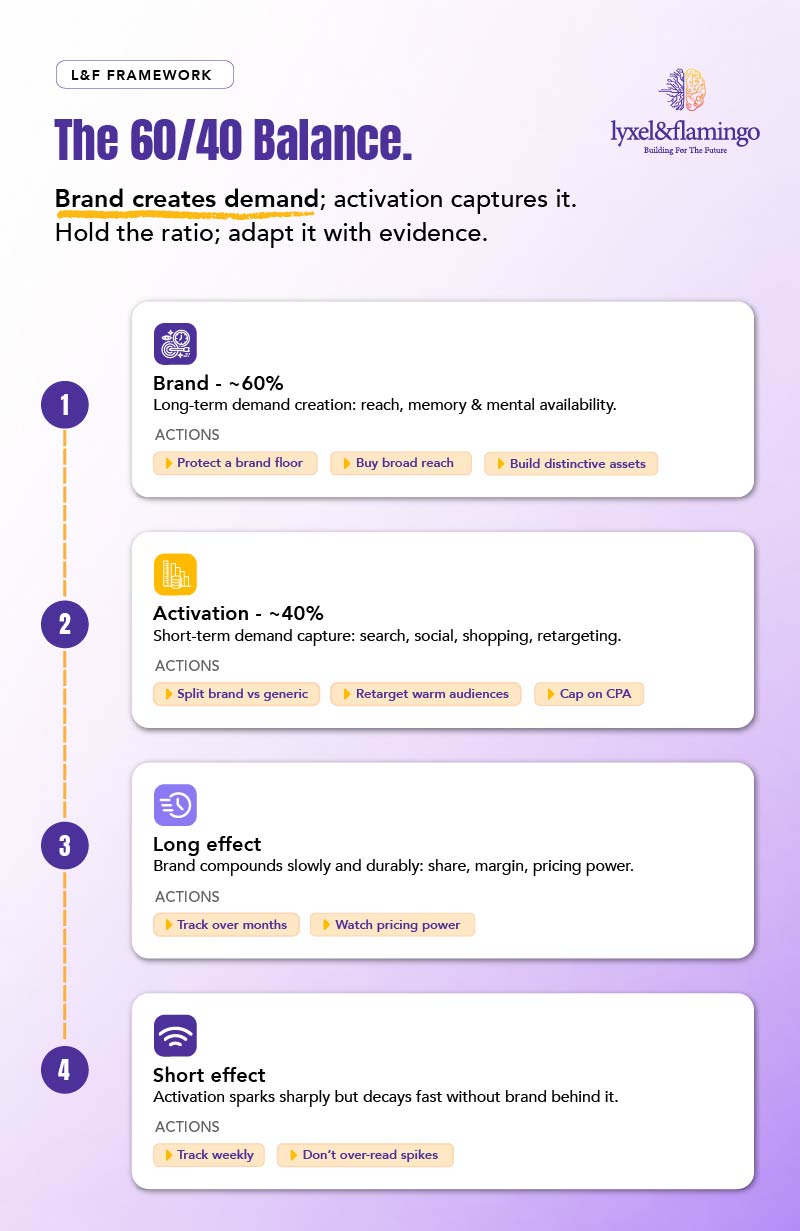
Inside the Balance: What Each Layer Fixes
01. Brand ~60%:
The problem it fixes: When budgets tighten, brand is cut first because last-click can’t defend it, and the demand engine slowly starves.
How this layer solves it: The ~60% brand allocation is a protected floor: broad reach and distinctive assets that build the future demand every activation pound later harvests, defended precisely when it’s tempting to raid it.
In practice: Hold a named brand-building line that survives budget cuts, and report it on branded search and share of search, not weekly ROAS.
02. Activation ~40%:
The problem it fixes: Activation-heavy mixes post great ROAS while overall growth quietly flattens, because you’re only harvesting existing demand.
How this layer solves it: The ~40% activation layer stays efficient and accountable: search, social and retargeting, but is sized to the demand brand creates, not treated as the whole plan.
In practice: Run search, social and retargeting to a CPA or MER target, and size it to the demand brand has created, not as the whole plan.
03. Long effect:
The problem it fixes: Brand effects are dismissed as unmeasurable, so long-term value is ignored in favour of this week’s number.
How this layer solves it: Naming the long effect forces a longer measurement horizon: share, margin and pricing power tracked over months, so brand’s compounding return is actually seen and credited.
In practice: Review the long effect quarterly against margin, price realisation and organic/direct traffic, the metrics that reveal compounding.
04. Short effect:
The problem it fixes: Teams over-read short-term spikes and dips, whipsawing budget and destroying learning.
How this layer solves it: Understanding the short effect: sharp but decaying, sets the right expectation for activation, so you judge it weekly without letting a spike or dip rewrite the whole strategy.
In practice: Expect activation to spike and decay, so judge it on rolling four-week efficiency, never a single day’s number.
The Traps Worth Naming Early
- Rebalancing to near-all activation the moment a quarter looks soft, harvesting short-term revenue while starving next year’s demand.
- Measuring brand and activation on the same last-click metric, guaranteeing brand always “loses” the comparison.
- Copying a competitor’s ratio without adjusting for your category, margin structure and growth stage.
- Treating 60/40 as a fixed law rather than a starting point you tune with evidence.
How to Find Your Real Split, Then Move It
Start by finding your real split. Add up everything that builds future demand: broad-reach video, brand campaigns, sponsorships, always-on brand-term defence, and everything that captures existing demand: performance search, shopping, retargeting, lower-funnel social. Most brands discover they are running closer to 20/80 than 60/40, which is exactly the pattern behind rising CAC and flat growth.
Then move deliberately, not overnight. Shift five to ten points toward brand over a quarter, and protect that share in the plan so it cannot be raided the moment a week looks soft. Put two leading indicators on the leadership dashboard: branded search and share of search, so the brand investment is visible long before it reaches the revenue line.
Finally, re-baseline every quarter and adjust with evidence, not instinct. Nudge toward activation early in your growth, and toward brand as you scale and start defending share. The specific number matters less than the discipline of never letting short-term measurement quietly defund the long-term engine.
What Good Looks Like
A well-run brand-to-performance split does not feel like a fixed rule; it feels like a living portfolio. The brand line is protected and reported on its own terms, the activation line is sized to the demand the brand creates, and the two are reviewed on different clocks. When it is working, activation efficiency quietly improves over time even though nothing changed in the performance account, because there is simply more demand for it to capture.
The signals a leader should watch are almost all leading. Rising branded search and share of search say the brand share is doing its job; stable or falling CAC at constant spend says the activation share is benefiting; and a healthy ratio of new-to-returning demand says the whole system is compounding rather than leaking. If branded search is flat while activation spend climbs, the split has drifted too far toward the short term.
Get the balance right and the compounding is real: cheaper acquisition, stronger pricing power, and a brand that is chosen rather than merely found. The brands that struggle are almost always the ones that let a soft quarter collapse the brand share to zero, and then spent the next year paying more to reach demand that had quietly evaporated.
Signals to Watch
- Branded search and share of search:is the brand share working?
- New-to-returning demand ratio: is the system compounding?
- Blended MER and contribution margin, not last-click ROAS.
- CAC trend at constant spend: is activation getting cheaper?
From Standing Start to 2.5X: boAt Nirvana
For boAt’s Nirvana line, we invested in brand building to make a brand-new sub-brand salient, and the activation followed. Branded search for the sub-brand rose 42% and Meta ROAS reached 2.5X, with a 44% video view rate feeding the funnel. The brand work was not a cost; it was what made the performance efficient.
What made the boAt Nirvana result repeatable was sequence, not spend: the brand-building reach came first and lifted sub-brand search 42%, which then made the activation layer cheaper and the 2.5X Meta ROAS achievable. Cut the brand half and activation would have paid more to chase demand that no longer existed, the exact trap the 60/40 discipline is designed to prevent.
The split only works inside a connected system: it delivers the full-funnel media engine, it is why creating demand raises the ceiling the activation half harvests, and it feeds profitable performance. To defend the brand share when budgets are cut, watch branded search as your early proof.
Score Your Own Budget Split: The 60/40 Scorecard
Score your operation against the following criteria. Give yourself one point for every “Yes”.
- Ratio
You run a deliberate brand-activation ratio, reviewed quarterly, not set by whoever shouts loudest.
- Defence
A protected brand-building floor that survives budget cuts.
- Stage-fit
The ratio reflects your growth stage and category, not a copied number.
- Measurement
Brand and activation judged on different horizons and metrics.
Key Takeaways
- 60/40 (brand/activation) is the profit-maximising baseline from 996 IPA case studies.
- Adapt it by stage and category: B2B ~46/54, early-stage more activation, but hold a deliberate ratio.
- Protect the brand share when budgets get cut; that is when it is most tempting, and most costly, to raid it.
- boAt Nirvana: brand investment lifted sub-brand search +42% and made 2.5X Meta ROAS possible.
The One Decision Everything Else Follows From
The 60/40 rule is less about the exact number and more about the discipline it enforces: never let short-term measurement quietly defund the long-term engine. Set a ratio, defend the brand floor, and adjust with evidence.
None of this requires a bigger budget; it requires a more disciplined one. The brands that compound are simply the ones that decided, in advance, what their brand floor was and refused to raid it when a quarter got noisy. Everything else: the ratio, the channels, the tactics, follows from that single act of discipline.
Frequently Asked Questions
The principle: balance long and short, is robust; the exact ratio flexes by category, stage and channel mix. Treat 60/40 as the default you adjust from, not a fixed rule.
IPA analysis points to roughly 46% brand, 54% activation for B2B: a modest tilt toward activation, reflecting longer, more rational buying cycles.
Early on you need proof of demand, so activation leads. But build a brand floor as soon as you scale, or your CAC will keep rising.
Show the leading indicators brand moves first: branded search, direct traffic, share of search, and the falling cost of activation over time.
It looks better on last-click. Blended metrics and incrementality usually reveal that brand is quietly making performance cheaper.
Activation returns in days; brand compounds over months and years. Expect the first signals: rising branded search and direct traffic, within weeks, cheaper activation within a quarter or two, and the full pricing-power and share benefits over a longer horizon. Judging brand on a weekly ROAS is the most common reason it gets cut too early.
You will likely post strong ROAS while growth quietly flattens, because you are harvesting a fixed pool of existing demand and never refilling it. CAC tends to creep up as you exhaust in-market buyers, and recovery is slow because the brand memory that makes activation cheap has decayed.