
Table of Contents
- What Is Creative Fatigue Marketing?
- The Hidden Costs Quietly Draining Your Budget
- How Platform Mechanics Make Creative Fatigue Worse
- The Evidence: What the Data Actually Says
- The Lyxel&Flamingo Three-Layer Creative Rotation System
- What This Looks Like in Practice
- Five Things to Do Before Your Next Campaign Launches
- Conclusion: Creative Fatigue Is a Process Problem
Here’s what it covers
Most performance marketing teams spend hours refining audiences, adjusting bids, and improving landing pages. Yet campaign performance often slips for a different reason. The same ad keeps reaching the same people for too long. Engagement drops, conversion rates soften, and impression costs start climbing. The budget keeps moving, but results don’t move with it.
This blog explores how creative fatigue and frequency waste quietly damage campaign efficiency across platforms such as Meta and Google Display. Fewer clicks on a specific ad, and more repeat impressions. Higher costs without a matching increase in conversions. Many teams miss those signals until performance has already weakened.
To address this, Lyxel&Flamingo’s Three-Layer Creative Rotation System provides a structured approach built around performance monitoring, creative variation, and refresh timing based on spend levels. Through practical examples and clear actions, the blog shows how brands can reduce wasted spend, protect ROAS, and keep campaigns performing longer. Managing creative fatigue is no longer a nice-to-have process. It has become a core part of profitable digital advertising.
Global marketing spend climbed 33% between 2023 and 2024. Purchase intent grew by only 17% across that same period. That 12% impact gap has since deepened to a cumulative 20% fall in marketing effectiveness through August 2025. More budget is going into campaigns than before, and noticeably worse returns are coming out the other end. The cause is not a bad media creative or a poorly built audience segment.
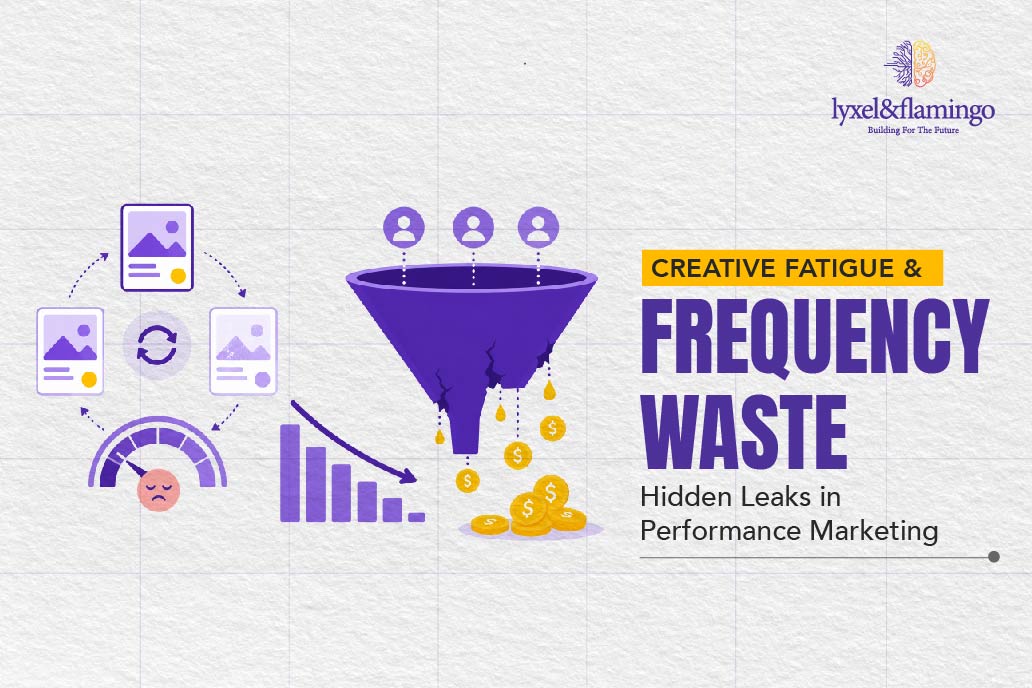
The root problem is creative fatigue, marketing running unchecked alongside frequency waste that most teams are not even measuring. Both failures tend to be invisible in a standard campaign dashboard until the damage has already compounded past a threshold that matters.
Most performance marketing audits go deep on targeting logic, bid caps, audience pools, and landing pages. Very few ever stop to check whether the creative has already been shown to the same people six, seven, or eight times. That kind of repeated exposure doesn’t just burn budget inefficiently. It actively destroys conversion rates, drives up cost per thousand impressions, and erodes brand sentiment quietly while the numbers still look stable enough to justify keeping the campaign running.
This blog covers how that process works at the platform level, how to catch it before ROAS falls apart, and what a structured fix looks like in practice.
What Is Creative Fatigue Marketing?
Run the same ad to the same people often enough, and something fairly predictable happens. After enough exposures, they stop clicking on it. Then, after a few more impressions, they stop noticing it altogether. The platform reads the weakening engagement signals as a relevance problem with the creative, not the audience, and it starts charging you more per impression while quietly shifting delivery toward lower-quality user segments.
Creative fatigue marketing is the formal name for this process. It occurs when a target audience is exposed to the same ad creative often enough that engagement drops, conversion rates fall, and platform algorithms begin penalising delivery because the asset is generating poor relevance signals. The platform does not care why the engagement dropped. It responds by making the creative more expensive to run and serving it to progressively lower-intent audiences to maintain the delivery pace.
It’s not just a frequency problem, though frequency is part of it. It’s a content-audience fit problem that compounds with every additional impression served past the saturation point.
It matters now because creative decay timelines are compressing fast. Meta’s own delivery data show that most ad assets begin to decline in performance after about 7 days at normal spend levels, with high-budget campaigns burning through creative considerably faster. Brands that still treat creative refreshes as a once-a-month calendar task are almost certainly running assets that have already peaked and are starting to slide.
Creative quality now accounts for 49% of a campaign’s total sales lift, per NCSolutions research, outweighing targeting (11%). That single number makes creative fatigue management the most important operational problem that most paid media teams are not treating as a priority.
The Hidden Costs Quietly Draining Your Budget
Here is how this typically plays out across most accounts. ROAS slips below target over two weeks. The team audits the audience segment and widens targeting a bit. They test a new interest layer or push the bid strategy slightly. The creative, which has been running for three weeks already, keeps running because nobody flagged it.
Most teams discover creative fatigue management issues the wrong way, and the fix they reach for is almost always the wrong one. The dashboard isn’t showing them where the problem lives, so they respond to the symptom instead of the source.
The issue has usually been compounding since week two of the campaign. CTR starts softening a few days before CPA climbs. Cost per thousand impressions rises quietly as the platform downranks the overexposed asset in its auction. By the time conversions have declined enough to trigger a formal review, the brand has already spent days, sometimes several weeks, delivering impressions that were converting at a fraction of the creative’s original efficiency. The numbers only look bad in clear hindsight.
For a brand spending ₹1 crore per month on paid media in India, that is ₹20 lakh leaving the account before a single tactical adjustment is even considered. India’s advertising industry surpassed ₹1,00,000 crore (US$ 11.41 billion) in FY25, with digital now claiming 46% of total ad spend according to Crisil Intelligence data cited by IBEF. With digital budgets growing at 9 to 11% each year, the absolute rupee value of this waste grows at the same pace as the market itself.
Industry survey data from Amazon Ads shows that 60% of paid media marketers already identify creative fatigue as a leading challenge in campaign optimisation.
The real leak in performance marketing is not poor targeting. It is the absence of a structured creative rotation system that keeps pace with how fast modern ad platforms exhaust creative assets.
How Platform Mechanics Make Creative Fatigue Worse
When a new creative goes live on Meta, the delivery system does not distribute it evenly across your whole target audience from day one. It runs a learning phase first, identifying the specific users within your target segment who are most likely to engage with that particular asset. This is why performance looks strong in the first few days, and it is also why teams misread that window. The algorithm is serving the creative to cherry-picked, high-propensity matches from your available pool. Marketers often read this initial performance as the campaign’s normal operating baseline. That reading of initial performance simply isn’t an accurate representation of how the campaign will sustain.
Once those high-propensity users have converted, scrolled past, or registered disinterest, the algorithm continues serving the same creative to progressively lower-intent audience segments to maintain the delivery pace the budget is calling for. The cost per thousand impressions begins climbing steadily. The click-through rate on the creative starts dropping. And the team, anchored to the numbers from week one, keeps the creative running and waits for performance to stabilise. It rarely recovers on its own past that point.
Ad frequency optimisation is a separate failure mode from creative fatigue management, even though the two show up together most of the time. Creative fatigue is about an individual asset wearing out with an audience segment. Frequency waste is about the audience pool being too narrow for the daily budget, so the same users are reached repeatedly, even when fresh creative is available in rotation. That is a predictable, measurable decay curve that runs in the background of every campaign that isn’t actively managed against it.
A stale creative at high frequency is the fastest way to simultaneously destroy ROAS and damage brand sentiment. These two failure modes compound each other in ways that are genuinely hard to untangle once both are already in motion.
Here is how they compare operationally:
| Factor | Creative Fatigue | Frequency Waste |
| Root cause | The asset is overexposed to the same audience segment | Audience pool too narrow for daily budget level |
| Primary signal | CTR is declining on the individual ad unit | CPM is rising across the ad set overall |
| First metric to shift | CTR drops before CPA starts climbing | Impression cost rises before conversion rate falls |
| Platform mechanism | Relevance score downgrade and delivery deprioritisation | Auction inefficiency, diminishing marginal returns |
| Fix required | New creative asset or variant rotation | Audience expansion or tighter frequency cap enforcement |
The Evidence: What the Data Actually Says
- Creative quality drives 49% of a campaign’s total sales lift, ahead of targeting (11%). For any brand still treating creative as the last deliverable checked off before a campaign goes live, this number changes the framing entirely. Creative is not a supporting element in performance marketing. It is the primary variable that everything else is built around.
- Global marketing spend rose 33% between 2023 and 2024, but purchase intent grew only 17%, creating a 12% impact gap. That gap widened to nearly 20% by August 2025. Shutterstock 2025 Creative Impact Report, based on 44 months of econometric modelling, AI-powered content analysis, and proprietary creative trend data across sectors. Volume-based marketing is structurally failing in conditions of content saturation and creative fatigue marketing pressure. Spending more on the same system is not solving the problem.
- Strong creative quality delivers 36% higher profitability than weak creative executions, and 20% more than medium-level ones, even on identical platforms and comparable budgets. The finding isolates executional quality as the independent outcome variable. How well the creative is built, not how much is spent amplifying it, is what tilts profitability in either direction.
- The report is direct about what the fix requires. The answer is not tighter audience targeting, rather it is stronger, more differentiated, creative, and built with a cleaner message before anything else is optimised.
The Lyxel&Flamingo Three-Layer Creative Rotation System
At Lyxel&Flamingo’s Media Creative Optimisation practice, we’ve seen this problem across FMCG, D2C, consumer durables, and BFSI clients in India and beyond. The brands that solve it most durably are not always the ones with the biggest creative production budgets. They are consistently the ones with the most structured approach to rotation and ad frequency control.
We use a three-layer system for managing this. We call it the Three-Layer Creative Rotation System. It works because it treats the problem as three separate operating decisions rather than one creative quality question. What to rotate, when to rotate, and how to rotate without disrupting the platform’s learning phase are three distinct problems that need three distinct answers.
Layer 1: The Performance Signal Dashboard
Most teams track ROAS and CPA at the campaign level, and that is the wrong level for catching creative fatigue early. One tired creative pulling down an otherwise healthy ad set looks exactly like a campaign-wide performance issue from the top. The team responds with a bid change or an audience adjustment when the real problem is a single overexposed asset sitting two levels deeper in the account structure.
The analysis needs to be broken down into each ad unit. Track unique CTR on a 7-day rolling window rather than blended CTR. Track frequency per individual creative asset, not per ad set. Watch CPM trends at the ad level specifically. Check the first-time impression ratio in Meta Delivery Insights. When that ratio drops below 50% on top-funnel campaigns, audience saturation has already begun, and the campaign is cycling through the same users instead of finding new ones.
Layer 2: The Creative Variant Architecture
Performance creative testing is not about setting up one variation against a control and waiting for statistical significance to appear. It’s about maintaining a live bench of active variants across three distinct levels at the same time: hook variation, meaning the first three seconds of a video or the primary visual in a static unit; offer framing, meaning the core message and value proposition itself; and format variation, meaning static, video, carousel, and UGC-style units. Accounts running three to five active creative angles consistently outperform those running on a single message, even when the total creative volume is lower. Rotation should be triggered by performance signals, not by a calendar date. The trigger points are: a 10% CTR drop from a creative’s peak, or frequency crossing 2.5 for cold audiences and 4.0 for retargeting audiences.
Layer 3: The Refresh Cadence by Spend Velocity
Creative refresh cycle timelines cannot be uniform across different campaign types and budget levels. At high spend, Meta exhausts a creative asset in 7 to 10 days. At moderate spend, the window extends to 14 to 21 days. The banner ad rotation strategy for display campaigns runs on a slightly different cadence.
Working guidelines for India-market budgets:
- Campaigns above ₹10 lakh per month need weekly creative monitoring and bi-weekly rotation minimum.
- Mid-tier budgets of ₹2 to 10 lakh need fortnightly review with monthly full rotation.
- Below ₹2 lakh, the monthly analysis with rotation triggered when any individual creative crosses a frequency of 3.0 on cold audiences is the minimum viable standard.
In our experience working across D2C, FMCG, and BFSI categories in India, Layer 3 is consistently the most under-built part of the creative operations setup. It is also the layer where fixing things has the most immediate and measurable ROAS impact once corrected.
What This Looks Like in Practice
Take a mid-scale D2C brand running Meta campaigns across prospecting and retargeting funnels, spending ₹25 to 30 lakh per month across both. Prospecting ROAS opened strong at 3.8x and degraded to 2.1x over eight weeks with no structural changes made to targeting or bidding. Retargeting held slightly better, but CPMs on that ad set had climbed 60% in the same window. The creative suite had two hero assets that had been live continuously since the campaign launched. No rotation had taken place during that entire stretch. No frequency cap had been configured at any level.
The fix wasn’t a creative overhaul or a budget reallocation to new platforms. The whole approach required was a system reset, not a creative production sprint.
Three new variants were introduced across different hook styles: testimonial-led, problem-statement-led, and results-first. All three kept the same offer and brand visual language as the original assets. Nothing was rebuilt from scratch because the offer was not the problem. Frequency caps were set at 2.5 for prospecting and 3.5 for retargeting. Creative performance review moved from a monthly calendar task to a weekly 15-minute pull. A minimum bench of five active variants per funnel stage was established as the ongoing operational standard.
A bigger production budget did not fix this. A better audience brief did not fix this. A structured creative rotation system operating on performance signals did, and it took three weeks to start showing in the numbers.
Five Things to Do Before Your Next Campaign Launches
Audit every live creative for frequency and CTR decay before setting new budgets.
Pull a 7-day report at the individual ad level, not the ad set or campaign level. Any creative showing a frequency above 3.0 alongside a CTR more than 15% below its own peak performance is already fatigued and should be paused. Catching a 10% performance decline early costs a fraction of what diagnosing a 40% decline costs three weeks from now, when the budget has already drained at degraded efficiency.
Build a minimum of three creative variants per audience tier before any campaign launches.
Cold traffic, warm retargeting, and cart abandoners each respond to genuinely different hook types and message angles. Problem-aware hooks tend to perform best for cold audiences. Benefit-forward messaging tends to outperform for warm ones. Urgency-led framing performs best when targeting high-intent hot audiences. Don’t go live with a single hero asset regardless of how well it performed in initial testing, because testing conditions rarely match the sustained delivery pressure of a live campaign running at full budget velocity.
Set frequency caps as a campaign default, not a last-minute configuration.
- Cold traffic: 2.5 impressions per user per week.
- Retargeting: 4.0 impressions per user per week.
- Display and programmatic: 2026 benchmark data puts the efficient prospecting range at 5 to 7 impressions per user per week before diminishing returns accelerate sharply.
Every impression past those thresholds costs more than the ones before it and converts at a lower rate. That is not a theoretical claim. That is what the platform performance data shows across categories.
Move creative performance reviews from monthly to weekly.
CTR decay signals CPA decline approximately 5 to 10 days in advance across most platform environments. Monthly reviews mean you are always catching the problem after the budget has already been wasted for weeks without anyone noticing. A focused 15-minute weekly pull of CTR, frequency, and CPM per individual creative asset is sufficient to catch decay early enough to schedule rotation before ROAS slides below target.
Separate the creative refresh cycle planning from the campaign planning cycle.
Creative pipeline planning needs to run four to six weeks ahead of the media execution calendar. Variants need to be built and approved before fatigue sets in, not commissioned in response to falling ROAS after the damage is already visible. Most creative pipeline delays trace back to this single structural misalignment between production timelines and media execution schedules, and it is one of the most fixable parts of the entire operation.
Conclusion: Creative Fatigue Is a Process Problem
Spend is not the constraint for most brands running paid digital at scale in India right now. The constraint is the operating system around the creative itself, specifically the absence of a structured approach to monitoring, rotating, and retiring assets before they start costing more than they return.
Creative fatigue and frequency waste are destroying performance marketing returns at scale, and the fix doesn’t require more budget or a new agency relationship. It requires a more disciplined operating system for how creative assets are built, monitored, rotated, and retired across the campaign lifecycle.
The brands building that system right now are compounding an advantage that competitors spending their way into audience saturation will find structurally difficult to close later.
To understand how short-form creative is designed to convert before fatigue can even begin, read Lyxel&Flamingo’s Creative That Converts in 3 Seconds from the Media Creative Optimisation practice. For a full-funnel view of where creative efficiency connects to targeting quality and data hygiene, Performance Marketing Without Waste maps the broader system.
Speak to L&F’s Media Creative Optimisation team to run a creative fatigue audit on your active campaigns.
Frequently Asked Questions
Look at ad-level performance, not just campaign averages. A weak creative often starts dragging results down before teams spot it. When engagement drops, and the same audience keeps seeing the ad, replace that asset. In many cases, one or two ads create most of the performance problems.
Frequency waste starts when the same people keep seeing an ad. It usually happens when the audience is too small for the budget being spent. Fresh creatives won't fix that. Expand reach, control exposure, and stop paying for repeated views.
Don't refresh creatives just because the calendar says so. Watch performance closely. When clicks start dropping, or the same audience keeps seeing the ad too often, step in. Bigger budgets need weekly checks. Smaller accounts can stretch reviews, but not for too long.
The first warning sign is usually fewer people clicking a specific ad, even when costs still look fine. That gives you some time to react. If reach starts shrinking and repeat views keep rising, performance is already slipping. Negative comments show up much later than most teams think.
No, ad fatigue does not happen at the same speed across all platforms. Social media ads usually reach audience fatigue sooner because users see the same creatives more frequently. Display campaigns tend to decline more gradually. Even so, brands should refresh ad creatives regularly to maintain engagement and campaign effectiveness.