
Table of Contents
- What Is a Single Customer View in Local Marketing?
- What Most Brands Get Wrong About Their GBP Listings
- The India Context: Why Hyperlocal Store Listing Management Is Non-Negotiable
- The L&F Local Intelligence Stack: Five Layers to a Hyperlocal Single Customer View
- Where Lyxel&Flamingo Comes In
- What This Looks Like in Practice: A Multi-Location Retail Brand
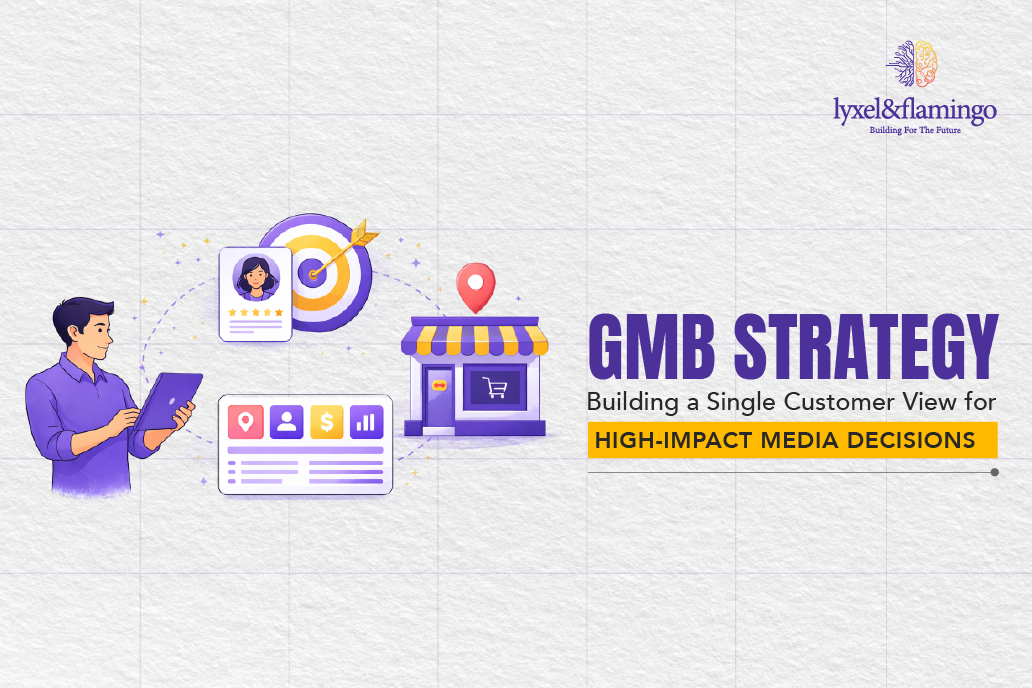
Most brands still treat Google Business Profile like a basic listing. That thinking fails sooner than expected. At scale, it starts breaking quietly. Each profile captures real customer intent signals across locations. Not abstract data, but actual behaviour patterns.
These signals help brands understand demand at a hyperlocal level. National averages don’t really hold here. Different locations behave differently, and it shows clearly. When used right, GMB becomes a working data layer. It feeds media decisions directly, not later. Targeting improves, waste reduces, and visibility gets sharper where it matters.
Multi-location brands in India are making hyperlocal media decisions based on national customer averages. The gap between that fiction and ground-level reality is where media ROI disappears. A retail chain with 200 stores does not have one customer. It has 200 distinct catchment behaviours, 200 sets of search queries, and 200 demand signals. A well-executed Google Business Profile strategy for brands is the mechanism that reads those signals and converts them into something a media planner can actually use.
Most brands are not doing this. Their GBP listings are live but unread. Their single customer view is built from CRM aggregates that flatten geography into one composite profile. And their media investment is allocated based on revenue history, not local demand intelligence.
The result is predictable. Campaigns over-invest in saturated markets. Under-served catchments with genuine intent get skipped. Footfall targets get missed. And nobody traces the problem back to the 200 listing profiles that were never properly connected to the planning process.
What Is a Single Customer View in Local Marketing?
A Single Customer View (SCV) in local marketing is a unified, location-resolved profile of customer behaviour, combining search intent data, footfall patterns, transaction history and engagement signals at the store or catchment level, rather than at the national brand level. Unlike a traditional CRM-based SCV, a local SCV treats geography as a primary variable, not a filter applied after the fact.
This distinction matters now because India’s e-commerce market is projected to cross 200-300 billion dollars by 2030, and because 46% of all Google searches carry local intent, connecting consumers with nearby businesses at the exact moment of need. A brand without a local SCV is planning media against a customer that does not exist at the pin code level, where conversion actually happens.
What Most Brands Get Wrong About Their GBP Listings
Most marketing teams treat Google Business Profile like a directory task. Set it up once, add in an address and a phone number, upload a few photos, and it’s done. Honestly, this is one of the most expensive mistakes a multi-location brand makes, and most of them never trace the ROI problem back to it.
GBP listings now appear across Google Search, Maps, AI-powered local pack results, and voice-based queries. Each profile functions as a live digital storefront. It’s often the first branded touchpoint a customer encounters before they reach your website. Brands treating it like a static listing are leaving that storefront completely unmanned.
Then there is the consistency problem. Mismatched categories, wrong service areas, outdated hours, and NAP data that varies by platform. All of it quietly dilutes local search authority. Small errors compound fast at scale, and they undermine the SEO signals that would otherwise drive organic visibility for free. So the media budget ends up working twice as hard to compensate for a broken foundation underneath.
The fix is not just cleaning up listings. Its treating GBP as the first layer of your customer intelligence stack.
The three data layers that build a hyperlocal SCV from GBP:
Layer 1: Search Query Intelligence. GBP Insights shows the exact search terms customers use to find each store listing. A store in an industrial zone pulls queries around bulk procurement and B2B availability. A store near a residential colony sees searches around weekend hours and delivery options. These are not variations of the same customer. They are different customers with different intents, and they should be receiving different media messages.
Layer 2: Catchment Geometry. Direction request data reveals where customers are physically travelling from to reach each store. This is your real catchment radius, not the circle your media agency drew on a slide. If direction requests for your Whitefield store originate predominantly from Electronic City, your geo-targeting perimeter is wrong. The creative is talking to the wrong neighbourhood.
Layer 3: Sentiment and Operational Signal. Review themes vary by location: parking complaints in one catchment, stock availability in another, wait times in a third. These qualitative signals tell you what each store’s catchment actually experiences, which directly affects what your media creative should address and whether driving footfall to that store is the right call at all.
The comparison that makes this concrete: Traditional CRM-based SCV is a photograph. It shows you where your customer was. GBP-based hyperlocal SCV is a live feed. It shows you where your customer is right now, what they want, and how far they are willing to travel. Media plans built on photographs consistently underperform media plans built on live feeds.
The India Context: Why Hyperlocal Store Listing Management Is Non-Negotiable
India does not run on a single consumer mindset. Everyone in marketing says this. Almost nobody actually acts on it when media plans are being built.
46% of all Google searches carry local intent, connecting users with nearby businesses at the exact moment of need. Indian retailers who have adopted a hyperlocal marketing strategy have reported up to a 50% drop in marketing spend while simultaneously improving ROI. The logic is not complicated. Stop trying to reach everyone everywhere. Start reaching people who are actually close enough to walk in.
Tier 2 and Tier 3 cities are moving faster than most metro-focused media plans give them credit for. Hyperlocal commerce shoppers in India have already crossed 214 million, and the hyperlocal delivery market is projected to triple in size by 2028. A retail chain that only has its metro listings well-maintained is actively ceding ground in markets growing faster than its current priority geographies. That’s a strategic problem, not just an SEO gap someone needs to fix.
Nearly 76% of people who run a local search visit a nearby business within 24 hours, and 28% of those visits result in a purchase. The intent-to-action window in local search is very short. Brands that show up accurately at that moment win the footfall. Brands that don’t, even if they significantly outspent every competitor on the campaign, lose it.
In India’s AI-driven local search environment, listing accuracy, engagement levels and data freshness now directly influence how a profile ranks in results. A listing set up two years ago and never revisited is not sitting there as a neutral asset. Its actively working against you every single day its left untouched.
The L&F Local Intelligence Stack: Five Layers to a Hyperlocal Single Customer View
This is where local SEO for retail chains and media operations has to stop being two separate workstreams that never talk to each other. GBP data should feed into media planning as an input. Do not arrive later as a separate SEO report nobody reads. Here is how you build that connection in practice.
Step 1: Audit and Baseline Every Listing First
Before any media decisions happen, build a per-store GBP health score. Profile completeness, category accuracy, photo freshness, review velocity, Q&A activity, and post frequency. This becomes your baseline intelligence layer. Now you actually know which stores are visible in local search and which ones are functionally invisible, based on data, not assumptions from a planning meeting.
Step 2: Map Store Performance to Real Catchment Zones
Pull direction request data and search query data per store. Use it to define actual customer catchment zones. Not the circles your media agency drew on a map in a deck. Real zones based on where the signal is genuinely originating from. Overlay this against your current geo-targeting parameters. The misalignment is almost always significant enough to change where the budget goes.
Step 3: Prioritise Budget by Demand Signal, Not by Revenue Rank
This part is counterintuitive, and most brand teams resist it at first. Using first-party data like purchase history, store location data and browsing behaviour lets you sharpen hyperlocal ads targeting and make every rupee of media spend work harder. GBP search impression data tells you which stores have the highest local demand but the weakest listing visibility. Those are your highest-ROI media targets. Not flagship stores. Not the highest-revenue locations. The stores where demand is real but visibility is not keeping pace.
Step 4: Localise Creatives by Catchment Theme
GBP Q&A sections and review themes tell you what each locality actually cares about in their own words. A store in a corporate zone is fielding queries about bulk orders and business accounts. A store in a residential colony is getting questions about weekend timings and same-day delivery. A single national creative cannot answer both of those simultaneously. Localised media assets built around real catchment themes consistently outperform generic national executions on conversion rate, and not by a little margin.
Step 5: Close the Loop and Use GBP as an Attribution Layer
Track new profile views, direction requests and website clicks through GBP Insights while your campaign is actively running. These become offline-intent attribution signals that connect media spend directly to store-level activity. This is especially critical in India, where last-click attribution consistently undervalues the role local media plays in the conversion path. A customer who saw a geo-targeted ad, searched on Maps, requested directions and walked in, that entire journey lives inside GBP data. Most brands are not connecting those dots at all.
Where Lyxel&Flamingo Comes In
Most agencies treat Google Business Profile optimisation as an SEO checkbox item. Something the SEO team handles once a quarter and reports on in a spreadsheet. We treat it as a media intelligence function. That is a fundamentally different starting point, and it changes everything downstream.
There is a very real gap in how multi-location brands manage the relationship between listing health and media performance. SEO teams optimise listings. Media teams plan and execute campaigns. The intelligence that lives between those two, the catchment data, the search query signals, the review sentiment, the footfall attribution, nobody owns it properly. That gap is exactly where poor media ROI quietly lives and compounds month after month.
At Lyxel and Flamingo, we build hyperlocal marketing strategy frameworks that connect store-level GBP data directly to media planning inputs. The campaign brief starts with real demand signals, not assumptions made in a conference room three weeks before go-live. We run multi-location GBP audits, build listing health scorecards per store, and map search intelligence to actual catchment zones that your media team can use immediately.
Whether you are an FMCG brand managing 500 distributor touchpoints across India or a retail chain running 80 stores across Tier 1 and Tier 2 cities, the work always starts with understanding what each location is already telling you. That data exists right now. Most brands are simply not reading it.
What This Looks Like in Practice: A Multi-Location Retail Brand
A leading retail chain with over 80 stores across Tier 1 and Tier 2 cities came to L&F’s Media Operations practice with a consistent problem: strong national campaign metrics but highly uneven footfall performance across store locations. Some stores over-performed against footfall targets. Others consistently underperformed despite receiving similar media investment. The variance was not explained by store size, market maturity or product mix.
What we found when we ran the Local Intelligence Stack audit was a different problem entirely. The brand had 80 live GBP listings. Fewer than 30 had accurate, category-specific service areas. NAP data was inconsistent across listings and third-party directories. The review response rate was below 10%. And critically, no GBP search query data had ever been analysed as a media planning input. The media team did not know the data existed.
After applying the Local Intelligence Stack across all 80 stores:
- Catchment geometry analysis revealed that geo-targeting parameters in 14 high-priority stores were missing 20-35% of the actual customer origin zones. Spend was being deployed outside the areas where real demand was concentrated
- Search query mapping identified 6 high-intent query clusters that were generating listing interactions but had no corresponding creative or keyword investment in the media plan
- Review sentiment clustering flagged 3 stores with recurring stock-availability complaints. Media spend driving footfall to those stores was paused pending operational resolution
- Listing health remediation across all 80 stores produced measurable improvement in local pack visibility within 60 days, reducing the organic visibility gap the paid media budget had been compensating for
The result was a reallocation of approximately 22% of the existing media budget toward stores and catchments where the intelligence showed genuine unmet demand, without increasing total spend.
Conclusion
Brands put crores into media planning every year. Research, creative, targeting infrastructure, distribution strategy. And then they make all those decisions without ever reading the most accurate, real-time, intent-rich data source they already own. Their own GBP listings.
Treating GBP as a strategic data layer instead of a listing task is not a technical upgrade. It’s a mindset shift. One that closes the distance between what your media plan assumes and what your customers are actually doing at the store level, right now, in their own neighbourhoods.
The GBP listings you already own are generating customer intelligence at the catchment level every day. The question is not whether to collect it. The question is whether your media planning process is designed to use it.
For brands managing multiple locations across India’s fragmented, deeply hyperlocal markets, that shift is the difference between generic reach and media decisions that actually move footfall on the ground where it counts.
Speak to L&F’s Media Operations and Local SEO Practice about a Local Intelligence Stack audit for your brand. We will assess the health of your current listings across all locations, map your real catchment zones against your existing media parameters, and identify the specific gaps between your GBP data and your current media brief. No generic recommendations. A location-specific intelligence gap analysis.
Frequently Asked Questions
Having listings live is just the starting point, not the finish line. Incomplete or inconsistent listings actively suppress local rankings and break the customer journey right at the last mile. The real value starts when listings are regularly optimised, monitored and fed into your media planning, not just sitting unchanged for months.
GA tells you what happens after someone reaches your website. GBP tells you what happens before that, what they searched, whether they asked for directions, and whether they called the store directly. For multi-location brands, that pre-visit intent layer is often richer and more actionable than anything post-visit web data can show you.
It won't be a perfect SCV, but yes. GBP Insights, per-location review data and search query reports give you a working version of localised customer intelligence without heavy tech investment. Its a practical starting point for brands still building out their data infrastructure.
At minimum, a monthly review covering hours, photos, posts and service details. But for retail chains and FMCG brands running seasonal promotions or campaign-specific offers, syncing listing updates directly with your campaign calendar makes a measurable difference in store-level visibility and footfall conversion.
It's both, and that's entirely the point. GBP data reveals where real demand exists at the catchment level, which directly improves how you allocate media budget, sets geo-targeting parameters and localises creatives. Brands that connect listing intelligence to media planning see consistently better ROI because they stop spending against assumed audiences and start spending against verified, real-time intent signals.