
What this blog covers
Shopify Markets has changed how Indian D2C brands can expand globally, but many businesses still approach international growth with an outdated structure. This blog explains why creating separate Shopify stores for every country is no longer the default answer in 2026. It breaks down how one Shopify backend can support multiple currencies, languages, taxes, and regional experiences without making operations harder.
Table of Contents
- What Is Shopify Markets?
- Most Indian D2C Brands Face Structural Issues Before Global Expansion
- How Shopify Markets Turns One Store Into Fifty Storefronts
- The Numbers Behind the 2026 Rush to Go Global
- The Market Activation Stack: Lyxel&Flamingo's Sequencing Framework
- What This Looks Like When the Sequencing Is Right
- 5 Things to Do Before You Switch On Your Next Market
- Conclusion
It also covers common mistakes brands make before launching new markets, why sequencing matters more than speed, and when a dedicated regional store still makes sense. Beyond setup, it looks at pricing strategy, compliance, localisation, APIs, and the business decisions that affect long-term profitability. Real market data and practical examples show why global expansion is now more about execution than technology. For Indian brands planning cross-border growth, this blog offers a structured approach that reduces unnecessary complexity while keeping international operations easier to manage from one store.
A single Shopify store can now sell in more than 150 countries, price in more than 130 currencies, and run checkout in 20 native languages, without a second store, a second domain, or a second ops team. That’s not a feature announcement. It’s the reason most “should we build a US store” conversations happening in Indian D2C boardrooms this year are asking the wrong question entirely.
Most brands still treat international expansion as a rebuild, because that’s how it worked back in 2019. They brief a new theme, register a new domain, and sometimes stand up a whole second tech stack. Shopify Markets changed the unit of expansion from “store” to “market” inside the same store, and brands still budgeting for duplicate storefronts in 2026 are paying, in engineering hours and support tickets, for a problem Shopify already solved.
At Lyxel&Flamingo, the Commerce Strategy work we do with D2C brands expanding out of India rarely opens with a platform question anymore. It opens with sequencing: which market first, which currency logic, which tax model, in what order. Get the sequencing wrong and Shopify Markets ends up just as messy as five separate stores, only harder to untangle because everything now lives in one admin.
What Is Shopify Markets?
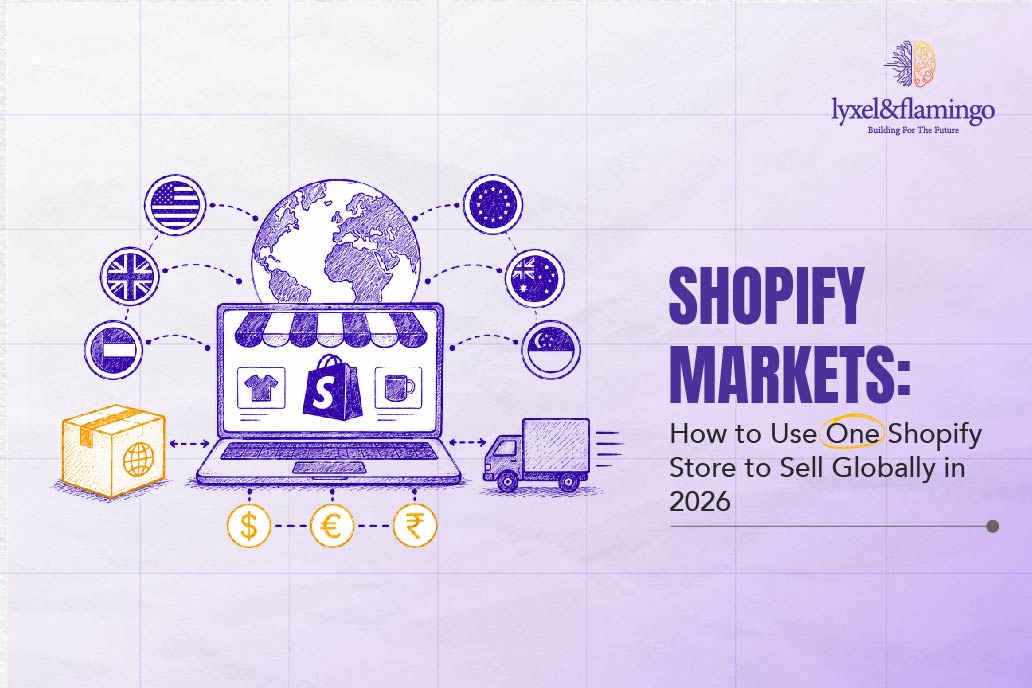
Shopify Markets is Shopify’s native infrastructure for running multiple country-specific storefronts from a single backend: one product catalogue, one inventory count, one admin login, with local currency, language, tax, and duty logic layered on top for each region. It replaced the older workaround of spinning up a separate Shopify instance per country. A merchant can activate a primary market plus additional markets, up to 50 in total, each carrying its own domain or subfolder, pricing rules, and checkout behaviour, according to Shopify’s own developer documentation.
2026 changes the equation for global selling. Buyers expect local prices and familiar payment methods, not a USD-only checkout anymore. Many brands still lose revenue without noticing it. A Shopify multi-currency, multi-language store keeps everything under one backend, and the business stays much easier to manage across markets.
How to Sell Internationally on Shopify
Stripped down to the mechanics, here’s what turning on international selling involves, step by step:
- Enable Shopify Markets in your admin and confirm your primary market, then add each new country or region as its own market.
- Assign a presentment currency and language to every market, using automatic conversion or fixed local pricing depending on how tightly you want to control margin.
- Add HS codes to your product catalogue so duties and import taxes can be calculated correctly at checkout instead of surprising the customer later.
- Choose your tax and compliance model. Register and remit in each country yourself, or route the obligation through Managed Markets.
- Localise checkout and transactional emails, not just the storefront. This is the step brands skip most, and it’s the one customers notice first.
- Launch one market at a time, starting with whichever country already shows organic demand rather than the one that looks most ambitious on a slide.
Most Indian D2C Brands Face Structural Issues Before Global Expansion
India’s B2C e-commerce exports currently sit at roughly US$2 billion, a fraction of what the country’s manufacturing and brand base could realistically support, according to IBEF. Set that against Amazon’s own stated ambition to help quadruple India’s e-commerce exports toward $80 billion, and the gap stops looking like a market-size problem. It starts looking like an execution problem, and a fairly ordinary one at that.
Here’s the pattern that shows up again and again in our Commerce Strategy conversations with founders. A brand starts getting international orders through Instagram DMs or a marketplace listing, gets excited, and reacts by commissioning a second Shopify store for “the US market.” Eighteen months later, they’re running three storefronts, three inventory syncs that drift out of alignment every few weeks, three separate SEO profiles competing against each other for the same backlinks, and one support team fielding the same ticket across three different admin panels.
None of this is really a technology failure. It’s a sequencing failure, plain and simple. Brands are solving for the country before they’ve solved for the underlying structure, and this is where Shopify cross border ecommerce India strategy conversations usually need to start over from scratch. Every market a brand adds through a duplicate store instead of through Shopify Markets is a maintenance cost that compounds for as long as that store stays live.
How Shopify Markets Turns One Store Into Fifty Storefronts
A “market” in Shopify’s architecture isn’t a separate store. It’s a rule set: a group of countries assigned a currency, a language, a domain pattern, and a catalogue, sitting on top of the same product database every other market reads from. Change a product description once, and every market that hasn’t been given its own localised override inherits that change automatically, no re-entry required.
Three currency concepts matter here, and most merchants only ever learn one of them the hard way. The presentment currency is what the shopper sees on screen and pays with. The shop currency is the merchant’s own reporting currency, used to convert every sale back for analytics purposes. The settlement currency is what lands in the merchant’s bank account, and it doesn’t always match either of the first two. Get this distinction wrong early, and your finance team spends months reconciling numbers that were never designed to match in the first place.
For merchants who don’t want to own tax registration and remittance in every country they sell into, Managed Markets (Shopify’s current name for what used to be sold separately as Shopify Markets Pro) hands that obligation to a third-party merchant of record, so a brand never has to register for VAT in Germany just to ship fifty orders a year there. The trade-off is a transaction fee of 3.25% to 3.5%, depending on the plan, plus a 1.5% currency conversion fee. Not free, but usually cheaper than the compliance headcount the alternative would need. Get this part right, and the rest of your Shopify international selling setup and Markets configuration is mostly a sequencing exercise, not an engineering one.
Shopify Markets vs Multi-Store Setup: Which One Fits Your Brand
This is the comparison every D2C founder eventually has to make, and the honest answer is “it depends on catalogue overlap,” not “Markets always win.”
| Factor | Shopify Markets | Multi-Store Setup |
| Admin & team | One login, one team manages everything | Separate login and often separate team per store |
| Inventory | Single source of truth across markets | Manual or app-based sync, with real drift risk |
| SEO | Shared domain authority across subfolders/subdomains | Authority split across separate domains |
| Cost structure | One Shopify plan, plus FX and transaction fees | A full plan per store, plus duplicated app subscriptions |
| Best fit | Markets sharing a catalogue and centralised operations | A market needing a distinct legal entity, catalogue, or fully autonomous regional team |
Shopify Markets vs multi-store setup isn’t really a technology debate, it’s a question about how much regional autonomy your business needs. If a market needs a genuinely different product range, its own legal entity, or a regional team with full control over merchandising, a dedicated store can still be the right call. We’ve seen brands run a deliberate hybrid: Markets covering the twenty-odd countries that share a catalogue and central ops, with one dedicated store reserved for the single market, often the US or the Gulf, that needs its own pricing logic and its own team.
The APIs and Integrations Behind Shopify Markets
For brands building headless storefronts or customising checkout logic, this entire layer is exposed through code, not just the admin panel, which is where Shopify Plus global expansion strategy for D2C brands conversations tend to get technical fast.
The Markets API, part of the GraphQL Admin API, lets developers define markets, assign price lists, and configure tax and duty logic programmatically, useful once a brand is managing pricing across dozens of markets and doing it by hand in the admin stops being realistic. The Storefront API handles the buyer-facing side of things: querying local prices, available countries, and supported languages, so a custom-built frontend shows the correct currency and language without guessing at a visitor’s location.
Translation runs through the Translate & Adapt API, which writes directly into Shopify’s own translation database rather than a third-party vendor’s, meaning a brand that switches translation apps later doesn’t lose its content in the process. For duties and taxes, Shopify’s Harmonised System (HS) code system and its Duties & Import Taxes engine calculate landed cost at checkout automatically, and merchants who’d rather hand off the whole compliance burden route it through Managed Markets instead.
Underneath most of this sit Shopify Functions and Shopify Flow, which let developers write custom logic (a discount that only applies in one market, automatic tagging when an order needs extra customs paperwork) without ever touching the storefront theme. None of these is exotic tools reserved for enterprise accounts. They’re the same building blocks Shopify gives every developer, applied specifically to the market layer, and together they’re what make a real Shopify Markets setup guide look different from a checklist of admin toggles.
The Numbers Behind the 2026 Rush to Go Global
The case for Shopify Markets’ global selling in 2026 isn’t a hunch or an agency talking point. Five numbers, from five separate sources, make it explicit.
- Seven in ten consumer products executives expect high-growth opportunities beyond their traditional markets by 2026, with Southeast Asia and India named as the two highest-potential regions. For any Indian D2C brand deciding where to expand first, that’s not a hunch. It’s where global growth capital is already pointed.
- India’s e-retail market scaled to $65–66 billion in GMV in 2025, growing at 19–21% a year, with shoppers roughly doubling to 290–300 million over five years. Domestic growth at that pace is exactly what’s funding the current wave of Shopify global expansion, D2C brands India stories, most of it self-financed rather than backed by fresh external capital.
- India’s cross-border B2C e-commerce market is projected to grow from $10.94 billion in 2025 to $13.57 billion in 2026, on its way past $36 billion by 2031. That headroom isn’t a projection built on hope, it’s already priced into three different forecasting models.
- During BFCM 2025, cross-border orders made up 16% of all global order volume on Shopify, and cross-border sales grew 22% year over year, outpacing domestic growth. When the busiest shopping weekend of the year skews more international every cycle, a brand’s checkout experience for a first-time overseas buyer stops being a nice-to-have.
The Market Activation Stack: Lyxel&Flamingo’s Sequencing Framework
When we scope a Shopify Markets setup guide for a Commerce Strategy client, we don’t start with countries. We start with layers, because the order things get switched on in decides whether the first ninety days build momentum or just bury the operations team in tickets. We call it the Market Activation Stack.
- Compliance and Currency Layer: Register your tax obligations, or route them through Managed Markets, assign HS codes across your full catalogue, and decide your presentment-currency logic before a single new market goes live. This step is unglamorous, and every founder wants to skip straight past it.
- Localisation Layer: Language, local payment methods, and genuine content adaptation, not just machine translation pasted over the top. A price ending in .99 doesn’t carry the same psychology in Tokyo that it does in Toronto, and neither does urgency-driven copy.
- Pricing Layer: This is the layer we see underinvested most often, by a wide margin. Most brands let Shopify auto-convert prices at the live exchange rate and never revisit it, which means a currency swing can erode margin in a market nobody’s actively watching, order after order, for months. A deliberate Shopify international pricing strategy, fixed local pricing in your top three markets and automatic conversion everywhere else, protects margin without needing a dedicated pricing analyst on staff.
- Demand and Discovery Layer: Local SEO, correct hreflang implementation, and increasingly, structuring content so AI assistants and answer engines can correctly tell a shopper whether a brand ships to their country at all. This layer comes last on purpose. There’s no return on driving demand into a market whose checkout isn’t ready to receive it.
Skip layer one, and layer four turns into expensive traffic landing on a broken experience. Skip layer three, and a brand ends up funding growth in a market that’s losing it money on every single order it fulfils, often without anyone noticing for months.
What This Looks Like When the Sequencing Is Right
Bombay Shaving Company, one of India’s better-known D2C grooming brands, moved off Magento onto Shopify Plus to handle a scale of traffic and order volume it had genuinely outgrown. What its published results show is instructive for any brand thinking about layering international markets on top of a shaky foundation:
A 150% uplift in conversion rate and a 20x increase in online revenue after the migration, with the platform now supporting mega-sale days of 50,000-plus orders without disruption.
That’s roughly what a foundation capable of carrying Shopify Markets needs to look like before a single international currency ever gets switched on. In our own Commerce Strategy work with Indian D2C brands preparing to expand into the UK, US, and Gulf markets, the same pattern shows up repeatedly: brands that treat their domestic Shopify Plus setup as infrastructure, not just a storefront skin, are the ones whose international launch takes weeks instead of quarters. The ones who try to bolt Markets onto a fragile, plugin-heavy store tend to end up rebuilding twice, once for the fix, and once more for the expansion they originally wanted.
5 Things to Do Before You Switch On Your Next Market
- Audit your HS codes before you enable duty collection. Missing or mismatched codes are the single biggest cause of the “surprise customs bill” complaints that tank repeat-purchase rate in a brand-new market.
- Decide your pricing model market by market, not once for every market at the same time. Fixed local pricing for your top three revenue markets, automatic conversion for the long tail, reviewed at least once a quarter.
- Check your entire app stack for Markets compatibility before you migrate anything. Not every app a brand relies on domestically works cleanly once multiple currencies and markets enter the picture. Test it in a development store first, not in production.
- Translate checkout and transactional emails, not only the product pages. A customer who receives an order confirmation in a language they can’t read loses trust fast, and this is the single most commonly skipped step we see.
- Pick your first market using existing demand signals, not internal ambition. Look at where organic traffic, social followers, or marketplace orders are already coming from before choosing a “strategic” market that currently has zero pull toward the brand.
Conclusion
Shopify Markets removes the technical excuse for staying domestic. It does not remove the sequencing work, and that’s precisely where most launches still go wrong even now. The brands pulling ahead this year aren’t the ones with the biggest international ambition. They’re the ones treating currency, tax, pricing, and demand as four separate decisions made in the right order, inside one store, instead of one rushed decision made all at once.
If you’re mapping a Shopify Markets rollout, or trying to work out whether your current multi-store setup is costing more than it earns, Lyxel&Flamingo Commerce Strategy practice can walk through your specific market sequencing before you commit engineering time to it. Book a Commerce Strategy session to leave with a market-by-market activation plan, not just a platform recommendation.
Frequently Asked Questions
Shopify Markets groups countries into "markets" inside a single store, each carrying its own currency, language, domain pattern, and tax rules, layered on top of one shared product catalogue. You configure it once inside the Shopify admin, and the storefront adapts automatically to each shopper's location. A store can run up to 50 markets from one backend.
Yes. Shopify Payments supports 130-plus currencies, so a single store can display and charge in USD, GBP, INR, and dozens of others depending on the shopper's market, with no separate storefronts required. Prices convert automatically by default, or you can set fixed local pricing per currency for tighter margin control.
For most Indian D2C brands, Shopify Markets on a Shopify Plus plan, sequenced through compliance, localisation, pricing, and then demand, outperforms a multi-store setup, unless one specific market genuinely needs its own legal entity or fully separate catalogue. Start with the market where organic demand already exists rather than the one with the largest addressable population.
Assign HS codes to every product first, then either configure duty collection at checkout yourself through Shopify's Duties & Import Taxes tools, or route the entire obligation through Managed Markets, where a third-party merchant of record handles tax registration and remittance on the brand's behalf.
If a brand already sees organic international orders or DMs asking about shipping abroad, yes, since the added infrastructure cost stays close to zero beyond the existing Shopify plan and standard fees. If there's no existing cross-border demand signal at all, that gap is worth closing first. Markets remove the technical barrier to expansion, not the demand-generation work behind it.