
What this blog covers
Google keeping third-party cookies in Chrome did not remove the bigger marketing problem. Most brands are still relying on browser tracking, while customer data they already own remains disconnected across CRM systems, Shopify, and WhatsApp. This blog explains why signal-based marketing has become the better long-term approach. Instead of depending on browser cookies, brands can improve targeting and attribution using consented first-party customer data.
Table of Contents
- What Is Signal-Based Marketing?
- Google’s Cookie Reversal Didn’t Close the Targeting Gap
- How Signal-Based Marketing Works Without Cookies
- The Data Behind the Shift
- The Signal Custody Chain: Lyxel&Flamingo's Framework for Cookieless Campaigns
- What This Looks Like for a D2C Brand in Practice
- 5 Things to Do Before Your Next Campaign Brief
- Google Isn’t Setting the Real Deadline
It also introduces the Signal Custody Chain, a practical framework covering data capture, connection, activation, and measurement in the right order. Industry research shows advertisers using owned signals report stronger campaign performance and more reliable attribution. The article also walks through a realistic Indian D2C example and outlines simple actions brands should take before planning the next campaign.
Waiting for another browser update will not improve marketing performance. Building better customer signals today creates stronger campaigns, better measurement, and results that keep improving over time.
Google spent six years building a replacement for the third-party cookie. On 17 October 2025, it retired most of that program and confirmed third-party cookies are staying in Chrome, with no removal date attached.
For a lot of Indian marketing teams, that news read as relief, though it probably shouldn’t have. Firefox has blocked cross-site tracking cookies by default for every user for years now, and Safari has done something close to that since 2020. Chrome keeping cookies alive never closed that gap. It just meant fewer teams noticed the gap was there.
The real shift underway has very little to do with a browser deadline. It’s about signal-based marketing, targeting and measurement rebuilt on data a brand collects and owns directly, rather than borrowed from a cookieless or cookie-based file dropped by someone else’s ad tech. And the brands getting this right are learning something most cookie-replacement content skips entirely.
What Is Signal-Based Marketing?
Signal-based marketing is the practice of targeting and measuring campaigns using data signals a brand collects and controls directly:
- hashed emails,
- logged-in behaviour,
- app events,
- CRM records, and
- server-side conversion events,
- instead of third-party cookies
- Dropped by outside AD tech.
Where cookie-based targeting borrowed identity from the browser, signal-based marketing sources identity from systems the brand owns outright, then passes it to ad platforms through consented, server-side connections rather than a browser pixel.
It matters right now because the industry spent years waiting for a hard cookie cutoff that Google itself walked back twice, once in 2024 and again in April 2025. Brands that treated a Chrome deadline as their trigger to modernise their first-party data marketing strategy lost time they didn’t need to lose. The ones who didn’t wait are now running cleaner campaigns on Safari, Firefox, and in-app browsers than competitors still leaning on cookie logic.
Google’s Cookie Reversal Didn’t Close the Targeting Gap
Most Indian marketing teams planned 2025 media around one assumption. Chrome will remove third-party cookies soon. That deadline never arrived, and the plan looked wrong twice already, leaving many teams reworking campaigns again fast. Google backed off a standalone cookie consent prompt in April 2025, then retired the bulk of its Privacy Sandbox program, including the Attribution Reporting API and Protected Audience, in October 2025. For anyone tracking Google Privacy Sandbox developments out of India, where Chrome carries the large majority of mobile browsing, that reversal changes the planning math more than most media plans currently account for.
Firefox blocks cross-site tracking cookies by default for 100% of its users, and Safari’s Intelligent Tracking Prevention has done something close to that since 2020. Chrome not deprecating cookies changed nothing for any brand running campaigns across those two browsers, or across the in-app browsers most Indian consumers shop from every day. Brands evaluating cookieless advertising solutions in India should treat that as the starting fact, not a future risk.
So brands weren’t looking at a future cookieless problem. They were already running an incomplete-data problem and calling it a media plan. The brands still waiting on a Chrome deadline are optimising every campaign against a shrinking, biased slice of their real audience, and most of them don’t know it yet.
How Signal-Based Marketing Works Without Cookies
Cookies worked by letting a third party read a small file dropped in someone’s browser, then stitch that file across sites to build a profile.
Signal-based marketing skips the browser entirely and moves identity server to server, which is exactly why it survives ad blockers, private browsing, and every restriction cookies keep running into.
The mechanism only works if the brand owns the underlying signal in the first place. A server-side tracking setup with nothing feeding it is just an empty pipe running to Meta and Google.
Signal-based marketing isn’t really a tracking upgrade, it’s a data ownership decision dressed up as a technical one, and most teams get the technical part right while skipping the ownership part completely.
The Data Behind the Shift
Fixing targeting was supposed to be the whole story here. It turns out fixing targeting and fixing attribution run through the same repair, because both depend on one input: signals a brand owns end to end, not signals borrowed from a browser or inferred inside a platform’s black box. Here’s what the data shows, in plain terms.
- 86% of commerce media buyers say advertising powered by first-party data outperforms other forms of digital marketing. BCG surveyed 200 retail and commerce media buyers and found more than 80% already spend, or plan to spend, on first-party-data-driven commerce media.
- Only 3% of advertisers say commerce media networks measure audience incrementality “very accurately.” McKinsey’s November 2025 survey of 150 US advertising decision-makers found that measurement, not inventory or pricing, is now the top challenge advertisers raise against these networks.
- 84% of companies are stuck in what Gartner calls a “brand doom loop,” where underfunded measurement produces unclear results, which then justifies even less measurement investment. Gartner’s survey of 426 senior marketing leaders found that companies that break this cycle are twice as likely to exceed growth targets.
Brands don’t end up trapped in a measurement doom loop because they lack data. They end up there because the data they had was never a signal they owned, so nobody trusts the number enough to fund what’s working.
The Signal Custody Chain: Lyxel&Flamingo’s Framework for Cookieless Campaigns
At Lyxel&Flamingo’s Growth Marketing practice, we walk brands through the same four-part sequence every time we rebuild a client’s targeting and measurement stack around owned signals. We call it the Signal Custody Chain because the entire point is provable custody of data, from the moment it’s collected to the moment it closes the loop back to revenue.
- Capture: Own the moment of consent. This means WhatsApp opt-ins, loyalty sign-ups, post-purchase surveys, and checkout fields, not a single newsletter pop-up treated as the whole first-party data collection strategy for an e-commerce funnel. In the D2C accounts we manage, the brands that treat capture as one job for the CRM team, instead of a shared job across every customer touchpoint, plateau the fastest.
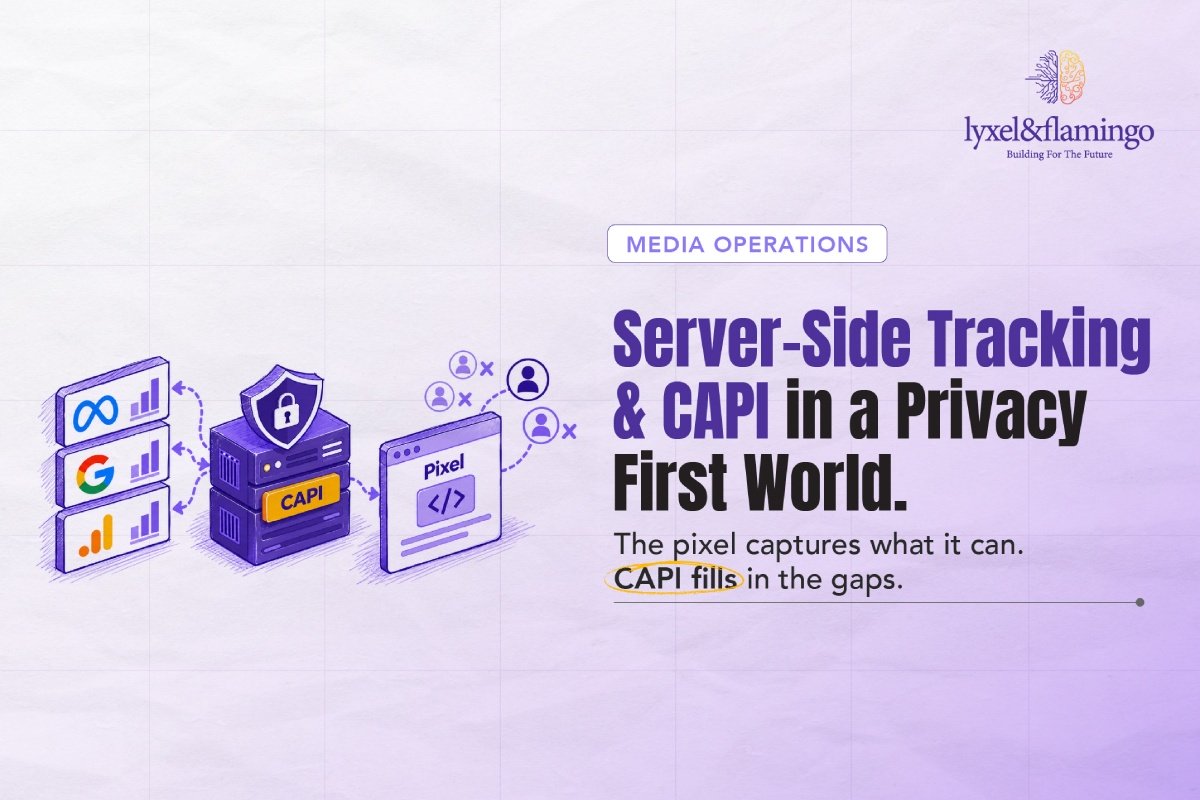
- Connect: Move signals server to server through Meta’s Conversions API, Google’s Enhanced Conversions, or a CDP sitting between the two. This is the server-side tracking layer, and it’s the piece most teams do get built, since it’s the part that shows up in a vendor’s setup guide.
- Activate: Feed those connected signals into targeting: lookalikes built on real purchasers instead of pixel-based visitors, suppression lists that stop wasting spend on existing customers, and cookieless targeting for D2C retargeting that doesn’t depend on a browser remembering anything. Done well, this is also what makes first-party data marketing automation possible for D2C brands: audience syncs and suppression updates that run on their own instead of someone exporting a CSV every Monday.
- Prove: Close the loop back to revenue. This is the layer most cookieless frameworks skip entirely, and it’s the one that turns cookieless campaign tracking and attribution from a defensive move into the reason a CFO stops second-guessing the media budget.
The order here matters more than most teams assume. Teams that jump straight to Activate without fixing Capture end up automating a data problem instead of solving it, and the fourth layer, Prove, is consistently the most under-invested of the four, even though it pays back the fastest once it’s built.
What This Looks Like for a D2C Brand in Practice
Imagine a mid-sized Indian D2C brand making between Rs 50 crore and Rs 200 crore every year. It still depends on Meta and Google pixels, while customer data from Shopify, the CRM, and WhatsApp stays disconnected for no real reason. The better move is not buying another expensive tool.
Connect checkout and CRM data to Meta Conversions API and Google Enhanced Conversions first. Then add one consent-based capture point, often a WhatsApp opt-in during checkout because many Indian buyers already use it. After that, rebuild audiences using those owned customer signals instead of old browser data. Industry studies have already shown why this works.
Advertisers using Conversion APIs reported stronger ROAS, while most commerce marketers now trust first-party data more than other digital signals. We have seen the same pattern in D2C accounts. Growth usually comes from fixing data capture first, not increasing ad spend. Better customer signals keep improving over time, while cookie-based targeting keeps becoming less reliable.
5 Things to Do Before Your Next Campaign Brief
- Audit how much of your tracked revenue depends on a browser pixel alone. Pull last quarter’s conversions and check what share came through server-side connections versus pixel-only tracking. Most Indian D2C brands are surprised by how low that number turns out to be.
- Connect your two highest-spend channels to server-side tracking first, not all five at once. Meta Conversions API and Google Enhanced Conversions cover most of a typical Indian D2C media budget. Get those two clean before touching retail media networks or CTV.
- Add one new consented capture point to your existing funnel this quarter. A WhatsApp opt-in at checkout or a post-purchase preference survey beats a big CDP project that takes two quarters to launch and collects nothing useful in the meantime.
- Run one holdout or incrementality test before your next major campaign. Without a true baseline, there’s no way to tell whether signal-based marketing lifted performance or whether the campaign would have worked regardless.
- Map your consent language against DPDP requirements now, not later. India’s Digital Personal Data Protection Rules were notified in November 2025, with consent-manager provisions coming into force by November 2026. Brands rebuilding capture flows today should build them compliant the first time round, instead of retrofitting them under deadline in 2027.
Google Isn’t Setting the Real Deadline
Google’s decision to keep third-party cookies alive was never the deadline that mattered most here. Safari and Firefox made their call years ago, and India’s DPDP Rules just set a new one for how consent gets collected, regardless of what any browser decides next. The brands building signal-based marketing infrastructure now are compounding a data advantage that gets structurally harder to close with every quarter they wait.
That’s the shift worth taking seriously this year: not a scramble to react to whatever Chrome does next, but a rebuild of targeting and attribution around signals a brand genuinely owns. Get the Signal Custody Chain right, and campaign accuracy ends up being the smaller win. The bigger one is finally being able to prove, in a way a CFO believes without pushback, what worked and what didn’t.
If you’re mapping this against your own funnel, Lyxel&Flamingo’s Growth Marketing practice runs a Signal Readiness Audit that shows exactly where your tracking still depends on borrowed signals versus owned ones, and what to fix first.
Related reading:
- The Attribution Problem No One in Your Organisation Wants to Solve
- Why Reach Is a Vanity Metric in 2026, and What to Measure Instead
- Quick Commerce Isn’t a Distribution Channel, It’s a Brand Visibility Engine
Frequently Asked Questions
Signal-based marketing is targeting and measuring campaigns using data a brand collects and owns directly, such as hashed emails, app events, and server-side conversions, instead of third-party cookies. It replaces borrowed browser identity with owned, consented data that a brand controls end to end.
Start by connecting your CRM and checkout data to Meta's Conversions API and Google's Enhanced Conversions. From there, rebuild your targeting audiences (lookalikes, suppression lists) on that connected first-party data so you can run campaigns without third-party cookies instead of losing reach on Safari and Firefox without ever noticing.
Cookieless tracking is the umbrella term for any method that skips third-party cookies, including contextual targeting and cohort-based approaches. Signal-based marketing is a specific, narrower version of that: it targets and measures using signals the brand itself owns and controls, not third-party or platform-inferred data.
Yes, and it costs less than most teams assume going in. Indian D2C brands can build a functioning first-party data stack using warehouse-and-CDP tooling for a fraction of what an enterprise platform like Salesforce or Adobe would charge, while still improving audience accuracy within a single quarter.
First-party data replaces cookies by giving platforms a direct, consented match key, a hashed email or phone number, instead of a file dropped by the browser. Meta and Google use that match key to build lookalike audiences and measure conversions without needing a cookie in the loop at all.