
Table of Contents
- Why Instamart Demands a Different Brand Strategy Than Every Other Platform
- Why Most Brands Struggle to Scale Here
- How Instamart's Shelf, Search, and Ad System Works Under the Hood
- The Numbers That Make This Channel Non-Negotiable in 2026
- The Lyxel&Flamingo Instamart Growth Stack: Our Framework for Q-Commerce Wins
- A Brand That Got It Right: Composite Case Study
- 5 Things Your Team Should Act on Right Now
- Conclusion
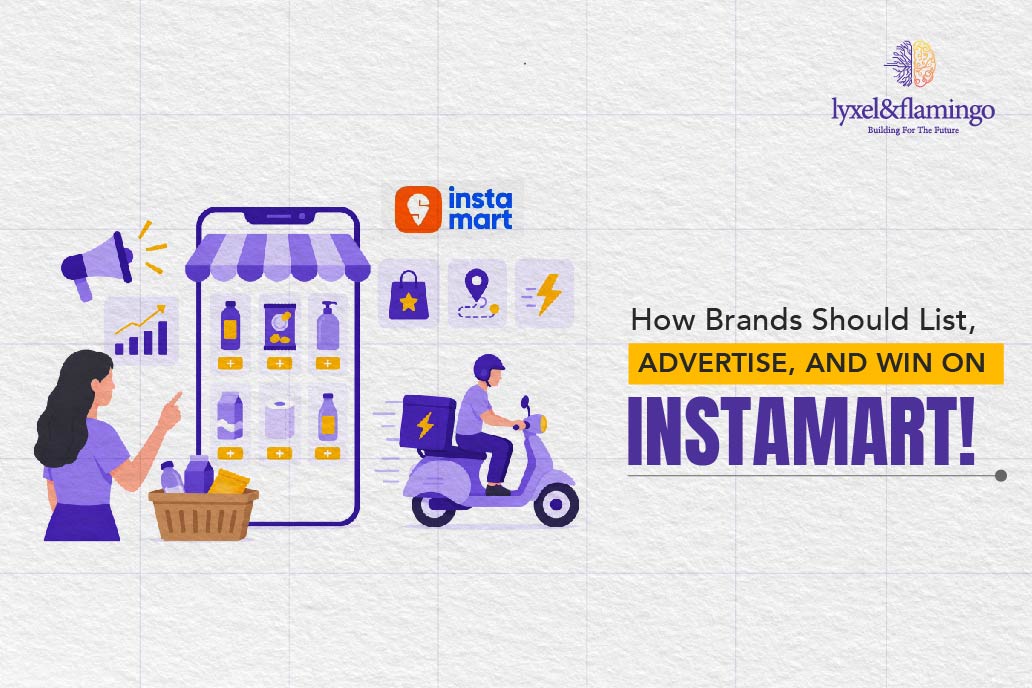
Swiggy Instamart is no longer a side channel that brands can treat as an afterthought. In 2026, it became one of India’s most important quick commerce platforms, where visibility, inventory, catalogue quality, and advertising all work together. Unlike traditional marketplaces, Instamart runs on a dark store network, which means products only appear when they are available in nearby fulfilment locations.
Many brands complete onboarding, upload a few SKUs, and expect sales to follow. That rarely happens. Success on Instamart depends on strong catalogue structure, relevant pack sizes, clean product data, consistent inventory, and well-planned advertising. Shelf position is highly competitive, and most purchases happen within the first few visible results.
This blog explains how Instamart’s search, shelf placement, and advertising ecosystem works. It explores ad formats such as Search Ads, Item Boost Ads, Homepage Banners, and Brand Store placements. It also highlights why dark store inventory management directly impacts campaign performance and conversion rates.
It also introduces Lyxel&Flamingo’s Instamart Growth Stack, a framework that combines listing optimisation, catalogue hygiene, creative strategy, advertising, and geo-based inventory planning. Through a practical case study and actionable recommendations, the blog shows how brands can turn Instamart from a simple listing platform into a scalable revenue channel.
Many brands still think of Swiggy Instamart like any other marketplace. They list a few products, wait for organic visibility, and push offers during major festivals. That approach worked a few years ago. In 2026, it usually falls short. The platform moves faster now, and brands need a far more active strategy.
Swiggy Instamart is not a traditional marketplace with a self-service listing portal and passive distribution. It is a curated, dark-store-led quick commerce platform where product placement, ad coverage, inventory availability, and creative all operate as a single interconnected system. And the customers using it are not patient shoppers. They open the app with high intent, scroll for about one or two seconds per product, and either tap or move on.
This blog covers the complete Instamart growth picture. We look at seller registration, ads, inventory planning, and geo-demand trends that brands often overlook.
It is built for brand marketers and marketplace teams chasing real growth, not just product visibility. Strong, quick commerce marketplace marketing services help brands gain measurable traction on Instamart. A listing alone rarely delivers results anymore, and most teams are seeing that now.
Why Instamart Demands a Different Brand Strategy Than Every Other Platform
Swiggy Instamart is Swiggy’s quick commerce vertical, built entirely on a dedicated dark store network. There is no third-party distributor fulfilling orders from a warehouse across town, and no customer-facing retail component. Each order is picked, packed, and dispatched from a micro-warehouse typically between 1,500 and 2,000 square feet, located within two to three kilometres of the delivery address.
This matters enormously from a brand strategy perspective.
As of Q4 FY26, Instamart operated 1,143 dark stores across 129 cities, covering over 4.8 million square feet of warehousing space. When a customer in Koramangala searches for a moisturiser, she only sees products stocked in a nearby dark store serving her pin code. That detail changes everything. If your brand is not mapped to that store, or inventory levels are running low, the listing never enters the consideration set. It does not matter how polished the catalogue looks or how strong the product ratings are. Customers cannot buy what they cannot see, and on Instamart, visibility starts with inventory availability long before marketing comes into play.
Instamart seller registration is also not like flipping a switch. Brands are onboarded through Category Managers (CMs) who assess product-category fit, pack size alignment, pricing, and supply-chain readiness before confirming onboarding. This supply-led model means first impressions and initial commercial proposals carry more weight than they do on open marketplaces. Brands that come in underprepared often get a slower start or face constrained city coverage in the early months.
Unlike platforms running a hybrid model, Swiggy Instamart controls inventory placement, pricing recommendations, and shelf position. This creates the feedback loop between brand performance and platform economics. It rewards disciplined brands and deprioritises inconsistent ones.
Why Most Brands Struggle to Scale Here
Many brands complete Instamart seller registration, go live with a handful of SKUs in two or three cities, and then wait for orders that never quite match expectations. There are structural reasons for this.
- Shelf position is not neutral. Research on Instamart listing optimisation consistently shows that roughly 80% of purchases happen from the first two rows of a search result or category page. If a brand is not in those positions organically, and not running Instamart ads to hold those slots, its products sit below more established SKUs that are getting all the clicks.
- Pack size architecture is more important in Q-commerce than anywhere else. Swiggy Instamart users are making impulsive decisions, not considered purchases. A 5-litre cooking oil SKU moves well on Amazon during monthly restocking. A 1-litre or 500ml variant fits a q-commerce basket. Brands that port their standard catalogue to Instamart without rethinking pack architecture regularly see below-average conversion rates, even with good visibility.
- Dark store inventory management gets treated as a logistics issue when it is a revenue decision. A brand might have strong visibility in Delhi but run dry every Friday evening in Bengaluru’s HSR Layout cluster. One stockout in a high-demand pin code burns ad spend on clicks that convert to zero.
- Quick commerce advertising struggles when the catalogue is weak. You keep spending money, but too much of it leaks away. Brands invest in sponsored placements while ignoring keyword attribute gaps, wrong category mapping, or mismatched SKU variants that confuse both the algorithm and the customer. If you want to understand how funnel design interplays with platform-specific execution, our post on High-Conversion Funnels on Blinkit, Zepto & Instamart covers that in detail.
How Instamart’s Shelf, Search, and Ad System Works Under the Hood
Understanding Q Commerce Strategy in India at a real execution level means understanding how Swiggy Instamart‘s visibility engine functions from the inside.
Organic placement is driven by a combination of signals: keyword relevance in the product title and attribute fields, sales velocity, ratings, in-stock rate, and the overall completeness of catalogue data. Think of it less like SEO and more like a physical shelf planogram: products that sell fast, stay in stock, and carry clean metadata get the eye-level position. New products with incomplete data and low velocity sit at the bottom of the page.
On top of organic placement, Instamart ads operate as a separate paid layer. The platform offers four primary ad formats for brands:
- Item Boost Ads show up across multiple touchpoints: category scroll pages, cart suggestions, and the “Did you forget?” section before checkout. These are high-frequency, high-surface-area placements, and they work especially well for consumables that benefit from impulse additions.
- Search Ads and Keyword Banners capture high-intent traffic at the exact moment of search. When a customer types “protein bar” or “hand cream,” sponsored product ads and quick commerce placements appear at the top of results. Brands with clean catalogue hygiene and relevant keyword targeting tend to see strong measurable ROAS from these formats.
- Homepage Banners are premium, high-CPM placements. The right use case here is brand launches, festive campaigns, or category expansion moments where reach and awareness matter more than direct conversion.
- Speciality Collections and Brand Store Placements allow brands with multiple SKUs to anchor a curated section within a category. These placements work best when a brand has at least five to six related products and the budget to commit to a sustained category presence.
The logistics layer also directly affects ad performance. Dark store inventory management determines the delivery time promise shown to each customer in each pin code. If your product is in stock in the right dark store, the app shows “15 minutes,” which meaningfully lifts the click-to-purchase rate. A stock gap triggers an “unavailable” flag, and no ad spend in the world recovers that moment.
The Numbers That Make This Channel Non-Negotiable in 2026
The case for taking quick commerce marketing seriously is not a hunch. It is in the data, and the data is recent.
- Quick commerce is heading to a $50 billion market by 2030, growing nearly sixfold. That projection comes from the Google and Deloitte report The $250 Billion Commerce Frontier, which also notes the channel already handles 70 to 75% of India’s online grocery orders. For most FMCG and consumer brands, that is no longer a test budget.
- India routes 16 to 17% of all e-retail GMV through quick commerce, the highest share of any major market. That makes the country a global outlier, ahead of even China on adoption intensity.
- Non-food categories are projected to drive 45% of quick commerce spend by 2030. Beauty, fashion, and electronics are moving onto the shelf fast, which widens the field of brands that need a real strategy here.
- Yet only about 4% of Indians currently shop on quick commerce platforms. The base is still small and mostly urban, which means the brands that build shelf authority now are claiming ground before the crowd arrives. The window for cheap visibility is open today, and it is closing.
The Lyxel&Flamingo Instamart Growth Stack: Our Framework for Q-Commerce Wins
At Lyxel&Flamingo’s Commerce Strategy practice, we stopped treating listings, ads, creative, and supply as separate workstreams. We call it the Shelf Velocity System, and it runs in five layers, in order. Order matters here because each layer fails without the one beneath it.
- Listing-as-Asset Layer: Treat every product page as a digital shelf asset, not a data-entry chore. Get the naming clear and human, map the product to the right category and sub-category, structure your pack sizes so the value choice is obvious, and price with intent. This is the core of Instamart listing optimisation, and it is where most brands stop too early.
- Hygiene Layer: This is the unglamorous one that quietly wins. Keyword tagging tied to real search demand, complete product attributes, consistent SKU naming, and structured variants so the same product does not split its own velocity across three half-built pages. Get this wrong, and the algorithm cannot read you, no matter how good your packshot is.
- Creative Layer: Build for the one-to-two-second decision. High-contrast packaging visuals, minimal on-pack text, and price-led communication that reads at thumbnail size. A creative that looks great on a laptop preview and dies on a phone is the single most common mistake we fix.
- Media Layer: Now, and only now, the ads. Match the format to the goal: Search Ads to defend intent, Browse Ads for discovery, Homepage Placements for moments, Sponsored Product Boosting for SKU velocity. This is quick commerce advertising done as amplification, not as a rescue mission.
- Supply-Geo Layer: The layer brands forget. Align stock with city-level demand so dark store inventory management does not quietly kill your best campaign. An ad that drives a shopper to an out-of-stock pincode is spending you set on fire. In our work across consumer categories, this fifth layer is consistently the most under-managed, and the one with the fastest payback once fixed.
Run as a loop, these layers compound. Better listings lift conversion, conversion lifts rank, rank lowers ad cost, and lower ad cost frees budget to expand. That flywheel is the whole of a serious Q-commerce strategy in India that brands can actually defend. If you want the funnel logic underneath it, our breakdown of high-conversion funnels on Blinkit, Zepto, and Instamart goes a level deeper.
A Brand That Got It Right: Composite Case Study
The following is a representative composite based on recurring patterns across brands we have supported on Q-commerce platforms. Names and specific metrics are anonymised.
A mid-sized personal care brand, a skincare line with a decent modern trade presence and growing e-commerce revenue, approaches Swiggy Instamart as an incremental channel. They go live with eight SKUs across Mumbai, Delhi, and Bengaluru. Initial orders are modest. ROAS on Instamart ads looks acceptable in the dashboard. But actual sell-through stays flat for two months.
The full diagnostic surfaces a familiar cluster of issues:
Products were mapped to the broad “Skin Care” parent category instead of subcategories like “Face Serums” or “SPF Moisturisers,” so they were not surfacing in high-intent searches. Titles were copied from the Amazon catalogue: long, feature-heavy, written for a desktop discovery context that does not exist on Instamart. The flagship 100ml serum was priced at ₹649; the 30ml travel variant that would have converted well on impulse was not listed. And Search Ads were running across five broad keywords, none of which matched the actual phrases Swiggy Instamart users in those cities were searching.
After a complete IGS implementation across all five layers:
- Subcategory mapping was corrected for all eight SKUs, and two new 30ml variants were onboarded.
- Product titles were rewritten to lead with the subcategory keyword and core benefit.
- Instamart ads were restructured into three distinct campaign types:
- Search Ads on seven high-intent category keywords,
- Item Boost Ads on the two top-velocity SKUs, and
- a Homepage Banner timed to a Friday evening launch window.
- Creative was refreshed to a clean white-background product shot with “30ml | ₹299” as the primary message element.
- Inventory was seeded in six additional Bengaluru dark stores based on pincode-level demand signals from the CM reports.
Three months after re-implementation:
- SKU impressions improved approximately threefold.
- Cart conversion rate rose by over 60%.
- The 30ml variant became the top-selling SKU in its subcategory across Bengaluru’s Instamart stores.
- And for the first time, Swiggy Instamart crossed the threshold to become the brand’s second-largest digital revenue channel by monthly order volume.
The change was not more ad budget. It was structural. Every IGS layer is firing in the same direction at the same time.
5 Things Your Team Should Act on Right Now
A practical Q-commerce strategy in India roadmap does not need to be complex. Here is where to start.
- Audit your packshots on an actual phone, not a desktop preview. Open your listings on a mid-range Android at arm’s length. If the pack and price are not readable in two seconds, the creative is the problem, not the budget.
- Rewrite your top 20 product titles for clarity, not for your brand team. Lead with what the product is, the variant, and the pack size. Match the words real shoppers type, then tag those keywords into the listing.
- Fix your variant structure before you spend another rupee. Consolidate duplicate or fragmented SKUs so one product is not competing against its own broken pages and splitting its velocity.
- Map stock to demand at the city level. Pull your dark-store availability against where your ads are actually serving. An ad pointing to an out-of-stock pin code is the fastest way to waste Instamart’s ad money.
- Sequence the work, do not parallelise it. Listing and hygiene first, creative second, ads third, supply running underneath all of it. Brands that run ads first almost always pay for the privilege of finding out their listing was not ready.
Our Third-Party Marketplace Services team executes exactly this kind of full-stack Swiggy Instamart strategy: from initial Instamart seller registration and catalogue architecture, through to ad operations and dark store geo-expansion planning.
Conclusion
Swiggy Instamart has moved well past the experimental phase. With Instamart GOV growing 68.8% year-on-year, 1,143 dark stores across 129 cities, combined overall ad revenue approaching ₹6,383 crore in 2026, and a user base of 33 million monthly transacting users across the quick commerce sector, this is a primary retail channel for any brand in FMCG, personal care, health, or home essentials.
But listing on Swiggy Instamart is not the same as winning on it. The brand’s compounding growth here treats the platform as an integrated system: catalogue, ads, creative, inventory, and pricing all operating in sync through a framework like the L&F Instamart Growth Stack.
When all six IGS layers work together, quick commerce advertising stops being a cost centre and becomes a performance engine. Listings that surface organically in subcategory searches. Sponsored placements that capture high-intent traffic at the right moment. Creative that closes a decision in under two seconds. Dark store inventory that supports delivery promises in every active pin code.
Whether your team is just starting Instamart seller registration or trying to break out of a stalled plateau on the platform, the approach is the same: treat Swiggy Instamart as a media-plus-operations system, build the catalogue with the same discipline you’d bring to a physical shelf reset, and make sure every ad rupee is backed by in-stock availability.
Frequently Asked Questions
Begin with Instamart seller registration through Swiggy's partner onboarding, then build your catalogue properly before activating any ads. Most brands rush onboarding and skip listing optimisation, which is exactly the mistake that makes the channel look like it does not work.
Listing optimisation makes your product page convert. Instamart ads buy more visibility. Ads amplify whatever your listing already does, so spending on ads before fixing the listing just helps more people find a page that does not convert.
Commerce advertising in India is projected to reach around $3.9 billion in 2026, growing 29% year on year. Quick commerce platforms are taking a growing slice of that, so budgets are shifting from pure social and search toward the shelf.
Because availability is city-specific. Dark store inventory management decides whether the shopper your ad reaches can actually buy from their pin code, and an out-of-stock listing turns paid visibility into wasted spend almost instantly.
Yes, with only about 4% of Indians on quick commerce today, shelf authority and ad costs are still relatively cheap, so a focused mid-sized brand can win category positions now that get far more expensive later.