
E-commerce teams often invest heavily in product pages, paid creatives, and user-generated content, yet manage each as a separate asset. The result is a fragmented experience where messages shift across touchpoints and confidence weakens before conversion. This disconnect is why a unified commerce content stack is increasingly central to how brands improve conversion consistency and scale performance.
At Lyxel&Flamingo, commerce content is approached as a system rather than a collection of deliverables. When PDPs, UGC, and creatives operate independently, their effectiveness declines. When they work together, they reinforce trust, relevance, and intent across the buying journey. This systems-led view has become more important as shoppers rely on multiple validation points before committing and expect consistency regardless of where they enter the funnel.
Why E-Commerce Content Can No Longer Be Managed in Silos
Modern shoppers do not move through a single channel or linear funnel. They encounter paid ads, organic social posts, influencer content, reviews, comparison pages, and product detail pages before making a decision. Each interaction subtly shapes expectations around credibility, quality, and value.
When content is managed in silos, those expectations often clash. Creatives may frame the product aspirationally, while PDPs focus on functional detail. Reviews might surface recurring concerns that are never addressed clearly on product pages. Visual tone can shift dramatically between platforms, weakening brand recognition and trust.
Siloed content typically results in:
- Inconsistent product narratives across channels
- PDPs that assume context shoppers do not yet have
- UGC that lacks framing or relevance
- Creatives that prioritise attention over accuracy
Brands can no longer afford content that performs well in isolation but fails to convert cohesively.
Understanding the Modern Commerce Content Stack
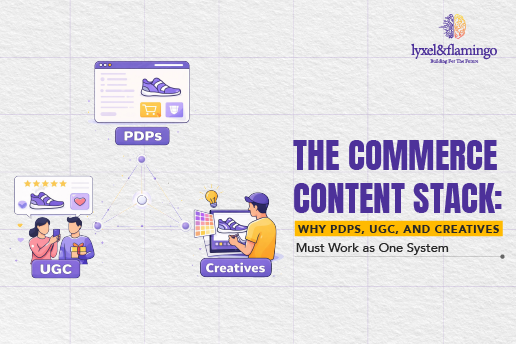
A commerce content stack refers to the coordinated system of assets that influence how products are discovered, evaluated, and purchased. It is not a list of formats, but a strategic framework that ensures every asset supports the same decision logic.
This stack usually includes:
- Product Detail Pages
- Paid and organic creatives
- User-generated content
- Supporting informational assets
When designed as a system, these elements reinforce the same value proposition, terminology, and expectations. Instead of repeating information or introducing contradictions, they build understanding progressively. This is often the functional answer to questions around how to integrate PDP, UGC, and creatives without creating duplication or friction.
The Role of PDPs in Conversion Decisions
Product Detail Pages remain the most critical conversion surface in e-commerce. Regardless of where traffic originates, most journeys eventually converge on a PDP.
Why PDP Optimisation Goes Beyond Layout
PDP optimization is not limited to page design, imagery, or load speed. Its central role is to remove doubt. Shoppers arrive with assumptions formed through ads, reviews, and external content. The PDP must either validate those assumptions or correct them clearly.
Effective PDPs:
- Reinforce claims introduced earlier in the journey
- Address objections surfaced in reviews or comments
- Explain pricing, delivery, returns, and support transparently
- Clarify suitability, limitations, and expected outcomes
This approach is especially relevant when considering optimizing product pages with user-generated content, as PDPs must integrate proof without overwhelming or distracting shoppers.
When PDPs lack this clarity, shoppers hesitate. That hesitation often leads to comparison shopping or deferred decisions, even when the intent was initially strong.
PDPs as the Anchor of the Content Stack
Within the commerce content stack, PDPs act as the anchor. Other content prepares the shopper emotionally and cognitively, but the PDP confirms the decision. This confirmation is especially important for first-time buyers who lack prior brand trust and rely heavily on consistency as a proxy for credibility.
UGC as a Trust-Building Layer in E-Commerce
User-generated content plays an important role in shaping buyer confidence. It introduces realism and authenticity at moments when shoppers seek reassurance rather than persuasion.
Why UGC Matters in High-Intent Moments
UGC in e-commerce allows shoppers to validate claims through lived experience rather than brand assertions. Reviews, photos, and videos provide context that product copy alone cannot.
UGC helps shoppers assess:
- Real-world performance and durability
- Fit, sizing, or usability nuances
- Common drawbacks alongside benefits
- Post-purchase satisfaction over time
This content reduces perceived risk, particularly for higher-consideration purchases where uncertainty carries greater weight.
Structuring UGC for Impact
UGC performs best when curated intentionally. Surfacing relevant reviews near feature explanations or grouping feedback by use case improves relevance and speeds evaluation. Unstructured UGC, by contrast, overwhelms shoppers and weakens its trust-building effect.
The Strategic Role of Creative Content
Creatives are often evaluated through engagement metrics, yet their real influence lies in expectation-setting.
Creative Content as a Signal
A strong creative content strategy treats creatives as a promise rather than a hook. Visuals, language, and scenarios should align closely with what the product can realistically deliver.
Effective creatives:
- Introduce benefits without exaggeration
- Reflect real usage contexts
- Use language that appears consistently on PDPs
When creatives oversell, PDPs must correct perception, increasing friction and scepticism at the decision stage.
Creatives as Pre-PDP Education
Creatives that educate reduce friction later. Introducing key features, use cases, or differentiators early allows PDPs to focus on reinforcement rather than persuasion, shortening the path to conversion.
Why Integration Improves Conversion Performance
Conversion is rarely driven by a single interaction. It reflects cumulative confidence built across multiple touchpoints.
How Integrated Content Reduces Friction
When content is aligned, shoppers encounter fewer contradictions and experience faster comprehension. This consistency underpins integrated marketing content, where each asset supports the same buying decision without redundancy.
This alignment also explains why integrated content improves conversion, as shoppers are less likely to pause, re-evaluate, or abandon due to mixed signals.
The Cost of Disconnected Content
Disjointed content introduces doubt. Messaging shifts signal risk, often subconsciously, leading shoppers to delay or abandon decisions even when price and product quality are competitive.
Designing an E-Commerce Content System, Not Assets
High-performing brands design content systems rather than isolated assets.
Principles of Effective E-Commerce Content Systems
Strong e-commerce content systems share common traits:
- A single source of product truth
- Reusable creative frameworks
- Structured UGC placement
- Clear governance and ownership
These principles are increasingly recognised as commerce content strategy best practices for teams looking to scale without losing consistency.
Platform Considerations
Platforms such as Shopify provide the infrastructure for delivery. Strategy determines whether that infrastructure enables cohesion or simply hosts disconnected assets. Systems thinking ensures platforms support consistency rather than fragmentation.
Aligning Product Page Optimisation With Content Strategy
Product page optimisation works best when aligned with a broader content strategy rather than treated as a standalone task.
Product Pages as Narrative Endpoints
Product page optimization is most effective when PDPs act as the logical conclusion of a story introduced earlier. Creatives generate interest, UGC builds trust, and PDPs confirm suitability.
Avoiding Information Overload
Optimisation does not mean adding more content. It means sequencing information so shoppers receive the right answers at the right moment, reducing cognitive effort and decision fatigue.
Content Strategy and UGC Working Together
UGC should reinforce strategy, not sit alongside it.
A strong Content strategy + UGC approach ensures reviews and visuals support specific claims rather than acting as generic validation.
Examples include:
- Reviews addressing durability near material descriptions
- Use-case imagery aligned with audience segments
- Visual UGC that reflects creative framing
This alignment strengthens coherence and credibility across the stack.
Measuring the Performance of the Commerce Content Stack
Measurement must reflect how content works together, not how individual assets perform. Page-level metrics fail to capture system performance.
More meaningful indicators include:
- Conversion uplift after UGC exposure
- Reduced drop-offs after creative-to-PDP alignment
- PDP engagement influenced by upstream messaging
Orchestration prioritises alignment across assets, delivering sustainable gains rather than isolated improvements.
The Role of Creative Content Optimisation
Creative optimisation should support system-level performance rather than isolated engagement. It works best when creative decisions are informed by how shoppers actually behave after clicking through.
Creative content optimization is most effective when informed by PDP behaviour. This ensures creatives attract traffic aligned with product expectations, not just attention, and helps reduce mismatches between promise and experience.
High-performing stacks use PDP interaction data and UGC insights to refine creative messaging, maintaining alignment as shopper needs evolve and ensuring creative output remains relevant as products and audiences change.
Scaling Integrated Content Without Losing Consistency
As product catalogues expand, maintaining consistency becomes more challenging. New launches, seasonal updates, and regional variations can quickly introduce misalignment if content standards are not clearly defined. Without a shared structure, teams often recreate assets differently, leading to uneven messaging and diluted product narratives across touchpoints.
Building Scalable Frameworks
Templates, playbooks, and shared standards allow new products to inherit proven structures. These frameworks support consistent value articulation, visual hierarchy, and proof placement at scale, while still allowing flexibility for category-specific nuances and creative adaptation.
Governance as a Growth Enabler
Clear ownership and review processes reduce rework and prevent drift. Governance enables speed by removing ambiguity and preserving alignment, ensuring teams can execute efficiently without compromising coherence as volume and complexity increase.
Preparing for the Future of Commerce Content
Commerce discovery continues to fragment across platforms and formats. Shoppers now encounter products through social feeds, marketplaces, search results, and creator-led content, often within the same purchase window. This fragmentation increases the importance of coherence, as inconsistent messaging becomes more visible and more damaging to confidence.
Why Integration Will Matter Even More
As entry points multiply, consistency becomes a competitive advantage. Shoppers expect continuity regardless of where they start, whether through an ad, a review, or a product listing. When content aligns across touchpoints, it reduces re-evaluation and speeds decision-making. Brands that treat content as a system adapt faster than those managing assets independently, particularly as new channels and formats emerge.
How Lyxel&Flamingo Approaches the Commerce Content Stack
Lyxel&Flamingo focuses on aligning content, media, and product experience as a single operating system. The team works across creative, commerce, and analytics functions to ensure consistency from first exposure to conversion.
Rather than treating PDPs, UGC, and creatives as separate deliverables, the emphasis remains on integration, governance, and performance clarity.
Conclusion
E-commerce performance is no longer driven by isolated improvements. PDPs, UGC, and creatives must work together as one system to support confident decision-making.
By structuring content as a commerce content stack, brands can reduce friction, improve clarity, and scale with consistency. Lyxel&Flamingo approaches this challenge through integration and governance rather than fragmented optimisation, helping brands turn content into a cohesive performance driver.
FAQs
Q. What Is a Commerce Content Stack?
A. A commerce content stack is the coordinated system of PDPs, creatives, and user-generated content that together support product discovery, evaluation, and conversion across the full buying journey.
Q. Why Should PDPs, UGC, and Creatives Work Together?
A. When these elements align, messaging remains consistent across touchpoints, reducing friction, reinforcing trust, and helping shoppers make faster, more confident purchase decisions.
Q. How Does Integrated Content Improve Conversions?
A. Integrated content improves conversions by aligning expectations, reducing contradictions, and reinforcing proof at key decision points, lowering uncertainty and shortening the path to purchase.
Q. What Are Best Practices for E-Commerce Content Systems?
A. Best practices include centralised product information, consistent creative frameworks, curated UGC placement, and governance models that keep content aligned as catalogues and channels scale.
Q. How Can Marketers Align Creative and Product Content Efficiently?
A. Marketers can align content by using shared narratives, coordinating creative messaging with PDP structure, and applying performance insights to refine both assets together over time.