
BLOG SUMMARY
At nine in the evening, a shopper adds a single small bottle to a quick commerce cart while the same brand’s value pack sits untouched on a supermarket shelf across town. The pack and price that win a planned monthly shop are not the pack and price that win a ten-minute craving, and brands that carry their retail pricing straight onto quick commerce quietly leave the channel misfit. This is a practical look at building pack sizes and pricing that suit the ten-minute cart.
Table of Contents
The bottle in the ten-minute cart
It is nine in the evening, and someone has run out of hair oil. They open a quick commerce app and add a single small bottle to the cart, the kind that lasts a fortnight, and it arrives before the evening is over. Across town, in a supermarket that same brand’s large value pack sits on a shelf, the better deal by any per-millilitre measure, and entirely beside the point in this moment. The shopper did not want value. They wanted the thing, now, in a size that matched a small immediate need.
That gap between the two purchases is where a lot of brands lose the channel without noticing. They take the pack range and the price ladder that were built for a planned, stock-up shop, port them straight onto quick commerce, and wonder why conversion is soft. The ten-minute cart is a different occasion, and it asks for a different pack and a different price, chosen for the moment rather than inherited from the aisle.
What pack architecture means on Quick Commerce
Pack architecture is the deliberate range of pack formats a brand offers, and the decision about which of them belong on which channel. Differential pricing is the related practice of varying price or pack format by channel to suit how people buy there. Neither is about charging more where a brand can get away with it. Both are about matching the format to the occasion: offering the size and the price that make sense in the moment a shopper is actually in, rather than assuming one pack and one price should serve every context a brand sells into.
Why the value pack loses the impulse moment
Quick commerce is bought in small, immediate baskets, and that is not a quirk of a few categories but the shape of the channel. Bain & Company describes a market built on frequent, top-up buying rather than the planned monthly shop, and notes that the category is broadening well beyond grocery. In that context, the value pack is not a strong offer that shoppers are strangely ignoring. It is the right pack for the wrong occasion. A shopper reaching for a ten-minute delivery is rarely stocking up; they are solving a small, immediate need, and a large pack asks them to make a bigger commitment than the moment wants. The brands that grow here lead with the format that fits the craving and let the value pack do its job where it belongs, in the planned shop.
The price a shopper reads in a glance
On a shelf where the decision happens in seconds, price is not read, it is glanced. A number that lands as obviously sensible in that glance does quiet work; a number that makes the shopper pause to do arithmetic loses the moment. This is why a smaller pack at a lower absolute price often converts better than a larger pack that is cheaper per unit but heavier to commit to, the entry price is legible and low-risk, and the decision stays inside the reflex. Pricing for quick commerce is less about the per-unit maths a planning shopper would do and more about the single figure an impulse shopper reads without thinking.
Differential pricing, and the line to walk
Vary price and pack by channel and a brand quickly meets a live sensitivity. Independent analysis by Medianama has shown that the same product can carry different prices across quick commerce platforms, and even between frequent and occasional users of the same app, and the practice draws regulatory and consumer scrutiny in India. The line to walk is a clear one. Differential pricing that reflects a genuine difference in occasion and pack: a single-serve built and priced for immediacy, is sound commercial sense and reads as fair. Pricing that simply charges a captive, in-a-hurry shopper more for the identical pack is the kind that erodes trust and invites attention no brand wants. The discipline is to vary the offer around the occasion, transparently, rather than around the shopper’s urgency.
The Ten-Minute Basket
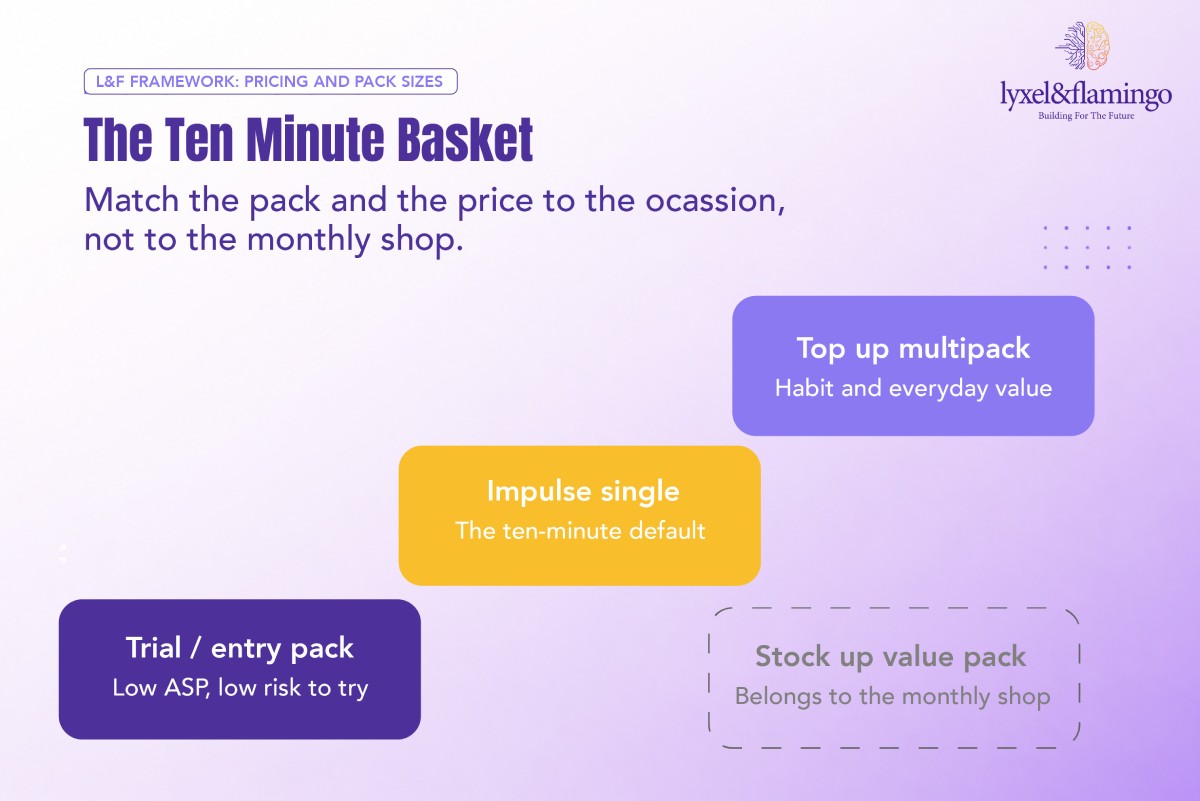
A simple way to hold this together is to map pack format to occasion, and let price follow. A trial or entry pack sits at the bottom: small, low absolute price, low risk for a shopper meeting the brand for the first time. The impulse single is the ten-minute default, the format built for the immediate craving. Above it sits the top-up multipack, a small multi for the shopper turning the brand into a habit and looking for everyday value. And the stock-up value pack sits deliberately off this ladder, because it belongs to the planned monthly shop, not the ten-minute cart. The point of the model is not to add packs for their own sake, but to make sure the format a shopper meets matches the moment they are in.
The Ten-Minute Basket: match the pack and the price to the occasion; the stock-up pack belongs to the monthly shop.
A challenger brand’s pack play
The pattern shows up in the work. Soulflower, a clean beauty brand growing its hair-oil range on quick commerce, leaned into exactly this thinking: prioritising smaller-capacity, lower-priced formats suited to an immediate purchase rather than pushing the larger packs built for a planned shop. The smaller formats, placed and priced for the moment, lifted conversion and accelerated sell-through, and the average order value on the hero hair-oil range grew by about 11%. The pack that fit the occasion did not just convert better; it pulled the whole range along with it, because a shopper who buys the single and likes it is the shopper who comes back for the multipack.
Reading whether the mix is right
Whether the pack and price mix is working shows up in a few honest places: the conversion rate on the hero single-serve, the rate at which those formats sell through, and the movement of shoppers up the ladder from trial to top-up over time. Those tell a brand whether its formats are matched to the channel or merely present on it, and they connect directly to the measures in our piece on the metrics that judge a quick commerce mix. Read together, they answer the real question not whether the whole range is listed, but whether the right pack is winning the right moment.
The reframe worth carrying out of all this is that a pack is a message about an occasion. The value pack says stock up and save; the single says here, now, no commitment. On a channel built for the craving rather than the plan, the brands that win are the ones that speak the language of the moment a shopper is actually in. So the question to sit with is a plain one: does your quick commerce range still sound like the monthly shop, or does it sound like nine in the evening?
Closing
Getting pack and price right for quick commerce is a discipline, and it is one Lyxel&Flamingo runs alongside brand teams choosing the formats that fit the occasion, pricing them for the glance, and building a ladder that carries a shopper from trial to habit. If you would like a clear read on whether your pack architecture fits the ten-minute cart, our third-party marketplace team can audit your range and show you where the mix is slipping. Start that conversation with us whenever you are ready.
Frequently Asked Questions
Usually yes, because the channel is bought in small, immediate baskets rather than planned stock-ups. Smaller, occasion-fit pack sizes tend to convert better on quick commerce because shoppers are solving an immediate need, not stocking up.
Because the occasion, pack format and cost to serve differ, and some platforms price by user and context. Independent analysis has found the same product can carry different prices across quick commerce platforms and user types, reflecting occasion and channel economics.
One a shopper reads as sensible in a glance, with a low, legible entry price on the hero format. The right quick commerce price is the single figure an impulse shopper can read without doing arithmetic, not the lowest per-unit cost.
Not when it reflects a real difference in pack and occasion and is handled transparently. Differential pricing is sound when it varies the offer around occasion and pack, and damaging when it simply charges a rushed shopper more for the identical pack.
As a ladder from trial to top-up, with the stock-up pack kept for the planned shop. A quick commerce pack ladder runs from a low-risk trial pack to an impulse single to a top-up multipack, leaving the stock-up value pack to other channels.