
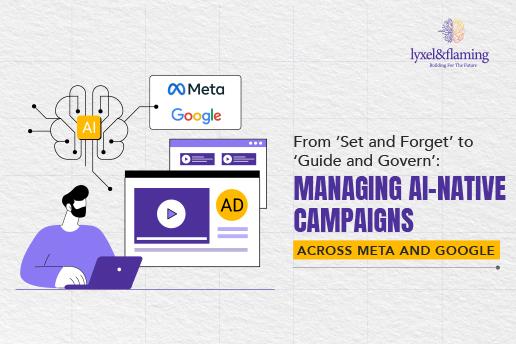
For years, digital advertising operated on a simple promise. Set up campaigns, optimise bids, refine targeting, and let performance scale. That promise has fundamentally changed. With the rise of AI-driven advertising, platforms like Meta and Google have shifted from rule-based optimisation to autonomous decision-making systems that control bidding, targeting, creative delivery, and budget allocation in real time.
This transition has created a new reality for marketers. Campaigns no longer behave like machines that respond predictably to inputs. They behave more like adaptive systems that learn, infer, and act independently. As a result, the old “set and forget” mindset is no longer just ineffective, it is risky.
Modern growth now depends on learning how to guide and govern AI-native systems rather than attempting to micromanage them. This requires a new operating model that balances automation with strategic oversight, creativity with control, and scale with accountability.
This article explores how brands can effectively manage Meta AI campaigns and Google AI campaign management systems through structured governance. It outlines practical rituals, creative input cycles, negative signal management, and simple scorecards that ensure AI works in service of business outcomes, not in isolation from them.
Understanding What Makes Campaigns Truly AI-Native
AI-native campaigns are not simply automated versions of traditional ads. They are fundamentally different in how they operate and optimise.
In AI-driven advertising, platforms use machine learning models to evaluate millions of signals simultaneously. These include user behaviour patterns, contextual signals, creative engagement, conversion probability, and real-time competition. Instead of marketers defining every rule, the system learns which combinations of audience, message, format, and timing are most likely to achieve outcomes.
This is visible across Meta AI campaigns, where Advantage+ systems dynamically assemble audiences and creative combinations, and in Google AI campaign management, where Performance Max and Smart Bidding optimise across search, display, video, and shopping without explicit channel control.
The shift brings scale and efficiency, but it also introduces opacity. Marketers often struggle to answer basic questions such as why performance changed, which signals drove growth, or where waste is accumulating. This is the core governance challenge.
Why “Set and Forget” Fails in an AI-Led Environment
The idea of fully autonomous campaigns is appealing, but dangerous when left unchecked.
AI systems optimise for the objectives they are given, not for broader business context. If goals are poorly defined or signals are noisy, AI will still optimise aggressively, often in ways that inflate short-term metrics while harming long-term value.
Common risks include audience saturation, creative fatigue hidden by aggregate performance, over-reliance on high-intent users at the expense of new demand, and inefficient spend masked by blended reporting.
This is why AI marketing governance has become a critical leadership responsibility. Governance does not mean restricting AI. It means providing the right structure, inputs, and feedback loops so that automation aligns with growth strategy.
The Shift from Execution to Stewardship
In AI-native systems, marketers are no longer operators. They are stewards.
This means success is defined less by tactical optimisation and more by how well teams shape inputs, monitor signals, and interpret outcomes. Campaign management becomes a process of guidance rather than control.
This stewardship mindset sits at the intersection of automated ad strategy and human judgment. Automation handles scale, speed, and pattern recognition. Humans handle intent, creativity, ethics, and long-term direction.
Brands that fail to make this shift often feel blind, even when dashboards look healthy. Brands that succeed build governance rituals that make AI predictable, accountable, and strategically useful.
Building Governance Into AI Campaign Management
Effective governance does not require complex systems. It requires consistency, clarity, and discipline.
Weekly Review as a Core Ritual
AI systems evolve continuously. Waiting for monthly reviews is too slow. High-performing teams establish weekly reviews that focus on directional health rather than daily fluctuations.
These reviews look beyond ROAS or CPA and examine distribution patterns, creative engagement trends, audience expansion behaviour, and channel-level contribution. This allows teams to spot drift early and recalibrate inputs.
Weekly governance rituals anchor AI campaign management within broader performance accountability.
Creative Input Cycles in AI-Native Campaigns
Creative remains the most powerful lever in AI systems, yet it is often treated as an afterthought.
AI does not invent strategy. It responds to creative inputs. In both Meta and Google environments, creative variety directly influences learning velocity, audience expansion, and performance stability.
High-performing teams design structured creative input cycles. New narratives, formats, and visual systems are introduced deliberately, not reactively. This ensures AI has fresh signals to test without destabilising performance.
This approach connects directly to data insights for creatives and Media Creative Optimisation, where creative decisions are informed by performance patterns without reducing storytelling to numbers.
Managing Negative Signals Before They Compound
One of the most overlooked aspects of AI marketing governance is negative signal management.
AI systems learn from all feedback, including poor quality conversions, high bounce rates, low engagement, and post-click friction. If left unaddressed, these signals compound and skew optimisation.
Effective governance includes identifying and correcting negative signals quickly. This may involve excluding low-quality placements, refining conversion definitions, adjusting landing experiences, or tightening creative messaging.
By actively managing negative signals, brands prevent AI from learning the wrong lessons.
Simple Scorecards That Restore Visibility
One reason leaders feel disconnected from AI campaigns is reporting complexity. Blended metrics obscure underlying dynamics.
Governance-friendly teams use simple scorecards that track a small set of leading indicators. These include creative fatigue signals, audience expansion rate, assisted conversions, and channel contribution shifts.
These scorecards do not replace platform dashboards. They complement them by translating AI behaviour into business-relevant insights.
This is where full-funnel performance analysis becomes essential. Understanding how AI-driven upper-funnel exposure supports mid and lower funnel outcomes restores strategic clarity.
Meta AI Campaigns: Guiding Without Constraining
In Meta environments, AI thrives on creative diversity and signal clarity.
Governance here focuses on creative rotation discipline, clear conversion prioritisation, and audience saturation monitoring. Instead of constantly tweaking settings, teams guide Meta AI campaigns by feeding high-quality inputs and observing learning patterns.
This approach allows Meta’s automation to scale discovery while avoiding creative burnout and audience fatigue.
Google AI Campaign Management Across the Funnel
Google’s AI systems operate across search, display, video, and commerce surfaces. This creates immense opportunity but also complexity.
Effective Google AI campaign management requires aligning intent-based signals with creative messaging and landing experiences. Governance ensures that AI does not over-index on branded demand or short-term conversions at the expense of growth.
Here, integration with Full Funnel Marketing frameworks ensures AI supports awareness, consideration, and conversion in balance.
Leadership Confidence in an Automated World
AI-native campaigns can feel like black boxes. Governance turns them into glass boxes.
When teams establish rituals, creative systems, scorecards, and feedback loops, leaders regain confidence. They can explain performance shifts, justify investment decisions, and scale responsibly.
This confidence is the difference between reactive automation and strategic acceleration.
How Lyxel&Flamingo Helps Brands Guide and Govern AI-Native Campaigns
Lyxel&Flamingo approaches AI-driven advertising as an operating system, not a tactic.
The team works with brands to design governance frameworks that integrate automation, creativity, and analytics. This includes structuring creative input cycles, building performance scorecards, managing negative signals, and aligning AI optimisation with business priorities.
By connecting AI campaign management within Automation systems and embedding Full-funnel AI strategy into execution, Lyxel&Flamingo helps brands scale AI-native campaigns without losing visibility or control.
The focus is not on fighting algorithms, but on guiding them intelligently.
Conclusion
AI-native campaigns are not the future. They are the present.
The brands that win will not be those that automate the fastest, but those that govern the smartest. Moving from “set and forget” to “guide and govern” is not about reducing automation. It is about elevating leadership.
With the right rituals, creative discipline, and measurement frameworks, AI-driven advertising becomes a predictable, scalable growth engine rather than an opaque risk.
In an era where Meta and Google increasingly decide how media performs, the competitive edge belongs to teams that know how to guide intelligence, not surrender to it.
FAQs
Q. What are AI-native campaigns?
A.AI-native campaigns are advertising systems where machine learning controls targeting, bidding, creative delivery, and optimisation in real time.
Q. How do I govern automated ads effectively?
A.By establishing weekly reviews, creative input cycles, negative signal management, and simplified performance scorecards.
Q. Which platforms support AI-driven advertising?
A.Meta and Google are the primary platforms offering advanced AI-native campaign systems today.
Q. Can AI campaigns improve ROI?
A.Yes, when guided correctly. AI improves efficiency, but governance ensures sustainable, high-quality growth.
Q. How often should AI campaigns be monitored?
A.Strategic monitoring should occur weekly, with daily checks focused only on critical anomalies.