
What this blog covers
Global e-commerce crossed around $6.42 trillion in 2025. And yet, for a large portion of enterprise brands, expanding into new markets still feels like building a ship while it’s sailing. The demand is real. The architecture is the problem.
Most e-commerce platforms were designed for a world where one storefront served one market. That world is gone. A brand running out of Delhi or Mumbai now has to serve buyers in Dubai, Singapore and Berlin, each with different languages, payment preferences, device behaviour and load-time expectations. Monolithic platforms were not built for this level of operational complexity. They were built for control. That control has now become the ceiling.
Table of Contents
- What is Headless Commerce?
- The Problem Nobody Puts In The Vendor Deck
- How Headless Commerce Actually Works
- The Numbers Behind The Shift
- The Commerce Velocity Stack: Lyxel&Flamingo's Framework For Headless At Scale
- What This Looks Like For Real Brands
- 5 Things To Do Before You Migrate To Headless
- Conclusion
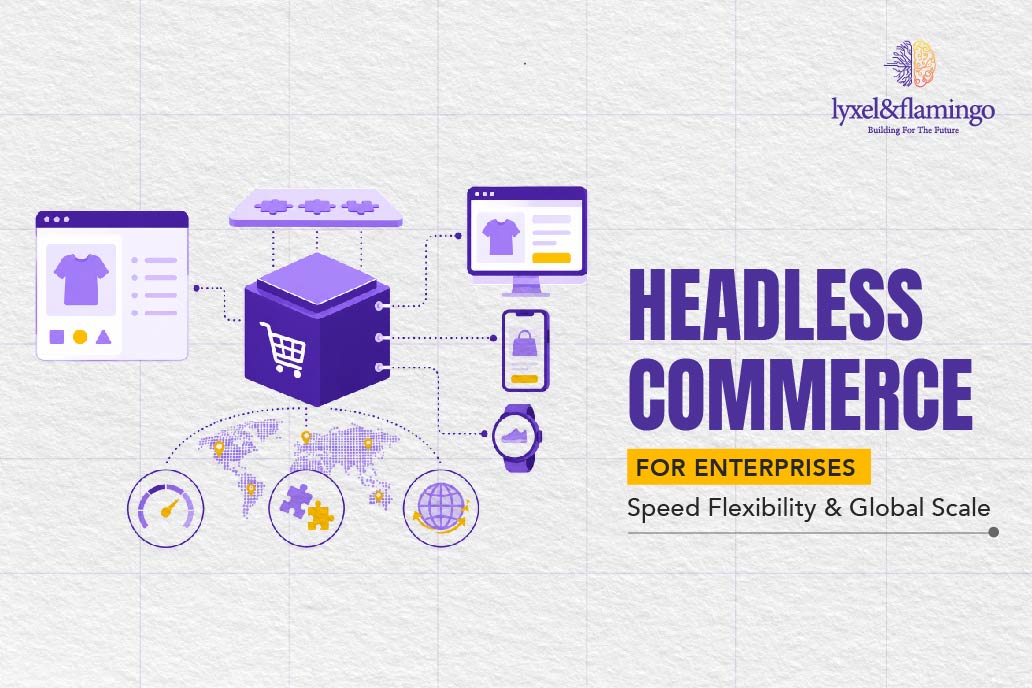
Headless commerce platforms are not a new technology trend. They are the structural response to a very specific business problem, one that grows more expensive to ignore as brands expand. The premise is straightforward: decouple the customer-facing storefront from the backend commerce engine. Let them communicate through APIs. Let both sides move at their own pace.
Brands that understand this architectural shift early are compounding an advantage that will be hard to close later. The ones that wait are paying for it in conversion losses, delayed market launches, and development cycles that eat up budget without shipping meaningful change. This piece covers what’s actually happening in the market, why it matters right now, and what a practical migration approach looks like for enterprise brands.
What is Headless Commerce?
A headless commerce platform separates the customer-facing frontend from the backend commerce engine. The two systems talk to each other through APIs, which means the team building the storefront experience and the team managing orders, inventory and payments are no longer locked inside the same codebase and the same deployment pipeline.
It’s an architectural decision, not a product you buy. The frontend becomes an independent layer. It requests data from the backend when it needs it, renders the experience however the brand wants, and can be updated, redesigned or rebuilt without touching the systems that process payments and fulfil orders.
This matters more in 2026 than it did three years ago because buyer expectations across devices and channels have moved significantly faster than most platform vendors have updated their core architecture. A brand that wants to ship a new mobile experience can do it in days on a headless setup. On a traditional monolithic platform, the same change might sit behind three weeks of backend involvement, QA cycles, and the ever-present risk of breaking something else in production.
Headless commerce is the technical foundation of what the industry now calls composable commerce solutions. The name changes depending on who’s selling it, but the underlying principle is the same: build a commerce stack where components can be swapped, upgraded or localised without rebuilding everything.
The Problem Nobody Puts In The Vendor Deck
Let’s set up the actual problem, because the sanitised version does not do it justice.
When a mid-to-large brand decides to expand from India into Southeast Asia or the Gulf, they expect to face challenges around logistics, localisation and market education. What they don’t expect is for their e-commerce platform to be the bottleneck. But that’s exactly what happens. Monolithic platforms force brands into a situation where updating the checkout experience for one new market puts the checkout flow for every other market at risk. That is not a fringe scenario. That is the daily operating reality for most enterprise ecommerce teams right now.
The frontend is stitched to the backend. Every regional customisation adds more fragile code to a codebase that was never designed to carry this much weight. Dev sprints that should be building new market experiences get consumed by debugging conflicts between frontend changes and backend systems. The marketing team in India waits three weeks for a promotional landing page, the developer says, but it should take two days. The regional lead in Singapore has been requesting a local payment gateway for five months, and it’s sitting in the product backlog with no timeline attached.
The digital commerce market crossed $10.2 billion in 2024 with 14% year-on-year growth, and Gartner projects 75% of B2B organisations will complete their highest-revenue deals through digital channels by 2028. This is a massive transfer of commercial value toward digital infrastructure. It is happening at a pace that most brands’ current enterprise ecommerce architecture simply was not designed to absorb.
The MACH Alliance’s 2025 Global Annual Research surveyed 561 senior IT leaders at enterprises with $500 million-plus in annual revenue. The research found 91% of organisations had increased their MACH infrastructure investment in the past year. The primary driver was not engineering preference or an appetite for new tooling. It was the business cost of being too slow to adapt. Marketing teams are losing campaign windows. Regional launches are taking too long. Dev teams are too tangled in platform constraints to build anything new.
Brands are not moving to headless because it’s a technical upgrade. They are moving because staying on monolithic architecture has started to cost them revenue they can measure.
How Headless Commerce Actually Works
The monolithic model is simple enough to explain. Frontend and backend live inside the same system. Changing one layer almost always involves the other. Deployments affect the whole codebase. Adding a new market means adapting a template that wasn’t built for it and hoping nothing in the existing markets breaks while you do.
Headless cuts that dependency. The frontend becomes a standalone application that pulls data from the backend through API calls, product information, pricing, inventory, cart logic, and ships the customer experience, however the brand specifies. The frontend team can redesign, localise or experiment without any backend involvement. The backend processes orders exactly as it always did.
For global commerce infrastructure, this architecture creates three advantages that compound over time.
Edge delivery changes the speed equation. Headless storefronts can be deployed to edge servers distributed globally. Shopify’s Oxygen platform, built specifically for its Hydrogen headless framework, deploys storefronts across 285+ edge locations worldwide at no extra cost on paid plans. A buyer in Singapore gets content served from a node near Singapore, not routed through a data centre in another region. That difference in latency is the difference between a conversion and a bounce.
API-first architecture kills vendor lock-in. An api first ecommerce setup lets brands connect best-in-class tools to their stack without touching the core commerce engine. Swap the search provider. Add a BNPL option for India. Plug in a loyalty platform for the Gulf. Each of these becomes an API integration decision rather than a platform rebuild. This is what Deloitte Digital’s Commerce Trends research calls the defining advantage of composable architecture: the ability to choose best-in-class tools across your stack rather than being permanently tied to whatever a single vendor provides.
Regional teams move faster. The MACH Alliance’s 2025 findings show companies with mostly composable infrastructure reports being 51% more competitive and 52% faster at adapting to change than peers on traditional setups. The mechanism is deployment frequency. When the frontend and backend no longer depend on each other for every release, regional teams ship localised experiences without waiting in a development queue behind every other market.
Shopify data also shows that 67% of companies are currently changing or planning to change their commerce architecture. That figure does not come from a developer survey. It reflects brand leaders recognising a structural limitation in how they’re currently building.
The Numbers Behind The Shift
- The headless commerce market hit $1.74 billion in 2025 and is projected to reach $7.16 billion by 2032, a 22.4% compound annual growth rate. This growth runs ahead of broader ecommerce expansion, which signals that enterprise capital is being allocated toward decoupled architecture in a deliberate, sustained way, not as a short-term experiment.
- 9 in 10 organisations that have adopted MACH technologies says it has met or exceeded their ROI expectations, a 7% increase from the previous year. The top three benefits: improved customer experience (55%), greater process and systems integration (54%), and faster organisational adaptation (50%).
- For Indian brands specifically, IBEF projects Indian ecommerce to grow at a 27% CAGR to reach $163 billion by 2026, with the D2C segment growing at 40% CAGR toward $60 billion by 2027. Smartphones account for 76.42% of Indian e-commerce transactions. Mobile-first site performance is not an enhancement for the Indian market. It’s a revenue requirement.
The Commerce Velocity Stack: Lyxel&Flamingo’s Framework For Headless At Scale
At Lyxel&Flamingo’s Commerce Strategy practice, most of the enterprise brands we speak to come in at the same inflexion point. Market ambitions are growing. The current platform is visibly slowing them down. The development team is stuck in a maintenance loop instead of building. And nobody on the business side is quite sure how to frame the case for an architecture change without it becoming a year-long IT project with unclear ROI.
We built the Commerce Velocity Stack to give brands a structured, phased approach to headless adoption that reduces the risk of a big-bang migration and surfaces measurable gains at each layer. It’s a four-layer model, and the sequencing matters.
Layer 1: Decoupled Experience Architecture
This is the decision that determines the ceiling for everything else, and most brands underinvest here because they’re in a rush to launch.
Before any API work begins, brands need to define what the frontend will actually be. Not as a design decision, as an architectural one. For brands on Shopify Plus Commerce, the default starting point is Shopify Hydrogen, the React-based headless framework deployed on Oxygen across 285+ global edge locations. Oxygen eliminates the third-party hosting overhead that historically made headless builds expensive and operationally complex. In our work with enterprise brands, this is the layer where underinvestment at the start shows up as a rebuild 12 to 18 months later, when a third market gets added, and the frontend decisions made during the initial launch turn out to have been backend constraints in disguise.
Layer 2: API Orchestration
The backend doesn’t always change in a headless migration. What changes is how the frontend talks to it, and how cleanly that conversation is structured.
Building a proper API orchestration layer means brands can eventually connect, swap, or add backend services without rebuilding the storefront. A regional tax engine for the UAE. A different payment gateway for Southeast Asia. A loyalty platform that a particular market requires. Each of those additions becomes an API integration rather than a platform project. That’s the promise of composable commerce solutions, and it rarely gets delivered without deliberate decisions at this layer.
This is also the layer where brands that have tried headless independently most often get stuck. It requires backend API documentation that’s usually incomplete, consistent data schemas across systems that were never designed to align, and coordination between frontend and backend teams that historically haven’t worked closely together.
Layer 3: Edge Delivery and Performance Baseline
This is where global scale becomes directly measurable in conversion data rather than in architectural theory.
Getting this layer right typically delivers 20-40% reductions in LCP across key markets. For markets like India, where smartphones account for 76.42% of all ecommerce transactions, the performance baseline at this layer is a direct revenue variable. Think with Google has documented that 53% of mobile site visits are abandoned when load time exceeds three seconds. That abandonment is not recoverable through a retargeting campaign or a discount code. The user goes to the competitor that loads faster, and they usually don’t come back.
Edge deployment configuration, CDN setup, server-side rendering for localised content and Core Web Vitals tuning all sit at this layer. For brands entering high-growth mobile markets across Asia or the Gulf, this layer is where the investment in headless architecture starts showing up in the monthly revenue numbers.
Layer 4: Composable Integration Stack
This is the layer where the business teams feel the difference in their daily operations, not just the development team.
With frontend and backend decoupled and the API layer structured cleanly, brands can plug in market-specific tools without triggering a platform-wide rebuild. A BNPL provider for the Indian market. A new loyalty integration for Gulf customers. A social commerce layer for TikTok Shop in Southeast Asia. Each of these becomes a configuration and integration decision that takes days, not months.
The MACH Alliance’s 2025 research projects that organisations will be using MACH-based architecture for 61% of their technology stack by 2026. For brands that have built the first three layers of the Commerce Velocity Stack correctly, this fourth layer is where that projection stops being a forecast and becomes an operational reality.
What This Looks Like For Real Brands
The clearest platform-level signal that headless commerce platforms have moved past enterprise experimentation comes from Shopify’s own numbers. The platform processed $378 billion in gross merchandise volume in 2025, up 29% year-on-year. International revenue grew 36%, B2B GMV expanded 96%, and the platform now serves merchants across 175+ countries. These numbers reflect what happens when the underlying infrastructure is flexible enough to serve buyers with fundamentally different behaviour, payment preferences and device profiles.
At the brand level, Nike’s move to a React-based headless frontend for its regional storefronts is one of the more documented examples. The architecture gave Nike the ability to deliver regionally differentiated content, pricing and promotions without modifying the core backend. This is the operational change headless makes possible at scale: regional marketing teams can move at their own pace without waiting for backend cycles.
One electronics brand was managing three markets through a single store setup. Teams spent too much time handling internal dependencies, and progress stayed slow. After moving to a more flexible architecture, updates went live much faster. Campaign launches that once took weeks were getting finished within days. The results showed up quickly, too. Conversion rates across markets improved within six months.
The improvement is not about the technology being better in the abstract. It’s about removing a structural constraint that was preventing the brand from doing the work it already knew how to do.
5 Things To Do Before You Migrate To Headless
-
Audit what’s actually slowing you down before assuming headless is the fix.
Many brands jump into headless setups too early. The real issue is often messy theme code, heavy scripts, or poorly optimised images. Check performance properly before planning a migration. Sometimes, a few targeted fixes solve most of the slowdown. Headless can deliver big gains, but it takes time, budget, and effort. Make sure the problem you’re trying to fix is the one it was built for.
-
Map your backend’s API layer before you scope anything else.
Headless works best when the backend is already well organised. If systems are poorly documented or managed by a very small team, costs can rise faster than expected. Spend time understanding how different systems connect before speaking with vendors. That exercise often reveals gaps, hidden issues, and work that should be completed first.
-
Choose your frontend framework before picking your headless platform or CMS.
The framework you choose affects far more than development. It influences hiring, ongoing costs, and how easily the platform can grow later. For many Shopify Plus brands, Hydrogen on Oxygen is a practical option because setup stays simpler and integrations work smoothly. Still, every business has different needs. Teams with strong Next.js experience or specific compliance requirements may find another approach fits better. It is worth sorting that out early, not halfway through the project.
-
Start headless on one market or one experience, not the full storefront at once.
Many brands try to move everything at the same time. Multiple markets, product lines, and teams all get pulled into one large project. That usually creates delays and budget pressure. A smaller rollout tends to work better. Start with one market or category, learn from it, then expand. Teams build confidence faster that way, and costly mistakes are easier to avoid before they spread across the business.
-
Agree on performance KPIs before the new storefront launches, not after.
Headless gives you the infrastructure to improve speed, conversion and deployment frequency. Without agreed baseline measurements from the start, the business case becomes difficult to defend when the CFO wants to see what the investment returned. Before launch, define target LCP values by market and device, set conversion rate benchmarks by channel, and agree on deployment frequency targets. These numbers also become how you communicate architecture investment to business stakeholders who are not close to the technical decisions and don’t need to be.
Conclusion
The brands that lead global ecommerce over the next three years will not necessarily be the ones with the biggest technology budgets. They will be the ones who built a global commerce infrastructure that removes the friction between what the marketing team wants to ship and what the development team can actually deploy.
Headless commerce is not a vendor decision. It’s an architecture decision. And the architecture decisions made now determine who can actually scale across markets in 2027 and beyond, without rebuilding from scratch every time a new geography or channel gets added to the roadmap.
If you’re working toward multi-market commerce, running into frontend bottlenecks that are eating your development capacity, or trying to build a clear case for an architecture change internally, our Commerce Strategy team is glad to walk through what a phased migration looks like for your specific setup.
Related Reading
- Why Global Brands Are Moving to Shopify Plus for Scale, Security and Automation
- Winning on Amazon, Flipkart and Myntra in 2026: Marketplace Growth Beyond Discounts
Frequently Asked Questions
Headless commerce separates the storefront from the systems running the store. Brands can update layouts, content, and regional experiences without changing order or payment operations. This setup gives more flexibility, and many growing ecommerce businesses now rely on it for managing multiple markets.
Traditional ecommerce platforms tie everything together in one setup. Even small storefront changes can slow down because multiple teams get involved. Headless separates those parts. Frontend teams can move faster, launch regional updates quicker, and avoid creating unnecessary risks for core commerce operations.
Shopify Plus already supports headless commerce quite well. Brands can build custom storefronts while keeping core store operations separate. Shopify also provides its own tools, which makes setup and deployment far easier than before. For many businesses, it removes much of the complexity that once made headless projects difficult to justify.
For brands operating in several markets, headless offers some clear benefits. Sites often load faster, which helps customer experience and conversions. Regional teams can launch local campaigns more freely. Adding new tools or payment options also becomes easier, since systems connect without major platform changes.
Headless is most useful when the business starts getting more complex. Multiple markets, growing development bottlenecks, or ongoing performance issues are common signs. Smaller brands may not see enough value early on. For larger operations, though, the investment can solve real scaling problems.