
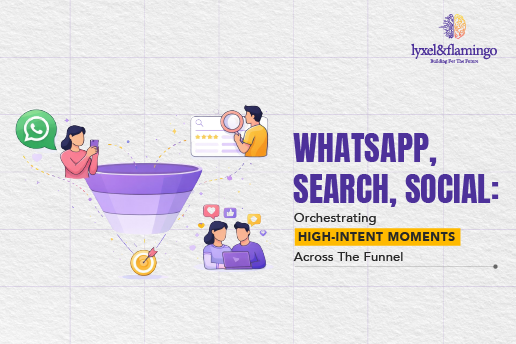
Digital journeys are no longer linear, predictable, or confined to a single channel. People move fluidly between platforms, devices, and intent states, often within minutes. A search query, a social interaction, and a private message can all form part of the same decision window. This reality has pushed omni-channel high-intent moments to the centre of modern growth planning.
Lyxel&Flamingo treats high-intent behaviour as a coordination challenge rather than a channel problem. Brands are not struggling because WhatsApp, search, or social media underperform individually. They struggle because these touchpoints are rarely orchestrated to support each other. As buying cycles shorten and attention fragments, the cost of disconnected intent handling continues to rise.
Why High-Intent Moments Matter More Than Ever
High-intent moments occur when a user is actively considering action. These moments may be explicit, such as searching for a product, or implicit, such as replying to a message or engaging deeply with content. What defines them is readiness, not channel.
As media environments fragment, these moments are shorter and more dispersed. Capturing them requires coordination rather than speed alone. Brands that rely on static funnels often fail to respond appropriately when intent surfaces outside expected touchpoints.
The Cost of Missing Intent Signals
When intent is detected in isolation, responses are often misaligned. A user searching with urgency may still see awareness-level messaging on social media. Someone engaging on WhatsApp may be retargeted with generic ads instead of contextual reinforcement. Over time, these gaps weaken trust and lengthen decision cycles.
This misalignment results in:
- Delayed conversions
- Repeated reassurance loops
- Increased acquisition costs
- Lower confidence at decision points
High-intent behaviour demands relevance, timing, and continuity. Without orchestration, even strong channels underperform, and optimisation efforts become reactive rather than directional.
Understanding Intent Across WhatsApp, Search, and Social
Each channel captures intent differently. Treating them as equivalents ignores their distinct contribution to decision-making and expectation-setting.
Search as Explicit Intent
Search reflects declared interest. Queries often signal urgency, comparison, or readiness to act. However, search alone rarely resolves all uncertainty, particularly for purchases that involve risk, complexity, or long-term commitment. Users frequently leave search environments to seek reassurance elsewhere before completing an action.
Social as Contextual Influence
Social platforms shape perception, familiarity, and preference. Engagement here often reflects emerging interest rather than final intent, yet it heavily influences recall and trust. Content seen on social media frequently frames how search results and messages are interpreted later.
WhatsApp as Confirmation and Reassurance
WhatsApp marketing strategies operate in a more private, conversational environment. Users engaging on WhatsApp often seek clarity, validation, or next steps rather than persuasion. This makes WhatsApp especially effective when users are close to a decision but still require reassurance.Understanding these distinctions allows brands to respond to intent with relevance instead of repetition.
From Multi-Channel Presence to Funnel Orchestration
Being present across channels does not guarantee performance. Orchestration requires sequencing, alignment, and shared intent definitions. Without this coordination, channels often operate in parallel, creating overlapping exposure without meaningful progression. True orchestration ensures each interaction builds on the previous one, guiding users forward rather than resetting the journey at every touchpoint.
What Funnel Orchestration Really Means
Funnel orchestration marketing focuses on how channels support progression rather than compete for attention. It replaces isolated optimisation with coordinated movement through the funnel, ensuring that intent signals are recognised and acted upon consistently across platforms.
This approach prioritises:
- Shared intent signals
- Consistent messaging logic
- Timing over frequency
- Continuity rather than repetition
When orchestration works, users experience clarity rather than pressure, and decisions feel supported rather than rushed.
Designing for Omni-Channel High-Intent Moments
High-intent moments do not belong exclusively to the bottom of the funnel. They can appear during research, evaluation, or re-engagement.
Recognising Intent Beyond Clicks
Intent is not limited to conversions or form fills. It can surface through:
- Repeated searches within short timeframes
- Deep or repeated content engagement
- Message replies or follow-up questions
- Cross-platform comparison behaviour
Designing for omni-channel high-intent moments requires recognising these signals collectively, not in isolation. This perspective aligns closely with discussions around how to orchestrate WhatsApp, search, and social campaigns without creating overlap or noise.
Matching Response to Readiness
When readiness is misjudged, messaging feels out of sync. High-intent users require clarity, reassurance, and relevance. Overexposure or premature persuasion often slows decisions instead of accelerating them.
The Role of WhatsApp in Cross-Channel Conversion
WhatsApp occupies a distinct position in the funnel. It blends immediacy with trust, creating space for dialogue rather than broadcast.
WhatsApp as a Decision Accelerator
Used thoughtfully, WhatsApp reduces friction by:
- Addressing specific questions
- Clarifying delivery, pricing, or availability
- Providing contextual guidance
- Reinforcing confidence at key moments
This makes WhatsApp a natural complement to search and social activity, particularly when users move from exploration to evaluation.
Integrating WhatsApp Without Overreach
Effective WhatsApp marketing strategies respect context, consent, and timing. Messaging should respond to demonstrated intent rather than attempt to manufacture urgency. Excessive messaging erodes trust and reduces long-term effectiveness.
Search and Social as Intent Builders
While WhatsApp often supports decision-making, search and social contribute heavily to shaping and signalling intent earlier in the journey.
Social Search Integration in Practice
As platforms evolve, social search integration is becoming more relevant. Users increasingly discover and evaluate products within social environments before formal searches occur. This convergence requires messaging consistency across paid search, organic social, and platform-native discovery.
This shift is often cited when discussing high-intent moments marketing strategies, where influence and intent no longer sit in separate stages.
Avoiding Channel Competition
When channels compete for attribution rather than contribute to progression, orchestration breaks down. Each touchpoint should reinforce the same narrative rather than attempt to independently close the conversion.
Cross-Channel Conversion as a System, Not a Tactic
Conversion reflects cumulative confidence rather than isolated interaction. Each touchpoint contributes to how users assess credibility, relevance, and risk over time. When channels operate independently, these signals often conflict, forcing users to re-evaluate decisions repeatedly. Treating conversion as a system ensures that confidence builds progressively instead of resetting at every interaction.
Why Cross-Channel Coordination Improves Outcomes
Cross-channel conversion tactics succeed when they focus on reinforcement instead of repetition. Aligned exposure across platforms reassures users and reduces uncertainty, particularly in crowded markets where choices appear similar. Coordination ensures that messaging evolves in step with user intent rather than repeating the same prompts across channels.
This coordination improves:
- Conversion efficiency
- Time to decision
- Trust perception
- Long-term retention
Fragmentation leaves users navigating conflicting messages and experiences across channels, increasing hesitation and extending the time it takes to reach a decision.
Measuring High-Intent Performance Holistically
Traditional reporting often isolates channels, obscuring how intent flows across the funnel. When performance is reviewed in silos, it becomes difficult to understand how earlier interactions influence later decisions.
This limited view can lead teams to optimise individual touchpoints while missing broader patterns that shape conversion behaviour over time.
Moving Beyond Channel-Level Metrics
Channel metrics rarely explain why conversions occur. Understanding intent requires visibility into progression, sequence, and interaction patterns across platforms. This thinking underpins cross-channel funnel optimization techniques focused on continuity rather than attribution alone.
By examining how users move between touchpoints, teams gain clearer insight into what sustains momentum rather than what merely captures attention.
From Attribution to Contribution
Contribution-based measurement reduces internal conflict and supports better decisions by showing how touchpoints work together rather than competing for credit. It encourages alignment across teams by focusing on collective impact instead of isolated performance outcomes.
Aligning Teams Around Shared Intent Signals
Orchestration depends on organisational alignment as much as technology. Even the most advanced platforms struggle to deliver results when teams interpret intent differently or act on incomplete information.
Alignment ensures that intent signals are recognised, prioritised, and acted upon consistently across functions.
Breaking Internal Silos
When media, CRM, and performance teams operate independently, intent signals are duplicated or lost. This often leads to delayed responses or inconsistent messaging.
Shared frameworks reduce fragmentation and improve response consistency by giving teams a common reference point for interpreting behaviour and readiness.
Creating a Common Operating Model
Shared intent definitions support social and messaging campaigns that feel coordinated rather than disjointed, improving experience continuity across the funnel. A common operating model also simplifies decision-making and helps teams respond more quickly as intent shifts.
Planning for High-Intent Moments Across the Funnel
High-intent behaviour can emerge at any stage. It does not always appear as a direct action and may surface through patterns that indicate growing readiness rather than immediate intent. Recognising these signals early allows teams to respond with relevance instead of urgency.
Intent at Upper and Mid-Funnel Stages
Early-stage intent may appear as repeated engagement or information-seeking behaviour. Recognising and supporting this intent builds momentum without introducing pressure too early.
This may involve reinforcing clarity, addressing common uncertainties, or maintaining presence without escalation. This perspective supports Full-funnel & performance alignment, balancing growth and efficiency without forcing premature conversion.
Orchestration in Practice: From Strategy to Execution
Execution discipline determines whether orchestration succeeds. Clear priorities, shared timelines, and defined triggers help translate strategy into consistent action. Without this discipline, even well-designed frameworks struggle to deliver continuity across channels.
Sequencing Over Saturation
Effective orchestration prioritises sequence. Users should encounter a logical flow rather than simultaneous exposure across channels, which often creates fatigue. Sequencing allows each interaction to build understanding, reducing repetition and improving receptiveness at high-intent moments.
Consistency Without Uniformity
Consistency does not mean identical messaging. It means aligned intent, tone, and outcomes adapted to channel context. This approach preserves coherence while allowing each platform to communicate in a way that feels natural to its environment.
How Lyxel&Flamingo Approaches Funnel Orchestration
Lyxel&Flamingo works across media, messaging, and analytics to support coordinated high-intent engagement. The focus remains on structuring systems that detect, interpret, and respond to intent across channels.
Rather than optimising WhatsApp, search, or social independently, the emphasis is on orchestration that supports progression, relevance, and sustainable conversion. This approach reflects best practices for omni-channel marketing focused on alignment rather than channel dominance.
Preparing for the Next Phase of Omni-Channel Marketing
As platforms evolve, orchestration becomes more complex and more necessary. New formats, privacy constraints, and shifting user behaviour make isolated channel planning less effective over time. Brands that adapt by coordinating intent across touchpoints are better positioned to maintain relevance as environments change.
Why Coordination Will Define Performance
Users expect continuity across touchpoints. Brands that deliver aligned experiences build confidence faster and convert more efficiently. When journeys feel coherent, decision-making becomes easier and less effortful. Disconnected journeys, on the other hand, introduce uncertainty and reduce trust, increasingly signalling risk rather than choice.
Conclusion
High-intent moments are fleeting, fragmented, and distributed across platforms. Capturing them requires coordination rather than channel excellence alone.
By aligning WhatsApp, search, and social within a shared intent framework, brands can respond to readiness rather than noise. Through funnel orchestration marketing, high-intent behaviour becomes easier to recognise, support, and convert. Lyxel&Flamingo approach this challenge through coordination, clarity, and long-term intent alignment rather than isolated optimisation. In an omni-channel environment, orchestration defines sustainable performance.
FAQs
Q. Why Focus on High-Intent Moments?
A. High-intent moments indicate readiness to act. Prioritising them improves efficiency by aligning messaging with intent, reducing wasted spend, and accelerating conversions across the funnel.
Q. How Can WhatsApp Complement Search and Social Marketing?
A. WhatsApp supports reassurance and clarification at decision points, complementing search-driven intent and social-led influence with timely, contextual responses.
Q. What Is Omni-Channel Funnel Orchestration?
A. It refers to coordinating multiple channels around shared intent signals to guide users through the funnel rather than managing channels independently.
Q. How Do Cross-Channel Campaigns Improve Conversion?
A. They reinforce aligned messaging across touchpoints, reducing confusion and increasing confidence, which shortens decision cycles and improves outcomes.
Q. What Tools Help Coordinate High-Intent Marketing Moments?
A. Coordination relies on analytics, CRM, and messaging systems that share intent signals and support timely, relevant responses across channels.