
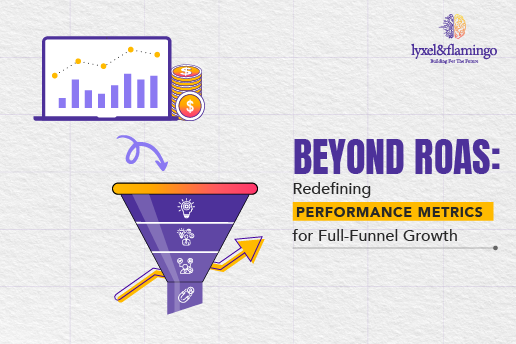
Return on Ad Spend has long been the default yardstick for digital performance. It is simple, familiar, and easy to report. Yet many brands now face a growing gap between strong ROAS figures and uneven business outcomes. Campaigns appear efficient on paper, while growth plateaus or becomes unpredictable. This tension has pushed full-funnel performance metrics to the forefront of modern marketing discussions.
Lyxel & Flamingo help brands move beyond ROAS-centric thinking by building measurement approaches that support long-term growth. As customer journeys become longer and more fragmented, success depends on redefining how performance is measured and optimised across the entire funnel. This shift is no longer optional; it is essential for sustained competitiveness, particularly for teams reassessing what metrics to track beyond ROAS as part of their planning cycles.
Why ROAS No Longer Tells the Full Story
ROAS gained popularity because it offered clarity in an increasingly complex digital ecosystem. However, what once provided focus now risks narrowing perspective. Many of today’s performance challenges stem from over-reliance on a single efficiency metric that was never designed to reflect the full customer journey.
Understanding why ROAS is losing relevance is the first step towards more balanced measurement. Without this understanding, brands risk refining tactics that no longer support broader objectives or long-term value creation.
The Limits of Efficiency-Only Metrics
ROAS focuses on the relationship between ad spend and immediate revenue. While useful for evaluating tactical efficiency, it fails to capture how demand is created, nurtured, and converted over time. It also struggles to reflect the influence of non-linear journeys, repeated exposures, and delayed decisions.
This narrow view can lead to:
- Underinvestment in upper-funnel activity
- Overexposure to high-intent audiences
- Declining incremental returns
- Short-term optimisation that weakens long-term growth
These patterns are increasingly common beyond ROAS marketing, where brands realise that efficiency alone does not guarantee sustainable performance.
When Strong ROAS Hides Weak Fundamentals
High ROAS often reflects demand capture rather than demand creation. Brands may simply be converting users who would have purchased anyway. Over time, this leads to shrinking audience pools and rising acquisition costs.
Without a broader context, ROAS can reward strategies that look successful but fail to expand the market. This disconnect becomes more visible as growth slows despite continued optimisation.
The Shift Towards Full-Funnel Thinking
Modern marketing success depends on how effectively brands influence customers before, during, and after conversion. This requires measurement that reflects the full journey rather than isolated touchpoints.
Full-funnel thinking changes not only what is measured, but how performance is interpreted. It encourages teams to look at momentum, reinforcement, and progression rather than isolated outcomes, answering the broader question of how to measure full-funnel marketing performance in a fragmented media environment.
Understanding Performance Across the Funnel
A full-funnel approach evaluates how awareness, consideration, and conversion activity work together. Rather than treating stages as separate, it examines how they reinforce one another over time.
This perspective highlights where bottlenecks occur and where investment truly drives momentum, even when direct attribution is limited. These views often form the basis of full-funnel campaign insights used to guide budget allocation and creative sequencing.
Why Single-Metric Optimisation Falls Short
Optimising for one metric often creates an imbalance. When teams chase ROAS alone, they risk starving upper-funnel activity that supports future growth and resilience.
Full-funnel performance metrics encourage balance by recognising that different stages serve different roles within the same system. This balance becomes increasingly important as competition intensifies.
Redefining Success Beyond ROAS
Moving beyond ROAS does not mean discarding it entirely. It means placing it within a broader measurement framework that reflects how marketing actually works in practice.
Redefining success requires clarity on what outcomes matter at each stage of the journey and how they connect.
From Transactions to Contributions
Instead of asking which campaign drove the most immediate revenue, brands increasingly ask which activities contributed to demand over time. This shift acknowledges that influence is often cumulative rather than instantaneous.
This approach supports more realistic performance assessment and reduces overconfidence in last-touch results.
Aligning Metrics with Business Objectives
Metrics should mirror business priorities. Growth-focused organisations often need to prioritise reach quality, engagement depth, and progression signals alongside revenue efficiency. This alignment ensures that measurement supports strategy rather than distorting it.
Incrementality as a Main Measurement Principle
One of the most important developments in modern measurement is the focus on incrementality. Rather than asking what converted, brands ask what actually caused conversion.
This distinction is essential for understanding true impact, particularly in crowded media environments where overlap is common.
What Incrementality Reveals
Incrementality measurement isolates the effect of marketing activity by comparing outcomes with and without exposure. This helps distinguish between captured demand and created demand.
Incrementality answers questions that attribution models cannot reliably address, especially when journeys span multiple channels.
Why Attribution Alone is Not Enough
Attribution assigns credit, but it does not prove causation. In complex journeys, many touchpoints receive credit without meaningfully influencing outcomes.
This is why incrementality testing for digital campaigns has become an important validation method, focusing on lift rather than credit distribution and providing clearer guidance for investment decisions.
Designing Metrics for Upper and Lower Funnel Balance
Balanced growth depends on recognising the distinct roles of upper- and lower-funnel activity. Measurement must reflect this distinction rather than collapsing everything into a single outcome.
This balance helps teams invest with confidence across the funnel, even when results unfold over different time horizons.
Measuring Upper-Funnel Contribution
Upper-funnel activity influences awareness, consideration, and preference. Its impact often appears indirectly and over time, making it harder to evaluate using traditional efficiency metrics.
Relevant indicators include:
- Quality reach
- Engagement signals
- Brand consideration shifts
- Assisted conversions
These signals support Upper & lower funnel performance analysis without forcing immediate revenue attribution.
Evaluating Lower-Funnel Effectiveness Responsibly
Lower-funnel metrics remain essential, but they must be interpreted carefully. Conversion rates and cost efficiency matter, but only within the context of demand and supply. This approach prevents over-optimisation that exhausts high-intent audiences and limits future growth.
Building a Holistic KPI Framework
As marketing complexity increases, isolated metrics lose meaning. Brands need integrated KPI systems that reflect the full picture rather than fragmented views. This is where holistic marketing performance becomes a functional requirement rather than a conceptual goal.
Connecting Metrics Across Stages
Holistic KPI frameworks link early-stage indicators with downstream outcomes. This reveals how awareness and consideration activities influence eventual revenue.
Rather than separate dashboards, teams benefit from shared views that show progression and contribution.
Avoiding Metric Overload
More metrics do not guarantee better insight. Effective frameworks prioritise a small set of meaningful indicators aligned to strategic goals, often described as holistic KPIs for marketing growth because they balance efficiency, contribution, and sustainability.
Clarity improves when teams focus on what truly guides decisions rather than tracking everything available.
Digital Marketing KPIs for the Next Planning Cycle
As planning horizons extend, marketers must reassess which KPIs remain relevant. Metrics designed for earlier platforms and behaviours may no longer reflect reality. This makes digital marketing KPIs 2026 an important area of focus for forward-looking teams.
Characteristics of Future-Ready KPIs
Effective KPIs for modern marketing share several traits:
- Resilience to tracking loss
- Alignment with business outcomes
- Applicability across channels
- Support for long-term analysis
These characteristics help teams navigate ongoing changes in data availability.
Moving From Platform Metrics to Outcome Metrics
Platform-specific metrics often optimise local performance rather than overall impact. Outcome-focused KPIs encourage cross-channel coordination and strategic alignment. This shift improves both efficiency and effectiveness and supports analytics-driven marketing strategies that scale beyond individual platforms.
The Role of Analytics-Driven Strategy
Measurement does not exist in isolation. Metrics shape decisions, budgets, and priorities. When designed poorly, they encourage short-term thinking. Strong analytics practices help teams interpret data responsibly.
From Reporting to Interpretation
Reporting answers what happened. Interpretation explains why it happened and what to do next. This distinction is important in Attribution & measurement discussions, where understanding matters more than raw numbers.
Supporting Better Decision-Making
Analytics should reduce uncertainty, not increase it. Clear definitions, consistent methodologies, and transparent assumptions help teams act with confidence. This is especially important in full-funnel environments.
Managing Trade-Offs in Full-Funnel Measurement
Every measurement framework involves trade-offs. Precision, coverage, and simplicity cannot all be maximised simultaneously. Recognising and managing these trade-offs is part of mature measurement design.
Accepting Partial Visibility
Modern analytics rarely offer complete visibility. Consent requirements and platform limitations mean some data will always be missing. Effective frameworks are designed to function despite these gaps.
Focusing on Direction rather than Certainty
Directional insight often matters more than precise figures. Trends, comparisons, and controlled tests provide enough signal to guide decisions. This mindset supports sustainable optimisation.
Aligning Teams Around Shared Performance Goals
Measurement influences behaviour. When teams are evaluated on conflicting metrics, performance suffers. Alignment around shared goals improves execution and accountability.
Creating a Common Performance Language
Shared KPIs help marketing, media, and leadership teams interpret performance consistently. This reduces internal friction and improves collaboration. Clarity at this level supports faster decision-making.
Reducing Internal Metric Conflicts
When ROAS dominates reporting, other valuable contributions may be undervalued. Balanced frameworks recognise multiple forms of impact. This encourages healthier investment decisions.
From ROAS to Growth-Oriented Measurement
Moving beyond ROAS is not about abandoning accountability. It is about redefining it to reflect how growth truly happens. A growth-oriented approach to measurement supports resilience, adaptability, and better long-term decision making.
Measuring What Drives Tomorrow’s Results
Metrics that capture learning, progression, and audience development often predict future performance better than immediate revenue efficiency. These indicators help brands stay ahead of diminishing returns.
Sustaining Performance Over Time
Short-term gains achieved through aggressive ROAS optimisation often erode over time. Sustainable growth depends on balanced investment and realistic evaluation. This perspective protects long-term value.
Conclusion
ROAS remains a useful metric, but it is no longer sufficient on its own. As journeys grow longer and data becomes less deterministic, brands need broader perspectives to guide investment and optimisation. By embracing full-funnel performance metrics, incorporating incrementality measurement, and designing KPIs that reflect holistic marketing performance, organisations can move beyond surface-level efficiency towards sustainable growth.
Lyxel&Flamingo approaches this shift with an emphasis on clarity, balance, and long-term decision-making rather than short-term metric chasing. In a complex marketing environment, the right metrics do not simplify reality; they make it understandable.
FAQs
Q. Why is ROAS no longer enough?
A. ROAS measures short-term efficiency but does not show whether marketing activity is creating new demand or simply capturing existing intent. This can lead brands to over-invest in conversion channels while weakening long-term growth potential.
Q. What metrics define full-funnel growth?
A. Full-funnel growth is defined by metrics that track awareness, consideration, engagement, progression, and conversion together. These indicators show how early-stage activity supports downstream performance rather than evaluating outcomes in isolation.
Q. How does incrementality improve measurement accuracy?
A. Incrementality improves accuracy by isolating the actual impact of marketing activity. It compares exposed and non-exposed audiences to determine which conversions occurred because of marketing, rather than attributing credit based on interaction order.
Q. Which KPIs should marketers focus on in 2026?
A. Marketers should focus on KPIs that reflect contribution, progression, and sustainability. These include quality reach, engagement depth, assisted conversions, and incremental lift, alongside efficiency metrics that support responsible investment decisions.
Q. How can full-funnel analytics drive better ROI?
A. Full-funnel analytics improves ROI by showing how different stages of marketing work together. This insight helps brands allocate budgets more effectively, reduce wasted spend, and optimise for long-term value rather than short-term efficiency alone.