
Marketing measurement is undergoing a structural shift. The loss of third-party cookies, combined with rising privacy expectations, has exposed how fragile many analytics setups have become. Brands are still collecting data, but confidence in what that data represents is steadily declining. This is why the post-cookie measurement strategy has moved from a technical concern to a key priority.
Lyxel&Flamingo observes that most brands are not struggling because they lack tools. They are struggling because existing measurement models were built for a level of visibility that no longer exists. In response, organisations must rethink how they define success, assess performance, and separate insight from distraction. Measurement is no longer about capturing everything; it is about knowing what matters and why.
Understanding Signal vs Noise in Modern Marketing
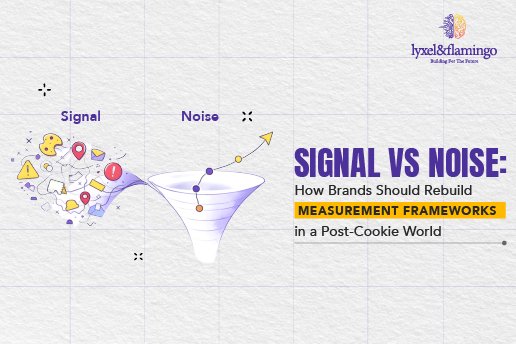
Marketing teams are surrounded by numbers, yet decision-making often feels uncertain. Dashboards grow more complex, but confidence continues to decline. The issue is not data scarcity but data quality and relevance. Understanding the difference between signal and noise is essential before any framework can be improved, particularly as discussions around Signal vs noise in analytics become more prominent across marketing and data teams.
This distinction influences every downstream decision, from budget allocation to campaign optimisation. Without clarity at this level, even sophisticated tools fail to deliver value.
What a meaningful signal looks like today
A signal is data that remains useful even when tracking conditions change. It reflects patterns rather than isolated events and connects clearly to business outcomes such as revenue, margin, or customer retention. Signals help teams understand direction rather than fixate on short-term fluctuations.
Signals are usually consistent across time and channels. They help teams decide where to invest, where to reduce spend, and where performance is genuinely improving. This is why understanding signal vs noise marketing has become important for modern analytics teams, especially as attribution becomes less deterministic.
Strong signals also withstand scrutiny. When questioned, they can be explained, validated, and defended using multiple sources rather than relying on a single platform view.
How noise undermines confidence in reporting
Noise enters measurement when metrics are collected without a clear decision in mind. Inflated conversion counts, duplicated attribution, and excessive segmentation often make performance appear stronger than it is. These issues create false confidence that collapses under deeper examination.
As tracking becomes more restricted, reliance on modelled data increases. Without a strong framework, assumptions stack on top of already uncertain metrics, eroding confidence across teams. When stakeholders stop trusting the numbers, analytics loses its ability to guide decisions.
This noise also slows decision making. Instead of acting on insights, teams spend valuable time questioning reports, weakening the very purpose of measurement.
Why Legacy Measurement Frameworks Are No Longer Fit for Purpose
Many brands continue to rely on frameworks designed for a different internet. These approaches struggle to cope with consent-driven data collection and incomplete user journeys. What once felt precise now feels misleading.
Rebuilding measurement starts with recognising why older models fail under current conditions and why incremental fixes are rarely enough.
Frameworks designed for certainty
Traditional measurement frameworks assumed that users could be tracked across sessions, devices, and platforms with minimal loss. Attribution models relied on deterministic paths, and reporting focused heavily on last-touch outcomes.
Today, these assumptions no longer hold. Attempting to maintain them creates misleading precision and encourages over-optimisation based on partial data. Campaigns may appear efficient while overall performance stagnates.
Modern measurement must prioritise usefulness over completeness. Fewer metrics, clearly defined, are more valuable than extensive dashboards that do not guide action. Measurement frameworks should help teams understand direction and contribution, not chase perfect attribution.
This shift requires a mindset change as much as a technical one. Accepting uncertainty is now part of responsible measurement design.
First-Party Data as the Foundation of Reliable Measurement
As external tracking weakens, brands must rely on data they directly collect. First-party data has become the most dependable source for understanding performance and audience behaviour.
This shift requires a change in both mindset and structure. Data ownership now carries greater responsibility and opportunity.
Why first-party data delivers stronger insight
A robust first-party data strategy focuses on data generated through direct customer interactions, such as websites, apps, and transactional systems. This data is collected with clear consent and governed internally.
Because ownership and context are clear, first-party data produces more reliable signals than third-party alternatives. It also aligns more closely with actual customer relationships rather than inferred behaviour.
Importantly, first-party data enables continuity. Even as platforms and policies change, brands retain a consistent view of their audiences.
Structuring first-party data for consistency
Reliability depends on standardisation. Event definitions, naming conventions, and integrations must be aligned across platforms. Without consistency, even owned data becomes fragmented.
When first-party data is structured with measurement in mind, it supports long-term insight rather than short-term reporting fixes. A disciplined first-party data strategy ensures that analytics evolves alongside business needs rather than reacting to platform changes.
Privacy-First Analytics and Measurement Quality
Privacy requirements have reshaped how data can be collected and used. While often viewed as a limitation, privacy-focused approaches can improve measurement when applied thoughtfully. They force brands to be selective and intentional, thus making Privacy-first marketing analytics a quality benchmark rather than a compliance exercise.
By limiting excess collection, teams are encouraged to focus on metrics that genuinely support decision-making.
Reducing noise through selective data collection
Privacy-first analytics encourages teams to collect only data that serves a clear purpose. This reduces clutter and shifts attention to metrics that genuinely reflect performance. By focusing on relevance rather than volume, reporting becomes easier to interpret and act upon. Fewer metrics often lead to better conversations and faster decisions.
Building resilience into analytics systems
Privacy-aligned measurement relies less on fragile identifiers and more on aggregated trends. This makes analytics systems more adaptable to future regulatory and platform changes.
Over time, this stability improves confidence and consistency. Privacy-first analytics also reduces the risk of sudden measurement gaps when policies change, supporting continuity in planning.
GA4 and the Evolution of Measurement Design
Google Analytics 4 reflects many of the structural changes required in modern measurement. However, its effectiveness depends on how it is planned and implemented.
GA4 should be treated as an enabler, not a standalone solution. Without a clear framework, it can replicate the same issues seen in legacy tools.
Event-based logic and evolving user behaviour
GA4’s event-driven model aligns with how users interact across devices and platforms. A well-designed GA4 privacy-first measurement approach allows brands to observe meaningful actions while respecting consent boundaries.
This helps maintain trend visibility even when direct tracking is limited and forms the backbone of a resilient GA4 measurement framework. The focus shifts from sessions to behaviours, which better reflects real engagement.
The importance of migration planning
Many GA4 implementations fall short because they focus on technical setup rather than strategy. A thoughtful GA4 migration strategy defines success metrics, event frameworks, and reporting logic before configuration begins.
Without this planning, GA4 risks replicating legacy measurement problems in a new interface, adding complexity without clarity.
Advanced Analytics Frameworks and Integrated Technology
As data sources multiply, single-platform reporting is no longer sufficient. Brands increasingly rely on integrated approaches that connect marketing, analytics, and commercial data.These systems support deeper insight when designed responsibly and governed consistently.
Connecting systems without creating complexity
Advanced analytics frameworks combine media performance, behavioural data, and commercial outcomes into a unified view. This integration helps teams understand performance across the full customer journey.
Technology enables this connection, but governance ensures consistency and accuracy. Without governance, integration can amplify confusion rather than reduce it.
From attribution to contribution
Rather than assigning all value to one interaction, advanced frameworks assess how channels contribute collectively to outcomes. This reflects how marketing influences demand in reality.
This shift reduces overconfidence in individual metrics and improves investment decisions by focusing on incremental impact.
Creating Marketing Analytics Clarity Across Teams
Measurement is only valuable when it is understood and trusted. Clarity requires alignment across teams and consistent interpretation of data. Without this, even accurate reporting fails to drive action.
Trust is built through transparency and shared understanding.
Governance as a measurement discipline
Clear ownership, documented definitions, and regular validation ensure that metrics mean the same thing across teams. This discipline helps in supporting marketing analytics clarity and reduces internal debate.
Governance transforms analytics from a reporting function into a shared decision tool rather than a source of conflict.
From questioning data to acting on insight
When teams trust measurement, conversations shift from challenging numbers to improving outcomes. This is where analytics begins to deliver strategic value rather than operational noise.
Designing Measurement for Long-Term Decision-Making
The post-cookie environment requires brands to accept uncertainty while still making informed decisions. Measurement frameworks must support this balance. Long-term clarity comes from discipline, not from chasing completeness.
Effective frameworks guide decisions even when data is imperfect.
Embracing trends over precision
Directional insight is often more valuable than precise but fragile metrics. Trends reveal whether performance is improving or declining, even when data is partially modelled.
This perspective encourages smarter, more sustainable optimisation and reduces overreaction to short-term variance.
Aligning measurement with business reality
Measurement should reflect how the business actually grows, not how platforms report success. This alignment ensures analytics remain relevant as conditions change and supports confident planning.
Strong measurement frameworks evolve alongside business strategy rather than reacting to external disruption.
Conclusion
The shift away from third-party cookies has exposed fundamental weaknesses in how many brands measure performance. Frameworks built for certainty struggle in an environment shaped by privacy, consent, and partial visibility.
By rethinking measurement frameworks, investing in strong first-party foundations, and adopting disciplined, privacy-aligned approaches, brands can regain confidence in their analytics. Lyxel&Flamingo approaches this challenge with a focus on structure, clarity, and long-term decision-making rather than short-term optimisation. In a landscape where less data is directly observable, better measurement design has become a competitive advantage.
FAQs
Q. What is signal vs noise in marketing?
A. Signal refers to data that consistently reflects real business impact and supports decision-making. Noise includes metrics that add volume without improving understanding.
Q. Why are cookies becoming obsolete?
A. Third-party cookies are being phased out due to privacy regulations, browser restrictions, and growing consumer expectations around data protection.
Q. What metrics matter in a post-cookie environment?
A. Metrics linked to revenue contribution, customer value, retention, and incremental impact are more reliable than click-based indicators.
Q. How does GA4 support modern measurement?
A. GA4 enables event-based tracking, consent-aware data collection, and modelling, making it more suitable for current privacy and tracking constraints.
Q. How can brands improve data accuracy?
A. Accuracy improves through strong first-party data design, clear frameworks, consistent governance, and regular validation across teams.