
Table of Contents
- What Is a GP / DPR Media Strategy?
- The Budget Allocation Problem Most Brands Won't Name
- Why the Imbalance Persists: The Mechanism Behind Misallocation
- Guaranteed Performance vs Programmatic: The Layered Buying Model
- The Evidence: What the Data Actually Says
- How GP Builds E-E-A-T and Earns AI Citations
- Where GP Fits Into the E-E-A-T Equation
- The GEO Angle: Paid GP as a Generative Engine Optimisation Tool
- The Practical Implications for GP Buying
- How DPR Measurement Captures the E-E-A-T Signal
- The Lyxel&Flamingo Media Capital Stack: Our Framework for GP/DPR Allocation
- What This Looks Like in Practice
- 5 Moves to Make Before Your Next Media Plan
Here’s What This Covers
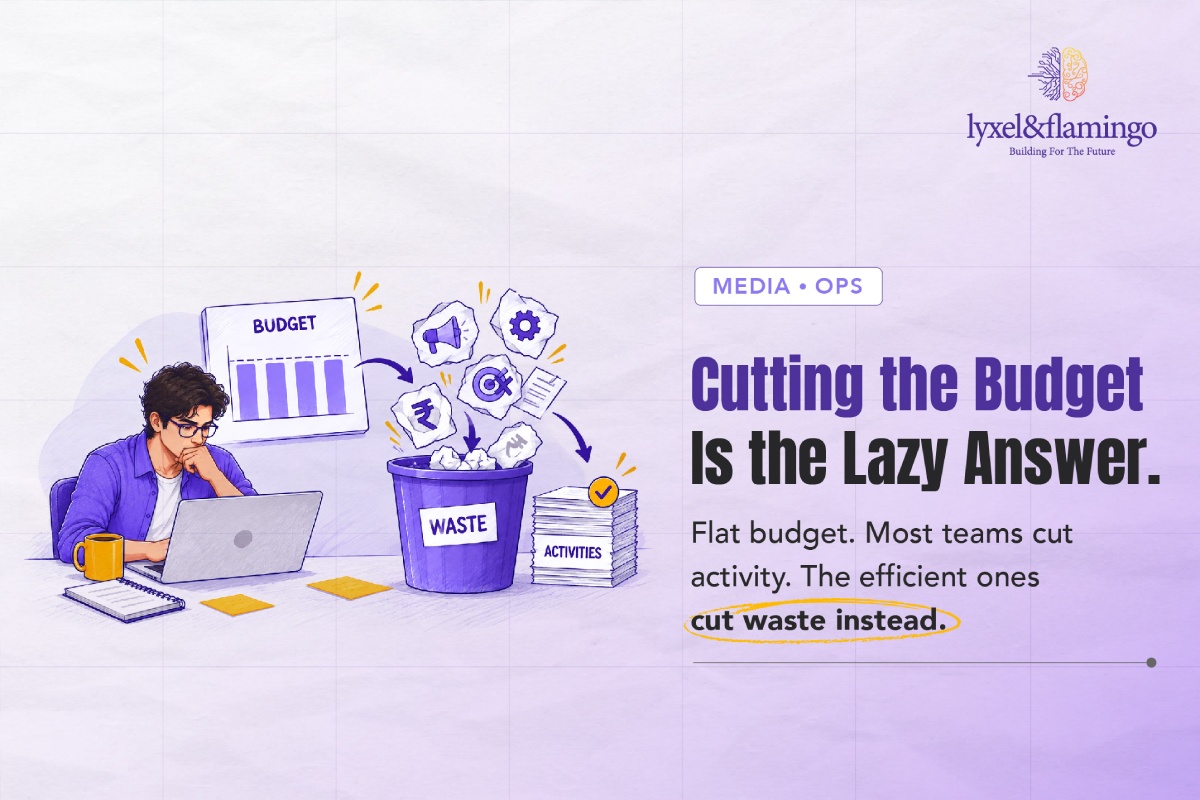
Most brands treat paid media as pure performance, but that approach breaks over time. When budgets focus only on conversions, the audience pool slowly shrinks. Costs rise, and teams try fixing it with tactics that do not address the real issue.
A GP and DPR strategy fixes this structurally. It balances brand and performance investments across the funnel. GP ensures premium visibility and consistent reach, while DPR measures real business outcomes, not just platform metrics.
The Media Capital Stack builds this into a working system. When allocation improves, efficiency follows. Brands do not need to spend more; they just need to spend smarter and with better structure.
Most brands treat paid media as a performance channel. That instinct is correct in principle, but it goes wrong in reality. They invest in what can be tracked, last-click conversions, bottom-funnel ROAS, cost-per-lead, and then call that accountability. It isn’t accountability, it’s optimising the exhaust while ignoring the engine.
A paid media budget allocation strategy that only funds what converts today will eventually have nothing left to convert. The top of the funnel is the awareness layer. It builds audience, consideration, and purchase intent. It is what makes bottom-funnel performance possible in the first place. When brands stop replenishing it, conversion costs don’t fall dramatically, but drift upwards.
The shift from pure performance marketing to a full funnel marketing model is financial rather than philosophical. And in India’s rapidly expanding digital market, where digital ad spends crossed ₹49,000 crore in FY2025, up 20% year-on-year, the brands that build structurally sound media strategies now will compound advantages that are genuinely difficult to close later.
This blog explains how Programmatic Guaranteed (GP) and DPR (Demand-side Performance ROI) strategy actually work together, why most Indian brands are using both incorrectly, and the framework Lyxel&Flamingo’s Growth Marketing team uses to build media plans that are accountable across every stage of the funnel.
What Is a GP / DPR Media Strategy?
Programmatic Guaranteed (GP) is a media buying model where an advertiser secures a fixed volume of impressions from a specific publisher at a pre-negotiated price. No auction or last-minute scramble for inventory. You know where your ad appears, at what price, and for how many impressions before the campaign goes live. It combines the placement certainty of direct buying with the operational efficiency of programmatic infrastructure. That combination is more powerful than it sounds.
A DPR (Demand-side Performance ROI) strategy applies a performance-first measurement lens to the entire paid media stack, not just bottom-funnel channels. Every budget decision gets evaluated against its contribution to a business outcome: revenue, qualified leads, app installs, or brand equity metrics. Not just media-layer KPIs like impressions and CPM. This is the part most Indian marketing teams skip.
Together, GP and DPR are not competing models. GP provides the certainty and premium inventory access required for brand-building. DPR provides the optimisation rigour required for performance accountability. A GP/DPR strategy is when a brand refuses to treat these two things as separate conversations in separate rooms.
The Budget Allocation Problem Most Brands Won’t Name
A 2025 CMO survey found that only 31.2% of marketing budgets were allocated to long-term brand building, versus 68.8% to short-term performance. The IPA Databank, which tracks 2,000-plus campaigns over several decades, consistently shows that the optimal brand-to-performance split is closer to 60/40 in favour of the brand for sustained, profitable growth. Most Indian brands are running the inverse of that and wondering why their CPAs keep climbing.
The consequence isn’t immediately visible. Short-term ROAS holds steady for a quarter, sometimes two. Then CPAs begin rising, and conversion volumes soften. The instinct is to optimise harder:
- tighter targeting,
- lower bids,
- Sharper creative.
But the root cause isn’t execution. It’s the depleted audience pool, and the only way to refill it is the investment you’ve been cutting.
This is the structural problem a paid media budget allocation strategy built around GP and DPR is designed to solve. Not spending more, but deploying what you have across the funnel in proportions that actually sustain growth over time.
Why the Imbalance Persists: The Mechanism Behind Misallocation
The bias toward bottom funnel performance is not just laziness in teams. It comes from how measurement systems are built and used daily. Most attribution models focus on final conversion events only.
They answer what happened last, not what actually made conversion possible.
This creates a systematic undervaluation of upper-funnel media. A YouTube pre-roll that built brand recall two weeks before a search query doesn’t show up in the conversion path. A programmatic display impression that drove a brand search three days later gets zero credit in the report. What doesn’t get credited doesn’t get funded. The attribution model shapes the allocation model, and most attribution models are structurally blind to 60-70% of the actual funnel journey.
The second issue is organisational, and it is harder to fix in practice. Performance teams focus on ROAS, while brand teams track softer metrics. Both work separately, without shared incentives.
The CMO mostly focuses on short-term revenue. So long-term bets rarely get enough attention.
The GP/DPR model addresses both problems simultaneously. GP deals, because they are negotiated at a fixed price against defined inventory, force brands to pre-commit to upper-funnel investment before the quarter begins. DPR strategy, because it evaluates all channels against business outcomes rather than media metrics, creates a common measurement language across funnel stages. Together, they close the attribution gap and the organisational gap at the same time.
Guaranteed Performance vs Programmatic: The Layered Buying Model
The question of guaranteed performance vs. programmatic is not a binary choice. It is a layered buying architecture, and each layer serves a distinct purpose:
| Buying Method | Best Used For | Primary Signal | Limitation |
| Programmatic Guaranteed (GP) | Brand campaigns, premium placements, seasonal peaks | Placement certainty, context quality | Limited in-flight optimisation |
| Private Marketplace (PMP) | Mid-funnel retargeting, curated publisher audiences | Audience precision, CPM efficiency | Requires publisher relationships |
| Open RTB | Performance campaigns, scale, and cost efficiency | Real-time price optimisation | Transparency and brand safety risk |
The sophistication is in knowing which layer to use, when, and in what proportion. Not in picking one and pretending the others don’t exist.
The Evidence: What the Data Actually Says
Brands using a full-funnel marketing approach see up to 45% higher ROI and a 7% lift in offline sales compared to single-stage campaigns. Research across high-growth brands confirms that advertisers who add upper-funnel channels enjoy stronger downstream conversion rates and lower acquisition costs. Not despite the upper-funnel investment, but directly because of it.
C-level leaders who prioritised media mix modelling were over 2x more likely to exceed revenue goals by 10% or more. MMM-informed budget allocation isn’t just a better measurement. It structurally changes which channels get funded, because it surfaces the cross-channel effects that last-click attribution routinely obscures and undercounts.
Brands with a balanced brand-and-performance mix see an average ROI lift of 90% compared with performance-only strategies. This is the single most underused insight in Indian marketing planning. The multiplier effect of brand investment on performance efficiency is not theoretical. It is documented at scale across categories and geographies.
India’s digital advertising market generated USD 13.6 billion in 2024 and is projected to reach USD 32.3 billion by 2030, a CAGR of 15.3%. The market is growing fast enough that media strategy errors made now will compound into structural disadvantages over time. Brands that build the correct allocation frameworks today are not just performing better in 2025. They are widening a gap that becomes harder to close in 2027.
Only 38% of global marketers evaluate their marketing ROI holistically by measuring traditional and digital channels together. The majority of brands are making budget decisions with a fundamentally incomplete picture. This is also the single most addressable competitive advantage available to any brand willing to invest in proper measurement infrastructure.
How GP Builds E-E-A-T and Earns AI Citations
Most conversations about Programmatic Guaranteed stop at media efficiency. They shouldn’t. There is a second-order benefit to GP that almost no brand in India is actively tracking, and it is becoming more valuable by the quarter.
GP placements on premium publishers build E-E-A-T authority. And E-E-A-T authority is now the primary currency of AI search visibility.
This isn’t a search engine optimisation argument wearing paid media clothing. It’s a structural truth about how Google’s systems, AI Overviews, and large language models like ChatGPT and Perplexity evaluate which brands are worth citing.
What E-E-A-T Actually Means for a Brand
E-E-A-T stands for Experience, Expertise, Authoritativeness, and Trustworthiness, the framework Google’s search quality raters use to assess whether a page, a brand, or a publisher deserves to surface in high-quality search results. Google’s Search Quality Rater Guidelines, last updated in September 2025, now explicitly extend E-E-A-T evaluation to AI Overviews, meaning the same signals that determine organic rankings also determine which brands appear in AI-generated answers.
The four components have precise definitions. Experience means the brand or author has demonstrable, first-hand involvement with the subject. Expertise means deep, verifiable knowledge. Authoritativeness means being externally recognised as a credible source. Trustworthiness is the most important of all, and according to Google’s own guidelines, a page can demonstrate experience, expertise, and authority but still receive a low E-E-A-T evaluation if the trust signals are absent or unverifiable.
Where GP Fits Into the E-E-A-T Equation
Here is what most paid media teams don’t think about when they buy GP deals. When your brand appears consistently on premium, contextually relevant publishers, those appearances are doing more than generating impressions. They are building the external corroboration signals that both Google and AI systems use to evaluate brand authority.
Analysis of E-E-A-T in AI narratives shows that AI Overviews and LLM-generated answers prioritise brands that own their knowledge graph, are widely referenced, and are recognised leaders in their industry. Brands with verified expertise, structured citations, and widespread recognition will have an advantage in AI-driven search. GP placements on authoritative publishers directly build that “widely referenced” signal.
Think about it this way. A GP deal with a premium finance publisher puts your brand’s messaging alongside editorial content that Google and AI systems already trust. The association is not incidental. LLMs form their understanding of brands based on where those brands consistently appear and what credible third-party sources say about them. A brand appearing in ten open exchange placements on made-for-advertising sites generates zero E-E-A-T equity. The same brand appearing in guaranteed placements on three premium vertical publishers generates measurable authority signals that AI models pick up and cite.
Research into AI citation patterns across 40,000+ AI responses and 250,000+ citations found that earned content from premium third-party publishers represents the largest percentage of AI citations. During the problem exploration and education stages of the buyer journey, third-party editorial content dominates AI-generated answers. That is the exact context in which a brand’s GP placements on premium editorial publishers accumulate citation equity.
The GEO Angle: Paid GP as a Generative Engine Optimisation Tool
Generative Engine Optimisation (GEO) is the emerging discipline of structuring brand presence so that AI systems cite you accurately and favourably when answering queries in your category. These systems interpret consistent coverage from reputable sources as evidence that a brand is trustworthy, increasing inclusion in summaries and recommendations.
GP placements function as a paid acceleration of this dynamic. You are not waiting to earn editorial coverage organically. You are guaranteeing your brand’s presence on the same high-authority publishers that AI systems already trust and reference. Publishers are now explicitly packaging their AI citation playbooks as services for brands, because they understand that consistent, structured brand presence in premium editorial environments directly improves AI citation rates.
This is the hidden dividend of the GP strategy that almost no Indian brand is measuring. You are not just buying impressions. You are buying contextual authority. And contextual authority is what makes a brand citable by AI.
The Practical Implications for GP Buying
This changes how you should think about GP publisher selection. A GP deal should now be evaluated on three dimensions, not two:
Dimension 1: Audience quality. Does this publisher’s audience match your target customer? This is the traditional criterion, and it still matters.
Dimension 2: Contextual relevance. Is the editorial context of this publisher consistent with the category authority you want to build? A fintech brand appearing in a premium business news environment builds category authority. The same brand appearing on a generic lifestyle site does not.
Dimension 3: AI citation equity. Is this publisher the type of high-authority domain that AI Overviews and LLMs already cite? Research confirms that AI Overviews consistently favour a subset of high-profile domains. Being present on those domains through GP deals increases the probability that AI systems will associate your brand with the topics those publishers cover.
For Indian brands, this means prioritising GP deals with publishers that are already appearing in Google’s AI Overviews for category-relevant queries. That list is shorter than you think, and being on it through GP placements is a competitive advantage that takes time to build.
How DPR Measurement Captures the E-E-A-T Signal
A performance media budget optimisation framework that stops at ROAS and CPA will never capture the E-E-A-T dividend from GP placements. DPR measurement needs to expand to include:
- Brand search volume trend as a proxy for brand awareness lift from GP placements
- Share of search in the target category, tracked quarterly
- AI Overview citation frequency for branded and category queries, manually tracked or via tools
- Direct and brand traffic lift in the weeks following GP campaign flights
These are not soft metrics. They are the leading indicators that tell you whether your GP investment is compounding into AI citation equity, or just generating viewable impressions that nobody can cite.
As Search Engine Journal’s entity authority research confirms, teams that track AI Overview citations alongside organic visibility and external brand mentions are the ones catching the compounding effect of authority-building earliest. Those early signals, rising brand search for related terms, first AI Overview citation, frequency of brand mentions in AI responses, are the leading indicators that the GP investment is building equity, not just generating reach.
The Lyxel&Flamingo Media Capital Stack: Our Framework for GP/DPR Allocation
At Lyxel&Flamingo’s Growth Marketing practice, we use a structured allocation model to build media plans that are accountable across every stage of the funnel. We call it the Media Capital Stack, a framework that treats paid media budgets the way a disciplined investor treats a portfolio: diversified by risk profile, evaluated by return, and rebalanced when performance signals justify it.
The framework has four layers, and the order matters.
Layer 1: Foundation Capital (30-40% of total paid media budget)
This layer is a non-negotiable brand investment for long-term growth. It includes premium placements like OTT, CTV, and direct publisher buys. The KPIs here are brand recall lift, unaided awareness, share of search, and increasingly, AI citation frequency, and not conversions. This layer gets funded first, before performance budgets are set, because it is literally what makes performance budgets efficient. The focus stays on awareness and recall, not immediate conversions.
Most brands underinvest here, which creates inefficiency later. We have seen this clearly across FMCG and consumer categories.
One D2C brand increased top funnel allocation from 15% to 32%. Within two quarters, CPAs dropped around 27% without changing performance campaigns.
Layer 2: Growth Capital (30-35% of total paid media budget)
Mid-funnel investment: search ads on informational queries, social retargeting, content amplification, and video completion campaigns. The audience at this stage has brand awareness but hasn’t formed purchase intent yet. The job is to create that intent. DPR measurement applies here, with every channel evaluated on its contribution to downstream conversion probability, not just click-through rate in isolation.
Layer 3: Conversion Capital (20-30% of total paid media budget)
Bottom-funnel, high-intent activity: branded search, shopping ads, retargeting with direct-response creative, and high-intent social campaigns. This is where ROAS measurement is genuinely appropriate. The critical constraint to keep in mind: Layer 3 performance is a direct function of how well Layers 1 and 2 are funded. Cut the upper layers, and this layer becomes progressively less efficient over the following quarters.
Layer 4: Experimental Capital (10-15% of total paid media budget)
Reserved explicitly for testing new channels, formats, and audience segments. This layer is not optional. It’s how you avoid being surprised by platform shifts, algorithm changes, or emerging inventory opportunities that you didn’t see coming. It’s also how you generate the data needed to rebalance the other three layers with confidence over time.
The Media Capital Stack is rebalanced quarterly using MMM outputs and channel-level incrementality data. This is not based on monthly ROAS reports, which are too short a window to capture the lagged effects of brand investment on downstream performance.
What This Looks Like in Practice
A QSR brand in India came to Lyxel&Flamingo with a recognisable problem. Rising CPAs on Meta and Google, despite stable targeting and creative performance on paper. Their media plan allocated approximately 78% of the paid budget to bottom-funnel conversion campaigns. Brand search volume had been declining for three consecutive quarters. On the surface, the campaign looks fine. Underneath, the audience pool was quietly draining.
Lyxel&Flamingo’s Growth Marketing team rebuilt the media plan using the Media Capital Stack framework, shifting allocation to 35% Foundation Capital, 30% Growth Capital, 28% Conversion Capital, and 7% Experimental Capital. We negotiated GP deals with two premium food and lifestyle publishers to anchor the Foundation layer, restructured their PMP deals for mid-funnel audience retargeting, and maintained the existing bottom-funnel channels with tightened frequency caps.
Results at the six-month mark:
- Brand search volume up 34%, the leading indicator that Foundation Capital investment was actually working
- Meta CPA down 22%, a direct result of a warmer and better-qualified audience entering the bottom funnel
- Overall, paid media ROAS up 18% on the same total budget
- Share of search (a proxy for brand salience) increased for the first time in four consecutive quarters
These results didn’t come from spending more. They came from spending differently, in proportions that respected how purchase decisions actually form in the real world.
5 Moves to Make Before Your Next Media Plan
Audit your current funnel allocation before setting a single budget figure.
Pull your last 12 months of paid media spend by channel. Map each channel to its primary funnel stage. If more than 65% sits in bottom-funnel conversion channels, you have a structural problem that no amount of creative or targeting optimisation will actually fix. The audit takes roughly two hours. The correction takes one budget cycle.
Set your Foundation Capital budget first, before performance channels.
Most teams set performance budgets first and fund brand investment from whatever remains. Reverse this process entirely. Decide your Foundation Capital percentage (minimum 30% for most Indian consumer brands), lock it in, and distribute the remainder across Growth and Conversion Capital. This one change in process produces significantly different allocation outcomes quarter over quarter.
Run a Programmatic Guaranteed deal on at least one premium publisher this quarter.
Even a modest GP deal, say 5 million guaranteed impressions on a contextually relevant publisher, generates benchmark data on what quality inventory actually does to your downstream conversion rates. You cannot make a credible argument for Foundation Capital without data that supports it. GP gives you data that open exchange simply never will.
Separate your measurement by funnel stage and stop using ROAS to evaluate brand campaigns.
Brand campaigns will never win a ROAS comparison against bottom-funnel retargeting. They’re not supposed to. Set distinct KPI frameworks per funnel stage: reach and brand recall lift for Foundation Capital; CTR, engagement rate, and brand search lift for Growth Capital; ROAS and CPA for Conversion Capital. Mismatched KPIs produce misallocated budgets every single time without fail.
Commission a media mix modelling exercise before your next annual plan.
MMM doesn’t require massive budgets or months of consultant work. A well-scoped MMM exercise using 12 months of channel spend and sales data will surface the cross-channel effects your current attribution model is missing entirely.
Conclusion
The argument in this blog is simple and structural: a paid media budget allocation strategy that only funds what converts today will eventually have nothing left to convert. GP and DPR aren’t just media buying tactics. They are a framework for treating media investment with the same discipline a CFO applies to capital allocation, diversified by risk, evaluated by return, and rebalanced when the evidence supports it.
India’s digital ad market is growing fast, but structure matters more than clever tactics now. Brands using proper allocation frameworks are building long-term advantage. If you cannot track where money goes and what it returns, it is not really a strategy.
Speak to Lyxel&Flamingo’s Growth Marketing team about a media allocation audit, a structured review of your current channel mix, funnel allocation, and attribution model against the Media Capital Stack framework.
Frequently Asked Questions
Programmatic Guaranteed (GP) involves pre-negotiated deals where a fixed volume of impressions is reserved for an advertiser at a set price. No auction, no competition for the same inventory. Open programmatic buying uses real-time bidding, where ad space is purchased through live auctions with multiple competing buyers. GP offers placement certainty and premium inventory access. Open RTB offers flexibility and price efficiency at scale. The majority of sophisticated media plans use both, allocated to different funnel stages based on the campaign objective.
Growth-stage brands typically allocate 40-50% to upper-funnel awareness, 30-40% to mid-funnel consideration, and 20-30% to lower-funnel conversion. Mature brands can shift toward 30-35% upper-funnel, but zero is never the right number. Upper-funnel investment is what replenishes the audience pool that conversion campaigns depend on. The IPA Databank's long-run data suggests a 60/40 brand-to-performance split for sustained profitable growth across most categories.
Standard performance marketing usually focuses on channel-level metrics like CPC, CTR, and ROAS. That works, but only to a point. DPR strategy looks at the full system instead. It connects every channel to real outcomes like revenue or growth. Brand and performance are treated together, not separately.
Standard attribution models work fine for campaign-level optimisation inside platforms. But they do not show how channels interact across the full funnel. MMM helps with that bigger picture. It tracks delayed impact and supports better budget decisions. If you spend ₹2 to 3 crore, it becomes worth it. Below that, simpler testing methods usually make more sense.
The principles apply at any scale. The specific mechanics differ. Large brands can negotiate GP deals directly with premium publishers. Mid-sized brands typically access guaranteed inventory through DSPs or agency trading desks that have existing publisher relationships. What doesn't change is the structural argument: any brand running purely bottom-funnel performance campaigns will eventually see rising CPAs as the audience pool depletes. The Media Capital Stack framework scales down without losing its logic. The percentages stay the same whether you are working with ₹50 lakh or ₹50 crore.
GP placements on premium, contextually relevant publishers builds the external corroboration signals that Google and AI systems use to evaluate brand authority. When a brand appears consistently on high-authority editorial publishers, LLMs like ChatGPT, Gemini, and Perplexity interprets that pattern as a trust signal. Research across 40,000-plus AI responses shows that third-party editorial content represents the largest share of AI citations, particularly during the awareness and consideration stages of the buyer journey. GP deals that land on those publishers accumulates citation equity that open exchange placements never builds. This is why GP publisher selection should now factor in the domain's existing AI citation status for category-relevant queries, not just its audience reach.