
Table of Contents
- The 3-Second Reality
- Attention Economics and Media Waste
- Designing for Thumb-Stop Behavior
- Short-Form Is Not Simplified. It Is Compressed
- Fragmented Consumption and Context Collapse
- The End of One-Size-Fits-All Campaigns
- Branding Without Slowing Down
- Metrics That Actually Matter
- Creative Teams Need a New Operating Model
- From Aesthetic to Asset
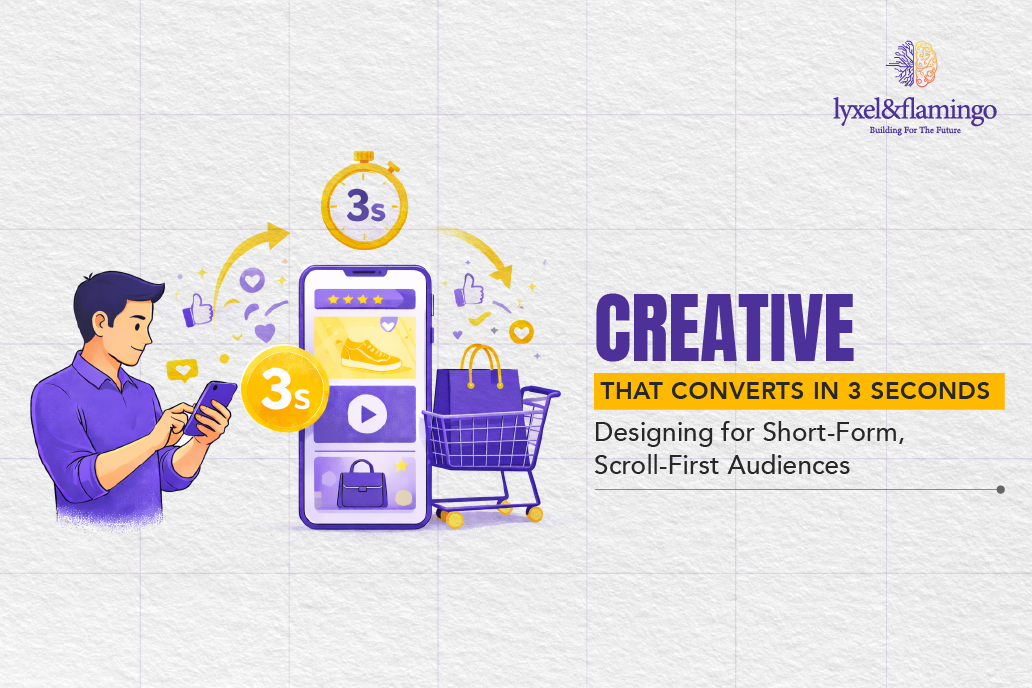
Every marketer says attention is shrinking. The sharper truth is this – attention is not shrinking, patience is.
Audiences today are not passive viewers. They are active filters. Their thumbs decide what survives. In under three seconds, your brand is either ignored or invited in. That is the new battlefield of ad creativity.
For a Marketing Head, this is not a design problem. It is an attention economics problem. Media costs are rising. Feeds are crowded. Audiences are fragmented across platforms. The only variable you truly control is the quality and structure of your creative.
If it does not stop the scroll instantly, nothing else matters.
The 3-Second Reality
Platforms like Instagram Reels, YouTube Shorts, and Facebook have reshaped consumption behavior. Content is vertical. Fast. Sound-optional. Context-light. This has redefined what Creative for the 3-Second Scroll actually means.
Three seconds is not about telling a story. It is about earning the right to tell it.
In that window, your creative must achieve three things:
- Signal relevance.
- Create visual disruption.
- Trigger curiosity or desire.
Most brands fail at the first step. They start with logos, slow fades, or brand statements. The audience is already gone.
Scroll-first audiences do not reward branding. They reward immediacy.
Attention Economics and Media Waste
From a Marketing Head’s lens, this is about efficiency. Every failed scroll costs money. When media budgets scale, creative inefficiency compounds.
You can optimize targeting. You can refine bidding strategies. But if your creative ad design does not hook early, your cost per result climbs regardless of platform sophistication.
Attention is now the scarcest resource in digital marketing. And it behaves like a market.
The more supply of content increases, the higher the price of engagement.
That is why brands investing in structured media creative optimisation services are outperforming those who treat creative as a one-time production exercise. Optimisation is no longer just about audience segments. It is about creative iteration at speed.
Designing for Thumb-Stop Behavior
Thumb-stop behavior is predictable once you study it.
People pause for:
- Faces with emotion
- Clear benefit statements
- Visual contrast
- Movement within the first second
- Pattern interruption
They do not pause for:
- Generic stock visuals
- Long introductions
- Overloaded messaging
- Subtle brand cues
This is where social media creatives need to evolve. Designing for scroll-first platforms is not about shrinking TV ads into vertical format. It requires platform-native thinking.
Vertical framing is not enough. The pacing, typography, and narrative entry point must change.
Start with the payoff. Not the setup.
Short-Form Is Not Simplified. It Is Compressed
There is a misconception that short form video ads require less strategic thinking. The opposite is true.
In a 30-second TV spot, you can afford buildup. In a six to ten second reel, you cannot.
Short form demands compression without losing clarity. That requires stronger scripting, sharper hooks, and tighter visual hierarchy.
Effective short form structure often follows this rhythm:
- Second 0 to 1: Visual disruption or bold statement
- Second 1 to 3: Core value proposition
- Second 3 onward: Proof, credibility, or offer
Anything that delays value delivery weakens performance.
The audience is not waiting for you to explain yourself.
Fragmented Consumption and Context Collapse
Audiences consume content in between tasks: while commuting, while working, and while multitasking across apps. There is no single mindset, no guaranteed sound, and no stable attention span. Creative must therefore function in silence, in motion, and in chaos.
This is where disciplined creative ad design becomes a growth lever.
Design must:
- Use legible typography in mobile-first sizing
- Highlight one clear benefit per asset
- Maintain brand consistency without overpowering clarity
- Adapt messaging across multiple variants for testing
When creative is built modularly, it becomes easier to optimise. When it is built as a single hero film, performance becomes fragile.
The End of One-Size-Fits-All Campaigns
Campaigns today are ecosystems. A single concept must generate multiple cuts, formats, and hooks such as static posts, reels, stories, carousel ads, and UGC-style edits.
High-performing brands treat ad creativity as a testing engine. Not as a final product.
They test:
- Different hooks
- Different opening frames
- Different benefit prioritisation
- Different pacing
- Different CTAs
Creative fatigue sets in faster than ever. Audiences move on quickly. Algorithms reward freshness.
This is why serious brands invest in structured media creative optimisation services instead of sporadic campaign bursts.
Creative is now an ongoing performance asset.
Branding Without Slowing Down
There is fear among legacy brands that performance-first creative weakens brand equity. It does not. It strengthens it when executed correctly.
The key is distinctive brand assets integrated early. A recognisable color palette. A consistent typography system. A unique visual device. A signature tone.
Branding should not come at the end. It should be embedded in the first three seconds. That is how Creative for the 3-Second Scroll builds both recall and revenue.
Performance and brand are no longer separate lanes. They intersect in the feed.
Metrics That Actually Matter
Vanity metrics mislead creative teams.
High impressions mean nothing if thumb-stop rates are low. Views mean little if retention drops before the key message appears.
Marketing Heads must track:
- 3-second view rates
- Hook retention curves
- Scroll stop percentage
- Conversion correlation by creative variant
When social media creatives are analysed at this depth, patterns emerge.
Certain hooks consistently outperform. Certain visual cues drive better retention. Certain benefit framings convert faster.
Creative decisions should be informed by data, but not dictated by it. Data shows what worked. Strategic thinking explains why.
Creative Teams Need a New Operating Model
Traditional workflows separate strategy, creative, and media. That model is too slow for today’s platforms.
Creative must be informed by performance data from day one.
Media teams must provide feedback loops quickly.
Design teams must think in batches and variants, not in single executions.
This integrated approach strengthens ad creativity and reduces wasted spend. The brands that win are not necessarily the loudest. They are the most adaptive.
From Aesthetic to Asset
There was a time when creative was judged primarily on aesthetic quality. Today it is judged on performance efficiency.
Beautiful work that does not convert is expensive art. High-performing work that aligns with brand strategy is a business asset. Strong creative ad design balances both. It understands platform mechanics. It respects audience behavior. It aligns with commercial goals. And most importantly, it earns attention before asking for action.
The Strategic Role of Creative in 2026
Looking ahead, feeds will become even more saturated. AI tools will increase content volume. Audience filtering will become sharper. This means differentiation will rely even more on strong ad creativity grounded in insight.
Shorter formats will dominate further. Interactive elements will expand. Personalised creative variations will scale. But the fundamentals will remain.
If you cannot capture attention in the first three seconds, nothing else will compensate.
Building Creative Systems That Actually Perform
Growth does not come from producing more creatives. It comes from building better systems behind them.
At Lyxel&Flamingo, we guide brands to treat creative as a performance engine, not a campaign task. Whether you are scaling aggressively or tightening efficiency, the principle remains the same. Creative must be structured, measured, and continuously refined.
We do not look at social media creatives as isolated posts. We build frameworks that strengthen hooks, improve retention, and increase conversion impact across formats. From static ads to short form video ads, every asset must serve a commercial purpose.
Many brands struggle because teams work in isolation. Strategy, media, and creative move at different speeds. The result is slow testing and rising costs. We help unify that process through disciplined media creative optimisation services, where performance feedback shapes the next iteration.
This approach strengthens ad creativity while keeping brand identity intact. It connects creative ad design directly to revenue outcomes.
If your creative is not built as a system, it will always depend on luck. If it is built with structure, it becomes predictable, scalable, and profitable.
At Lyxel&Flamingo, that is how we advise brands to win the three-second battle.
Conclusion
The shift is not from long form to short form. It is from passive viewing to active filtering. From campaign thinking to continuous optimisation. From static brand storytelling to dynamic, data-informed creative systems. For Marketing Heads, this demands a change in mindset. Creative is not decoration. It is infrastructure.
Investing in structured media creative optimisation services, refining social media creatives, and mastering short form video ads are not tactical moves. They are strategic imperatives. Because in a scroll-first world, your brand is competing against everything. And you only get three seconds.
Frequently Asked Questions
High-converting short-form content focuses on a strong opening hook, a single clear value proposition, and visually simple design. The message must be understood within seconds, supported by bold visuals, concise text, and a quick payoff that reinforces the benefit.
Brands should start with an immediate visual or benefit-led statement rather than a slow introduction. Motion, human emotion, bold text, or an unexpected visual can interrupt the scroll and signal relevance instantly.
Scroll-first creatives work best with mobile-first typography, strong visual contrast, minimal messaging, and clear focal points. Each asset should communicate one idea quickly while remaining easy to understand on small screens.
Vertical, mobile-native video formats increase engagement because they fill the screen and match natural viewing behaviour. Shorter durations, fast pacing, and caption-led storytelling also improve retention and completion rates.
Key indicators include 3-second view rate, retention curves, scroll-stop rate, and conversions linked to specific creative variations. These metrics reveal whether the creative successfully captures attention and drives action.