
Table of Contents
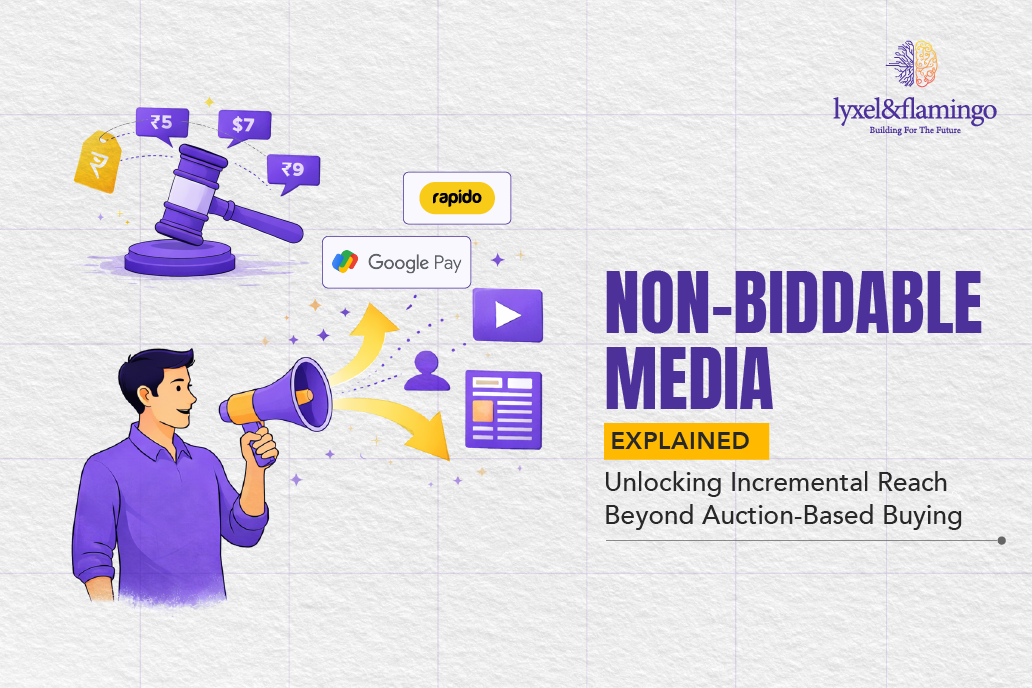
Most media teams eventually hit a growth ceiling with only programmatic advertising. It delivers efficiency, but reach and control start getting limited over time. Brand impact also feels restricted.
Non-biddable media offers guaranteed placements and better contextual alignment. It reaches audiences that auctions often miss.
The real advantage comes from combining both approaches. One builds visibility, the other drives conversions.
Brands that scale well focus on media architecture, not just performance metrics alone.
There is a point most momentous media teams reach eventually. Dashboards look clean and stable. CTR (Click-Through Rate) remains consistent, and ROAS (Return on Ad Spend) seems fine on paper. Still, growth does not really follow the expected direction.
New audiences stop entering the funnel properly. The same users keep circulating again and again. Performance looks efficient, but expansion stays limited over time.
This is often called the auction trap. It happens quite frequently, and honestly, it is not fully the team’s fault. It’s a systemic issue that our media teams observe across brand audits, repeatedly, regardless of industry or budget size.
The Efficiency Ceiling: When Programmatic Hits Its Limits
Programmatic advertising came in promising scale, precision, and efficiency. It delivered all three for a while. But there’s a bitter truth most media reviews don’t put on the slide:
“Efficiency does not equal effectiveness”
Think about what actually happens when you win an auction. You’re paying the second-highest price for an impression your competitor also wanted. But:
- Did the user see it?
- Did it register at all? Or
- Did it disappear into the noise of fourteen other ads fighting for attention on the same page load?
Open auction environments have three structural flaws. Brand leaders at the senior level are running into all three more often now.
Volatility in CPMs
Peak seasons like Diwali or the IPL often cause sudden spikes in CPM (Cost Per Mille). Budgets planned in Q2 get consumed faster than expected. This is not a forecasting issue. It comes from how biddable inventory behaves.
The Reach Wall
Algorithms efficiently identify convertible users over time. They keep targeting the same audience segments repeatedly. Frequency increases and incremental reach media planning value drops. You stop finding new users. Ads just repeat for people already decided about your brand.
Brand Safety and Contextual Risk
In open exchanges, you mostly buy audiences, not environments. Premium ads can appear beside low-quality or clickbait content. Brand safety is now a board-level concern.
The programmatic media planning systems remain powerful, but alone, they create a performance ceiling.
So What Actually Is Non-Biddable Media?
Non-biddable media strategy means buying guaranteed inventory at a fixed, pre-agreed rate. No auctions running in the background. No dynamic pricing shifting under your feet. You negotiate directly with a publisher or platform, lock in a price and a placement, and your creative runs exactly there. Nobody outbids you for it. The slot is yours.
It shows up in several forms. Worth knowing each one:
- Direct Sponsorships: Homepage takeovers on Times of India, Moneycontrol, or Mint. These are premium, high-attention placements. They don’t go to whoever bids highest in the last millisecond. They go to whoever books first and builds the relationship.
- OTT and CTV Fixed Placements: On platforms like Jio+Hotstar or Netflix, specific inventory blocks get sold directly to advertisers. Pre-roll on a live IPL match? You can’t bid on that in real time. It’s booked well in advance.
- Podcast and Influencer Host-Reads: Inventory is finite here by nature. One episode, one host-read, a flat fee. This is a non-biddable media strategy at its most straightforward.
- Digital OOH (DOOH): High-value screens in airports, metro stations, and premium malls are booked through reservations. Nobody is competing for that impression at the last millisecond.
There’s also “Programmatic Guaranteed” worth mentioning. It sits at the overlap of both approaches. It uses programmatic infrastructure, but inventory is locked at a fixed rate. You get the operational efficiency of automation with the certainty of a direct deal. Best of both, more or less.
Incremental Reach and Owning the Conversation
This is where incremental reach media planning stops being a buzzword and becomes an actual argument.
Consider audiences not reached through open exchange programmatic channels. Ad blocker users form a significant urban segment now. Niche publisher readers stay outside exchanges. CTV viewers consume content in low-ad environments. These audiences remain valuable but mostly unreachable here.
Non-biddable media strategy is how you reach them. But the stronger argument is probably about the share of voice media strategy. Les Binet and Peter Field, the most referenced researchers in marketing effectiveness by a wide margin, showed clearly that Excess Share of Voice drives market share growth over time. Brands holding more SOV (Share of Voice) than their actual market share tend to grow. Brands with less tend to lose ground.
Lyxel&Flamingo approaches media mix design for brands that are serious about growing category presence, not just harvesting existing demand. Brands holding more SOV than their actual market share tend to grow. Brands with less tend to lose ground.
Guaranteed Media Buying vs. Programmatic: Let’s Actually Compare Them
The framing of guaranteed media vs programmatic as a debate is already wrong. They’re different tools. The problem comes when either is treated as a complete strategy on its own.
| Feature | Auction-Based (Programmatic Open Market) | Non-Biddable (Guaranteed / Direct) |
| Pricing Model | Dynamic CPM (unpredictable) | Fixed cost/sponsorship (predictable) |
| Inventory Access | Remnant or long-tail | Premium / first-look |
| KPI Focus | Efficiency (CPA, CTR) | Impact (brand lift, recall, SOV) |
| Brand Safety | Reactive (blacklists, whitelists) | Proactive (curated environments) |
| Reach Type | Algorithmic, in-audience | Contextual, new audiences |
The best Media Operations teams use both in tandem. Non-biddable anchors the campaign, secures premium visibility, and builds equity. Biddable harvests the demand that brand-level activity actually generates. One plants the crop. The other does the harvesting.
Running only programmatic is like trying to harvest a field nobody seeded.
The India Angle: Why This Matters More in This Market
Non-auction media buying in India is not a niche or emerging concept. It’s how premium inventory has always moved here, and that dynamic isn’t going anywhere.
According to Pitch Madison Advertising Report (PMAR) 2026, India’s ad market crossed Rs 1.55 lakh crore in 2025. Digital now holds nearly 60% share of total spends. Big number, but the story goes deeper.
A large portion of this digital spend does not flow through open auctions. IPL 2026 on Jiohotstar priced CTV inventory around ₹600 CPM for short spots. That pricing comes from demand and scarcity, not bidding systems.
Large Screen, including TV and CTV, is a major growth driver for 2026. CTV alone may reach Rs 7,800 crore soon.
Most of this premium inventory is directly negotiated and reserved. These are not legacy channels. They are high-value, competitive media environments where control matters more.
For brands targeting premium Tier 1 and Tier 2 consumers, this becomes important. The audiences you want are often less reachable through programmatic systems. That sounds counterintuitive, but it happens often.
This is where direct publisher relationships matter more. Lyxel&Flamingo’s access to premium and regional inventory that exchanges usually miss.
Digital Is the New Above-the-Line
There’s been a real shift in how above-the-line media planning digital functions for larger brand advertisers.
A homepage takeover on a leading Indian news app now carries roughly the same prestige weight as a front-page print placement once did. Probably more, actually, because you can actually measure what happened after. Brand lift, search uplift, cross-platform spillover, all trackable. The prestige is real. The measurement is real.
Digital ATL has expanded well beyond video pre-roll. It includes event sponsorships embedded inside OTT platforms. It’s branded content integrations with high-authority publishers. Its podcast series where the host actually uses the product and says so. These formats build salience. They shift how audiences think about a brand. And they do it inside environments where the brand controls context, not just a demographic audience segment.
That distinction matters more than most planning briefs acknowledge.
How Media Teams Actually Make This Shift
Here’s where it becomes practical. Here’s how media directors and brand managers start embedding non-biddable media strategy into real planning cycles.
- Audit Your Rented Reach: Pull the last three campaign reports from your team. What percentage of your total reach depends entirely on algorithmic decisions you don’t control? If the answer is “most of it,” you have a fragility problem. One policy update, one CPM spike, one privacy regulation shift, and your reach strategy comes apart quickly.
- Think Contextual First, Behavioural Second: Audience targeting is a tool, not a full strategy. A luxury automobile brand buying fixed inventory on a premium financial news platform isn’t just buying “auto enthusiasts” as a segment. It’s buying context, credibility, and brand association together. That combination is worth considerably more than a behavioural profile on the open web.
- Build a Hybrid Architecture: Use programmatic media planning to scale, drive retargeting, and convert lower-funnel demand. Use a non-biddable media strategy for launches, brand-building phases, high-stakes moments, and any campaign window where contextual risk is unacceptable.They work better together than either does alone. That’s not a diplomatic statement. It’s just true.
- Measure the Right Things: Stop evaluating non-biddable investments by CTR. That’s the wrong metric applied to the wrong job entirely. Measure Brand Lift Studies, aided and unaided recall, search lift during the active campaign window, and Share of Voice across key periods. These connect media spend to the actual brand trajectory, not just click volume.
How Lyxel&Flamingo Approaches Non-Biddable Media Planning?
At Lyxel&Flamingo, we’ve seen this pattern more times than we can count. A brand walks in with solid performance numbers and a growth problem. The two things aren’t contradictory. They’re actually connected.
We don’t treat non-biddable media as an upsell or a premium add-on. Its a planning conversation we have early, because getting the architecture right at the start saves a lot of expensive course-correcting later. Our starting point is always the same: understand where a brand’s current reach is, then figure out where it needs to be anchored.
Across finance, FMCG, D2C, and mid-to-large enterprises, we build hybrid media structures in which guaranteed inventory holds the brand layer, while programmatic media planning drives demand conversion below it. Our non-biddable media strategy work is built on actual publisher relationships, not just platform access. That difference shows up in the quality of inventory we can secure, and ultimately in what the brand gets seen next to.
If your media mix feels like it’s running on autopilot and growth has quietly stalled, the problem usually isn’t the creative or the targeting. Its the architecture. And that’s exactly the kind of problem we work on.
Conclusion
Brands that lead their categories five years from now won’t get there by being better bidders. They’ll get there by showing up in places competitors aren’t, with the kind of consistent visibility that builds memory, preference, and actual trust over time.
Non-biddable media is the strategic adult in the room. It brings predictability, contextual control, and guaranteed visibility back to digital advertising when everything else feels volatile and reactive. It’s not a retreat from programmatic thinking. Its the layer that makes programmatic actually work at the brand level.
To build something that lasts, own the space. Stop renting pixels and hoping the algorithm sends someone valuable. Integrate guaranteed outcomes into your media mix before the brand down the road figures this out first.
Frequently Asked Questions
Not really. Non-biddable inventory includes guaranteed placements protected from open exchanges. Think homepage takeovers, live integrations, or podcast reads. These cost more because they deliver focused attention in trusted environments, not just labels.
Reframe what efficiency actually means in this context. Programmatic metrics like CPA and CTR only track cost per action. Non-biddable investments should use brand lift or search lift instead. These show real changes in perception over time. One high-quality impression can matter more than repeated retargeting exposures.
Budget size is not really the main factor here. A mid-sized brand can buy fixed inventory from a niche publisher. It can achieve a full share of voice for days. This level of control is not possible in open auctions. The real question is where owning that space actually impacts your brand.
Start with contextual alignment rather than demographic overlap. Ask where your target audience goes when they're actively in a mindset relevant to your category, not just when they match a profile. A financial services brand belongs on premium business news. A health and wellness brand belongs on fitness and lifestyle platforms with engaged, returning readers. Contextual resonance matters more than raw impression volume in this kind of planning.
Yes, and that combination is exactly how the best teams are running it. Effective Media Operations use non-biddable to anchor brand-building at the top of the funnel and use programmatic media planning to capture and convert the demand that brand activity generates downstream. Non-biddable plants it, and the programmatic harvests it. Running only one half of that equation leaves real value sitting on the table every campaign cycle.