
Table of Contents
- The Indian Attention Economy Has Fundamentally Changed
- Why the 3-Second Rule Is the New Creative Gatekeeper
- Short-Form Creative Is a UX Problem, Not Just a Content Problem
- The Thumb-Stop Moment Is the New Brand Moment
- Building Mental Availability in a Fragmented Attention Landscape
- Copy, Visuals, and Motion: What Wins the First Three Seconds?
- Measuring Engagement When Attention Is Fleeting
- Creative Systems, Not Isolated Assets
- The Role of Media Creative Optimisation and Media Operations
- Why India Demands a Different Creative Mindset
India is no longer a market of considered browsing. It is a market of relentless motion. Reels, Shorts, feeds, stories, and infinite scroll environments dominate how people discover brands today. Attention is fragmented, decisions are instantaneous, and relevance is judged in seconds. In this reality, creative success is no longer defined by how well a story is told, but by how quickly it earns the right to be heard.
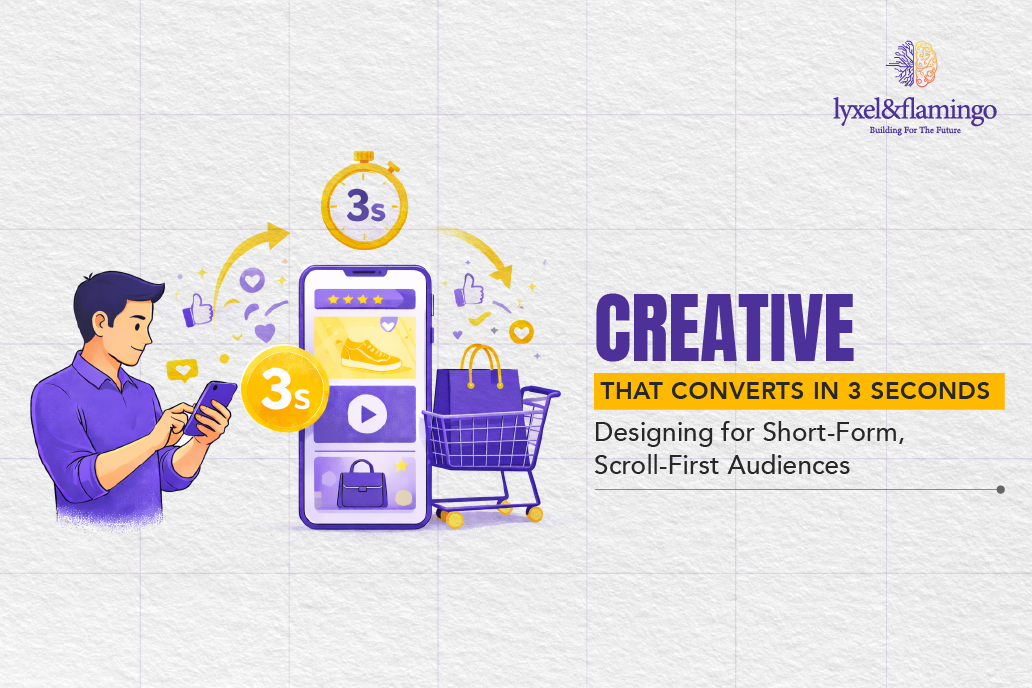
This shift has profound implications for how brands approach short-form creative strategies, attention span marketing, and digital ad design. The modern Indian consumer does not wait to be convinced. They decide whether to engage almost immediately, often within the first three seconds of exposure. This makes 3-second creative optimization not a tactical adjustment, but a strategic requirement.
In this article, we examine how endless scroll behaviour has reshaped creative and UX expectations in India. We explore why thumb-stop moments matter more than ever, how hooks function in fast-consumption environments, and how brands can build mental availability even when attention is fleeting. We also connect creative design decisions to Media Creative Optimisation and Media Operations, showing how strong creative systems translate fragmented attention into measurable engagement and long-term impact.
The Indian Attention Economy Has Fundamentally Changed
India’s digital growth has been driven by mobile-first adoption, low data costs, and platform-led content discovery. As a result, consumption patterns have shifted dramatically. Content is no longer searched for deliberately. It is encountered passively through feeds that never end.
This has changed the nature of competition. Brands are no longer competing only with other advertisers. They are competing with creators, entertainment, news, memes, and social conversations, all within the same scroll. In this environment, attention span marketing is not about holding attention for longer. It is about earning attention instantly.
The implication for digital ad design is clear. If creative does not signal relevance immediately, it is ignored. If it does not visually interrupt the scroll, it is invisible. If it does not reward attention quickly, it is abandoned.
The first three seconds are no longer an introduction. They are the entire audition.
Why the 3-Second Rule Is the New Creative Gatekeeper
The concept of a 3-second rule is not arbitrary. It reflects how the brain processes visual information under cognitive load. In endless scroll environments, users subconsciously filter content based on pattern recognition and perceived value.
Within the first three seconds, users decide:
- Is this relevant to me?
- Is this worth my attention?
- Does this feel familiar or trustworthy?
- Is there a reason to pause?
This makes 3-second creative optimization a function of both creative and UX design. It is not just about hooks. It is about how visuals, motion, copy, and context combine to create instant clarity.
In India, where feeds move faster and competition for attention is more intense, this rule is even more critical. Creative that works in slower-consumption markets often fails here because it assumes patience that does not exist.
Short-Form Creative Is a UX Problem, Not Just a Content Problem
Short-form creative is often discussed as a content challenge. In reality, it is a UX challenge.
Every short-form ad or piece of branded content sits inside an interface designed for speed. Reels, Shorts, and feeds are optimised for continuous motion, not contemplation. This means creative must work with the interface, not against it.
Effective short-form creative strategies consider:
- How the content appears within the feed
- How quickly the message becomes legible
- How motion guides the eye
- How visual hierarchy communicates meaning instantly
UX-led creative design prioritises immediacy. The message is not hidden behind a slow reveal. The value proposition is not delayed. The brand does not wait politely for attention. It earns it decisively.
This is where creative design strategies within Media Creative Optimisation become essential. Creative is no longer judged only on aesthetics, but on how effectively it performs inside fast-scrolling interfaces.
The Thumb-Stop Moment Is the New Brand Moment
In endless scroll environments, the thumb-stop is the equivalent of a storefront pause. It is the moment when a user chooses to interrupt momentum.
This moment is not created by cleverness alone. It is created by relevance, contrast, and recognition.
Thumb-stop moments are driven by:
- Strong visual contrast that breaks feed uniformity
- Familiar cues that trigger category recognition
- Immediate clarity about what the content is offering
- Emotional or functional hooks that feel personally relevant
In India, where users are exposed to hundreds of content units daily, thumb-stop success often depends on how quickly a brand communicates familiarity. This is where mental availability becomes critical.
Brands that consistently use recognisable visual codes, narrative patterns, and tonal cues increase the likelihood of being noticed even when attention is low.
Building Mental Availability in a Fragmented Attention Landscape
Mental availability is the ability of a brand to come to mind easily in buying situations. In fast-scroll environments, this is built through repetition, consistency, and recognisable creative assets.
When attention is fragmented, brands cannot rely on long storytelling arcs to build memory. Instead, they must design creative systems that reinforce identity in small, repeatable moments.
This requires:
- Consistent visual language across formats
- Repeatable hooks and opening frames
- Clear category cues
- Stable brand signals that appear early in the creative
These principles connect directly to consumer engagement techniques that prioritise familiarity over novelty. While novelty may attract attention once, familiarity sustains it over time.
This is why creative systems outperform one-off ideas in India’s digital ecosystem.
Endless Scroll and the Rise of Discovery-Led Creative
Endless scroll has transformed how discovery happens. Users do not actively seek brands. Brands are discovered through adjacency.
This aligns closely with the thinking behind designing for discovery beyond walled gardens, where relevance is earned through context rather than targeting alone.
In scroll-based environments, discovery happens when creative feels native to the content around it while still maintaining brand distinctiveness. This balance is delicate.
Creative that is too polished feels like an interruption. Creative that is too native risks losing brand identity. The most effective creative borrows the language of the platform without sacrificing recognisability.
This is where audience engagement tips within Media Operations play a crucial role. Creative must be informed by how audiences actually behave, not how brands wish they behaved.
Copy, Visuals, and Motion: What Wins the First Three Seconds?
The debate between visuals and copy misses the point. In short-form environments, they are inseparable.
Visuals earn the pause. Copy earns the stay.
In India’s fast-scrolling feeds, visuals must communicate meaning even without sound. Motion must guide attention without overwhelming it. Copy must be legible instantly, often within a single glance.
Effective digital ad design often follows a simple principle: show, then tell, then reinforce.
The opening frame carries the hook visually. The next moment adds clarity through copy or motion. The following seconds reinforce relevance through benefit or proof.
This sequencing respects the reality of limited attention while still delivering substance.
Measuring Engagement When Attention Is Fleeting
Traditional metrics struggle to capture the value of short-form creative. Clicks and conversions tell only part of the story.
In fast-consumption environments, engagement quality matters more than engagement quantity. Signals such as:
- Video completion rates
- Scroll stops
- Repeat exposure
- Brand recall lift
- View-through conversions
These metrics provide a more accurate picture of how creative performs under attention constraints.
Optimising for these signals is central to 3-second creative optimization. It shifts the focus from immediate action to cumulative impact.
Creative Systems, Not Isolated Assets
One of the biggest mistakes brands make in short-form environments is treating each asset as a standalone execution.
In reality, success comes from systems.
Creative systems define:
- How hooks are structured
- How narratives are sequenced
- How visual identity is maintained
- How learning is fed back into production
This systems-led approach aligns with AI-native campaign management guide thinking, where creative, media, and optimisation operate as a continuous loop rather than isolated functions.
In India’s dynamic digital landscape, systems scale better than ideas.
The Role of Media Creative Optimisation and Media Operations
Short-form creative success cannot be achieved by creative teams alone. It requires tight integration with media planning, performance data, and operational workflows.
Within Media Creative Optimisation, creative is tested, refined, and evolved based on real-world behaviour. Hooks are evaluated. Formats are iterated. Learnings are systemised.
Within Media Operations, audience engagement signals inform distribution, frequency, and sequencing decisions. Creative is not just launched. It is governed.
This integration ensures that creative decisions are not subjective. They are evidence-led.
Why India Demands a Different Creative Mindset
India’s scale, diversity, and pace demand creative humility. Assumptions fail quickly. What works in one cohort may fail in another. What worked last quarter may fail today.
This makes adaptability a creative advantage.
Brands that succeed do not chase trends blindly. They build flexible creative frameworks that can respond to changing behaviour without losing identity.
In a market where attention is fleeting, resilience comes from consistency and learning, not from constant reinvention.
How Lyxel&Flamingo Designs for the 3-Second India
Lyxel&Flamingo approaches short-form creative as a performance discipline rooted in behaviour, UX, and systems thinking.
Creative is designed with scroll behaviour in mind. Hooks are engineered for immediate relevance. Visual language is built for recognition under pressure.
By combining Media Creative Optimisation with Media Operations, Lyxel&Flamingo helps brands translate fragmented attention into measurable engagement and long-term mental availability.
Creative is not treated as decoration. It is treated as infrastructure.
Conclusion
Endless scroll has changed the rules of engagement in India. Attention is shorter. Competition is fiercer. Patience is rare.
In this environment, winning brands are not those who shout louder, but those who communicate faster, clearer, and more consistently. Short-form creative strategies, grounded in attention span marketing, thoughtful digital ad design, and disciplined 3-second creative optimization, are no longer optional.
They are the foundation of modern brand growth.
By designing for how people actually consume content, not how we wish they would, brands can build relevance, memory, and trust even when attention is fleeting. The future belongs to those who respect the scroll and design for it intelligently.
Frequently Asked Questions
The 3-second rule refers to the critical window in which users decide whether to engage with content in fast-scrolling environments.
By prioritising immediate relevance, clear visuals, legible copy, and strong opening hooks designed for mobile-first consumption.
Reels, Shorts, feeds, and story-based environments demand creativity optimised for rapid attention decisions.
Metrics such as completion rates, scroll stops, brand recall, and view-through conversions provide better insight than clicks alone.
Visuals earn the pause, but copy sustains engagement. Both must work together for effective short-form creative.