
Table of Contents
- What Makes Shopify Plus Enterprise-Ready in 2026?
- How Ecommerce Automation Becomes a Real Operational Advantage
- Why Ecommerce Security Is a Core Decision Driver
- How Shopify Plus Supports Multi Store Ecommerce Across Borders
- Shopify Plus vs Shopify: Where the Enterprise Line Is Drawn
- Why Brands Choose Shopify Plus for Governance and Operational Control
If you sit inside a serious ecommerce boardroom in 2026, you will notice something interesting. Nobody is debating themes. Nobody is obsessing over homepage banners. The discussion revolves around systems, control, stability, and expansion.
The real question leadership teams are asking is simple: can our infrastructure keep up with our ambition?
For global brands, ecommerce is not an isolated channel anymore. It connects inventory planning, warehouse logistics, finance reporting, performance marketing, customer service, and compliance. When that system slows down, every department feels the impact. When it fails, revenue loss is immediate and public.
This is why many enterprises have stepped back and reassessed the platforms they rely on. And in that reassessment, Shopify Plus keeps coming up as a serious contender. Not as a trend. Not as a growth hack. But as a legitimate enterprise ecommerce platform capable of handling modern complexity.
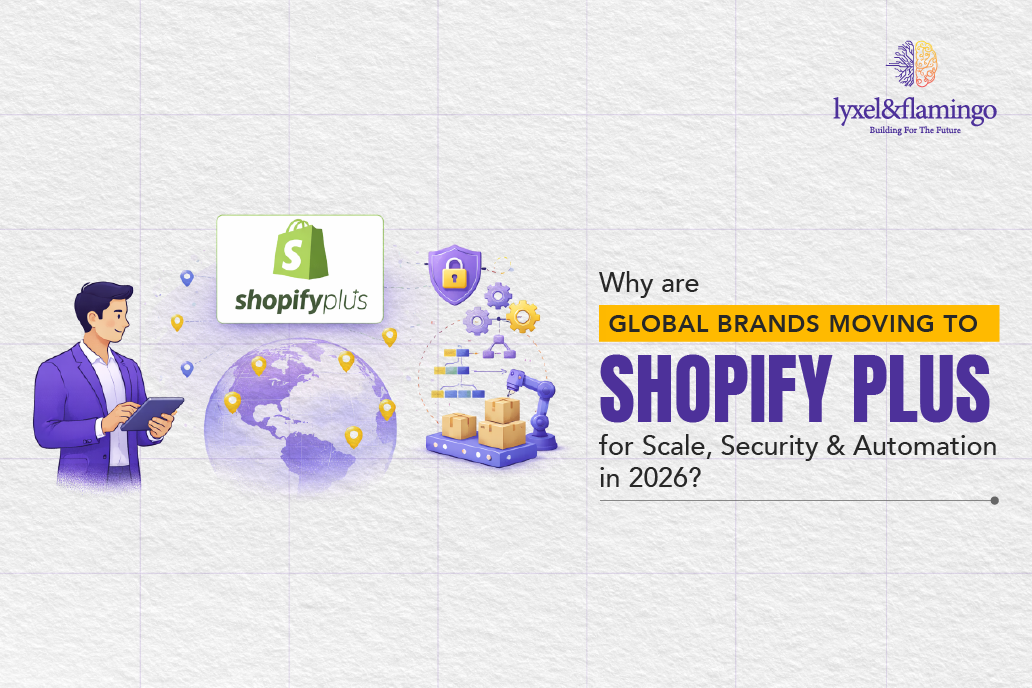
The movement toward shopify plus ecommerce is happening because businesses feel pressure from all sides. Pressure to automate internal processes. Pressure to strengthen ecommerce security. Pressure to enter new regions without rebuilding everything from scratch.
The decision is no longer cosmetic. It is structural.
What Makes Shopify Plus Enterprise-Ready in 2026?
Enterprise buyers think differently. They do not begin with design inspiration. They begin with risk assessment.
They ask whether the platform can handle traffic surges during product drops. Whether integrations with ERP systems will remain stable. Whether expansion into three new markets next year will require a rebuild.
A serious enterprise ecommerce platform must hold large product catalogs, process high transaction volumes, connect with multiple backend systems, and remain stable during peak demand.
Shopify Plus has earned attention because it removes much of the infrastructure burden. Hosting scales automatically. Traffic spikes do not require emergency server upgrades. Internal teams are not pulled into performance firefighting during campaign launches.
At the same time, flexibility remains intact. Enterprises can adjust checkout logic, connect deeply with ERP systems, and shape backend workflows around operational realities without destabilizing the platform.
That balance matters.
Older enterprise systems often require heavy development effort just to make minor adjustments. Over time, they become rigid. Every update feels risky. Costs rise quietly in the background.
With Shopify Plus, brands retain the ability to move quickly while keeping the underlying structure stable. That mix of adaptability and control is one of the main reasons enterprises are taking it seriously.
How Ecommerce Automation Becomes a Real Operational Advantage
Growth looks exciting from the outside. Internally, it can be messy.
As orders increase, so do edge cases. Fraud checks multiply. Customer segments become more nuanced. Campaign coordination grows more complex. Without strong ecommerce automation, operations teams spend their days reacting.
Manual tagging. Manual routing. Manual checks.
That model breaks at scale.
Inside Shopify Plus, automation tools such as Shopify Flow allow businesses to build structured workflows. High-risk orders can be flagged automatically. Loyal customers can be segmented without manual review. Inventory thresholds can trigger internal alerts before stockouts happen.
This is not about convenience. It is about consistency.
Well-implemented ecommerce automation reduces human error and removes repetitive effort from daily operations. Teams can focus on performance improvement rather than maintenance.
Over time, automation also brings clarity. Processes become predictable. Expansion across regions becomes manageable because workflows follow defined rules rather than individual habits.
In 2026, the question is no longer whether automation is useful. It is whether your platform allows it to be deeply embedded into daily operations. Shopify Plus gives enterprises that flexibility.
Why Ecommerce Security Is a Core Decision Driver
For global organizations, ecommerce security sits at the center of platform evaluation.
Customers expect protected transactions. Regulators expect compliance. Boards expect risk mitigation. One incident can cause long-term damage.
Shopify Plus includes Level 1 PCI DSS compliance as part of its infrastructure. Payment encryption, secure hosting, and ongoing monitoring are not optional add-ons. They are built in.
That simplifies internal risk management significantly. Enterprises are not required to stitch together multiple security vendors to create a compliant system.
However, security is not limited to payment protection. Governance plays a major role.
In large organizations, dozens of people access backend systems daily. Marketing edits campaigns. Developers adjust templates. Regional teams modify pricing. Without structured permissions, risk grows quietly.
Shopify Plus enables detailed role-based access controls. Specific actions can be restricted. Sensitive changes can require approval. This governance layer strengthens overall ecommerce security while maintaining operational clarity.
As traffic grows and integrations expand, security must scale alongside revenue. The infrastructure behind shopify plus ecommerce supports that growth without creating performance trade-offs.
How Shopify Plus Supports Multi Store Ecommerce Across Borders
Expanding internationally sounds straightforward until execution begins.
Currencies shift. Tax rules vary. Payment methods differ. Customer behavior changes by region. Marketing messages need localization.
Trying to manage this across disconnected systems quickly becomes inefficient.
Shopify Plus allows brands to operate structured multi store ecommerce environments under a centralized system. Each storefront can reflect regional needs while remaining connected to a master framework.
Localized pricing, translated content, regional product assortments, and country-specific payment gateways can exist without fragmentation.
This makes reporting cleaner. Governance remains intact. Integrations do not multiply unnecessarily.
True ecommerce scalability means being able to launch in a new market without months of redevelopment. With Shopify Plus, that process becomes structured and repeatable rather than disruptive.
For enterprises, repeatability equals confidence.
Shopify Plus vs Shopify: Where the Enterprise Line Is Drawn
The conversation around Shopify Plus vs Shopify usually surfaces during growth inflection points.
Standard Shopify performs well for scaling brands. It offers stability, flexibility, and strong ecosystem support.
However, enterprise complexity demands more. Deeper ecommerce automation, expanded API capacity, advanced checkout customization, and centralized multi store ecommerce management become essential.
That is where Shopify Plus separates itself.
Organizations comparing Shopify Plus vs Shopify often realize the decision is less about current size and more about future direction. If global expansion, operational automation, and structured governance are priorities, the enterprise tier becomes the logical step.
Why Brands Choose Shopify Plus for Governance and Operational Control
Growth introduces fragmentation if not managed carefully.
Multiple regions. Multiple teams. Multiple campaigns running simultaneously.
One reason Why Brands Choose Shopify Plus is the level of structured control it enables. Role-based permissions, publishing workflows, and centralized oversight reduce the risk of accidental errors.
Governance also strengthens compliance. Access is aligned with responsibility. Sensitive data is protected through structured controls.
When governance and ecommerce security work together, large organizations operate with greater stability.
Building Ecommerce Scalability Without Creating Technical Debt
Many enterprises carry years of accumulated technical debt. Custom integrations stack up. Small patches become permanent fixes. Upgrades become risky.
Sustainable ecommerce scalability requires simplicity at the core.
Because Shopify Plus operates as a managed SaaS platform, infrastructure updates happen without disruptive version overhauls. Brands avoid the burden of maintaining complex server environments.
The integration ecosystem supports ERP systems, marketing tools, analytics platforms, and logistics connections without excessive customization.
That balance between adaptability and structural simplicity allows long-term growth without compounding risk.
Why Global Enterprises View Shopify Plus as Strategic Infrastructure
Ecommerce now influences nearly every major business decision. It shapes acquisition strategy, supply chain forecasting, retention planning, and brand positioning.
Shopify Plus supports this central role by combining automation capability, governance structure, international readiness, and strong ecommerce security within one cohesive system.
It gives enterprises room to expand without constant reconstruction. It reduces operational friction. It supports structured global growth.
For organizations planning aggressive expansion, shopify plus ecommerce offers infrastructure aligned with long-term ambition.
Why Partnering with Lyxel&Flamingo Strengthens Your Shopify Plus Strategy
Adopting Shopify Plus is not a cosmetic shift. It is a structural move.
Migration involves more than theme changes. It requires data architecture planning, integration mapping, automation design, and governance alignment.
We have seen migrations that succeed because they were carefully planned. We have also seen migrations struggle because execution was rushed.
At Lyxel&Flamingo, we treat shopify plus ecommerce implementations as long-term infrastructure projects. Before configuration begins, we assess how data flows between systems, how automation should support operations, and how governance will scale with growth.
Enterprise transitions demand clarity. Data structures must remain clean. Integrations must remain stable. Workflows must be built for tomorrow’s volume, not just today’s.
When designing ecommerce automation, we focus on eliminating daily friction. Order routing, fraud checks, segmentation, campaign triggers. These processes should run reliably without constant human input.
Security is approached similarly. Platform protections matter, but structured internal governance matters just as much. Clear access roles and disciplined publishing controls strengthen overall ecommerce security, especially in multi-region environments.
For brands building structured multi store ecommerce operations, we ensure regional flexibility does not compromise centralized oversight.
For enterprises weighing Shopify Plus vs Shopify, we help frame the conversation around long-term operational direction rather than short-term cost comparison.
Our objective is not simply to migrate. It is to build a resilient enterprise ecommerce platform capable of sustaining growth without ongoing reconstruction.
Because at the enterprise level, stability and scalability are not enhancements. They are expectations.
Conclusion
At its core, this entire conversation comes down to infrastructure.
The platform beneath your ecommerce operation quietly determines how quickly you can expand, how securely you can operate, and how confidently you can enter new markets.
In 2026, that foundation must support meaningful ecommerce automation, dependable ecommerce security, disciplined multi store ecommerce management, and long-term ecommerce scalability without constant operational stress.
That is where Shopify Plus fits.
It allows leadership teams to focus on growth instead of maintenance. It reduces friction instead of introducing it. It supports international expansion without forcing repeated rebuilds.
Enterprises moving to Shopify Plus are not chasing novelty. They are strengthening their operational core.
And in enterprise commerce, the strength of that core determines how far the business can realistically go.
Frequently Asked Questions
Shopify Plus offers deeper automation, advanced customization, higher API limits, and better control for large-scale ecommerce operations.
It enables automated workflows for tasks like order management, fraud checks, customer segmentation, and inventory alerts.
Yes. Shopify Plus is designed to manage large traffic spikes, high order volumes, and multi-region storefronts.
It includes Level 1 PCI DSS compliance, secure hosting, encrypted payments, and role-based access controls.
A structured migration plan, stable integrations, clean data transfer, and automation setup help ensure a smooth transition.