
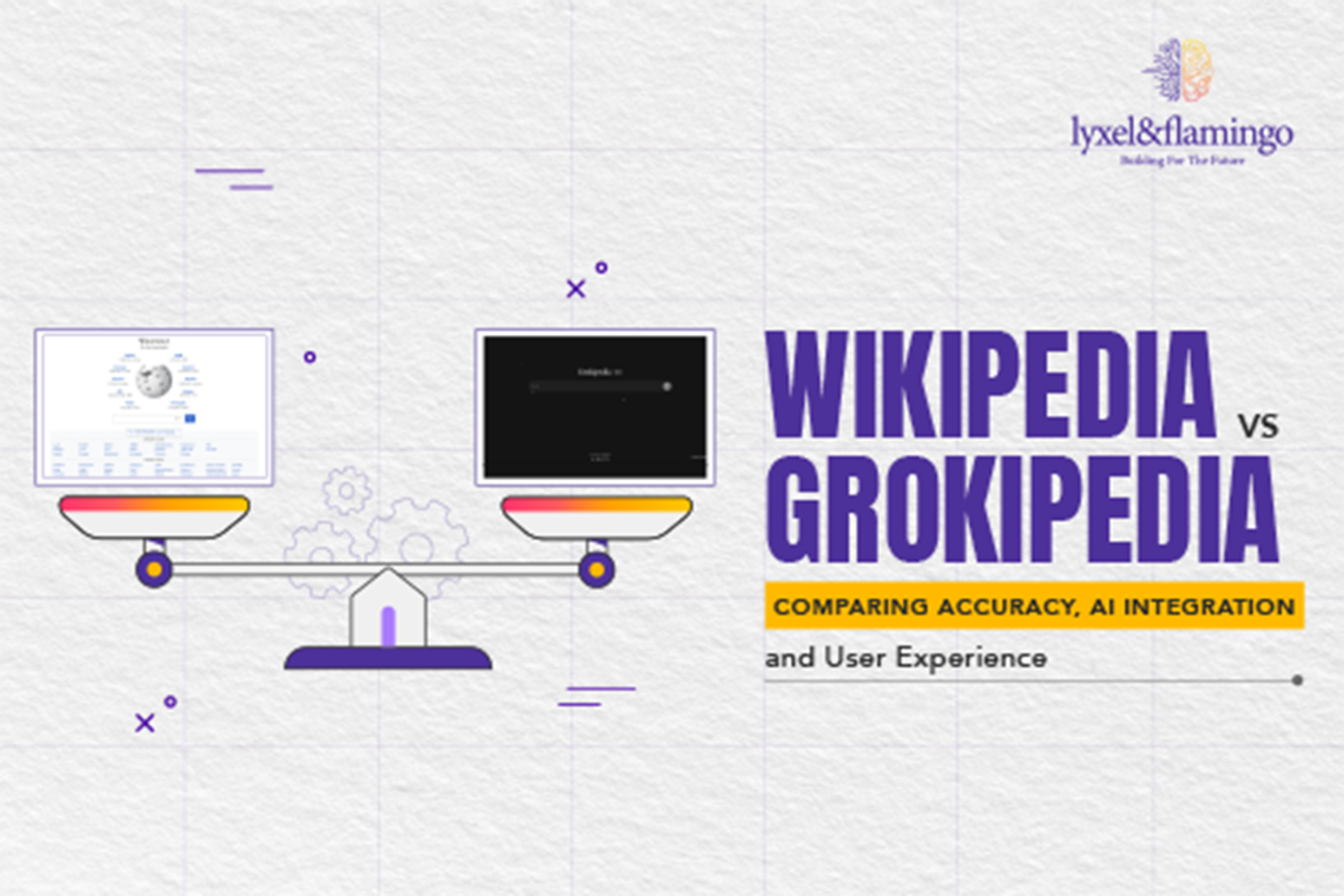
Artificial intelligence continues to transform how knowledge is created, verified, and consumed. With the introduction of Grokipedia, xAI has entered a space long shaped by Wikipedia’s global volunteer community. The comparison between Grokipedia vs Wikipedia has quickly become one of the most discussed topics in the knowledge and AI ecosystem, especially as users explore the trade-offs between human moderation and AI-powered content generation.
Wikipedia remains the world’s largest open encyclopedia, built on human-led editing, strict citation practices, and a transparent governance model. Grokipedia, on the other hand, represents a new category. It is an AI-powered encyclopedia, created using the Grok model to generate topic pages, surface facts, summarise information, and refresh entries rapidly using retrieval-enhanced generation.
At Lyxel&Flamingo, we observe these developments closely because they shape how brands approach content governance, accuracy, search visibility, and long-term authority in an AI-led digital landscape. AI knowledge platforms will influence everything from SEO to content indexing, and the rising interest in Grokipedia signals an important shift in how information systems may evolve.
Below, we explore the differences, the strengths and weaknesses, and what these changes mean for brands preparing for AI-indexed ecosystems.
How Does Grokipedia’s AI-Driven Content Compare in Accuracy to Wikipedia?
Accuracy is the core question in the Grokipedia accuracy comparison. Both platforms take very different approaches to validating information, and the results vary.
Wikipedia’s Accuracy Strengths
Wikipedia relies on:
- A global volunteer community
- Peer-reviewed editorial changes
- Strict referencing requirements
- Transparency in version histories
- Discussion boards for conflict resolution
This system has been refined for more than two decades and has become a benchmark for crowd-reviewed, citation-led information.
Grokipedia’s Accuracy Results So Far
Independent reviews and early user tests show mixed outcomes:
- Strong semantic alignment with Wikipedia (per Quantum Zeitgeist’s semantic analysis)
- Faster incorporation of new information
- Occasional factual inconsistencies
- Limited citation details
- Potential for AI hallucinations in niche or emerging topics
Media reports, including comparisons by global publications, highlight instances where Grokipedia’s entries appeared similar to Wikipedia but lacked citation depth.
The Conclusion
Grokipedia offers speed and real-time updates, but Wikipedia remains more reliable for factual precision.
The AI-powered encyclopedia Grokipedia is improving, but its verification mechanisms are not as mature as community-led human editing.
What Is the Difference Between Wikipedia’s Human Editing Model and Grokipedia’s AI Model?
This comparison reveals the most fundamental divide between the platforms.
Wikipedia’s Volunteer Editing Model
Built on human oversight, it includes:
- Crowdsourced editing
- Layered moderation
- Strict sourcing guidelines
- Talk pages for resolving disputes
- Expertise derived from distributed contributors
Wikipedia’s governance model ensures transparency and consistency, supported by real editors rather than automated processes.
Grokipedia’s AI Creation Model
Built on the Grok model and automated reasoning:
- Content generated by the Grok AI model
- Retrieval-based content curation
- Summarisation and reasoning layers
- Grokipedia fact-checking AI to verify key claims
- Limited human intervention except for user flags
This approach enables speed and scale but introduces variability in tone, structure, and accuracy.
The Big Difference
Wikipedia improves through collective human intelligence.
Grokipedia improves through model updates, training data, and machine learning.
How Does Grokipedia Integrate the Grok AI Model in Its Article Creation Process?
The platform uses a structured, multi-stage workflow for generating entries.
1. Retrieval Layer
Grok gathers information from:
- Web-indexed content
- News sources
- Internal AI knowledge banks
This helps Grokipedia offer real-time updates faster than Wikipedia.
2. AI Reasoning Layer
The Grok model interprets the collected data, identifies patterns, and produces synthesised summaries.
This sets Grokipedia apart within the broader world of AI knowledge platforms.
3. Fact-Checking Layer
The Grokipedia fact-checking AI cross-checks key statements and flags uncertain information.
4. Human Feedback Loop
Users are encouraged to flag issues, adding a human correction mechanism on top of automated generation.
5. Dynamic Regeneration
As the Grok model evolves, entries can be rewritten or expanded automatically.
This approach reflects how next-generation AI-powered content verification might operate at scale.
Which Platform Offers a Better User Experience: Wikipedia or Grokipedia?
User experience varies depending on what readers value: reliability, depth, or speed.
Wikipedia User Experience
- Comprehensive article depth
- Clear citations and reference lists
- Predictable structure
- Neutral, academic tone
- Detailed navigation and categories
Wikipedia caters to users looking for thorough research and verified information.
Grokipedia User Experience Review
- Fast, simplified explanations
- Conversational tone
- Quick-loading summaries
- Dynamic updates
- Minimalist interface
- Less citation detail
- Occasional inaccuracies
Grokipedia offers speed and simplicity rather than exhaustive depth.
So which is better?
- For quick learning: Grokipedia
- For credible research: Wikipedia
As Grok evolves, enhancing UX with AI insights may shape Grokipedia’s interface and reading flow.
What Are the Limitations of Grokipedia’s AI-Generated Entries Compared With Wikipedia?
Grokipedia has several early-stage limitations:
1. Higher Risk of Inaccuracies
AI models hallucinate when data is incomplete or ambiguous.
2. Limited Citation Transparency
Wikipedia offers clear, academically structured citations.
Grokipedia summarises sources without extensive documentation.
3. Bias and Tone Variability
Users have noted ideological leanings and occasional inconsistencies.
4. Lack of Governance Framework
There are no equivalent editorial boards, arbitration panels, or dispute systems.
5. Weak Coverage of Niche Topics
AI knowledge bases struggle when data is sparse.
6. Dependence on Grok Model Updates
Accuracy improves only when the underlying model does.
Wikipedia’s limitations, by contrast, revolve around human challenges such as editor disputes and occasional vandalism.
How Reliable Is Grokipedia for Citations and Fact-Checking?
This is one of the biggest concerns for users.
Wikipedia
- High transparency
- Strict referencing rules
- Clear sourcing trail
Grokipedia
- Includes automated fact-checking
- Less detailed citation structures
- Sometimes paraphrases Wikipedia content without showing references
- Dependent on model interpretation
Quantitative tests indicate:
- High semantic similarity
- Lower citation reliability
Wikipedia remains the more reliable resource for academic or professional research.
What Impact Could Grokipedia Have on the Future of Knowledge-Sharing Platforms?
Grokipedia’s launch signals a major shift in how knowledge systems may evolve.
1. Dynamic Knowledge Systems
Content will no longer be static. AI-based knowledge pages can update continuously.
2. Automated Content Drafting
AI takes on the early editing tasks that human editors traditionally handled.
3. New Verification Standards
Governance models for AI fact-checking must evolve quickly.
4. Search and Indexing May Change
AI search tools may draw directly from AI-powered encyclopedia Grokipedia or similar platforms.
5. Misinformation Challenges
AI systems introduce new risks at scale.
6. Competitive Ecosystems
Crowdsourced encyclopedias may coexist with AI-generated ones, each serving different use cases.
At Lyxel&Flamingo, we believe brands must rethink how they build authority as AI-powered content verification and content indexing tools evolve.
What the Wikipedia vs Grokipedia Era Means for Brands, According to Lyxel&Flamingo
AI-driven knowledge platforms are changing how information is created, validated, and surfaced.
For brands, this shift requires a stronger focus on:
- Content governance
- Clear sourcing
- Metadata hygiene
- Accuracy in claims
- Transparent referencing
- Regular content updates
As content indexing AI tools mature, the standards for digital authority will become more rigorous.
Brands that strengthen their validation systems today will be better positioned in AI-led search ecosystems.
At Lyxel&Flamingo, we guide organisations through this transition, helping teams build safe pilots, refine verification frameworks, and adapt content for AI-driven discovery environments.
Begin with clarity and accuracy. Scale with confidence as AI knowledge systems evolve.
FAQs
Q. How does Grokipedia compare to Wikipedia in accuracy?
A. Grokipedia offers fast AI-generated summaries but shows more inconsistencies compared with Wikipedia’s human-reviewed entries.
Q. How do the editing models differ between the two platforms?
A. Wikipedia uses volunteer editors and strict citations. Grokipedia uses the Grok AI model and automated fact-checking.
Q. What level of AI integration does Grokipedia use?
A. It uses retrieval, reasoning, summarisation, and dynamic generation powered by the Grok model.
Q. Which platform offers a better user experience?
A. Wikipedia excels in depth and reliability. Grokipedia focuses on speed, simplicity, and accessibility.
Q. What is Grokipedia’s biggest limitation?
A. Its limited citation transparency and occasional AI hallucinations.