
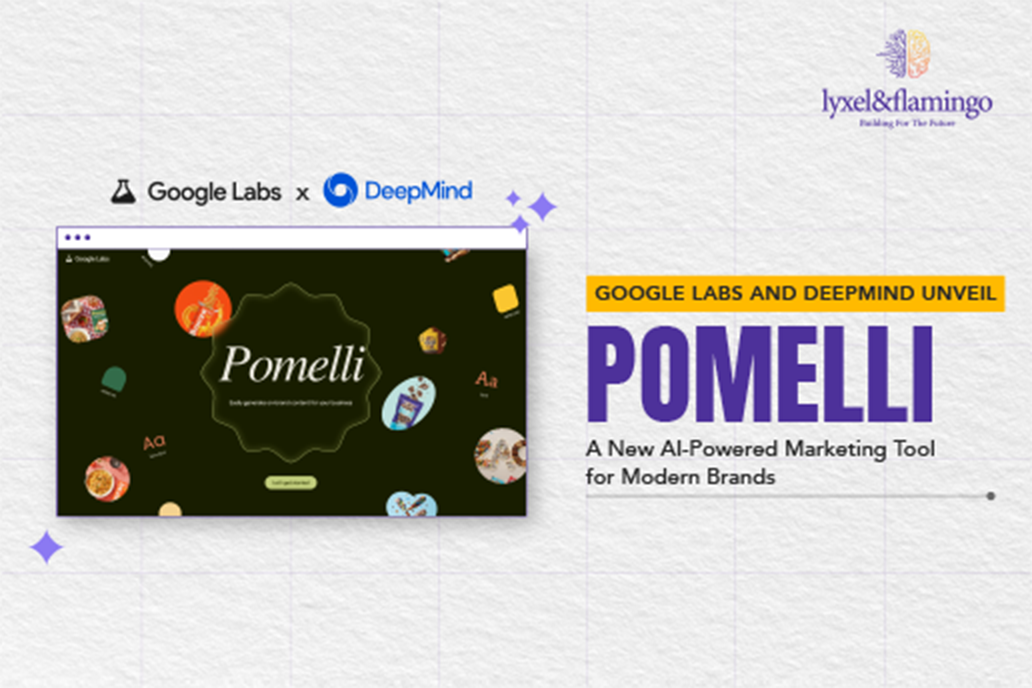
Artificial intelligence continues to reshape the marketing landscape, and the latest development from Google Labs and DeepMind is a clear signal of where content creation is headed. Their newly introduced AI marketing tool Pomelli is designed to help brands generate on-brand campaigns quickly, combining machine learning with intuitive workflows that fit into real marketing routines.
At Lyxel&Flamingo, we work closely with brands that want to move faster without losing strategic clarity. In many of the strategy workshops we run, teams often tell us they can plan well, but executing content at speed is the real challenge. Pomelli is an interesting step forward in this space because it is not just another generator. It is a tool built around brand identity, consistency, and structured content creation. Although the Google Labs Pomelli launch is still in public beta, the tool already reflects where AI marketing innovation is moving: accessible, context-aware, and aligned with real production challenges. Pomelli is initially available in the United States, Canada, Australia and New Zealand, in English.
What Is Pomelli, and How Does It Support Brands With Marketing Tasks?
Pomelli is an AI-powered marketing assistant created to help small-to-medium-sized businesses (SMBs) generate scalable, on-brand social media campaigns. Unlike generic tools, Pomelli focuses on brand-consistent asset creation with AI, enabling teams to upload brand guidelines, visual references, and previous campaign materials so the tool can learn tone, style and visual identity.
A core feature introduced by Google is the ability to create a Business DNA profile. Pomelli analyses logos, colours, sample copy and imagery from a brand’s website to understand creative patterns and brand personality. This allows it to generate options that align with real brand behaviour rather than generic templates.
During the early phase of the Google Labs Pomelli launch, Google highlighted that Pomelli is built to help brands produce social posts, captions, variations and lightweight creative concepts quickly. The tool uses DeepMind’s models to analyse brand inputs and generate content that feels aligned with how the brand already communicates.
For marketers or SMB teams working with limited capacity, Pomelli offers a practical way to scale output without stretching resources. It supports AI campaign generation for SMBs, offering repeatable workflows that reduce manual effort.
How Can Brands Create On-Brand Marketing Assets Using AI Tools Like Pomelli?
One of the biggest challenges with AI-generated content is maintaining on-brand consistency. Pomelli addresses this directly through its Business DNA engine. When teams upload logos, colours, website elements, sample lines or existing creative, Pomelli draws from these inputs to guide the content it generates.
This approach allows Pomelli to operate as an on-brand marketing assets AI tool, producing material that feels like a natural extension of the brand’s style. Instead of receiving random outputs, users get content that mirrors their tone, layout cues and visual identity.
In practical terms, Pomelli can:
- Adapt brand copy for social channels
- Create variations of campaign messages
- Build lightweight social media visuals
- Support early-stage creative exploration
- Provide structured starting points for social campaigns
While human creatives still need to refine, direct and approve final output, Pomelli helps teams move from concept to draft significantly faster. This balance is central to a modern content creation strategy, particularly when speed and consistency both matter.
Here is the interesting part. Marketers we speak to often mention how much time is lost creating multiple variations of the same post. Tools like Pomelli help reclaim that time by handling repetition so creative energy can focus on messaging and direction.
Which Steps Does Pomelli Follow to Build Brand Identity and Generate Campaigns?
Google and DeepMind explained that Pomelli follows a structured process that learns brand identity before generating content. The workflow is designed to mirror how marketers plan social media campaigns.
1. Build a Business DNA Profile
Pomelli creates a brand model by analysing logos, fonts, colours, sample copy, imagery and website elements. This forms the foundation for tone and visual consistency.
2. Brand Identity Modelling With Machine Learning
The tool categorises these elements using DeepMind’s language and vision models. This is where machine learning in campaigns becomes essential, enabling Pomelli to recognise brand cues rather than replicate assets directly.
3. Campaign Goal Interpretation
Users provide inputs such as campaign objectives, target themes or launch details. Pomelli interprets this context before generating ideas.
4. Content and Visual Generation
Pomelli produces caption options, layouts, design variations and lightweight social assets. This step showcases its AI marketing content generator capabilities.
5. Refinement and Variation Loop
Users can adjust tone, request changes or regenerate variations. These refinements help Pomelli improve future outputs.
This multi-step flow reflects a practical blend of creative automation and human direction.
What Are the Limitations of Pomelli in Its Public Beta?
Pomelli is promising, but like any early-stage tool, it comes with limitations that matter for teams expecting full automation.
- Output may vary for complex or highly technical brand identities
- Limited precision for detailed design layouts
- Focuses primarily on social media assets during beta
- Occasional tonal inconsistencies for niche industries
- No direct integration with Google Ads or wider Google Marketing tools yet
Pomelli is not intended to replace brand strategists or designers. Instead, it fits into the category of AI marketing automation tools, supporting early content creation, variation development and social media scaling.
At Lyxel&Flamingo, we see early AI tools boosting efficiency for teams that need fast iteration, even though human direction remains essential for nuanced storytelling.
As Pomelli matures, it may introduce features that allow deeper brand-rule customisation, more sophisticated layout editing and closer integration with Google’s broader ecosystem.
How Can SMBs Scale Marketing With Pomelli Without Large Budgets?
Pomelli is especially helpful for SMBs and small teams managing content cycles with limited resources. Many spend hours rewriting captions, adjusting visuals or testing multiple versions of the same post. Pomelli reduces this workload by producing multiple variations aligned with brand identity.
This supports small business marketing automation AI, enabling small teams to expand output without needing extensive design or copywriting bandwidth. Pomelli can help SMBs:
- Test multiple campaign directions
- Generate consistent social media templates
- Produce brand-aligned base visuals
- Create lightweight multi-channel variations
- Maintain a steady and predictable posting rhythm
Pomelli is not meant to replace high-impact creative work. It accelerates repetitive tasks and makes content production more manageable for teams handling multiple responsibilities.
How Do Google Labs and DeepMind Integrate AI for Marketing Content Creation?
Pomelli sits at the intersection of deep learning research and applied marketing workflows. DeepMind provides the vision and language models, while Google Labs builds an accessible interface tailored for marketers.
This combination enables Pomelli to interpret brand details, understand messaging patterns and generate content aligned with campaign objectives. It also positions Pomelli within a wider evolution in AI marketing innovation, where generative tools move from generic output to contextual, brand-informed execution.
Future iterations could extend into media optimisation with AI, where assets created in Pomelli are tested and refined across channels. This is not available in the current beta, but the direction is clear.
What Future Features Can We Expect From Pomelli and AI-Powered Marketing Tools?
While Google has not disclosed full future plans, several likely enhancements can be anticipated:
- Deeper brand-rule personalisation
- Stronger layout and design editing
- Direct connections to Google Ads, YouTube and Business Profiles
- Templates built from high-performing brand data
- Multi-channel publishing paths
- Expanded workflows for brand content marketing
- Collaboration features for distributed teams
As AI tools evolve, the industry will move towards integrated ecosystems in which content generation, performance testing, audience insights and optimisation all sit within a unified environment.
At Lyxel&Flamingo, we see Pomelli as an early example of this hybrid direction, where AI handles the groundwork and human creativity shapes the narrative, the concept and the craft.
Creating Space for AI Readiness
AI readiness starts with understanding your own processes. Once you know what slows you down and what repeats often, tools like Pomelli become easier to evaluate. At Lyxel&Flamingo, we see this awareness phase as the most important step for any brand exploring AI. Begin with clarity, not urgency.
FAQs
Q. What is Pomelli used for in marketing?
A. Pomelli is an AI marketing tool that generates brand-consistent social media campaigns, content variations and lightweight visuals.
Q. How does Pomelli learn a brand’s identity?
A.It builds a Business DNA profile using logos, colours, website assets, sample texts and imagery to understand tone and layout behaviour.
Q. Is Pomelli suitable for SMBs?
A. Yes. Pomelli supports AI campaign generation for SMBs, helping teams increase content output without expanding budgets.
Q. Does Pomelli replace human creatives?
A. No. It assists with exploration, ideation and drafting, while human judgement remains essential for strategy and final direction.
Q. What innovations can we expect from Pomelli next?
A. Future updates may include advanced editing controls, multi-channel publishing, deeper brand-rule customisation and expanded support for AI marketing automation tools.