
The way audiences discover, evaluate, and commit to brands has undergone significant changes. In 2025, trust isn’t won through flashy campaigns or one-size-fits-all messaging; it’s earned step by step, across every interaction. Modern buyers are not just seeking products or services; they’re searching for authenticity, reliability, and consistent value before deciding to engage.
This shift is where full-funnel creatives come in. Unlike isolated ads or fragmented campaigns, full-funnel marketing uses carefully designed performance marketing creatives at every stage of the customer journey: awareness, consideration, decision, and beyond. The goal? To create a seamless narrative that builds credibility with new audiences and steadily encourages them to take action.
For businesses, this approach is no longer optional. A full funnel marketing strategy powered by marketing funnel optimisation doesn’t just boost engagement; it directly helps brands increase conversion rates and stay ahead in an environment where customer attention is fleeting.
By aligning content, design, and messaging to the precise mindset of your audience at each touchpoint, you ensure every interaction works harder toward the final conversion.
What Are Full-Funnel Creatives?
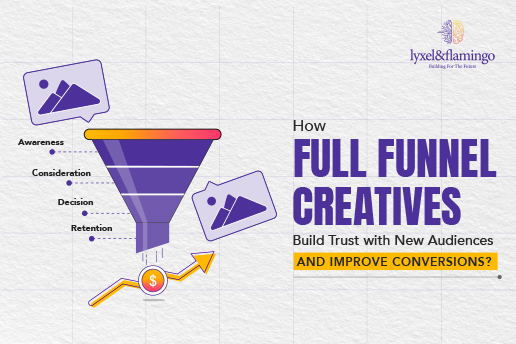
At its core, a full-funnel creative is not just another marketing asset; it’s a strategic tool designed to align with every stage of the customer journey. Instead of relying on a single campaign to do all the heavy lifting, these creatives are intentionally created to meet audiences where they are: whether they are just discovering your brand, comparing options, or ready to make a purchase.
Think of it as a storytelling map.
- At the awareness stage: A full-funnel creative might take the form of an engaging brand film, thought-provoking ad, or social content that sparks curiosity.
- The consideration stage could be explainer videos, case studies, or product comparisons that address doubts and provide value.
- By the time prospects reach the decision stage, these creatives transform into proof-driven assets: Customer testimonials, free trial campaigns, or persuasive landing pages that give the final nudge.
Even beyond purchase, advocacy-driven creatives like community stories or referral programs keep the cycle alive.
What makes them unique is their performance marketing focus. Each creative is designed with metrics in mind: optimising impressions, clicks, engagement, and ultimately conversions, ensuring no stage of the funnel is left unsupported. When combined, they form a full funnel marketing strategy that builds trust, nurtures intent, and drives measurable outcomes.
Full-funnel creatives are not about a single message shouted into the void; they’re about delivering the right message at the right time in a way that feels authentic, consistent, and trustworthy. This is how modern brands fuel growth and increase conversion rates in an attention-scarce digital world.
How Full-Funnel Creatives Differ from Traditional Marketing Funnels?
Traditional marketing funnels have long served as a roadmap for guiding potential customers from awareness to purchase. However, their structure is often rigid and linear. Brands push broad awareness campaigns at the top, nurture leads in the middle, and push hard conversions at the bottom.
While effective in the past, this approach assumes that all buyers move through the funnel predictably. In reality, today’s audiences don’t follow a straight path; they explore, compare, and switch channels before making a decision.
| Aspect | Traditional Marketing Funnels | Full Funnel Creatives |
| Structure | Linear and rigid: assumes buyers move in a step-by-step manner. | Dynamic and adaptive: adjusts to buyer behavior and intent. |
| Messaging | Generic, one-size-fits-all at each stage | Stage-specific, context-rich, and personalised storytelling |
| Trust Building | Trust is assumed, often addressed only at the end | Trust is earned progressively at every stage of the funnel |
| Creative Approach | Isolated campaigns with limited continuity | Unified performance marketing creatives creating a seamless narrative |
| Optimisation | Evaluated post-campaign; limited agility | Real-time testing, iteration, and marketing funnel optimisation |
| Focus | Brand-first, often pushing products or offers | Audience-first, guiding them with relevance and value |
| Outcome | Awareness may be generated, but drop-offs are high | Builds loyalty, nurtures intent, and helps increase conversion rates |
Full-funnel creatives don’t just map a journey; they guide it dynamically, respecting how modern audiences actually make decisions. It’s not about pushing people down a funnel. It’s about walking beside them, building trust, and optimising every interaction until conversion feels like a natural next step.
Why Is Full-Funnel Marketing Crucial for Businesses in 2025?
In 2025, the customer journey is no longer straightforward; it’s multi-touch, non-linear, and constantly shifting. People bounce between social media, search engines, reviews, and even offline experiences before making a decision. That means businesses can’t rely on single-stage campaigns or outdated funnels. What they need is a full funnel marketing strategy powered by performance marketing creatives that adapt at every stage.
Here’s why this approach is now essential:
- Audiences Demand Trust Before Action
Buyers are more skeptical than ever. Full-funnel creatives build credibility step by step, ensuring prospects feel confident before converting.
- Conversions Come from Consistency
A one-off ad won’t seal the deal. A full-funnel approach delivers cohesive storytelling across awareness, consideration, and decision stages, helping brands steadily increase conversion rates.
- Algorithms Reward Relevance
In 2025, digital platforms prioritise brands that deliver personalised, engaging, and stage-specific creatives. Marketing funnel optimisation ensures your campaigns perform better in these environments.
- Real-Time Adaptability Matters
Unlike traditional funnels that are measured only after campaigns end, full-funnel strategies thrive on data-driven iteration. Businesses can tweak performance marketing creatives in real time, reducing drop-offs and maximising ROI.
- Future-Proofing Brand Growth
A fragmented approach may win short-term clicks, but it won’t sustain growth. Full-funnel marketing creates scalable systems for long-term audience engagement and loyalty.
In 2025, full-funnel marketing isn’t just about better ads; it’s about guiding audiences with clarity, consistency, and trust at every step of their journey.
The Core Benefits of a Full-Funnel Marketing Strategy
A well-executed full funnel marketing strategy isn’t just a trend; it’s a performance-driven framework that empowers businesses to engage meaningfully with audiences while achieving measurable growth.
By combining performance marketing creatives with marketing funnel optimisation, brands can move beyond vanity metrics and create a system where every touchpoint builds trust and accelerates conversions.
Here are the core benefits:
- Builds Trust with New Audiences
In a world where skepticism is high, full-funnel creatives focus on value-first storytelling. Instead of selling immediately, they educate, inspire, and build credibility at the top of the funnel. This trust becomes the foundation for conversions later.
- Drives Higher Engagement
Because each stage of the funnel delivers context-relevant messaging, audiences stay engaged longer. From curiosity-inducing awareness ads to problem-solving explainers, every interaction feels intentional and personal.
- Improves Conversion Rates
With marketing funnel optimisation, businesses can identify and fix drop-off points. Tailored creatives at each stage reduce friction and ensure prospects move smoothly towards a decision, directly helping brands increase conversion rates.
- Strengthens Brand Consistency
Full-funnel strategies ensure your voice, design, and messaging stay aligned across platforms and channels. This consistency not only boosts recognition but also reinforces trust and reliability in the eyes of your audience.
- Maximises ROI Through Data-Driven Decisions
Unlike static campaigns, full-funnel strategies thrive on continuous testing and optimisation. Every creative is measured against performance benchmarks, ensuring marketing spends are directed toward what actually drives results.
A full-funnel approach isn’t just about reaching customers; it’s about guiding them through a journey where trust is built, engagement is sustained, and conversions are inevitable.
How Can Businesses Implement a Full Funnel Marketing Strategy?
Building a full funnel marketing strategy may sound complex, but in reality, it’s about combining clear customer insights with the right performance marketing creatives at every stage. Rather than overwhelming audiences with one-size-fits-all messaging, this approach ensures every interaction feels intentional, relevant, and trust-building.
Here’s a step-by-step roadmap businesses can follow:
- Map Your Customer Journey
Start by understanding how your audience discovers, researches, and decides. Identify the key touchpoints: social media, search, email, reviews, where they engage with your brand. This clarity ensures you design creatives that align with real behaviors, not assumptions.
- Audit Existing Creatives and Content
Take stock of what you already have. Are your campaigns top-heavy, focusing only on awareness? Do you lack testimonials or product explainers? This audit highlights gaps in your funnel and helps prioritise creative development.
- Create Stage-Specific Creatives
Design assets for each stage:
- Awareness: Brand films, social shorts, thought leadership content.
- Consideration: Case studies, comparison guides, interactive ads.
- Decision: Testimonials, offers, and persuasive landing pages.
- Advocacy: Loyalty programs, user-generated content, referral campaigns.
- Each creative should guide audiences naturally to the next stage.
- Leverage Data for Marketing Funnel Optimisation
Don’t set and forget. Use analytics to track drop-offs, engagement rates, and conversion paths. Real-time optimisation: A/B testing creatives, tweaking messaging, or adjusting targeting ensures your funnel becomes more efficient over time.
- Integrate Across Channels
Today’s audiences don’t stay in one place. Align your messaging across social platforms, search, email, and even offline touchpoints. Consistency across these channels strengthens recognition and builds trust.
- Measure, Refine, Repeat
A full-funnel strategy is never “done.” By continually refining based on performance data, businesses can ensure creatives remain relevant, impactful, and conversion-focused.
Implementing a full funnel strategy isn’t about adding more campaigns; it’s about smarter alignment. When businesses design performance marketing creatives for every step of the journey, they unlock the ability to increase conversion rates while nurturing long-term trust.
The Evolving Role of Full-Funnel Creatives in Performance Marketing
As digital ecosystems become more complex, the role of full-funnel creatives is set to grow even more critical. In 2025 and beyond, performance marketing will not be measured merely by clicks or impressions, but by how effectively brands can create trust-driven journeys that convert audiences into loyal customers.
Here’s what the future holds:
- AI-Powered Personalisation at Scale
Artificial intelligence and machine learning will allow brands to deploy performance marketing creatives tailored in real time to each user’s behavior, preferences, and context. This means hyper-relevant content at every stage of the funnel, maximising engagement and improving efficiency.
- Interactive and Immersive Experiences
Creatives will move beyond static visuals or videos. Augmented reality (AR), virtual experiences, and interactive ads will bring full-funnel storytelling to life, helping audiences not just see but experience the value of a brand.
- Predictive Funnel Optimisation
Instead of reacting to drop-offs, brands will use predictive analytics to anticipate customer behavior. This next step in marketing funnel optimisation will allow businesses to proactively adjust creatives before conversion paths break down.
- Trust as the Ultimate Currency
With rising concerns around privacy and AI-driven content, consumers will gravitate toward brands that communicate with transparency and authenticity. Future full funnel marketing strategies will prioritise credibility as much as creativity.
- Integration of Advocacy Into Performance Marketing
Funnels won’t stop at purchase. Customer advocacy: reviews, testimonials, and community-driven content will be woven into the funnel as high-performing creative assets that drive organic growth and repeat conversions.
The future of performance marketing belongs to businesses that combine data-driven optimisation with human-centered storytelling. Full-funnel creatives will evolve into the backbone of campaigns: Bridging technology, trust, and creativity to help brands increase conversion rates while building deeper relationships with their audiences.
Unlock Sustainable Conversions with Lyxel&Flamingo
At Lyxel&Flamingo, we combine the wisdom of data with the spirit of exploration to create full-funnel marketing strategies that don’t just attract attention; they build lasting trust. Our performance marketing creatives are designed to guide your audience through every stage of the funnel, optimising touchpoints and driving conversions with precision.
Ready to optimise your marketing funnel and increase conversion rates? Explore the full-funnel approach with Lyxel&Flamingo today.
FAQs
Q. How do full-funnel creatives increase conversion rates?
A. By delivering stage-specific messages that reduce friction and build trust before asking for action.
Q. Is a full funnel marketing strategy only for big businesses?
A. No. SMEs can leverage funnel-focused creatives to compete effectively and scale.
Q. How is marketing funnel optimisation done in practice?
A. Through continuous testing, audience feedback loops, and performance-driven creative adjustments.
Q. What role do performance marketing creatives play in the funnel?
A. They act as precision tools that drive measurable outcomes at each stage: awareness, consideration, and conversion.