
Table of Contents
- Why Traditional Attribution Models Are Breaking Down
- Understanding the New Attribution Stack
- The Role of Marketing Mix Modelling in Modern Attribution
- Incrementality as a Foundation for Causal Insight
- Platform Signals and Their Role in Measurement
- Blending Models for Full-Funnel Measurement
- Attribution and Measurement Frameworks in Practice
- Measuring Full-Funnel Performance Accurately
- Analytics-Driven Decision Making Across the Stack
- Incrementality and MMM Working Together
- Using Platform Signals Without Distortion
- Building the Attribution Stack for the Next Planning Cycle
- Balancing Complexity and Usability
- Preparing for the Future of Digital Attribution
Marketing leaders are facing a growing measurement gap. Campaigns continue to deliver activity, yet confidence in reported performance is steadily declining. Attribution models that once provided clarity now struggle to reflect reality in a fragmented, privacy-constrained environment. This is why modern marketing attribution has shifted from relying on a single method to building blended systems that reflect how growth actually happens.
Lyxel & Flamingo, approaches attribution as a structural challenge rather than a tooling issue. Brands are not short of data; they are short of coherence. As customer journeys extend across channels and timelines, no single model can provide a complete view. The answer lies in combining multiple perspectives into a unified attribution stack that supports confident, full-funnel decision-making.
Why Traditional Attribution Models Are Breaking Down
Attribution models were originally designed for a more observable internet. Clear user paths, stable identifiers, and deterministic tracking made last-click or multi-touch attribution workable. That environment no longer exists.
Today’s journeys are incomplete, delayed, and influenced by channels that cannot be directly tracked. Privacy controls, platform restrictions, and cross-device behaviour have reduced the reliability of user-level tracking. As a result, traditional attribution increasingly overstates certainty while understating contribution.
Common challenges include:
- Over-crediting lower-funnel touchpoints
- Undervaluing brand and upper-funnel activity
- Inconsistent reporting across platforms
- Conflicting performance narratives between teams
Rather than being the result of execution flaws, these issues arise from structural constraints that require a more flexible measurement approach.
Understanding the New Attribution Stack
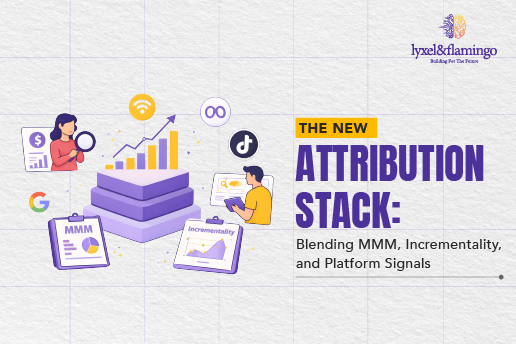
The new attribution stack blends complementary methodologies rather than forcing a single model to answer every question. It acknowledges that different methods explain different parts of performance and operate at different levels of certainty.
This stack typically includes:
- Marketing Mix Modelling
- Incrementality testing
- Platform-level signals
Together, these components form a more resilient measurement system that supports full-funnel measurement rather than isolated optimisation. Each method contributes context that others cannot provide alone.
The Role of Marketing Mix Modelling in Modern Attribution
Marketing Mix Modelling (MMM) has re-emerged as a valuable tool as direct tracking weakens and long-term planning regains importance.
What MMM Contributes
MMM analyses historical data to understand how marketing investment influences outcomes over time. It captures channel interactions, lagged effects, and external factors such as seasonality or macroeconomic shifts.
This makes MMM particularly useful for:
- Evaluating long-term impact
- Assessing upper-funnel contribution
- Informing budget allocation
- Supporting scenario planning
By focusing on patterns rather than individuals, MMM remains stable even as tracking constraints increase.
Limitations to Acknowledge
MMM operates at an aggregate level. While it provides directional insight, it lacks the granularity required for tactical optimisation. Results are not immediate and require careful interpretation. This balance is central to discussions around MMM and incrementality, where each method compensates for the other’s blind spots and strengthens overall confidence.
Incrementality as a Foundation for Causal Insight
Incrementality testing focuses on causation rather than correlation. Instead of asking what happened, it asks what would have happened without marketing activity.
Why Incrementality Matters
Incrementality isolates true lift by comparing exposed and non-exposed groups. This helps distinguish between demand creation and demand capture, which attribution models often struggle to separate.
Incrementality is especially valuable for:
- Validating performance claims
- Testing channel contribution
- Reducing reliance on attribution assumptions
- Supporting confident investment decisions
Where Incrementality Fits in the Stack
Incrementality does not replace MMM or attribution models. It complements them by grounding insights in observed behavioural change. Used selectively, it strengthens trust in reported outcomes.
Platform Signals and Their Role in Measurement
Platform-reported metrics remain a significant input into performance analysis. However, their role must be clearly defined to avoid distortion. Without clear boundaries, these signals can be misread as indicators of overall impact rather than indicators of platform-level activity, leading to inconsistent interpretation across teams.
Understanding Platform Signals
Platform signals include conversions, reach, engagement, and optimisation outputs reported by media platforms. These signals are useful for managing campaigns but are inherently platform-specific.
Integrating them effectively requires platform signal integration rather than direct comparison or aggregation.
Avoiding Over-Reliance on Platform Reporting
Platform signals are designed to optimise performance within individual ecosystems. When interpreted without context, they often exaggerate contribution and underrepresent overlap. Blending them with other models provides balance by grounding platform performance within broader measurement perspectives.
Blending Models for Full-Funnel Measurement
No single model explains the entire customer journey. Blending methods allows each to answer the questions it is best suited for. This approach recognises that performance unfolds across time, channels, and contexts, requiring multiple lenses to interpret impact accurately.
How the Blended Stack Works
- MMM explains long-term and upper-funnel impact
- Incrementality validates causal lift
- Platform signals support day-to-day optimisation
Together, they form a digital attribution framework approach that balances strategy and execution. Each model contributes insight at a different level, reducing reliance on any single perspective.
Reducing Measurement Conflict
A blended stack reduces internal disagreement by aligning teams around shared principles rather than competing metrics. This clarity improves collaboration and planning confidence, particularly when performance signals appear to diverge.
Attribution and Measurement Frameworks in Practice
Strong attribution and measurement frameworks prioritise decision-making over theoretical precision. The objective is consistency and usefulness, not perfect attribution.
In practice, this means frameworks are designed to guide planning, budgeting, and optimisation decisions, even when data is incomplete or signals conflict. The emphasis remains on stability and interpretability rather than constant recalibration.
Effective frameworks share key characteristics:
- Clear definitions of success
- Agreed roles for each model
- Transparent assumptions
- Regular validation cycles
These foundations support sustainable measurement rather than reactive reporting. Over time, they help teams build confidence in insights, reduce internal debate, and maintain alignment as channels, platforms, and data availability continue to evolve.
Measuring Full-Funnel Performance Accurately
Accurate full-funnel measurement requires recognising that impact unfolds over time and across channels. Customer decisions are shaped by multiple exposures, messages, and contexts, often spread across weeks or months. Measurement approaches that compress this complexity into a single moment fail to reflect how influence actually accumulates.
Moving Beyond Conversion-Centric Views
Focusing only on conversions ignores how awareness, consideration, and reinforcement influence outcomes. Full-funnel measurement tracks progression, not just endpoints, allowing teams to understand where momentum builds or stalls. This visibility supports more balanced investment decisions by highlighting which activities sustain demand rather than simply capture it.
This perspective aligns with full-funnel measurement for 2026, where growth depends on sustained demand rather than isolated wins.
Analytics-Driven Decision Making Across the Stack
Measurement is only valuable when it informs action. Analytics must support interpretation rather than overwhelm teams. As data volumes increase, clarity becomes more important than completeness. Without a clear framework, teams often spend more time debating numbers than improving outcomes.
Strong analytics-driven decision making relies on:
- Clear reporting hierarchies
- Consistent metrics across teams
- Contextual interpretation of results
Clear hierarchies help teams understand which metrics guide strategy and which support monitoring. Consistency across teams ensures that performance discussions are grounded in shared definitions rather than competing interpretations. Contextual interpretation adds meaning by connecting metrics to market conditions, campaign objectives, and timing.
This discipline ensures insights translate into strategy rather than noise. Over time, it enables faster decisions, reduces internal friction, and helps organisations respond to change without constantly revisiting foundational assumptions.
Incrementality and MMM Working Together
Incrementality & MMM are most effective when used together. MMM provides scale and direction, while incrementality confirms causal impact. Used in isolation, each method answers only part of the performance question. Together, they offer a more complete understanding of how marketing investment influences outcomes over time.
MMM helps teams understand broader patterns, including how channels interact, how effects persist beyond immediate exposure, and how external factors influence results. Incrementality adds depth by testing whether observed outcomes would have occurred without specific activity. This distinction becomes increasingly important as attribution signals weaken and assumptions multiply.
This combination strengthens confidence, especially when signals conflict or when planning decisions carry long-term implications. It allows teams to validate strategic conclusions drawn from models with observed behavioural change, reducing reliance on proxies and improving the credibility of investment decisions across the funnel.
Using Platform Signals Without Distortion
Platform signals remain essential for execution. The challenge lies in interpreting them responsibly. These metrics are designed to guide optimisation within individual platforms, not to provide a complete view of marketing impact. When taken at face value, they can create an illusion of certainty that does not hold up across channels or timeframes.
Responsible use begins with recognising what platform signals can and cannot explain. They are valuable for understanding delivery, engagement, and short-term responsiveness, but they do not account for overlap, delayed effects, or external influence. Treating them as one input among many helps maintain balance.
Platform Signals Insights in Context
Platform signals insights are most useful when viewed as directional indicators rather than definitive truth. Contextualisation prevents overreaction to short-term fluctuations by anchoring interpretation in broader trends, testing outcomes, and complementary models. This approach allows teams to act decisively without mistaking optimisation feedback for true contribution.
Building the Attribution Stack for the Next Planning Cycle
Attribution systems must evolve alongside media environments. As channels diversify and data signals become less deterministic, planning cycles need measurement frameworks that remain reliable over time rather than optimised only for short-term reporting.
Forward-looking attribution design focuses on durability, flexibility, and alignment with how decisions are actually made.
How to Build a Modern Attribution Stack
Understanding how to build a modern attribution stack starts with clarity around decision needs. Measurement should serve planning, not the other way around. When frameworks are designed around real business questions, they are easier to interpret and more likely to be adopted consistently.
Key considerations include:
- Planning horizons
- Channel mix complexity
- Data availability
- Organisational alignment
Addressing these factors early helps teams avoid over-engineered solutions and supports consistent evaluation as strategies and conditions evolve.
Balancing Complexity and Usability
More models do not automatically lead to better insight. Effective stacks balance sophistication with usability, ensuring adoption across teams. When frameworks become too complex, interpretation slows and confidence erodes.
Clear documentation, simple visualisation, and shared understanding help teams engage with insights consistently, supporting better decisions without adding unnecessary analytical burden.
Preparing for the Future of Digital Attribution
As tracking constraints increase, reliance on blended models will continue to grow. Privacy regulation, platform changes, and evolving user behaviour make deterministic measurement less reliable over time. Attribution approaches that accept partial visibility while still supporting confident decisions will become the standard rather than the exception.
Digital Marketing Attribution Best Practices
Digital marketing attribution best practices increasingly emphasise transparency, validation, and decision-focused reporting rather than single-metric optimisation. Clear assumptions, regular testing, and consistent interpretation help teams maintain trust in insights and adapt measurement frameworks as environments continue to change.
How Lyxel&Flamingo Approaches the New Attribution Stack
Lyxel & Flamingo focuses on building attribution systems that align measurement with real decision-making needs. The emphasis is on integrating MMM, incrementality, and platform signals into cohesive frameworks that reflect how real performance decisions are made within complex media environments.
The agency combines data from multiple sources to help clients understand not only what happened, but why it happened and what actions the data supports.
This approach supports clarity, consistency, and long-term planning across marketing teams by encouraging context-aware interpretation rather than raw reliance on platform-level outputs.
By embedding measurement within broader analytics and strategy, Lyxel & Flamingo ensures that insights are tied to organisational priorities and that cross-functional teams can interpret signals with shared understanding.
Conclusion
Attribution is no longer about choosing the right model. It is about building the right system. As journeys fragment and visibility declines, blended approaches offer the most reliable path forward.
By combining modern marketing attribution methods, aligning MMM and incrementality, and applying disciplined platform signal integration, brands can regain confidence in their measurement. Lyxel&Flamingo approaches attribution as a strategic capability, helping organisations move beyond fragmented reporting towards consistent, full-funnel insight.