When costs rose and competition intensified, returns held at 2x ROI.

Myntra's Big Fashion Festival growth story for Royal Enfield - rewriting the event playbook for efficient scaling during cost-intensive periods.

About the Brand

Royal Enfield is one of the world’s oldest motorcycle brands still in continuous production – 124 years of heritage, a fiercely loyal rider community, and an ASP that has never been built on discounts and an ASP built on product and brand value.

Beyond motorcycles, it has grown a premium lifestyle range: apparel, gear, and accessories that carry the same positioning as the machines. These products sell across D2C and marketplace channels, including Myntra – where premium and discount-first coexist uneasily.

The brand’s equity lives in specificity: the Royal Enfield buyer is not everyone. That fact is both its competitive advantage and its strategic challenge during a sale event.

The Brief

Clocking Order Volume Without Putting Profitability at Stake.

During BFF, CPCs inflate as competition peaks with higher spends in a concentrated window. Consumer attention tilts toward high-traffic placements. The default discovery layer rewards volume bidders. In this environment, scaling efficiently – growing orders without eroding ROAS – is the real brief.

Royal Enfield needed to grow orders and revenue during BFF, while keeping budget uplift controlled and, more importantly, scaling profitably.

The brief was precise: clock order volume at a lower cost per order during a window when costs were rising for everyone. The measure of success wasn’t reach. It was ROAS held or improved on incremental spend that could justify itself several times over.

Most brands treat a sale event as a volume opportunity. We treated BFF as an efficiency exercise. The question wasn’t ‘how do we reach more people?’ – it was “how do we achieve higher order volumes at lower costs in a high-CPC environment, without compromising profitability?”

Two Obstacles That Define the Efficiency Challenge in Sale Windows

01 The targeting gap for niche lifestyle categories – For niche segments like motorcycle lifestyle, audience discovery isn’t pre-defined at a granular level as the search volumes are limited. Targeting typically relies on layering platform signals to build and target relevant segments. As a result, identifying and scaling the right audience requires continuous testing, refinement, and optimization of these signals rather than relying on a single ready-made segment.

02 CPC inflation during high-traffic windows – BFF compresses every brand’s bidding into the same window, driving Top-of-Search CPCs sharply higher. Spending more to stay visible, without improving targeting quality, produces diminishing returns and ACOS deterioration.

The Strategy

Rewriting the Event Playbook – Profitability First, Scale Second.

The standard BFF playbook – scale spend, widen targeting, chase impressions – treats profitability as a post-event reckoning. L&F’s Marketplace Strategy team inverted the model: map every rupee of incremental spend to the placements and touchpoints where conversion was already happening, use BAU audience signals as the blueprint for finding the right buyer during BFF, and let efficiency metrics – not traffic volume – govern where the budget moved.

OLD PLAYBOOK L&F COMMERCE APPROACH
Maximise impressions – buy all available reach Maximise conversion quality – reach the right buyer only
Generic category targeting during sale window BAU audience signals retargeted with BFF discount triggers
Top-of-Search for all SKUs to maximise visibility TOS reserved for top 45% of budget – high-intent placements only
Increase spend proportionate to traffic spike +12.1% budget with surgical reallocation to high-CVR SKUs

Four Decisions That Separated Performance from Activity

01 Performance-Based Budget Architecture Efficiency metrics bucketing determined where the budget moved - not intuition or assumed priority. SKUs were evaluated against conversion and efficiency benchmarks, and capital was shifted toward products demonstrating purchase intent in the window. Low-efficiency SKUs were capped immediately, shifting budget to where the data was pointing
02 Precision Placement at Top-of-Search Search and Top-of-Search ads received 45% of the total campaign budget - a deliberate concentration ensuring the brand appeared first for high-intent buyers. Targeting was continuously refined throughout the window, narrowing to the audiences and placements demonstrating the strongest efficiency signals. Brand protection campaigns secured visibility on branded search queries, preventing competitors from intercepting traffic within the brand's own keyword territory.
03 Price Band Optimisation for ASP Defence Premium SKUs were placed on recommendation-driven surfaces. This sequencing protected average selling price by reaching buyers before they had anchored on a competitor's offer, not after.
04 Price Band Optimisation for ASP Defence Premium SKUs were placed on recommendation-driven surfaces - where a buyer is in discovery mode rather than price-comparison mode. This sequencing protected average selling price by reaching buyers before they had anchored on a competitor's offer, not after.

The Results

What Precision Over Scale Actually Delivers.

Compared to the BAU baseline (Aug 19 – Sep 5), the BFF campaign (Sep 19 – Oct 5) produced the following results for Royal Enfield on Myntra:

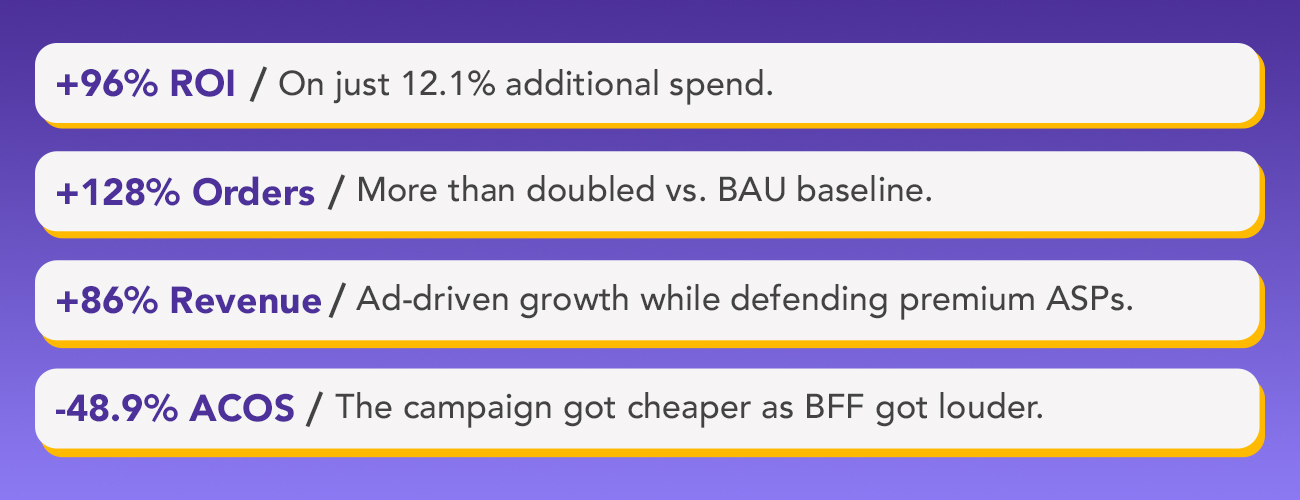
  • +128%

    Ad-attributed order growth

    More than double BAU order volume, driven by sharper audience quality – refined targeting – rather than broader reach.

  • +86%

    Ad-driven revenue uplift

    Significant absolute revenue growth while defending premium ASPs throughout the sale window.

  • +95.7%

    ROI growth

    Growth on 12.1% more budget – the headline that should make every brand manager rethink what ‘scaling’ means during a sale event.

  • +40%

    CTR improvement

    A signal of audience precision. Higher CTR in a competitive environment means the right users are seeing the right products at the right moment.

  • −48.9%

    ACOS improvement

    The campaign became substantially more cost-efficient as BFF progressed, confirming the placement-first, efficiency-led strategy was qualifying buyers before the sale opened – not scrambling during it.

12.1% more budget. 95.7% more ROI. That gap is not luck – it is the direct output of precision over scale.

The Royal Enfield outcome confirms a principle that runs through everything L&F’s Commerce Strategy team does on marketplace platforms: precision is not a constraint on scale – it is the mechanism that makes scale sustainable. A brand that doubles its orders while improving its ACOS has built something compounding. A brand that doubles its orders by doubling its spend has bought a number.

Get in Touch