
Search behaviour has changed more in the last few years than it did in the decade before that. Users no longer search once, click once, and convert. They explore, compare, reassess, and refine their intent in real time. Google’s SERP has evolved to reflect this reality, and one of the clearest signals of that evolution is the People Also Search For (PASF) feature.
Often overlooked, PASF is not just a UI element. It is a direct window into how users think, hesitate, and reframe their queries. For brands and SEO teams planning for 2026, understanding PASF is no longer optional. It plays a critical role in search intent optimization, SERP behavior analysis, and content relevance across both traditional and AI-driven search environments.
This blog breaks down what PASF really means, how the Google PASF feature works, why it matters for SEO today, and how to use it strategically without falling into keyword stuffing or surface-level optimisation.

What Does People Also Search For (PASF) Mean?
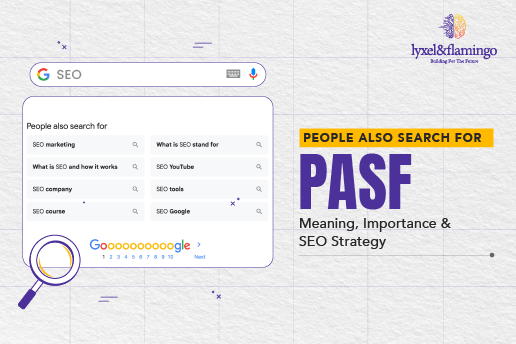
People Also Search For refers to a Google SERP feature that displays a set of related search queries after a user interacts with a result and then returns to the search results page. These suggestions are not random. They are generated based on observed user behaviour, particularly when the original result does not fully satisfy the search intent.
Unlike auto-suggest or People Also Ask, PASF appears after interaction, not before. This distinction is crucial. PASF reflects refined intent, not initial curiosity.
When a user clicks a result, scans the page, and comes back to the SERP, Google interprets that behaviour as a signal that the intent may not have been fully met. PASF suggestions then surface alternative or adjacent queries that better match what users tend to look for next.
This makes PASF one of the most honest reflections of real search journeys.
How the Google PASF Feature Actually Works
The Google PASF feature is triggered by behaviour, not keywords alone. It is deeply tied to how users move through the SERP.
A typical PASF trigger looks like this:
A user searches for a query, clicks a result, spends limited time on the page, and then returns to the search results. At this point, Google displays a set of related queries under the clicked result. These suggestions are based on aggregated behaviour from thousands of similar search journeys.
What makes PASF different is that it is post-click contextual. It does not assume intent upfront. Instead, it reacts to how intent evolves after exposure to content.
For SEO teams, this means PASF is not about predicting what users might search. It shows what they actually search next.
Why PASF Matters More Than Ever in SEO
Traditional SEO focused on ranking for a single keyword or a tight group of variations. That approach is increasingly insufficient.
Modern search is non-linear. Users rarely convert after one query. PASF captures the moments where intent shifts, expands, or becomes clearer.
From an SEO perspective, PASF matters because it reveals:
- How users refine their intent
- Where content gaps exist on ranking pages
- What related questions or comparisons users care about
- Which angles competitors may be addressing better
PASF in SEO is especially valuable because it is grounded in SERP behavior analysis, not assumptions or tool-generated clusters.
PASF vs Related Searches vs People Also Ask
It is important not to confuse PASF with other SERP features.
Related searches appear at the bottom of the SERP and are often broader keyword expansions. They are useful, but they are not behaviour-triggered.
People Also Ask is question-based and focuses on informational intent. It is helpful for content structuring, but it does not necessarily reflect dissatisfaction with results.
PASF is different. It surfaces because something did not fully work. That makes it one of the most actionable signals for content improvement and intent alignment.
For teams working on search intent optimization, PASF offers insights that no keyword tool can fully replicate.
What PASF Reveals About Search Intent
Search intent is rarely binary. A query may start informational, turn comparative, and end transactional. PASF often sits at the transition points.
For example, a user searching for a broad concept may see PASF suggestions that indicate comparison, alternatives, or deeper evaluation. This tells you that the original content may not have addressed the next logical question in the journey.
PASF helps answer questions like:
- What does the user want after reading the top result?
- What doubts remain unresolved?
- Which dimensions of the topic matter most?
This is why PASF is increasingly relevant to SXO in modern SEO, where experience, relevance, and intent satisfaction matter more than raw rankings.
PASF and SERP Behavior Analysis
SERP behavior analysis looks beyond clicks and rankings. It focuses on how users interact with search results, how long they stay, and what they do next.
PASF is a direct output of this analysis at scale.
When PASF suggestions repeatedly surface for a query, it indicates a pattern. Either the SERP lacks comprehensive coverage, or user expectations are shifting faster than existing content.
For brands, this creates both risk and opportunity. Ignoring PASF can mean losing users mid-journey. Using PASF strategically can help capture those users before they leave the ecosystem.
Using PASF for Smarter Content Strategy
PASF should not be treated as a list of keywords to stuff into a page. That approach often backfires.
Instead, PASF should guide content architecture.
High-performing pages in 2026 are not single-purpose. They anticipate follow-up intent. They answer adjacent questions before users need to go back to Google.
When PASF suggestions repeatedly point to comparisons, deeper explanations, or clarifications, that is a signal to expand content depth, not create thin standalone pages.
This approach aligns closely with SEO best practices focused on topical authority and relevance rather than surface-level optimisation.
PASF in the Context of AI-Driven Search
AI-driven search systems increasingly rely on understanding user journeys rather than matching keywords. PASF data aligns naturally with this shift.
Because PASF reflects real behaviour, it offers insights into how users refine queries, which is critical for AI-driven search behavior analysis.
As AI summaries, conversational search, and generative answers become more common, content that aligns with PASF patterns is more likely to be surfaced, cited, or summarised.
This is particularly relevant when considering brand visibility in AI search, where relevance and completeness often matter more than exact keyword matching.
How PASF Supports Search Intent Optimization
Search intent optimization is about reducing friction between what users want and what content delivers.
PASF shows where friction exists.
If users consistently return to the SERP and explore alternative queries, it means intent was not fully satisfied. Analysing PASF patterns helps identify these gaps.
Optimising for PASF does not mean chasing every variation. It means understanding intent clusters and addressing them holistically within content.
This approach improves engagement, dwell time, and perceived relevance, all of which support long-term SEO performance.
PASF and Content Relevance in 2026
Content relevance in 2026 is no longer about length alone. It is about alignment.
PASF helps answer a critical question: does this content move the user forward, or send them back to search?
Pages that align with PASF-informed intent pathways tend to perform better across organic search, AI summaries, and discovery-driven surfaces.
This is where PASF connects strongly with SXO, blending SEO with user experience and intent fulfilment.
Common Mistakes When Using PASF for SEO
One of the most common mistakes is treating PASF like auto-suggest keywords. PASF is not predictive; it is reactive.
Another mistake is creating multiple thin pages targeting each PASF query separately. This often fragments authority and confuses users.
The right approach is synthesis. PASF should inform how topics are structured, not how many pages are created.
How Teams Should Operationalise PASF Insights
To use PASF effectively, teams should treat it as part of ongoing SERP analysis, not a one-time exercise.
Regularly reviewing PASF for core queries helps track shifts in intent over time. This is especially valuable during category expansion, product launches, or market changes.
PASF insights should inform content updates, not just new content creation. Often, improving an existing page to address PASF-related intent delivers faster results than publishing something new.
PASF as a Signal, Not a Ranking Factor
It is important to clarify that PASF itself is not a direct ranking factor. Google does not rank pages because they mention PASF queries.
However, PASF is a reflection of user behaviour, and user satisfaction signals influence performance indirectly.
Pages that reduce pogo-sticking, improve engagement, and satisfy refined intent tend to perform better across the board.
In that sense, PASF is not something to optimise for directly, but something to optimise with.
The Strategic Value of PASF for Brands
For brands, PASF offers insight into how users evaluate credibility, compare options, and validate decisions.
It helps identify where messaging falls short, where explanations are unclear, and where competitors may be winning attention.
In competitive categories, PASF analysis often reveals the real battleground, not the primary keyword.
How We Apply PASF Insights in Real SEO Workflows
At Lyxel&Flamingo, we treat People Also Search For signals as behavioural indicators, not just keyword suggestions. PASF helps us understand where search intent shifts, what users feel is missing after an initial result, and how Google interprets relevance across a session.
Instead of using PASF in isolation, we layer it into our broader SERP behavior analysis and search intent optimization work. This allows us to structure content that answers primary queries while naturally covering adjacent questions users are likely to explore next. Over time, this approach improves depth, reduces content gaps, and aligns pages more closely with how real searches unfold.
By integrating PASF insights into content planning, internal structure, and intent mapping, we focus on building pages that stay relevant as search behaviour evolves, including in AI-influenced search experiences.
Conclusion
People Also Search For is not just another SERP feature. It is one of the clearest reflections of how users think, hesitate, and refine intent in real time.
In a search landscape shaped by behavioural signals, AI interpretation, and experience-led ranking systems, PASF offers insights that keyword tools alone cannot.
For teams focused on long-term SEO performance, search intent optimization, and relevance in 2026, PASF should be treated as a strategic input, not an afterthought.
Those who learn to read PASF correctly will not just rank better. They will understand their audience better, meet intent more precisely, and build content that genuinely serves the modern search journey.
FAQs
Q. What is People Also Search For in SEO?
A. People Also Search For is a Google SERP feature that shows related queries after a user clicks a result and returns to the search page. In SEO, it helps understand refined user intent and content gaps.
Q. How does PASF show user intent?
A. PASF reflects what users search for next when their initial query is not fully satisfied. This makes it a strong indicator of evolving or unresolved intent.
Q. Does PASF help with AI search optimization?
A. Yes. Because PASF is based on real behaviour, it aligns well with how AI-driven search systems interpret intent and relevance across journeys.
Q. How can PASF improve content relevance?
A. By revealing follow-up queries and intent shifts, PASF helps teams structure content that answers adjacent questions and reduces the need for users to return to search.
Q. Is PASF a ranking factor?
A. No. PASF itself is not a ranking factor. However, optimising content to satisfy PASF-related intent can improve engagement and indirect performance signals.
Q. Why are ‘People Also Search For’ helpful?
A. They provide a direct view into real user behaviour, helping brands understand how users refine searches and what information they seek next.