
Table of Contents
Artificial intelligence is no longer an emerging trend in marketing. It has become a core capability shaping how brands plan, execute, and optimise campaigns. As the digital ecosystem grows more competitive and fragmented, marketers increasingly rely on a structured digital marketing AI tools list to stay efficient and relevant.
From automation and personalisation to analytics and creative optimisation, artificial intelligence marketing tools now influence nearly every stage of the marketing funnel. For agencies and in-house teams alike, understanding the best AI tools for digital marketing is no longer optional. It is foundational.
The Shift Toward AI-Driven Digital Marketing
Marketing today operates at a speed and scale that manual processes cannot sustain. Consumer behaviour shifts rapidly, channels evolve constantly, and performance expectations continue to rise.
AI bridges this gap by enabling real-time decision-making, predictive insights, and scalable execution. This is why AI tools for digital marketing agency teams and enterprises are now embedded into daily workflows, supporting everything from campaign optimisation to customer engagement.
Rather than replacing marketers, AI enhances their ability to act with precision.
What Is AI in Digital Marketing?
AI in digital marketing refers to the use of technologies such as machine learning, natural language processing, and predictive analytics to improve how marketing decisions are made and executed.
These systems analyse large datasets, identify patterns, and generate insights that would be difficult or time-consuming to extract manually. In practice, this enables marketers to run smarter campaigns, personalise at scale, and optimise performance continuously.
This evolution has made AI tools for performance marketing particularly valuable, as they directly influence efficiency, ROAS, and growth outcomes.
Why AI Matters More in 2026
As competition intensifies across platforms, AI has shifted from a productivity aid to a strategic advantage.
In 2026, brands that rely solely on manual optimisation struggle to keep pace with those using AI-led systems. AI enables marketers to understand not just what is happening, but why it is happening, allowing faster course correction and more confident planning.
This is why most best AI tools for performance marketing now focus on insight generation rather than automation alone.
How AI Marketing Tools Work
AI marketing tools function by analysing large volumes of data to detect trends, predict outcomes, and recommend actions. Over time, these tools learn from results and improve their recommendations.
In practice, AI helps marketers:
- Understand audience behaviour more deeply.
- Automate repetitive optimisation tasks.
- Improve targeting, creative relevance, and timing.
- Make data-backed decisions in real time.
In a crowded digital environment, AI becomes the compass that guides marketing strategy.
How AI Is Used in Digital Marketing Today
AI is now embedded across multiple marketing functions.
Content Creation
AI tools accelerate content production for blogs, ads, social media, and email. This allows teams to scale output while maintaining consistency and relevance.
Personalisation
AI enables personalised experiences across touchpoints, improving engagement and conversion rates by aligning messaging with user intent.
Data Analysis
AI processes complex datasets to surface insights that inform campaign optimisation, budget allocation, and audience targeting.
Customer Interaction
Conversational AI and chatbots provide real-time assistance, improving customer experience and reducing response times.
Top AI Tools Every Digital Marketer Should Know
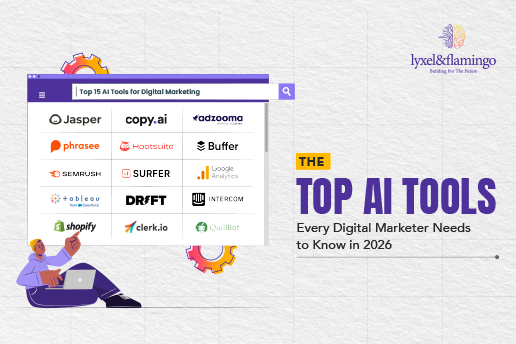
Below is a curated AI tools list for digital marketing, organised by function.
Content Creation Tools
Jasper AI, Copy.ai, and Quillbot help marketers generate, refine, and scale written content efficiently while maintaining brand voice.
Ad Optimisation Tools
Adzooma and Phrasee support campaign optimisation across paid channels, making them valuable AI tools for performance marketing.
Social Media Management Tools
Hootsuite and Buffer Analyse use AI insights to optimise posting schedules, content formats, and engagement strategies.
SEO Enhancement Tools
SEMrush and SurferSEO combine data analysis and AI recommendations to improve on-page SEO, keyword strategy, and content relevance. These tools are frequently included in any top 10 AI tools for digital marketing list.
Analytics and Insights Tools
Google Analytics 4 and Tableau leverage AI to surface predictive insights, supporting better measurement and decision-making.
Customer Engagement Tools
Drift and Intercom enable conversational engagement, lead qualification, and personalised customer journeys.
E-commerce Optimisation Tools
Shopify AI, Clerk.io, and Weavr use behavioural data and AI insights to optimise product discovery, recommendations, and conversions.
AI Tools for Video Marketing and Editing
Video continues to dominate digital channels. As a result, interest in the best AI video editing tools for digital marketers has grown significantly.
Tools such as Synthesia and Pictory enable scalable video creation, personalisation, and localisation without extensive production overhead. These tools are increasingly important for brands investing in short-form and performance-led video strategies.
Future Trends Shaping AI in Digital Marketing (2026)
As we move into 2026, several trends are redefining how AI is applied in marketing.
AI-driven video and interactive content are becoming central to engagement strategies. Generative AI is enabling deeper personalisation across channels. Predictive analytics continues to evolve, helping marketers anticipate behaviour rather than react to it.
The integration of AI with AR and VR is also opening new possibilities for immersive brand experiences, particularly in retail and experiential marketing.
Together, these trends reinforce why AI is now a core pillar of modern digital strategy.
Conclusion
AI marketing tools are no longer experimental. They are essential infrastructure for modern marketing teams.
By building a well-defined digital marketing AI tools list and selecting the best AI tools for digital marketing based on business goals, marketers can improve efficiency, enhance creativity, and drive measurable growth.
At Lyxel&Flamingo, we help brands and agencies identify, implement, and operationalise the right artificial intelligence marketing tools across SEO, performance marketing, analytics, and content ecosystems.
Frequently Asked Questions
AI helps analyse data, automate optimisation, and personalise campaigns, leading to higher efficiency and better results.
AI marketing tools support content creation, advertising optimisation, analytics, SEO, and customer engagement.
SEMrush, SurferSEO, Jasper AI, and Quillbot are widely used for SEO and content workflows.
The best tool depends on use case, but agencies often use a combination of content, analytics, and ad optimisation tools.
Adzooma, Phrasee, and Google Analytics 4 are commonly used for automation and campaign optimisation.
SEO tools, social media management platforms, and AI-powered content tools play a key role.
Synthesia, Pictory, and similar tools are among the most popular AI-driven video platforms.
Generative AI, predictive analytics, conversational AI, and AI-driven video are shaping 2026 strategies.
Agencies should prioritise automation, data integration, predictive insights, and scalable personalisation.